
Heading 2
17 Best HockeyStack Alternatives and Competitors In 2026
Looking for HockeyStack alternatives? Compare 17 attribution, GTM intelligence, and revenue analytics tools by pricing, integrations, best-fit use case, and tradeoffs in 2026.
Written by

Subiksha Gopalakrishnan
Growth Marketer
Summarize this article




.svg)


TL;DR
- While HockeyStack leans heavily into tracking sales team execution and individual rep behavior (via its Rep Cockpit and deterministic ML blueprints), many marketers find its setup complex and prefer platforms focused on closing the loop between early marketing intent and downstream pipeline.
- Factors.ai merges granular multi-touch marketing attribution with deep account intelligence, real-time visitor unmasking, and no-code AI workflow automation that goes live in days instead of months.
- Dreamdata excels at pulling fragmented, multi-year stakeholder data together to build an expansive macro view of B2B revenue reporting.
- Adobe Marketo Measure (Bizible) remains the legacy standard for large enterprise teams deeply tied to Salesforce-native environments.
The right choice depends on your reporting needs, implementation complexity, CRM stack, and budget.
Investing in campaigns and SEO can grow traffic, but B2B teams still need to know which channels, accounts, and touchpoints actually influence pipeline. That is why many teams evaluate HockeyStack alternatives.
HockeyStack is known for attribution, journey mapping, and cookieless tracking, but buyers also compare it against tools that offer simpler setup, stronger CRM visibility, deeper ABM workflows, better pricing clarity, or more reliable revenue reporting.
In this guide, we compare 17 HockeyStack alternatives for B2B marketing and RevOps teams. Some are direct attribution replacements, while others are broader GTM intelligence, account-based marketing, or revenue analytics tools worth considering depending on your stack and sales motion.
Also, read HockeyStack Pricing
HockeyStack alternatives and competitors comparison table
How we chose these HockeyStack alternatives
To build this list, we evaluated each tool on five criteria: attribution depth, CRM and ad-platform integrations, pricing transparency, implementation complexity, and fit for B2B sales cycles. We also looked at customer-review themes, common buyer objections, and how well each platform supports pipeline and revenue visibility.
{{INLINE_BOFU}}
Why are marketers looking for HockeyStack alternatives?
No tool is perfect. Teams often start comparing HockeyStack competitors when they need clearer reporting, broader integrations, or a platform that better fits their GTM motion.
1. Setup and learning curve can be a hurdle
For lean marketing and RevOps teams, implementation speed matters. Buyers often look for an alternative when they want faster time to value or less technical overhead.
2. Pricing clarity matters more during vendor evaluation
Many buyers want a cleaner understanding of what is included in the base plan, what requires add-ons, and how costs scale as traffic, seats, or data volume grow.
3. Attribution accuracy and reporting trust are critical
If revenue reporting feels inconsistent, teams lose confidence in channel decisions. That makes data reliability one of the biggest reasons to compare platforms.
4. CRM, ABM, and offline visibility vary by tool
Some teams care most about account identification, while others need Salesforce-native reporting, offline attribution, or deeper buying-journey analysis. The right alternative depends on those priorities.
17 Best HockeyStack Alternatives in 2026
1. Factors.ai – Best HockeyStack alternative in 2026
Best for: B2B teams that want multi-touch attribution, account intelligence, and funnel visibility in one platform.
Factors.ai is an AI-powered ABM platform built for B2B go-to-market teams who need more than a rep-level view of their pipeline. They need to know which accounts to target, when to act, and (the part everyone skips over) why those accounts matter right now.
Here's what makes it different.
While HockeyStack leans into sales execution and rep behavior through its Blueprint and Revenue Agents framework, Factors.ai starts earlier in the journey. Way earlier. It answers the following: who's visiting your website right now, what intent signals are firing across channels, and how do you turn all of that into a coordinated campaign before the moment disappears.
So if HockeyStack is built primarily for sales leaders and reps, Factors.ai is built for the whole crew: marketing, sales, and revenue operations, all working from the same account intelligence layer.
Key features
Scout – AI ABM Coworker
Scout lets you query your pipeline, campaigns, and intent signals in plain language and get answers with visualizations in seconds. Instead of pulling reports manually, navigating three dashboards, and triangulating data across tabs you definitely have too many of, you just... ask. Plain language, like: "Why did pipeline increase last month?" And Scout gives you a direct answer, with visualizations, tied back to actual campaign activity.
HockeyStack's Rep Cockpit is great for individual deal execution. Scout is better for cross-functional GTM querying, the kind where marketing, sales, and ops are all trying to answer the same question but from completely different angles.
Multi-Touch Attribution (Finally Built for Marketing Teams)
This is where Factors.ai has a meaningful edge over HockeyStack for marketing teams. Factors.ai supports both single-touch and multi-touch attribution models in a dedicated attribution report builder.
With Factors.ai's attribution models, you can
- You can define your own conversion goals (Contact Created, Discovery Call Done, Opportunity Creation, Deal Won)
- Select specific touchpoints across paid media, referrals, blog visits, content downloads, emails, and offline events
- Filter in or out specific tactics like branded search campaigns
- Set attribution windows from up to 180 days
Account Identification at Scale
Factors.ai offers multi-touch attribution with account-level insights and visitor identification, identifying up to 75% of accounts visiting your website by company, without requiring a form fill.
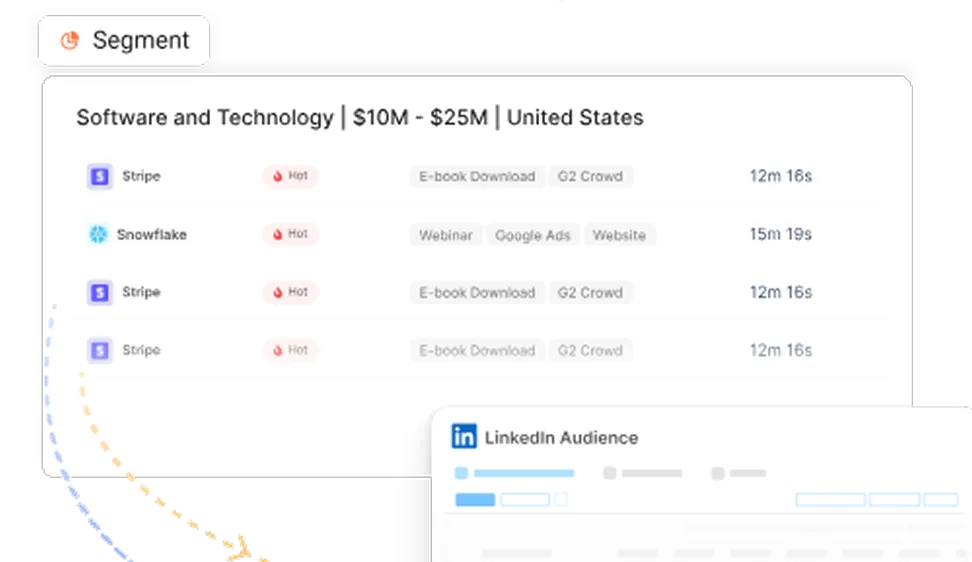
Combined with intent signals from G2, LinkedIn Ads, Google Ads, Meta, and third-party providers, you get a unified Hot/Warm/Cool engagement score per account. HockeyStack's Atlas data foundation is strong on post-sales-engagement data; Factors.ai captures the buyer journey that happens before a rep ever gets involved.
Agentic Workflow Automation
Through Scout Agents, Factors.ai's agent framework inside Scout, you can build event-triggered workflows in plain language. No code required. No ticket to submit.
A new form fill can trigger account enrichment, personalized Gmail outreach, a LinkedIn Audience sync, and a CRM update, all automatically, all in sequence.
HockeyStack's Revenue Agents are deterministic and ML-driven. Factors.ai's agents are more accessible for marketing and ops teams that don't have engineering resources sitting around waiting to build automation for them. (Most teams don't. You probably know this.)
Factors.ai MCP
Factors.ai is available via MCP, which means your team can run Scout agents directly inside Claude, ChatGPT, Gemini, Cowork, or Cursor. From a single prompt, a rep can research an account, update the CRM, draft a follow-up, and schedule a meeting, without switching tabs once.
Integrations
Factors.ai supports no-code integrations with tools such as HubSpot, Salesforce, LinkedIn Ads, Google Ads, Facebook Ads, Google Search Console, Slack, and Google Sheets.
Pricing
Request a demo with our experts to know the pricing. Free forever plan available.
2. Dreamdata
Best for: Mid-market B2B teams with long sales cycles that want strong revenue reporting and journey stitching.
Key features
- Performance attribution: Connects channel performance to revenue and helps teams compare ROAS and LTV across campaigns.
- Revenue analytics: Aggregates data from multiple sources to show how programs influence pipeline and closed revenue.
- Journey visibility: Helps marketing teams understand how stakeholders engage throughout the buying process.
Integrations
Dreamdata integrates with platforms such as HubSpot, Salesforce, LinkedIn Ads, Google Ad Manager, and Zendesk.
Pricing
Dreamdata offers a free version with limited functionality. Paid plans start at $999/month, with custom pricing available for larger teams.
Limitations
Dreamdata is a strong fit for revenue reporting, but some teams may want more visibility into anonymous pre-conversion research or a simpler entry point for smaller stacks.
3. Adobe Marketo Measure (Bizible)
Best for: Enterprise teams already invested in Salesforce and Adobe that need mature multi-touch attribution.
Key features
- Multi-touch attribution: Supports multiple attribution models and can track both online and offline touchpoints.
- Custom reporting: Helps teams measure ROI, marketing spend, and funnel contribution with enterprise-grade reporting.
- CRM alignment: Fits organizations that already rely heavily on Salesforce and Adobe infrastructure.
Integrations
Common integrations include Salesforce, Marketo Engage, Pardot, Google Ads, and SnapEngage.
Pricing
Adobe Marketo Measure pricing is custom and typically sold as part of the broader Adobe Marketo ecosystem.
Limitations
This option can be resource-intensive to implement and manage, so it is usually a better fit for enterprises with dedicated ops and analytics support.
4. Attribution
Best for: Teams that want straightforward multi-touch attribution and an easier reporting experience.
Key features
- Multi-touch attribution: Tracks spend, visits, conversions, revenue, and ROAS in one place.
- Built-in integrations: Connects with major CRM and marketing platforms to centralize reporting.
- Usability: Often positioned as a more approachable option for teams that want simpler setup.
Integrations
Popular integrations include LinkedIn, Salesforce, Google Ad Manager, Zendesk, and Shopify.
Pricing
Attribution pricing is custom. You need to contact the vendor for a quote.
Limitations
Limited public pricing transparency can make early-stage vendor comparison harder, especially for buyers trying to shortlist tools quickly.
5. Ruler Analytics
Best for: Teams that need call tracking, form tracking, and offline attribution tied back to revenue.
Key features
- Opportunity attribution: Helps sales and marketing teams track which sources contribute to pipeline progression.
- Revenue analytics: Connects marketing, sales, and revenue data to show channel impact.
- Call tracking: A strong option for businesses where phone conversions matter.
Integrations
Ruler Analytics integrates with Google Analytics, Facebook, Google Ads, Salesforce, and Intercom, among others.
Pricing
Paid plans start at £199/month for smaller traffic volumes, with higher tiers at £499/month and £999/month.
Limitations
Setup can take time, especially if you need model customization, CRM mapping, or more advanced closed-loop reporting across teams.
6. CaliberMind
Best for: RevOps-heavy organizations that need strong governance, funnel reporting, and cross-system analytics.
Key features
- Marketing attribution: Measures how marketing influences revenue and acquisition across channels.
- Funnel analytics: Tracks customer movement through the funnel and surfaces conversion bottlenecks.
- Scalability: Built for more complex enterprise data environments.
Integrations
CaliberMind integrates with HubSpot, LinkedIn, Marketo, Outreach, and Google Analytics.
Pricing
CaliberMind pricing is custom. Prospective buyers need to request plan details.
Limitations
It is generally best suited for larger teams with analytics resources. Smaller companies may find it heavier than they need for basic attribution use cases.
7. Full Circle Insights
Best for: Salesforce-first marketing teams that want campaign and attribution reporting inside their core CRM workflows.
Key features
- Revenue and pipeline analysis: Helps marketers understand which campaigns influence revenue and pipeline.
- Custom attribution models: Supports different models based on business goals and sales-cycle complexity.
- Salesforce-native orientation: A practical fit for teams that want marketing measurement close to CRM reporting.
Integrations
Key integrations include Marketo, Eloqua, Act-On, and Salesforce.
Pricing
Full Circle Insights pricing is custom and available on request.
Limitations
Its fit is narrower than some broader GTM platforms, so buyers should confirm that its Salesforce-centric approach matches their reporting and orchestration needs.
8. 6sense
Best for: Enterprise ABM teams that want account identification, buyer intent, and sales prioritization in one platform.
Key features
- Intent and account scoring: Helps teams prioritize in-market accounts based on behavior and fit.
- Journey orchestration: Supports coordinated sales and marketing plays across channels.
- Pipeline visibility: Connects account engagement to pipeline progression and forecasting.
Integrations
Common integrations include Salesforce, HubSpot, Marketo, LinkedIn, and major ad platforms.
Pricing
6sense pricing is custom and usually aimed at mid-market and enterprise GTM teams.
Limitations
It can be expensive and more complex to roll out than lighter-weight attribution tools, especially for smaller teams.
9. Demandbase
Best for: Organizations that want a broad GTM platform spanning ABM, advertising, sales intelligence, and reporting.
Key features
- Account intelligence: Surfaces account insights, buying signals, and audience segmentation.
- Advertising and orchestration: Supports account-based ad targeting and campaign activation.
- Revenue visibility: Helps tie engagement trends back to pipeline outcomes.
Integrations
Demandbase connects with Salesforce, HubSpot, Marketo, LinkedIn, Google Ads, and other GTM tools.
Pricing
Demandbase pricing is custom and typically packaged for larger GTM programs.
Limitations
It is broader than a pure attribution product, so teams should confirm they need the extra orchestration depth.
10. HubSpot Marketing Hub
Best for: HubSpot-centric teams that want attribution reporting inside an all-in-one CRM and marketing platform.
Key features
- Native attribution reporting: Lets teams measure campaign influence without stitching together as many external tools.
- Automation and CRM workflows: Combines reporting with email, lifecycle, and lead-management capabilities.
- Familiar ecosystem: Works well for teams already standardized on HubSpot.
Integrations
HubSpot connects with Salesforce, Google Ads, LinkedIn Ads, Slack, Zapier, and a wide app marketplace.
Pricing
HubSpot offers free tools, with paid Marketing Hub plans starting at $20/month and scaling by tier and contacts.
Limitations
Attribution depth and reporting flexibility may not match specialized enterprise attribution platforms.
11. InfiniGrow
Best for: Revenue teams that want to connect marketing planning, budgeting, and attribution in one workflow.
Key features
- Scenario planning: Helps teams model budget allocation and expected outcomes.
- Performance visibility: Connects spend and channel activity to pipeline impact.
- Cross-functional planning: Useful for teams aligning finance, marketing, and RevOps.
Integrations
InfiniGrow supports integrations with common CRM, advertising, and analytics systems, including Salesforce and HubSpot environments.
Pricing
InfiniGrow pricing is custom.
Limitations
It is less widely evaluated than larger attribution vendors, so buyers may need a more hands-on evaluation process.
12. Funnel.io
Best for: Teams that need strong marketing data consolidation before building attribution or executive dashboards.
Key features
- Data centralization: Pulls performance data from many ad, analytics, and CRM sources.
- Flexible reporting outputs: Feeds business intelligence tools and custom dashboards.
- Connector breadth: Helpful for fragmented reporting stacks.
Integrations
Funnel.io integrates with Google Ads, Meta, LinkedIn, HubSpot, Salesforce, Looker Studio, and many other connectors.
Pricing
Funnel.io pricing is custom.
Limitations
It is primarily a data pipeline and reporting layer, so most teams still need separate attribution logic or CRM analysis.
13. LeadsRx
Best for: Teams that need multi-touch attribution across both digital and offline media.
Key features
- Cross-channel attribution: Measures online and offline touchpoints in one model.
- Media impact analysis: Helps marketers compare how channels contribute to conversions.
- Unified reporting: Supports organizations with more complex channel mixes.
Integrations
LeadsRx supports integrations with advertising, analytics, and CRM systems used for multi-channel reporting.
Pricing
LeadsRx pricing is custom.
Limitations
Public pricing transparency is limited, and B2B buyers should confirm the fit for their CRM and sales-motion needs.
14. UserGems
Best for: Sales and marketing teams focused on pipeline generation through relationship and job-change signals.
Key features
- Signal detection: Surfaces buyer movement and account changes that can trigger outreach.
- Account prioritization: Helps teams focus on higher-likelihood expansion and outbound opportunities.
- Workflow activation: Supports routing insights into sales and marketing execution.
Integrations
UserGems commonly integrates with Salesforce, HubSpot, Outreach, Salesloft, and other sales engagement tools.
Pricing
UserGems pricing is custom.
Limitations
It is not a direct attribution replacement. It is better viewed as an adjacent GTM intelligence option.
15. Triple Whale
Best for: Ecommerce and paid media teams that want fast visibility into blended performance and ad efficiency.
Key features
- Marketing performance dashboards: Centralizes ad, store, and conversion data.
- Blended attribution views: Helps teams compare channel contribution using simplified reporting.
- Operator-friendly analytics: Built for fast decision-making by media teams.
Integrations
Triple Whale integrates with Shopify, Meta, Google Ads, TikTok, Klaviyo, and other ecommerce tools.
Pricing
Triple Whale pricing is custom.
Limitations
Its best fit is ecommerce rather than classic B2B attribution, so relevance depends heavily on your business model.
16. MadKudu
Best for: Teams that want predictive scoring, segmentation, and product-led revenue signals.
Key features
- Predictive scoring: Helps prioritize accounts and leads with stronger conversion potential.
- Segmentation: Supports routing and targeting based on fit and behavior.
- Pipeline signal enrichment: Adds context for GTM teams evaluating buyer readiness.
Integrations
MadKudu integrates with Salesforce, HubSpot, Segment, Marketo, and warehouse-oriented data stacks.
Pricing
MadKudu pricing is custom.
Limitations
It solves adjacent GTM and scoring problems more than full-funnel attribution by itself.
17. Google Analytics 4
Best for: Teams that need a low-cost analytics foundation before layering on CRM and attribution tooling.
Key features
- Event-based analytics: Flexible tracking for web and app behavior.
- Broad ecosystem support: Works with Google Ads, BigQuery, and many reporting tools.
- Low entry cost: Gives teams a useful baseline for channel and conversion analysis.
Integrations
GA4 integrates natively with Google Ads, Search Console, BigQuery, and many BI, CDP, and CRM workflows through connectors.
Pricing
Google Analytics 4 is free for standard use, with enterprise options available through Google Analytics 360.
Limitations
GA4 is not a complete B2B attribution platform on its own. Most teams still need CRM reporting, identity resolution, or a warehouse layer for deeper revenue analysis.
Other HockeyStack competitors worth evaluating
Because many buyers compare attribution needs against broader pipeline-generation goals, GTM and ABM platforms show up often in HockeyStack comparison searches. We now cover 6sense and Demandbase in the main list above, where you can review their fit, pricing approach, and tradeoffs in more detail.
Which HockeyStack alternative is right for your team?
- Choose a direct attribution replacement if you mainly need pipeline and revenue reporting: Dreamdata, Ruler Analytics, Adobe Marketo Measure, Full Circle Insights, or Attribution.
- Choose an account intelligence or ABM platform if you care more about buying signals and account targeting: Factors.ai, 6sense, Demandbase, or UserGems.
- Choose a broader analytics stack if you want flexible reporting and already have strong internal ops support: Funnel.io, Google Analytics 4, or HubSpot Marketing Hub.
- Choose a specialized option if your motion is ecommerce, mixed media, or predictive scoring: Triple Whale, LeadsRx, or MadKudu.
How to choose the right HockeyStack alternative
The best HockeyStack alternative depends on the problem you are solving.
- If you want attribution plus account intelligence, start with Factors.ai or Demandbase.
- If you need precise multi-touch revenue reporting, look at Dreamdata, Ruler Analytics, or Adobe Marketo Measure.
- If your team is ABM-first, compare 6sense, Demandbase, and UserGems.
- If you are already standardized on HubSpot or Salesforce, prioritize the tools that fit that ecosystem first.
- If you need lighter-weight or lower-cost reporting, consider GA4, Funnel.io, or HubSpot Marketing Hub before moving to a full GTM suite.
Before switching, compare implementation effort, reporting transparency, integrations, and pricing structure—not just feature count.
FAQs on HockeyStack alternatives: Honest Community FAQs (Sourced from r/SaaS & RevOps Circles)
Q1. What are the best HockeyStack alternatives?
Some of the best HockeyStack alternatives for B2B teams include Factors.ai, Dreamdata, Adobe Marketo Measure, Attribution, Ruler Analytics, CaliberMind, Full Circle Insights, 6sense, Demandbase, HubSpot Marketing Hub, InfiniGrow, Funnel.io, LeadsRx, UserGems, Triple Whale, MadKudu, and Google Analytics 4.
Q2. What is a cheaper alternative to HockeyStack?
If budget is a major factor, tools such as Factors.ai's lower-tier plans or Ruler Analytics can offer a more affordable starting point, depending on your traffic and attribution needs.
Q3. What should B2B teams look for in a HockeyStack competitor?
Look for attribution accuracy, CRM integrations, implementation effort, pricing transparency, and the ability to tie activity to pipeline and revenue.
Q4. How does HockeyStack compare with Dreamdata and Factors.ai?
HockeyStack is often evaluated for attribution and GTM visibility, Dreamdata for multi-touch revenue reporting, and Factors.ai for account intelligence plus multi-touch attribution.
Q5. Are all HockeyStack alternatives direct replacements?
No. Some tools, such as Dreamdata, Ruler Analytics, and Adobe Marketo Measure, are closer attribution replacements. Others, such as 6sense, Demandbase, UserGems, and MadKudu, solve adjacent GTM or account-intelligence problems that may still be relevant depending on your use case.
Q6: Why do teams actively migrate away from HockeyStack?
It usually comes down to a mismatch in user personas. HockeyStack is built on its Blueprint framework, which is fantastic for analyzing sales rep activities and deal velocity. But if you are a marketing or demand gen leader trying to optimize live ad budgets on LinkedIn or unmask anonymous traffic in real time, the platform can feel over-engineered for your daily workflow.
Q7: How does Factors.ai avoid the "black box" intent scoring problem?
Most platforms hide their intent calculation behind a vague "Account Score: 82" text label. Factors keeps things completely transparent. It shows you the exact underlying logs, which page they hit, what keywords they searched on G2, or which LinkedIn post they engaged with, and allows you to configure your own custom weight thresholds.
Q8: Can I run multi-touch attribution without an in-house data analyst?
If you are using enterprise tools like Bizible or CaliberMind, honestly, no, you will need dedicated ops support. But if you use an agile alternative like Factors.ai or Dreamdata, the reporting builders use a visual drag-and-drop interface that a growth marketer can easily master in an afternoon.
Q9: Does Dreamdata completely replace HockeyStack's capabilities?
From a pure historical attribution and revenue data stitching standpoint, absolutely. Where they diverge is actionability: HockeyStack leans toward post-sale rep tracking, whereas Dreamdata focuses purely on macro journey logs. If you want something that bridges both data worlds and includes live ad automation, look at Factors.
Q10: Is a free tier like GA4 enough to track B2B pipeline attribution?
No way. GA4 tracks independent anonymous web sessions, not accounts or linear pipelines. It has no native concept of a "Salesforce Opportunity" or a "HubSpot Deal Stage Change." To tie marketing clicks to actual closed revenue dollars, you need a dedicated B2B attribution engine.

See how Factors can 2x your ROI
Boost your LinkedIn ROI in no time using data-driven insights
Try AdPilot Today


.avif)
.avif)
See Factors in action.
Schedule a personalized demo or sign up to get started for free
LinkedIn Marketing Partner
GDPR & SOC2 Type II

.svg)










.png)