

Good Reads
Fix pipeline pains. Solve GTM puzzles. Read strategic brain dump.
Written for marketers who want real solutions to a leaking pipeline (and their dark circles).
Want to read more from us?
%2520(1).avif)

I’m looking for…

The LinkedIn B2B Marketing Strategy We’d Build After Studying 50,000+ Closed Deals and $150M+ in Ad Spend.
A 5-step framework to build a LinkedIn B2B marketing strategy that reaches active buying committees, protects deal velocity, and drives influenced pipeline.

TL;DR
- This research looks at how LinkedIn B2B marketing actually works, using two Factors.ai datasets. The first one is 850+ B2B companies representing $150M+ in LinkedIn ad spend, and the second one is 100+ CRM-connected companies with 50,000+ closed deals worth $5B+.
- Sustained LinkedIn engagement starts 124 days before deal creation, so ICP accounts belong in your campaigns months before they ask for a demo.
- Engaging six or more contacts at an account before deal creation is associated with a 17.1-percentage-point higher win rate than engaging one.
- Accounts that engage through both organic and paid have a win rate 10.8 points above baseline, higher than either channel on its own.
- Executives, VPs and directors, and practitioners respond to different offers: original research, peer events, and practical resources, respectively.
- Deals that engage three or more new contacts after the opportunity opens have win rates 16.3 points higher than deals that engage one.
- Influenced pipeline, buying-group coverage, and movement between engagement bands show whether LinkedIn is working before deals close.
In our previous benchmark study on why B2B marketers are shifting ad budgets to LinkedIn, we tracked ad dollars moving toward the platform in volume. The appeal was obvious, because no other network offered comparable firmographic targeting.
Moving budget, however, is not the same thing as having a workable LinkedIn B2B marketing strategy.
In our latest analysis of 850+ advertisers, direct lead generation absorbed 38% of total spend, more than any other campaign objective. On top of that, 76% of title-targeted budgets chased directors, VPs, and the C-suite. The default plan for most teams is straightforward. Find the person who signs off on the budget and get them to fill out a form.
I get why. A form fill is easy to count, and executives do approve purchases. But when we matched LinkedIn activity to closed deals, the form turned out to be a narrow view of how those deals were won. Accounts engaged months before anyone filled out a form, and winning deals usually had several people paying attention, many of them nowhere near the C-suite.
This guide turns those findings into a five-step LinkedIn B2B marketing strategy. The full analysis, including deal-size breakdowns and sales cycle timing, is in our report, From Benchmarks to Blueprints: The LinkedIn Revenue Engine for B2B.
What is a LinkedIn B2B marketing strategy?
A LinkedIn B2B marketing strategy is an operating plan for coordinating organic posts, employee networks, and paid ads to reach the people evaluating a business purchase. It builds familiarity while buyers diagnose their problems and supports your sales motion until the deal closes.
In practice, three pillars work together:
- Founders and leaders share clear, interesting viewpoints on problems in their niche.
- Internal practitioners explain how they solve those operational hurdles day to day.
- Paid campaigns distribute the strongest arguments to target accounts, while sales reps use account engagement context to guide outreach.
Why a LinkedIn strategy matters (and why search is not enough)
Search is great at capturing demand when someone is actively looking for a tool. But enterprise software is evaluated by committees over months, long before anyone types a query into Google.
Reaching those people by company, function, and seniority is why LinkedIn advertising is crucial for B2B marketing. It gives you a way to build familiarity across the entire buying team while they are still shaping their requirements.
In our comparison of LinkedIn Ads vs. Google Ads vs. Facebook Ads, LinkedIn has higher front-end click costs, but clicks alone do not close enterprise contracts.
Because LinkedIn builds trust across multiple evaluators in an account, downstream returns are significantly stronger. In our From Benchmarks to Blueprints report, we found that LinkedIn delivered a 1.6x return on ad spend against Google’s 1.18x, and sourced deals were 34% larger on average.
Campaign setup, ad formats, and bidding mechanics are covered in our guide to LinkedIn ads for B2B.
Here is how to build that LinkedIn B2B marketing strategy in six steps, based on what 50,000+ closed deals show works.
1. Start engaging on LinkedIn before the account is in your CRM
Accounts start engaging on LinkedIn about four months before a deal shows up in your CRM, and roughly two months before they begin returning to your website with any consistency.
We only counted repeat activity across the 50,000+ closed deals we analyzed, filtering out one-off impressions and stray website bounces. That means 124 days before deal creation marks the point where accounts began paying attention on purpose.
Why does engagement start on LinkedIn so far in advance? Because buyers do not log into LinkedIn with a corporate credit card ready to buy tools. They are in research and observation mode.
Our co-founder Praveen explained why when he hosted AJ Wilcox, founder of the LinkedIn ads agency B2Linked, for our webinar on advanced LinkedIn ad hacks.
“What I’ve seen is that primarily LinkedIn as a channel is an awareness channel. People are not on LinkedIn to really buy software in that sense, so most of the people there are not actively in a buying journey.”
So, pushing a demo form at them off the bat is an expensive way to get ignored. Instead here’s what you can do.
What to show accounts during the pre-pipeline window
Accounts in this early stretch are still deciding whether an internal friction is worth budget and what approaches exist to fix it. I would swap the direct product pitch for assets they can actually use today.
One technical setting trips marketers up here. Awareness is the objective, but AJ Wilcox avoids LinkedIn's Brand Awareness objective entirely. He says, "Please never, ever run a campaign in the brand awareness objective on LinkedIn. It’s an absolute waste."
His reasoning is practical. Brand Awareness forces you to pay by impression, which burns budget rapidly. He instead runs awareness campaigns under Website Visits using cost-per-click bidding instead.
Prioritize the accounts that keep coming back
Accounts with 30 or more website sessions before deal creation had win rates 14.1 percentage points higher than accounts with fewer than three.
All win-rate figures in this guide reflect absolute percentage points, meaning the straight difference between two rates.
The type of activity matters as much as the volume, because what an account reads tells you what they need to see next.
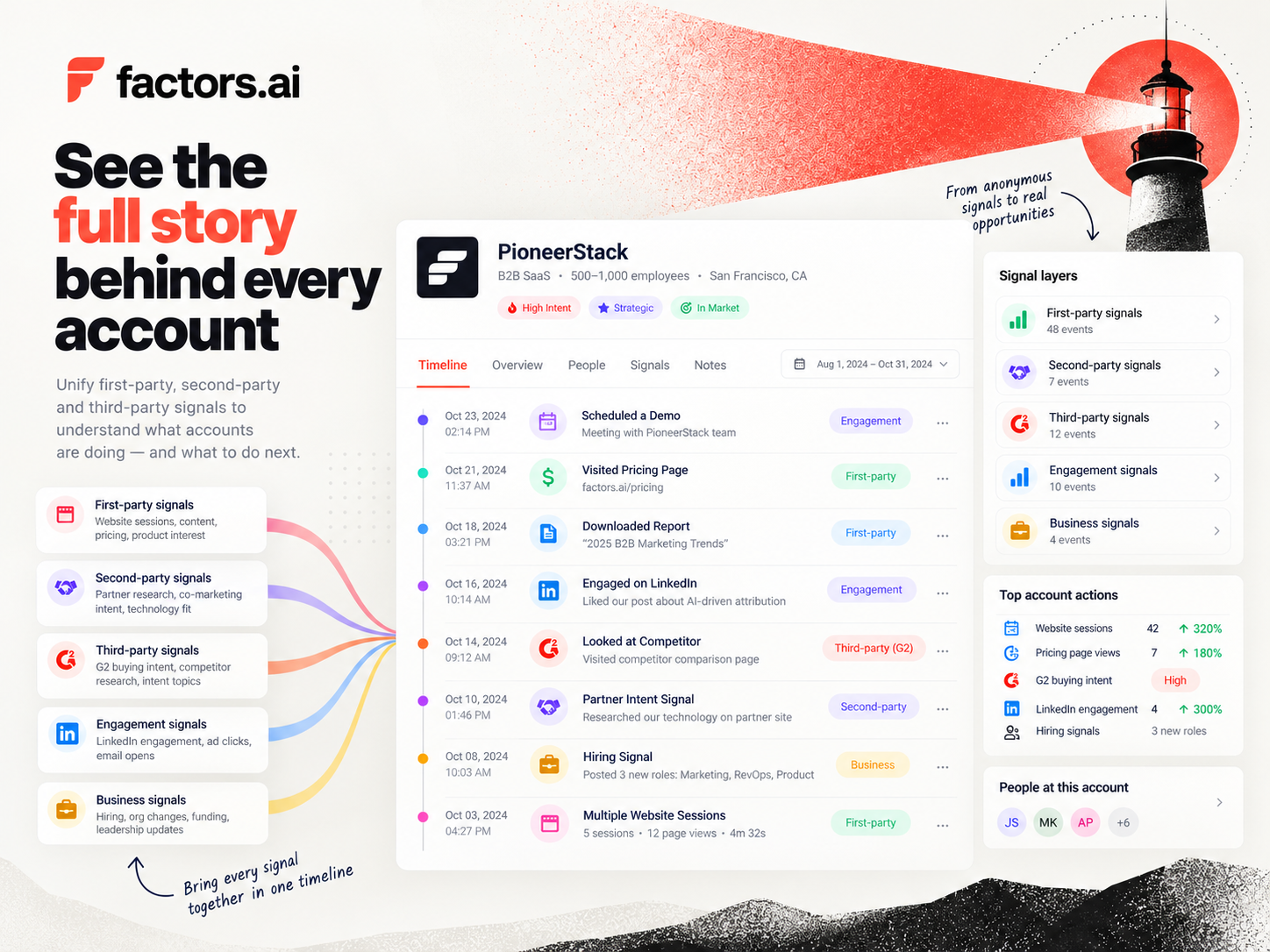
Factors.ai’s account timeline brings website visits, LinkedIn ad interactions, and sales touches into one combined feed, making it easy to spot when an account shifts from early research to technical validation. Predictive scoring models rank those accounts against historical conversion patterns so revenue teams can spot high-intent accounts weeks before anyone fills out a form.
For the exact playbook on routing these accounts to your sales team, read our guide on using LinkedIn intent data in your B2B sales strategy.
2. Target the entire B2B buying committee instead of chasing executive titles
Win rates climb as more people at an account engage, yet most marketing budgets target a tiny slice of the company.
- Accounts with six or more engaged contacts before the deal had a 17.1-point higher win rate than accounts with one. On deals of $250K or more, that gap widened to 24.5 points.
- 76% of title-targeting spend went to director, VP, and C-suite titles, which make up just 13.9% of job titles on LinkedIn.
- The role combination linked to the biggest lift (+22.0 percentage points) was the end user, influencer, and technical evaluator. The budget holder was not in it.
Spending three-quarters of your budget on one in seven titles drives up LinkedIn ads costs while ignoring the people who actually decide whether a tool gets adopted.
Steve Armenti, founder of twelfth agency and former marketer at Google, broke this down during a conversation with Ganesh, Factors.ai’s Associate Director of Content and Brand. In his work building LinkedIn marketing strategies for enterprise SaaS brands, the CRM records consistently show that senior executives rarely initiate product evaluations.
"Your senior ICP, CIO, CISO, CHRO, they do not sign up for demos. That person’s going to be a director, maybe a senior manager. All of the decision-making and all of the research and all of the actual sales is happening at a more junior level."
In his experience, the executive shows up in the second or third meeting to approve a project that has mostly been decided below them.
To move past broad job titles, read our guide on targeting B2B audience intent on LinkedIn and explore our framework for building LinkedIn trust across B2B buying committees.
Segment LinkedIn campaigns by operational role and seniority
To reach the entire committee, split campaigns by seniority while keeping the core problem consistent.
A CFO looking at marketing spend might want a revenue benchmark, while the ops manager on the same deal wants to see how tracking is configured.
Alex Goodwin, Director of Demand Generation at Fingerprint, uses LinkedIn specifically to solve this committee puzzle. While his sales reps cast a wide net across an account with email outreach, he concentrates Fingerprint's paid advertising on LinkedIn directly on engineering and product leaders.
Those are the practitioners who have to implement the software and put it on their development roadmap. If engineering rejects the product, no executive can force it through. To get their attention on LinkedIn, his team ran five-minute technical walkthroughs with account executives breaking down real use cases. The clicks were expensive, but high-value accounts converted because the ads spoke directly to the technical team's daily problems.
Trying to close an enterprise contract by retargeting the same single champion with more ad impressions never works. You have to work with sales to identify which technical, financial, or security roles are absent from the evaluation, then serve role-specific collateral to pull them into the conversation.
Most of those operational leads will never follow your company page organically, which is why paid distribution becomes essential.
3. Run LinkedIn organic and paid as one program
Organic publishing and paid campaigns perform very different commercial jobs in our research, and accounts exposed to both delivered the highest win rates across the board.
Three takeaways stand out from those numbers:
- Organic content builds genuine credibility with the people who encounter it, but feed algorithms reach only a fraction of your target accounts. It produces a higher win-rate lift than paid working by itself, yet accounts for less than a tenth of influenced pipeline.
- Paid campaigns can reach your entire target list, touching nearly two-thirds of pipeline, but convert at lower rates when running in a vacuum.
- The two motions reinforce each other. Paid distribution guarantees delivery across target accounts, while organic content provides the authentic proof buyers look for when evaluating an ad.
(The pipeline-share column tracks where influenced deals came from historically, so treat it as an observation of buyer behavior rather than a recommended budget split.)
Why this combination of organic and paid LinkedIn works
When Alex spoke to our CMO Praveen, he mentioned how paid ads on their own can easily feel transactional
"Whenever you see an ad on LinkedIn, I think the experience is massively improved if when you click on the company logo and you go to the company page, you see a ton of proprietary research, you see all of their executives posting, and they post unique things that are really actionable and insightful." says Alex.
His team also found where sponsored posting hits a wall. When Fingerprint promoted every executive update to a broad brand audience, engagement dropped off quickly.
"What I see work the most effectively on LinkedIn is targeted content that speaks to a small group of individuals with a high level of depth." Alex reinforces.
The organic and Thought Leader Ads discussion starts around the 47-minute mark.
Here is how to run both organic and paid LinkedIn as a single engine.
- Write for specific operational roles, with founders and internal practitioners leading the arguments.
- Watch who engages in the comments instead of tracking total number of likes. Questions from engineers or directors at target companies show where positioning is actually landing.
- Sponsor the posts that resonated with target accounts using LinkedIn Thought Leader Ads.
- Hook cold audiences before the fold by following proven LinkedIn ad copy best practices. A prospect scrolling their feed will not expand a post unless the first two lines address a problem they recognize immediately.
- Evaluate sponsored posts on account progression and site visits rather than assuming a post that worked with existing followers will resonate with buyers who don't know your company.
Cap impressions per account to prevent budget concentration
Paid campaigns only add value if ad delivery spreads across your account list, and LinkedIn's default auction does the opposite.
AJ Wilcox ran into this while managing ABM campaigns for his own agency against a list of 400 target companies.
"Those three top ones, Google, Facebook, and I think Twitter at the time, like 96% of my impressions went to those three companies, and that means none of the other companies were even getting hit by the ads." AJ explains.
The LinkedIn auction simply serves impressions to whichever accounts have active users in the feed right now. If a few large enterprises on your target list employ thousands of people, their employees soak up your entire daily budget while the rest of your list gets almost nothing. Knowing what an impression actually means on LinkedIn makes that skew fatal, because an impression only tracks an ad loading on a screen, not real buyer attention.
Most legacy ABM tools and native LinkedIn campaign settings cannot solve this problem because they lack account-level frequency controls.
Factors.ai built Smart Reach inside its LinkedIn AdPilot suite to eliminate this blind spot. The platform monitors impressions per company domain in real time.
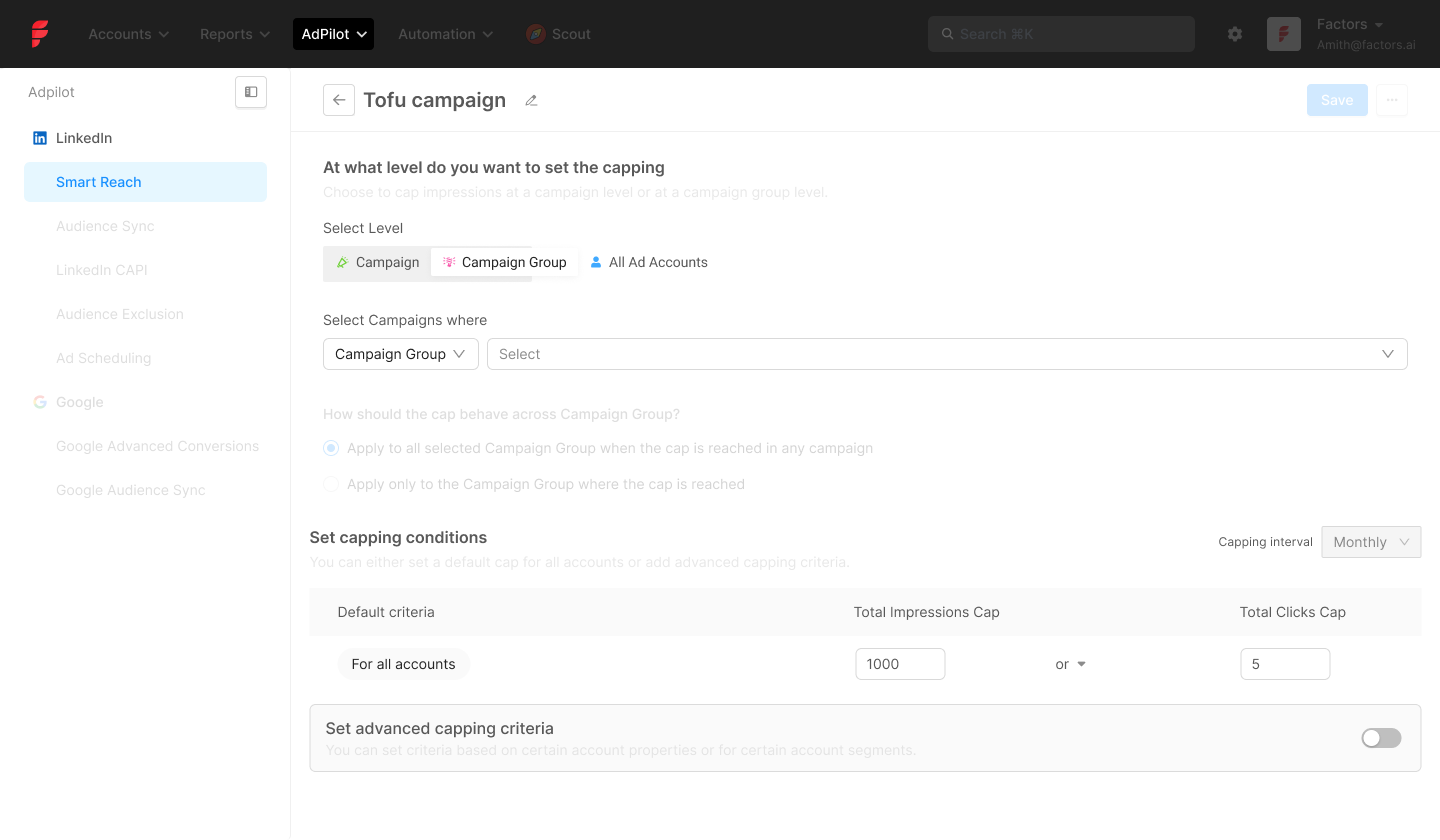
Factors.ai lets you cap impressions per account on LinkedIn
Once an account in your target list hits your designated frequency cap, delivery pauses for that company until the budget window resets. This way, impressions get spread across accounts, making sure your LinkedIn ABM programs achieve genuine list-wide coverage.
Descope used Smart Reach to solve this exact delivery bottleneck. By capping over-served accounts, they redistributed more than 158,000 impressions to unreached companies on their list, lifting LinkedIn ads ROI by 22% on the same overall spend.
4. Keep running LinkedIn marketing campaigns even after the deal opens
Most marketing teams treat LinkedIn purely as a net-new acquisition engine. The moment an opportunity opens in Salesforce or HubSpot, they hand everything over to sales.
Our data in the From Benchmarks to Blueprints report shows why shutting off LinkedIn at the deal creation stage stalls pipeline.
- 55.6% of closed deals engaged zero new contacts during the active sales cycle.
- Another 20.7% engaged just one.
- Deals that engaged three or more new contacts after opportunity creation won 16.3 percentage points more often than deals that engaged only one.
Roughly three in four deals add one person or nobody after opening. That is where evaluations die, because the people who sign off on the purchase later in the cycle, such as security, compliance, procurement, and finance, bring concerns the initial champion never had to address.
Leaving your sales rep to handle those late stakeholders through cold emails introduces friction. A complete LinkedIn B2B marketing strategy stays live across the entire buying committee until the contract signs.
Shift LinkedIn creatives as accounts advance through your CRM
Your LinkedIn creative needs to reflect the account's stage in your pipeline.
This is where standard pixel retargeting fails. A browser cookie only follows the single person who previously visited your website, and that cookie usually expires in days. You cannot run stage-specific LinkedIn ads to an incoming CFO or security architect if they have never visited your site.
Understanding pixel-based vs. account-based LinkedIn retargeting solves this. Instead of tracking browsers, an account-based marketing platform syncs your CRM opportunity stages directly into LinkedIn matched audiences.
This allows you to apply LinkedIn’s job-function filters to reach the exact roles surrounding your champion, even if those people have never interacted with your marketing material before.
In Factors.ai, Audience Builder syncs dynamic CRM rules directly into LinkedIn Campaign Manager, updating your matched audiences as deal stages advance.
Document Ads are particularly effective here because stakeholders can swipe through a five-page security brief or implementation plan directly in their LinkedIn feed without filling out a form or clicking away from the platform.
Review our breakdown of the types of LinkedIn ads to align each asset with the right visual format, and reference our guide on structuring LinkedIn retargeting ads for maximum B2B ROI to keep frequencies balanced across active opportunities.
Use LinkedIn distribution to revive deals going quiet
Account disengagement accounts for 27.1% of documented lost deal value across our dataset, jumping to 49.5% on deals between $250K and $1M. These are rarely deals lost to competitors. They are evaluations that quietly slipped away because the buying committee went dark.
When an account stops responding, the default reaction across most sales floors is to ramp up outbound pressure. Reps send "just checking in" emails, bump old threads, and start messaging other people at the company.
But if a deal stalled because of internal politics, budget reshuffling, or implementation anxiety, another sales follow-up only pushes the buyer away.
LinkedIn ads give you a way to stay present without cornering the committee. While sales steps back to give the account breathing room, targeted campaigns keep running quietly in the background. Serving a peer case study, an implementation blueprint, or a compliance overview keeps your platform top of mind while the team works through whatever stalled the project internally.
None of this mid-deal acceleration shows up in traditional sourced-pipeline reports, because the account entered your database months earlier. But keeping LinkedIn campaigns live across active opportunities protects win rates where deals get decided.
5. Measure LinkedIn influenced pipeline and account lift instead of direct leads
If you evaluate your LinkedIn B2B marketing strategy purely on direct form fills, you will underinvest in the channel every time.
B2B buyers research products in groups over several months, frequently converting through organic search, direct website traffic, or sales calls after being influenced by paid campaigns.
Track these three indicators instead to evaluate how your campaigns move accounts before a contract signs.
Influenced pipeline
Track influenced pipeline by setting a strict threshold for what counts as meaningful exposure.
Counting every account that received a single ad impression inflates your numbers with false positives. Useful baseline thresholds include, for instance, five distinct content engagements, a webinar attendance, or more than five visits to technical evaluation pages.
Evaluating this journey requires dedicated LinkedIn revenue attribution to connect top-of-funnel ad exposure directly to CRM opportunities.
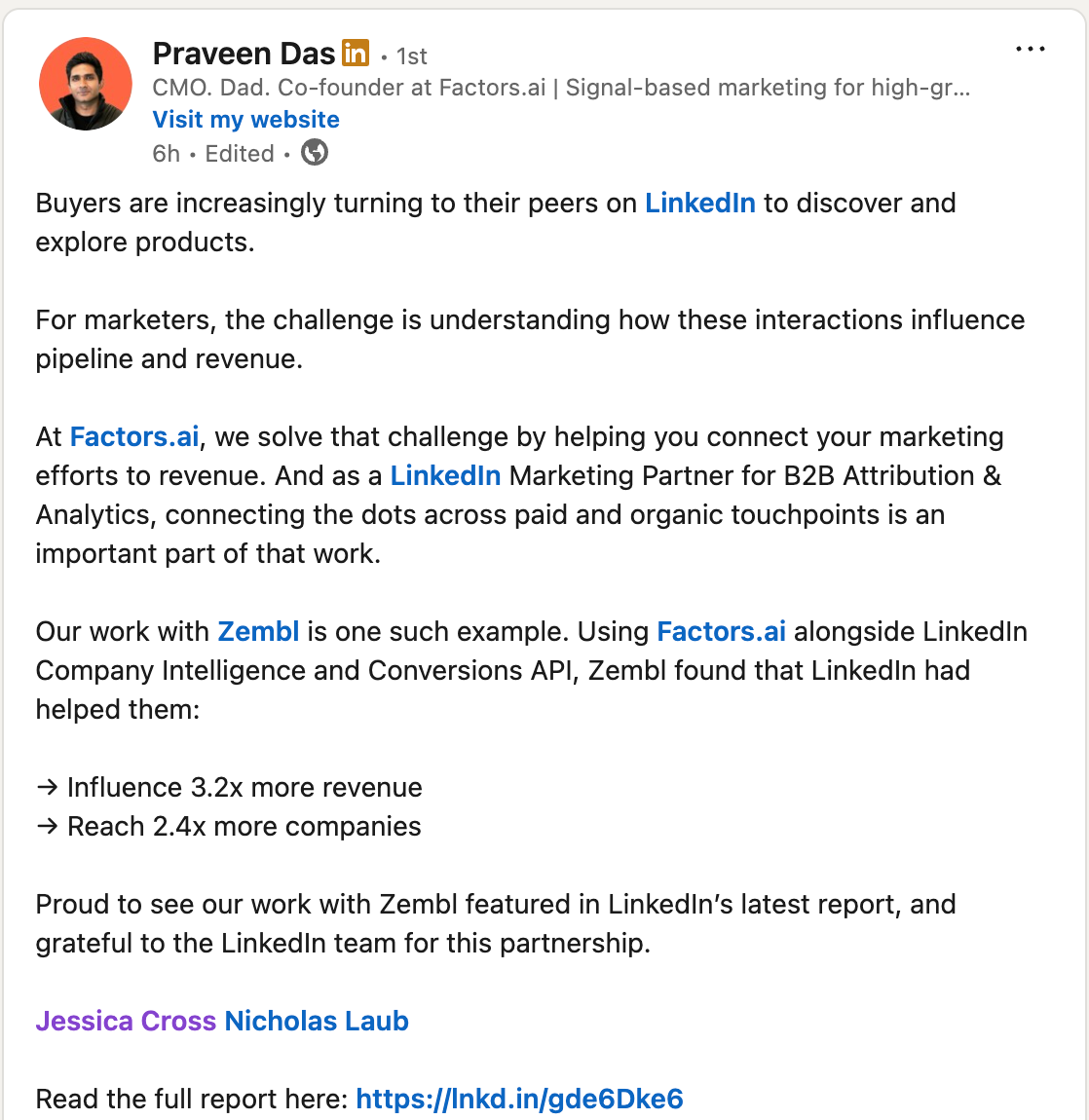
At Sprinklr, Chief Marketing Officer Arun Pattabhiraman faced this exact challenge across long enterprise sales cycles. "LinkedIn allows us to engage accounts early in their journey, and events accelerate that engagement," he explained. "The challenge is proving this connected journey in a way sales and leadership can trust." By using Factors.ai to track cross-channel account touches, Sprinklr verified that LinkedIn directly influenced 15% of their enterprise pipeline.
Factors.ai brings company-level paid and organic activity into a unified account feed through its LinkedIn Company Intelligence integration. This connection records impressions that never produced an immediate click, tying feed exposure back to active deals. Our guide to LinkedIn view-through conversions and B2B attribution explains how to measure that influence accurately.
Our CMO, Praveen Das, even spoke about how the partnership with LinkedIn is helping companies tie LinkedIn Engagement to pipeline and revenue.
Engagement bands
Influenced pipeline reveals what LinkedIn touches, but engagement bands tell you whether accounts are warming up before revenue enters the forecast.
Set up an engagement scoring framework in three steps.
- Pull closed-won and closed-lost opportunities from a single target segment over the last twelve months.
- Group those accounts into low, medium, and high engagement bands based on ad interactions, site visits, and the number of stakeholders reached.
- Compare win rates across the bands to identify the minimum engagement threshold an account needs to close.
Alex Goodwin uses this model at Fingerprint to guide sales and marketing reviews. His team defines what a warm account looks like, tracks which target companies hit that threshold, and scores accounts on how well campaigns are multithreading across engineering and product teams.
Cross-channel conversion lift
LinkedIn campaigns often do their best work by lifting the performance of other channels.
When we analyzed multi-touch journey data across B2B teams using Factors.ai, ICP accounts that engaged with LinkedIn ads converted on paid search at a 52% higher rate than accounts that never saw an ad.
A standard last-touch report, however, gives Google Search 100% of the credit for those conversions. In reality, buyers see an ad on LinkedIn, remember your positioning, and later search for your brand directly on Google.
To prove this lift in your own data, compare search conversion rates for target accounts that saw LinkedIn impressions against a control group of accounts that received none over the same quarter.
What to report each month
Consolidate these indicators into a monthly scorecard to track whether your campaigns are building pipeline momentum.
For dashboard templates and reporting structures, check out our B2B LinkedIn ads analytics and reporting framework.
Stop optimizing for form fills and fix your real pipeline bottleneck
Treating LinkedIn as an expensive direct-response lead engine guarantees frustration. If your entire measurement model depends on capturing an email address on the first visit, you will underinvest in the channel, bid on the wrong titles, and shut off campaigns right when buying committees need them most.
Enterprise buyers do not buy software through impulse clicks. They research in groups, build internal consensus over months, and convert when the risk of adoption feels managed.
To build an effective LinkedIn B2B marketing strategy, pull an audit of your active opportunities and closed-lost deals from the last two quarters. Identify where your pipeline actually breaks down, and fix the operational gap first.
Explore LinkedIn AdPilot to see how account-level frequency caps, intent-driven audience building, and pipeline attribution work together inside a single platform.
If you liked this guide on LinkedIn B2B Marketing, check out these:
- Campaign execution: B2B LinkedIn Ads: The Complete Execution Guide
- Dynamic audiences: Targeting B2B Audience Intent on LinkedIn
- Attribution and measurement: LinkedIn View-Through Conversions and Attribution
Frequently asked questions on LinkedIn B2B Marketing
1. Is LinkedIn effective for B2B marketing?
In our data, LinkedIn returned 1.6x on ad spend against 1.18x for Google, and LinkedIn-sourced deals were 34% larger on average. How well it works depends on whether you reach the full buying group and engage accounts before they enter the CRM pipeline.
2. How long does a LinkedIn B2B marketing strategy take to show results?
It depends on your sales cycle, but sustained LinkedIn engagement began an average of 124 days before deal creation in our data. Expect account engagement to show up months before pipeline does, and track influenced metrics in the meantime.
3. Who should B2B companies target on LinkedIn?
B2B companies should target the whole buying group, not only senior titles. The strongest role combination - based on our From Benchmarks to Blueprints report - was the end user, influencer, and technical evaluator, linked to a 22-point win-rate lift.
4. How do you measure LinkedIn B2B marketing?
Track influenced pipeline and revenue alongside sourced leads, and set engagement bands from your own past deals. This shows which accounts are getting warmer before they contribute to revenue.

How Much Does 6sense Cost in 2026? Plans and Pricing
See what 6sense costs in 2026, including reported prices, credit limits, contract terms, and other costs to check before you buy.

TL;DR:
- 6sense uses custom pricing, while Vendr reports a median annual purchase of $63,199 across 383 purchases.
- Your 6sense budget needs to cover more than the subscription, including advertising media spend and any separately priced data, services, or additional usage.
- Approximately 29% of the 83 current or former 6sense users in our buyer research raised cost concerns, with another 13% questioning seat charges, usage limits, or contract terms.
- For teams that can afford 6sense, the bigger question is whether it delivers enough value, especially when sales adoption is low, or only part of the platform is used.
- Compare 6sense’s annual price and total contract cost. A slightly lower yearly price may mean committing to a much longer contract.
- Keeping 6sense can make sense when its intent, advertising, or sales workflows are delivering results, and any replacement, including Factors.ai, should face the same test.
- Factors.ai is a better alternative for 6sense. It offers better pricing and features and is a better tool for running multi-channel ABM campaigns. To learn more, read Factors.ai vs 6sense for ABM in 2026.
How much does 6sense cost in 2026?
There is no single published price for a paid 6sense subscription. Its Sales Intelligence pricing page describes package combinations without listing their costs.
Here is the public pricing information buyers can use.
Use these figures as a reference when evaluating a quote, since actual pricing may vary. Different purchases cover different products, account volumes, and contract terms.
The next step is to establish exactly what you are buying.
What does 6sense pricing include?
6sense sells products for both sales and marketing. Its public Sales Intelligence packages do not describe everything available across the wider platform.
6sense Sales Intelligence
Sales Intelligence gives sellers company and contact information, account activity, intent signals, and alerts they can use to prioritize outreach.
The public pricing page lists three combinations.
The page does not publish a dollar amount for these packages. Ask for the number of licensed users, the data-credit allowance, and the specific predictive features included in your quote.
Also, read How to choose the best sales intelligence tool in 2026
6sense Revenue Marketing
6sense’s marketing offering is currently presented as Revenue Marketing. It covers identifying accounts visiting your website or researching relevant topics, building audiences, running campaigns, and measuring marketing’s contribution to pipeline.
Predictive modeling can help prioritize accounts, while audiences and workflows let marketers act on those signals through campaigns and connected tools.
There is no public marketing-specific rate card on the page we reviewed. A Revenue Marketing quote therefore needs its own breakdown; you cannot infer its cost from the Sales Intelligence package descriptions.
If you need both products, ask which capabilities belong to the marketing subscription, which require sales licenses, and which are separately priced.
How do 6sense credits work?
6sense credits pay for certain data-access and export actions. Your allowance comes from your contract, and different actions can consume credits separately.
Some 6sense applications, including Orchestration, use separate credit systems. The main credit pool does not cover every activity, and you can purchase additional credits through your customer success manager.
Before choosing an allowance, map out what your team will actually do. A rep who unlocks a contact and exports it may consume more than one credit, while repeated enrichment within the maintenance period is treated differently.
Buying more credits than you use also costs money, because unused credits expire.
What additional 6sense costs should you budget for?
- Intent Data Packs and setup
Intent Data Packs let you receive 6sense data in your own data warehouse or reporting tools. Keyword Intent covers research across 6sense’s publisher network, while Web Intent covers activity on your website.
The documentation says new purchases bundle Keyword and Web Intent together. These Intent Data Packs require an active ABM Platform or Intent Platform subscription rather than a one-time purchase.
Getting the feeds set up requires work from 6sense’s professional services team.
These are hours of professional services work, rather than a published setup fee or a delivery timeline. Ask whether those hours are included in your proposal or billed separately, and what additional work your own team must complete.
- Advertising media spend
The platform subscription and the money spent running ads are separate budget items. Access to advertising capabilities does not mean the subscription funds your campaigns.
6sense’s advertising documentation also describes variable data and service fees, typically 15%–18%, deducted from campaign spend. They take these from that budget rather than automatically adding them on top.
The general advertising terms do not require a specific spending commitment unless you request prepaid options; confirm the terms of your own proposal.
When comparing costs, separate the subscription cost from campaign spend.
Our take on 6sense pricing
If your team can afford 6sense, the more important question is whether you are getting enough value for the money you spend.
A company can have the budget for the platform and still struggle to justify it. This happens when the subscription covers capabilities nobody uses, sales does not act on the recommendations, or the team relies on only a few parts of a much larger purchase.
We reviewed buyer conversations from July 2024 through September 29, 2026 to understand how companies assess 6sense’s cost and value. Our sample included 83 current or former 6sense users who raised specific concerns and 61 companies that evaluated the platform without buying. This research also informed our guide on why companies reconsider 6sense.
Within those groups:
- Approximately 29% of current or former users raised cost concerns about 6sense.
- Approximately 13% of users questioned seat charges, usage limits, or contract terms.
- Approximately 64% of evaluators who did not buy raised cost concerns.
Affordability was a clear barrier for many evaluators. Among existing users questioning their purchase, the discussion often focused on value for money.
One buyer using 6sense for intent, advertising, enrichment, and predictive scoring put it plainly:
“It's not that it doesn't work necessarily. It's just that the cost is incredibly high for the value that we're getting from it.”
Here are the recurring issues we found and what they mean for anyone evaluating a 6sense purchase or renewal.
1. Paying for more capability does not guarantee more value
A broad ABM tool like 6sense can be worth its price when a team uses it to its fullest potential. It becomes harder to justify when the purchase assumes a level of adoption or staffing the company never reaches.
In our conversations, one lean marketing team estimated it had used about 60% of 6sense’s capabilities and had no marketing or sales operations team to manage the platform. Another buyer had the full predictive model but said sales did not use it enough to justify what the company paid.
These are different situations, but the cost problem is similar. The company has purchased more capability than it is putting to work.
You do not need every feature to earn its place individually. But you do need a credible reason for the overall purchase.
There is also an opportunity cost. A marketing leader whose company paid $72,000 annually for 6sense questioned whether that money would do more as paid-media budget.
2. The annual price can hide a much larger commitment
Two quotes can look close on annual cost while asking you to accept very different levels of risk.
In one evaluation, a buyer discussed a 6sense annual quote of around $30,000 for intent and other features, with a requested two- or three-year term. Factors.ai proposed $25,000 per year for its Growth plan with the Bombora intent data add-on on the call.
The buyer described the annual difference as approximately $5,000. But their bigger concern with 6sense was committing before they had experienced the platform:
“It's like a commitment that you make without even experiencing the platform.”
Separate three things when reviewing a proposal:
For example, a three-year 6sense contract at $30,000 a year means a total subscription cost of $90,000. Advertising spend and separately billed services or add-ons would cost extra. Even if you pay one year at a time, you’re still signing a three-year agreement.
Another buyer told us their team had inherited a two-year 6sense agreement after paying for only the first year, and finance was trying to negotiate an exit.
All of this does not establish a standard 6sense contract length or exit policy. It does show why incoming marketing leaders should review the signed agreement before assuming the next payment date is an opportunity to cancel.
3. Usage limits can affect the value of an otherwise affordable package
The annual fee matters less if the 6sense package restricts the work you bought it to do.
One buyer told us per-user charges had limited 6sense access to five BDRs. They also described noisy intent and low adoption.
Advertising teams raised a different issue. One buyer’s previous agreement allowed ten segment syncs to advertising platforms, although the allowance became more generous at renewal. Another buyer described paying for additional segments pushed into LinkedIn and Google Ads.
Such anecdotal evidence shows why a quote needs to be checked against the campaigns you plan to run.
A segment sync sends a defined account audience to another platform. If you need separate audiences for regions, products, customer stages, or campaigns, the number required can grow quickly.
For an advertising use case, assess the complete budget together:
- The subscription and any separately priced advertising capabilities.
- The audience-sync allowance required for your campaigns.
- The media spend needed to reach those audiences.
- The people or services responsible for running and improving the campaigns.
The 6sense subscription may fit your budget, but additional seats and audience syncs can increase the bill. You still need enough left for ad spend and the people running your campaigns.
4. Leaving 6sense does not automatically save the subscription cost
Replacing a platform like 6sense can mean buying several tools and rebuilding work your team has already done.
One former 6sense customer moved to Clay and Outreach, then realized the replacement stack was missing website visitor identification:
“We thought that Clay could be a good replacement for 6sense. But I think the team hasn't accounted for... a de-anonymization tool.”
The replacement was not necessarily the wrong choice. The initial comparison had missed a capability the team still needed.
💡By the way, if you are looking to replace Clay, read our blog on Clay alternatives for GTM teams.
Other conversations raised the work involved in rebuilding segments and connected workflows. Even when the replacement subscription costs less, somebody must recreate those processes, check the data, and make sure sellers can use the results.
Budget for paying for 6sense and its replacement at the same time. Your new subscription may begin before your 6sense contract ends, or you may need to keep 6sense running while setting up the new tool. Include that overlap when estimating how much switching will save.
Setup, retraining, and additional tools to replace missing capabilities can also add to the cost. Compare the full cost of switching with what you currently spend on 6sense.
How does Factors.ai pricing compare?
Factors.ai publishes its pricing publicly, unlike other tools in the ABM space. The plans are as follows.
These prices come from the Factors.ai pricing page. Add-ons and requirements can increase the final pricing
When comparing 6sense and Factors.ai pricing, get quotes for the capabilities your team will actually use. For example, you might need one or more of the following:
- Intent Signals: Identify companies visiting your website or researching relevant topics. Combine first-party website activity with second-party signals from ad platforms such as LinkedIn, Google, Meta, Reddit, and G2, plus third-party Bombora data, to help sales prioritize accounts.
- Advertising activation: Build account audiences, send them to channels such as LinkedIn and Google Ads, and improve campaign targeting.
- Attribution: Connect advertising, website, and CRM activity to understand which marketing efforts contribute to opportunities and revenue.
Ask each vendor which plan covers your requirements, what usage limits apply, and what costs extra. Factors.ai offers up to 40% contact-level identification through RB2B (US traffic only) and advanced attribution as add-ons, so include those costs in your quote if you need them.
If Factors.ai would replace only part of your 6sense package, also include the cost of any other tools you would need. This gives you a more useful comparison than putting a Factors base-plan price next to the cost of a broader 6sense quote.
What should you ask before buying or renewing 6sense?
Ask for a proposal that explains both the bill and the work required to get value from it.
For a new purchase, agree on success criteria before signing. Use a trial or proof of concept where available to test the workflows people will actually use.
For a renewal, review recent campaigns and prioritized accounts. Establish what 6sense contributed, which capabilities went unused, and whether the proposed package reflects what the team needs next.
Is 6sense worth the cost?
For teams that can afford 6sense, we would judge the price against the capabilities they actually use. Several buyers in our research were already paying for extensive packages and questioning how much of that spend they could justify.
A team primarily using 6sense for intent needs to decide whether those signals are worth the full package price. Unused predictive models, sales licenses, or advertising features add little to that decision. Before buying or renewing, ask for a package built around the requirements you can justify funding.
That standard should apply to 6sense, Factors.ai, or any other platform under consideration.
Frequently asked questions on 6sense pricing
Q. Does 6sense publish a price per user?
6sense does not publish a fixed per-user dollar rate on the Sales Intelligence pricing page we reviewed. Ask for the licensed-user count and the cost of adding the people who need access.
Q. Is 6sense’s free plan still available?
The Sales Intelligence Free Plan was discontinued on August 12, 2026, and new registrations are no longer available. Existing paid subscriptions were unaffected.
Q. Can you cancel 6sense before the contract ends?
It depends on your signed agreement and any changes negotiated with 6sense. We encountered buyers exploring early exits, but those conversations do not establish a general cancellation policy; review your term and termination provisions before planning a switch.
Q. Can you buy 6sense intent data without the full ABM platform?
6sense documents an Intent Platform option for data-only customers using Intent Data Packs. Since September 2025, those Data Packs require an active ABM Platform or Intent Platform subscription; one-time purchases are no longer available. Public prices are not listed in the documentation.
Q. Do unused 6sense credits roll over?
No. Credits expire at the end of their allocation period and do not carry into the next period.
Why Companies Are Switching From 6sense, Based on Buyer Feedback
Explore 6sense drawbacks through feedback from 83 current and former users, covering black-box scoring, data quality, adoption, cost, and contracts.
TL;DR
- 6sense’s black-box model scoring and intent can be difficult to evaluate when buyers cannot explain why an account was prioritized or find the research topics too broad for useful outreach.
- Teams can struggle to get enough value from 6sense when managing the platform requires more resources than they have or its recommendations fail to produce useful sales conversations.
- 6sense’s data quality and coverage can create extra verification work when company mappings, contact details, or regional coverage fall short of the team’s needs.
- The platform’s cost and contract terms become harder to justify when usage is low, particularly when buyers pay for unused capabilities.
To understand why some companies were reconsidering 6sense, we reviewed our sales conversations from July 2024 through September 29, 2026. We searched roughly 14,800 recorded meetings and their deal notes in Oliv, identifying 83 current or former 6sense users with specific complaints. We also examined 61 companies that evaluated 6sense but did not buy.
💡If you are considering replacing 6sense, read our detailed breakdown of top 6sense alternatives that can replace 6sense in your tech stack.
Four main concerns about 6sense came up repeatedly in our conversations. Here’s what buyers told us and how those issues affected their teams.
1. 6sense’s Black-box scoring and broad intent make recommendations harder to evaluate
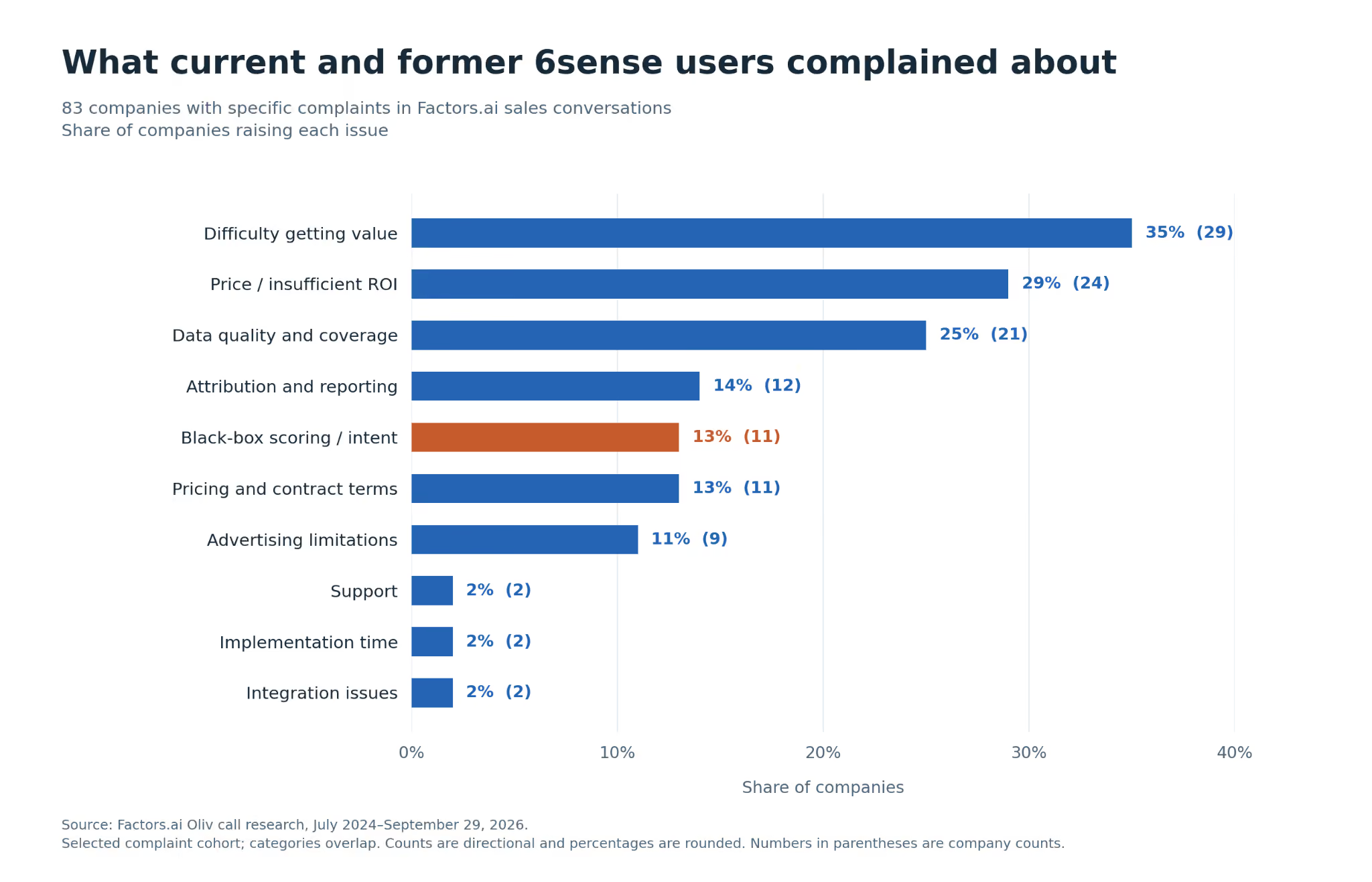
Approximately 13% of current or former users raised concerns about 6sense’s black-box scoring or intent. Buyers questioned how accounts were prioritized and whether the available signals were specific enough to guide outreach.
One buyer exploring a replacement described their experience:
“It’s a black box sometimes. We have lots of intent information all over the place. HubSpot itself does a better job with intent.”
A colleague on the same call explained the problem with topic specificity:
“Intent topics can be a little bit too vague... it doesn’t mean anything to me if a company is interested in compliance.”
Knowing a company is researching “compliance” gives a seller little direction about the requirement behind that research. It may be relevant to the product they sell, or concern something entirely different.
The scoring complaint needs a separate explanation. 6sense exposes the inputs, but not the predictive model’s internal weights. Users can configure keywords, website classifications, ICP definitions, and qualification thresholds. They can also inspect account activity and review reports comparing predictions with outcomes. However, the precise reasoning behind an individual account score is not available in the platform.
For a marketer, this limits how directly they can change the scoring logic. They can adjust the data and criteria feeding the model, but cannot decide exactly how much a particular action contributes to its prediction.
A proprietary model can still produce useful recommendations. The difficulty arises when a team questions the output and wants to trace or change the calculation behind it.
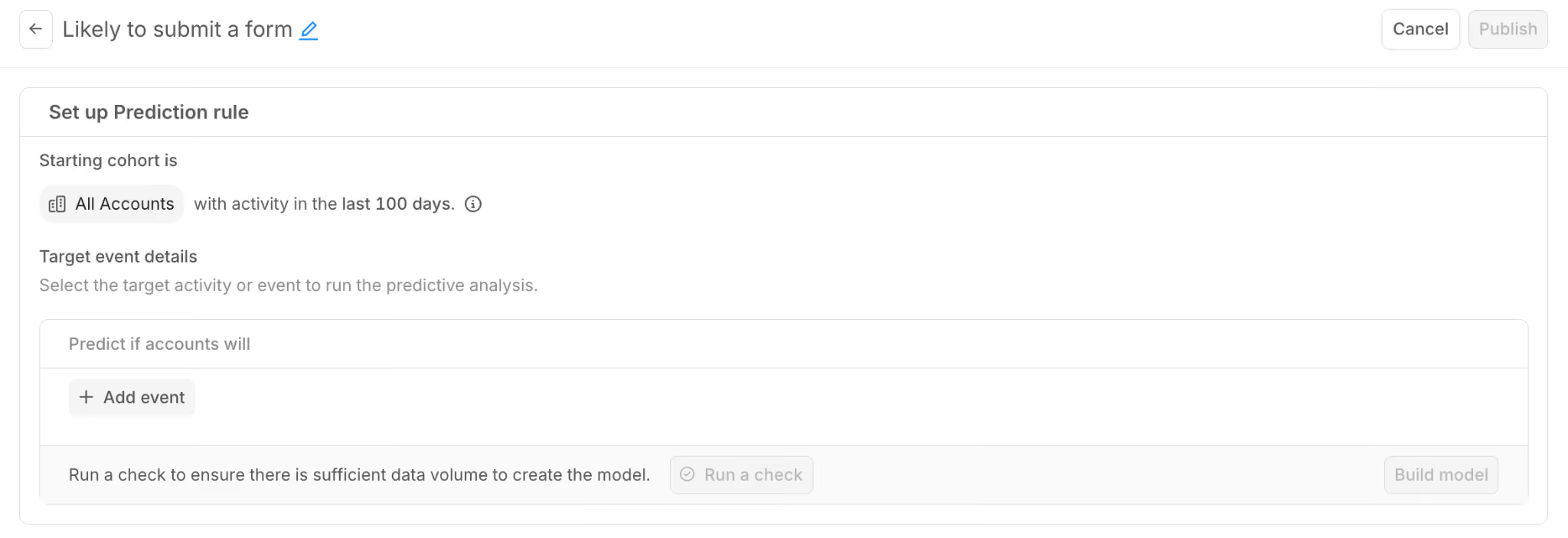
Factors.ai’s custom engagement scoring addresses that requirement by letting teams choose events, assign weights, and limit how much repeated activity contributes. Its separate predictive scoring learns from historical activity toward a selected outcome, such as opportunity creation.
Users control the rules in custom scoring; in predictive scoring, they select the outcome and review model performance rather than manually setting the learned weights.
2. Teams struggle to get enough value from 6sense
Difficulty getting value out of 6sense was the largest complaint category, raised by approximately 35% of users. Some lacked the resources to run the platform consistently. Others used it actively but were disappointed with the results.
One marketing lead described the resource gap:
“We don’t have a marketing operations team. We don’t have a sales operations team. We don’t have that team to orchestrate it at all.”
They estimated their company was only using roughly 60% of the platform’s capabilities. Another growth marketing leader described an inherited subscription as “shelfware at the moment.”
These buyers had access to more capabilities than their teams could regularly use. Maintaining audiences, reviewing accounts, coordinating follow-up, and assessing results required time they struggled to find.
Navigating the platform was another obstacle. A person responsible for their team’s day-to-day usage said:
“The entire UI UX has been a little difficult for our team to actually navigate through and pull out the data.”
But the problem wasn’t always insufficient effort or difficulty using the interface. One sales team initially worked 6sense-qualified accounts, or 6QAs, diligently, with service level agreements (SLAs) governing follow-up. Their marketing leader described what happened afterward.
“There was no trust built, because they did not see results out of it, so now the sales team is mostly distrustful of 6sense.”
The team had adopted the process. Confidence declined after reps followed the recommendations but didn't see the results they expected.
Before renewing, check why your team isn’t getting enough value from 6sense. Training may help people navigate the platform, while a dedicated owner can manage audiences and coordinate follow-up. If reps already follow the recommendations but struggle to book meetings, review which accounts are being prioritized and whether the signals justify outreach.
3. Data quality and coverage can leave teams doing extra verification
Approximately 25% of users in our sample raised data quality or coverage concerns about 6sense. Buyers reported incorrect company mappings, duplicate records, inaccurate contact details, and gaps across regions or company sizes.
One buyer described repeatedly seeing familiar accounts rather than discovering new ones:
“We're somehow seeing the same accounts that are popping up. We don't see net new accounts.”
Another buyer wanted more detail about the people behind the activity. They acknowledged the information 6sense collected, but described the missing granularity:
“Six Sense pulls all that in, so technically it should be all of it. It's just... Not at a contact level.”
Other conversations raised accuracy and coverage concerns, including incorrect account mappings and insufficient data for smaller companies, specialized industries, or markets outside the US. These complaints affected different parts of the purchase. More identified companies alone would not fix inaccurate contact details or reveal who was visiting.
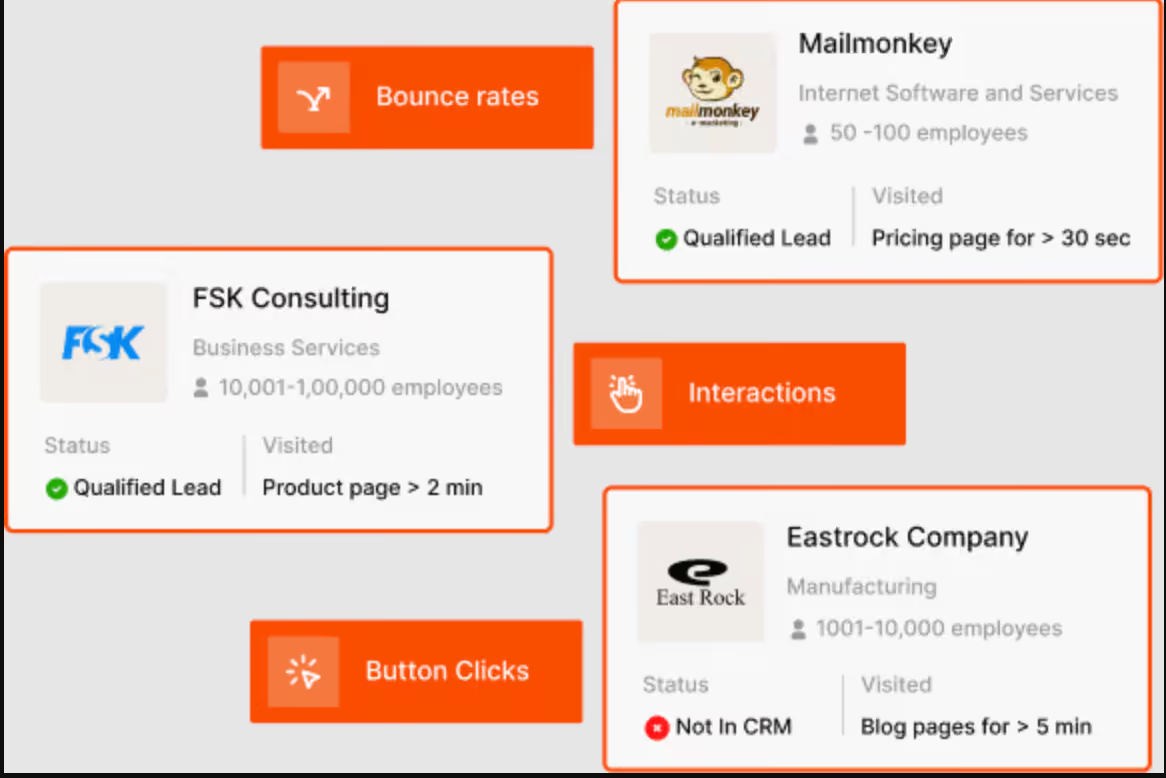
Factors.ai’s waterfall identification model uses four data sources to expand company-level account identification coverage up to 75%. Its RB2B integration adds person-level identification for eligible US-based website visitors (up to 40%), surfacing their LinkedIn profile and, where available, name, job title, and work email.
Sales can view those details alongside the visitor’s activity in the account timeline or receive them through alerts. This helps address the need to see who is engaging within an account, although RB2B identifies only a subset of US visitors.
4. 6sense’s cost and contract terms become harder to justify when usage is low
The cost of 6sense was a concern for approximately 64% of companies who evaluated it but didn’t buy, compared with 29% of current or former users. Around 13% of users also questioned seat charges, usage limits, or contract terms.
Some teams ruled out 6sense because the quote exceeded their budget. Others had already paid for it but weren’t using the platform enough or getting the results they expected.
One buyer reported paying $28,000 a year and receiving a $16,000 renewal offer, a reduction of approximately 43%. The company still canceled because it remained dissatisfied with the intent recommendations. A lower price didn’t resolve the problem it had with the product.
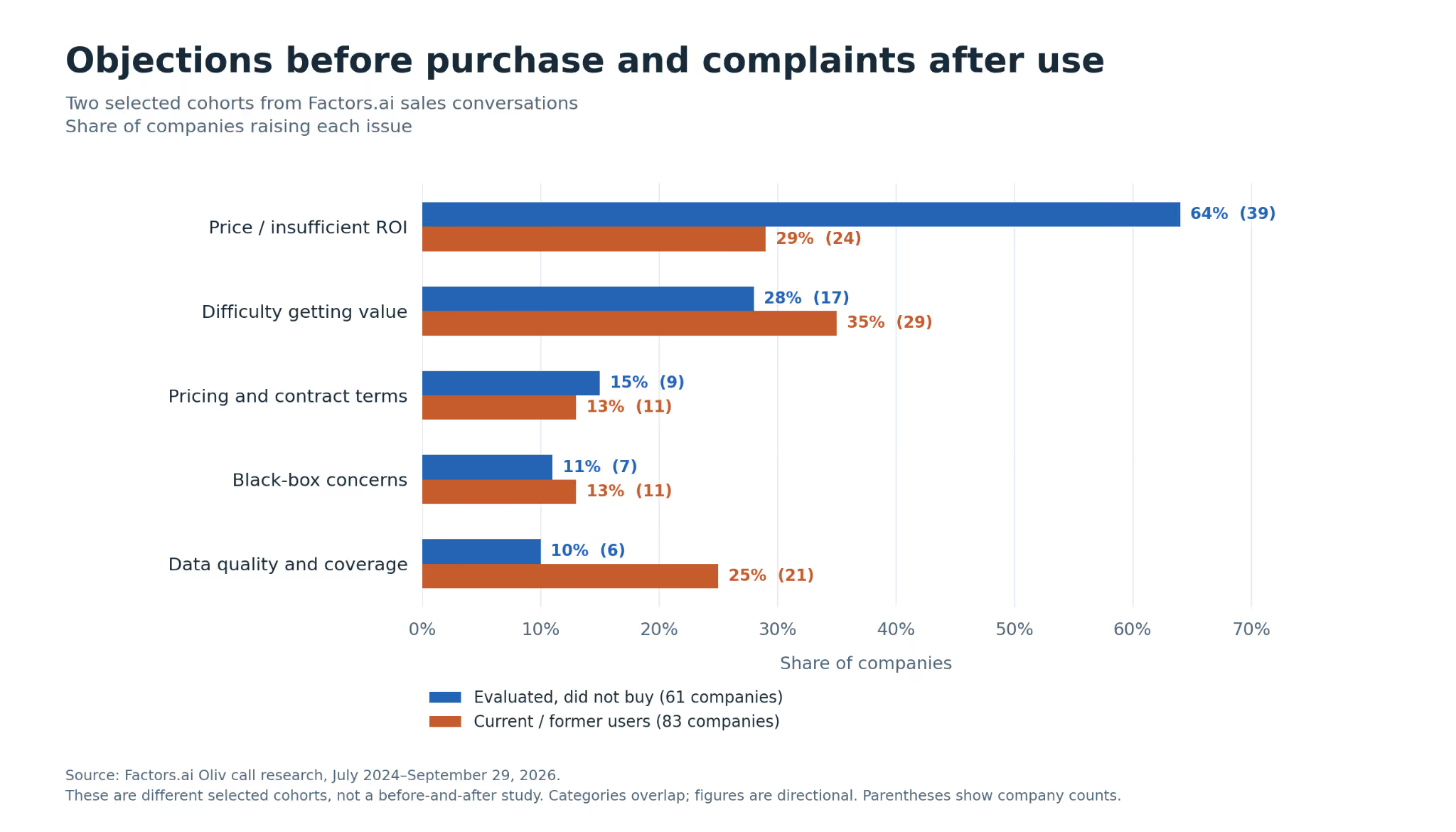
Objections among evaluators compared with complaints among users
Seat charges also affected how widely teams used 6sense. One marketing lead explained:
“Our adoption of 6sense is low. Because they charge us by user and we only enable the BDR team, which is five at the time.”
Contract length became a problem for another company. It had purchased the top tier, including predictive modeling, but felt sales wasn’t using it enough to justify the cost. Finance was trying to exit the second year of a two-year agreement.
For comparison, Factors.ai’s published pricing lists Growth at $20,000 a year and Enterprise from $30,000 a year, with defined seat and usage allowances. Add-ons can increase the cost, and Factors.ai typically uses annual contracts. Compare the package your team needs rather than treating these starting prices as equivalent to every 6sense purchase.
If you are curious to know how 6sense pricing works, read the detailed breakdown on 6sense pricing and costs in 2026
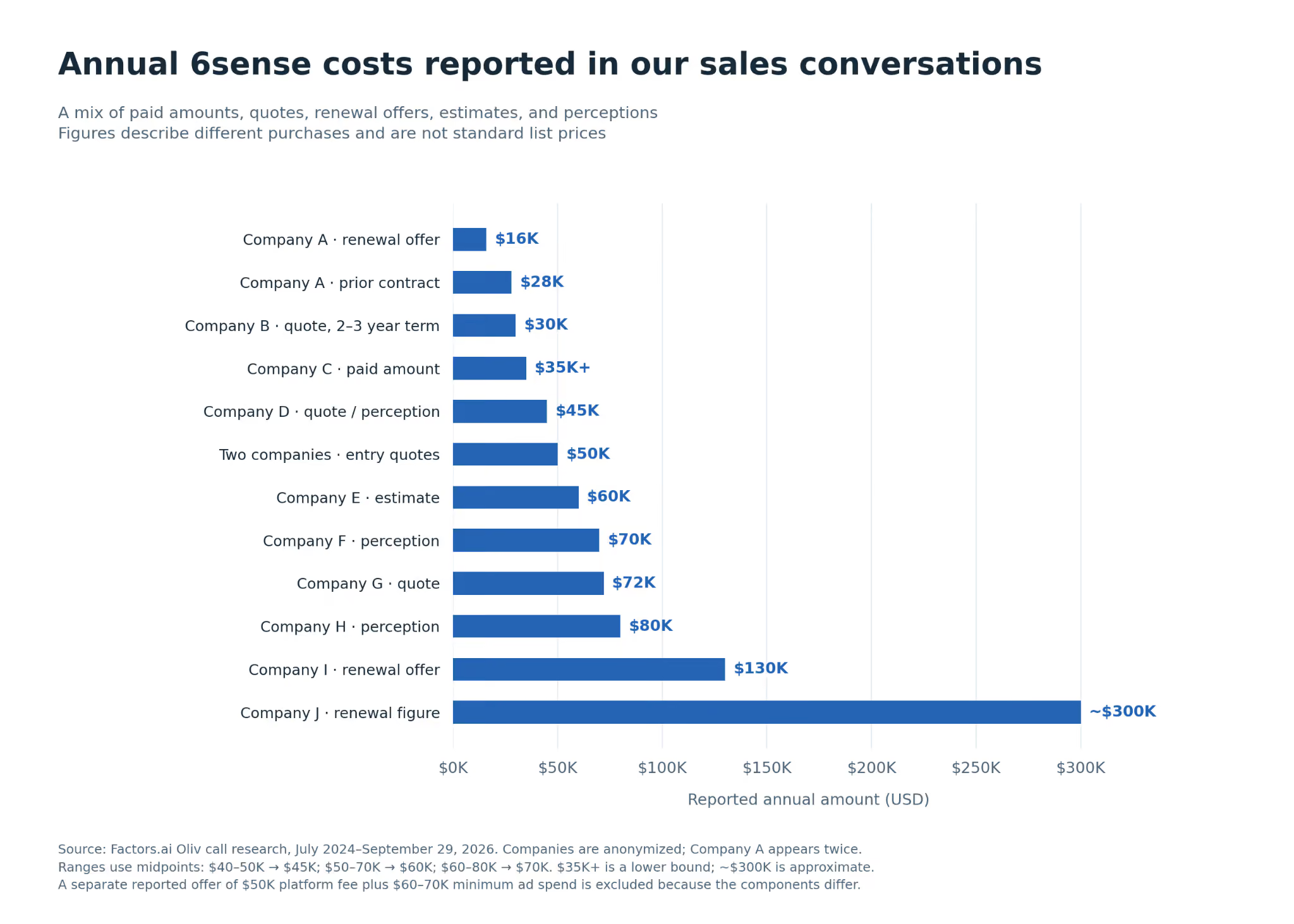
Other drawbacks those evaluating or using 6sense mentioned
Buyers also raised a few other concerns about 6sense:
- Around 14% wanted better attribution and reporting, including clearer revenue attribution, account journeys, campaign reports, and historical data.
- Around 11% questioned display-campaign results or said they had little use for the advertising features.
- Around 2% reported poor support or frequent changes in their customer success manager.
- Around 2% described implementation problems during their rollout; this figure excludes concerns evaluators raised about expected timelines.
If you are considering a better alternative to 6sense, try Factors.ai. Read the detailed comparison on Factors.ai vs 6sense before evaluating other options.
What are Reddit users saying about 6sense?
Public Reddit discussions describe similar concerns, although these are more anecdotal.
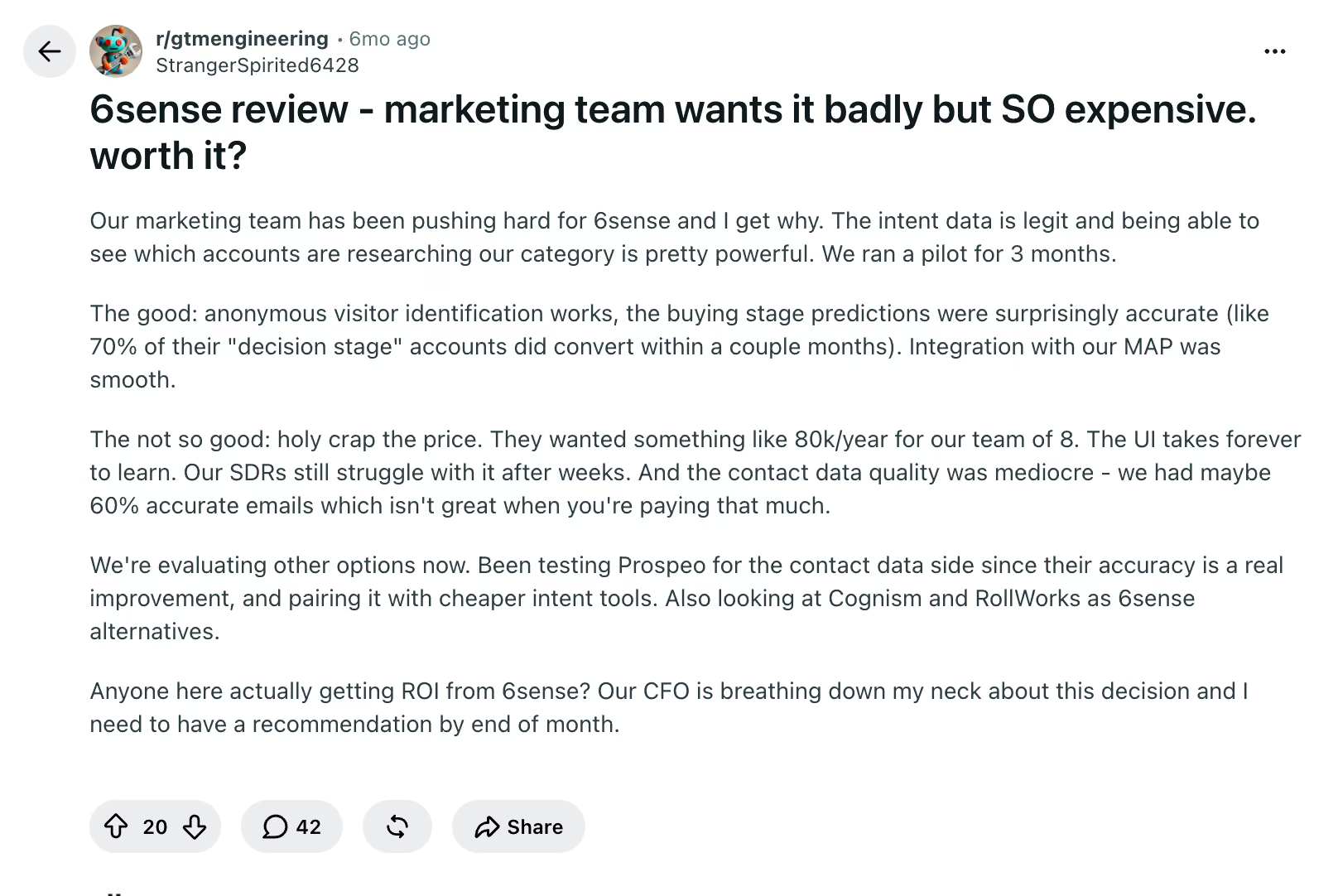
In a thread asking whether 6sense was worth the cost, the original poster described a three-month pilot. They praised identification, buying-stage predictions, and their marketing automation integration, while questioning an approximately $80,000 annual quote, the learning curve, and contact accuracy.
The buyer saw useful capabilities but remained unsure whether the complete purchase made sense for the team.
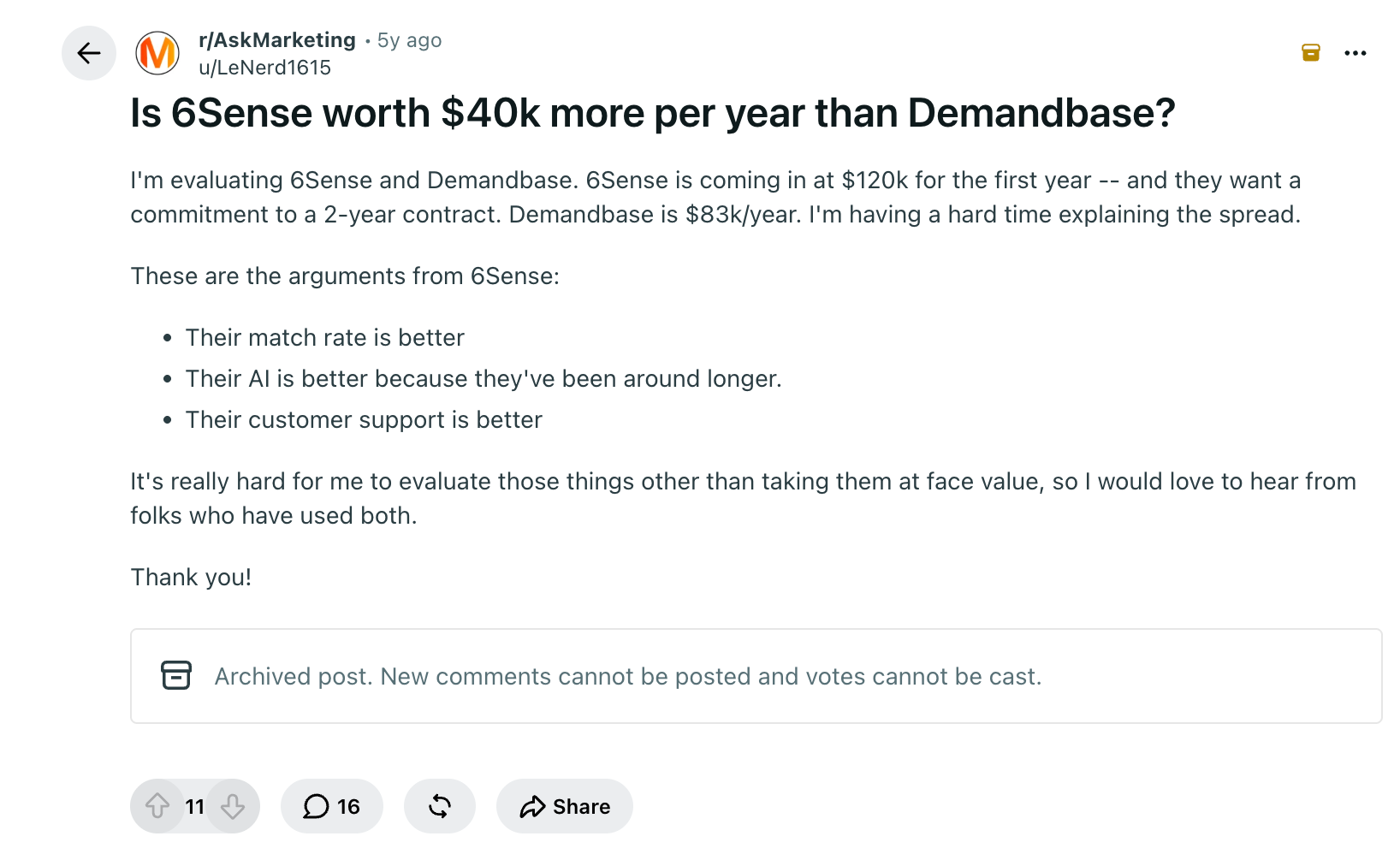
An older discussion comparing 6sense with Demandbase described a $120,000 first-year quote and a requested two-year commitment. The buyer struggled to assess claims about better matching, AI, and support.
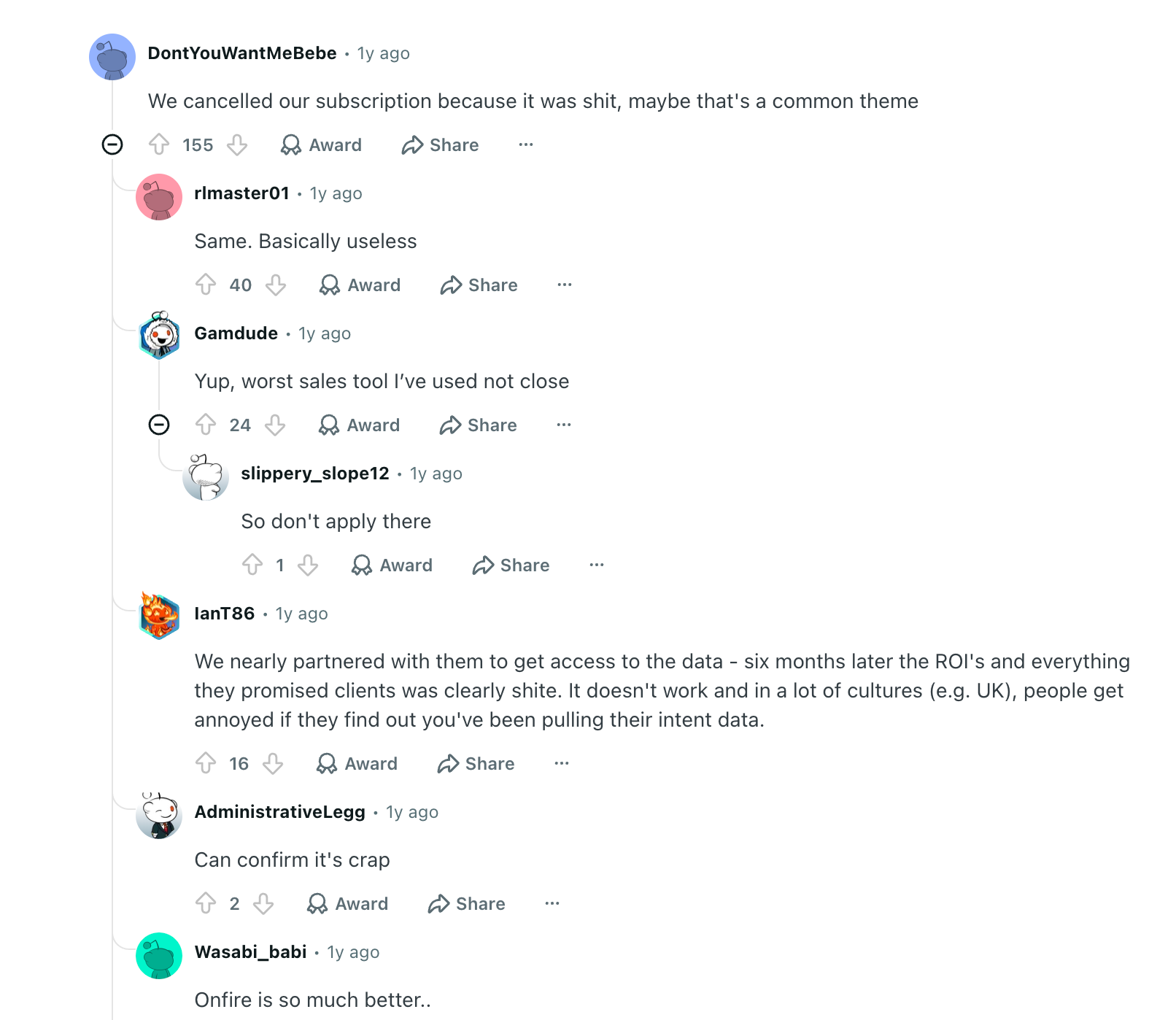
The “What’s going on at 6sense?” thread includes comments about disappointing results and account alerts that lacked enough detail for outreach. Its opening topic concerns employee departures, which should be kept separate from the product experiences discussed here.
Is 6sense the right fit for your team?
If you’re evaluating 6sense, ask the vendor to demonstrate how it would work with your accounts and data. Can the 6sense team explain the recommendations, find the contacts it needs, and turn the signals into useful outreach? Also check who will manage the platform and what the required features, seats, and usage will cost.
If you already use 6sense, compare those expectations with your experience. Look at the capabilities your team uses, the results it gets, and the work needed to keep everything running. This can help you decide whether to renew, adjust the package, or evaluate another platform.
Use the same criteria when considering Factors.ai or any other option. The right choice should meet your requirements at a cost your team can justify, with results you can assess.
ChatGPT Ads for B2B: What They Cost, How They Work, and How to Launch Your First Campaign
Learn how ChatGPT Ads work for B2B, including costs, targeting limits, campaign setup, and how to measure the channel against pipeline.

TL;DR
- ChatGPT Ads crossed a $1 billion annualized revenue run rate in under 200 days, and self-serve access now spans more than 40 countries.
- Ads Manager runs three bidding objectives: CPM for reach, CPC for clicks, and oCPC, a conversion-optimized version of CPC that still bills per click. OpenAI's own suggested starting bid for CPC is $3 to $5.
- The minimum daily budget is $25 in the US, and it varies by market currency elsewhere.
- Custom audience targeting needs at least 25,000 matched users, with 100,000+ recommended. Most B2B ABM lists are too small for this to be useful on day one.
- Targeting runs on plain-language context hints tied to conversation intent, not keywords or job titles.
- ChatGPT Ads only appear on Free and Go plans. Users on Plus, Pro, Business, Enterprise, and Education plans won’t see them.
- On September 16, OpenAI added Sponsored Agents and a native HubSpot integration, the first real bridge between ad spend here and actual CRM pipeline data.
I’ve been testing ChatGPT Ads since the self-serve beta launched. It’s still new, so there’s no proven playbook yet. But it’s already big enough that every B2B paid media team should understand how it works, even if you’re not ready to invest heavily.
Here’s what I’ve learned, what changed this month, and how I’d run the first test on ChatGPT Ads.
What are ChatGPT Ads?
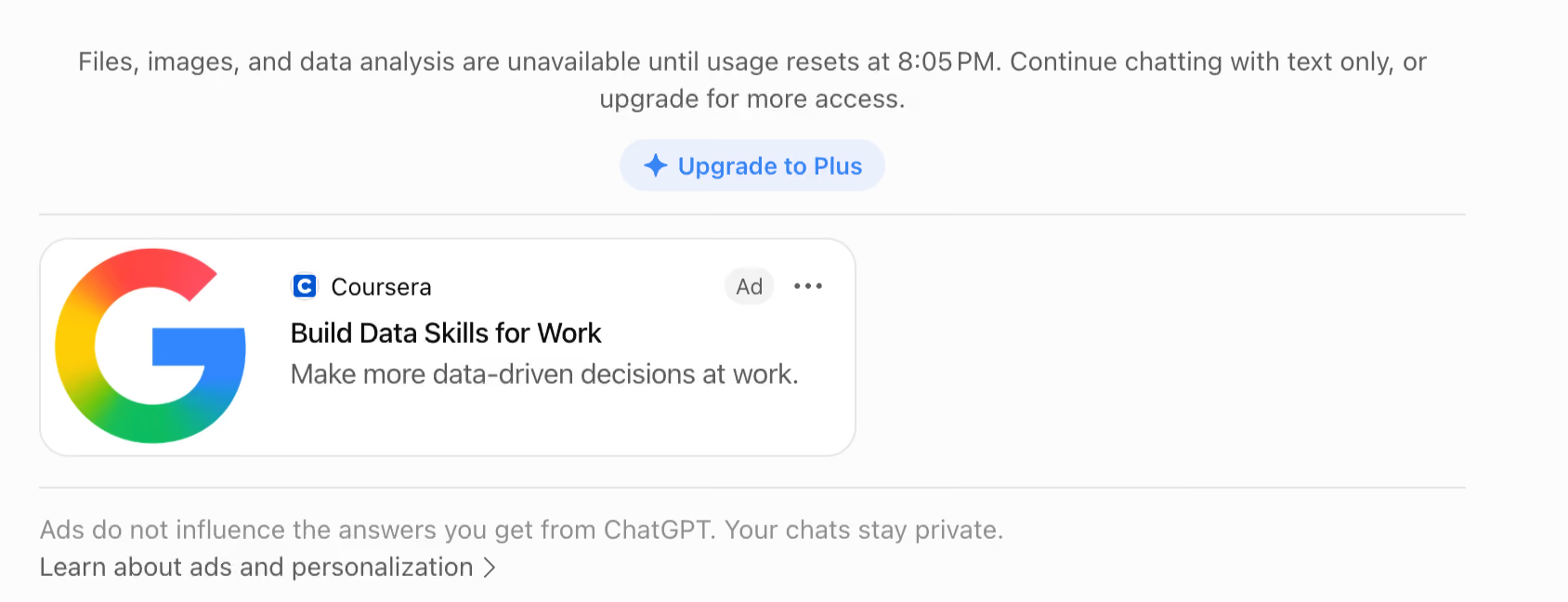
ChatGPT Ads are sponsored placements that appear below the model's response inside a conversation, clearly labeled and visually separated from the organic answer.
OpenAI is explicit that ads never influence what ChatGPT actually says. The system picks which ad to show by matching advertiser submissions against your conversation topic, your past chats, and your past interactions with ads, and advertisers never see the private content of any of that.
The main ad unit is a sponsored answer card: a headline, a short description, a brand image, and a link, one per response.
There's also a shopping format built for ecommerce, running as a product carousel pulled from a retailer's feed. As of this month, there's a third format, Sponsored Agents, which I cover below.
Ads only show up for people on ChatGPT's Free and Go tiers. Plus, Pro, Business, Enterprise, and Education subscribers never see one. OpenAI also keeps ads away from users it believes are under 18, and away from health, mental health, and political topics for everyone.
A clearly labeled “Ad” placement appears on the advertisement.
How ChatGPT Ads platform grew 10× in five months
If you last checked this platform earlier this year, a lot has changed. Here’s how quickly it has grown.
For context, the annualized figure grew from $100 million in March to $1 billion by the end of August. Things are changing quickly, so check OpenAI’s advertiser page for the latest availability.
How much do ChatGPT Ads cost?
Official pricing guidance and early advertiser reports tell two different stories, so it’s important to keep them separate.
- Officially, OpenAI recommends starting CPC campaigns with a maximum bid of $3–$5 per click.
- Ads compete in a relevance-weighted, second-price auction, so your final CPC may be lower than your maximum bid.
- The standard minimum daily budget in the US is $25.
OpenAI has not published average CPC or CPM benchmarks across advertisers or industries. Its official FAQ says the platform is still too early for reliable benchmarks.
Early reports provide context, but I wouldn't use them to forecast performance.
- The agency-managed pilot reportedly charged around $60 CPM.
- By April, some reports placed CPMs as low as $25.
These are early observations, not official benchmarks.
The bigger change is how easy it has become to start. In March, Criteo was reportedly pitching advertisers commitments of $50,000–$100,000. Today, self-serve advertisers can start with the standard $25 daily campaign budget.
You no longer need a large media commitment to test the channel. That makes running a small, controlled experiment more practical than waiting for industry benchmarks.
What B2B marketers should know before testing ChatGPT advertising?
1. Not everyone can see ChatGPT Ads
Here's a limitation most guides I have read miss. Ads only run on the Free and Go plans. Plus, Pro, Business, Enterprise, and Education users do not see them.
I'm not saying that most senior B2B buyers are on paid ChatGPT plans, because I don't have evidence for that. But it's the right question to ask before you commit budget. What share of your actual audience is even reachable through ad-supported inventory right now?
If your ideal buyers mostly use paid or company-managed ChatGPT plans, your reach may be much smaller than ChatGPT’s total user numbers suggest.
2. The custom audience limitation in ChatGPT Ads
This is by far one of the biggest limitations for B2B marketers.
ChatGPT Ads lets you upload first-party audiences using email addresses or phone numbers. You can use them to target people, exclude them, or adjust bids. However, OpenAI requires at least 25,000 matched users for targeting and bid adjustments, and recommends 100,000 or more.
Smaller audiences can only be used for exclusions. OpenAI confirms these thresholds here.
That’s a high bar for a typical mid-market SaaS company. You might have 500 Tier 1 accounts, 5,000 target contacts, and 12,000 engaged prospects in your CRM. Those lists may work on LinkedIn, but they are too small for direct targeting on ChatGPT Ads.
So don’t expect to upload a focused ABM list and target it as you would on LinkedIn’s company and job-title targeting. For most B2B teams, context hints, ad creative, and landing-page relevance will matter more than first-party audience targeting for now.
The real test is whether richer conversational context can generate qualified demand despite weaker audience controls. Nobody knows that yet, including me.
How to set up your first ChatGPT Ads campaign
1. Get your account verified
- Register at ads.openai.com with a legal business name that matches your tax documents, since you can't change it later without going through support.
- You'll also need a tax ID, a billing method, a business category, and a landing page ready to receive traffic.
- Verification runs stricter than most ad platforms. Build in a few days of buffer.
2. Understand the campaign hierarchy
- There are three tiers: Campaign, Ad Group, Ad, a very similar three-tier structure to Google or Meta.
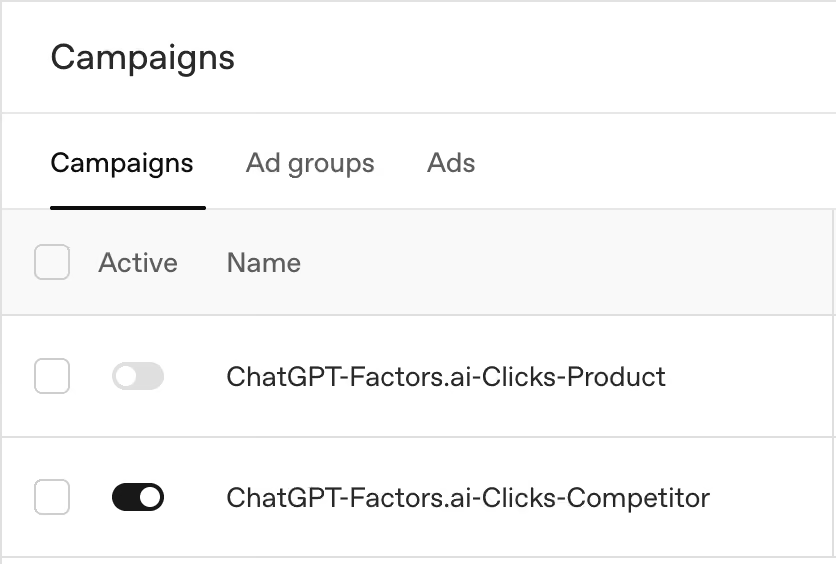
- Use a consistent naming convention from day one, something like BrandName | Objective | Market | Month | Test#, because once you're running several context-hint variations at once, an unnamed mess slows you down.
In the ads below, we named it as Medium-Brand name-Objective-Type of ads
3. Choose your objective
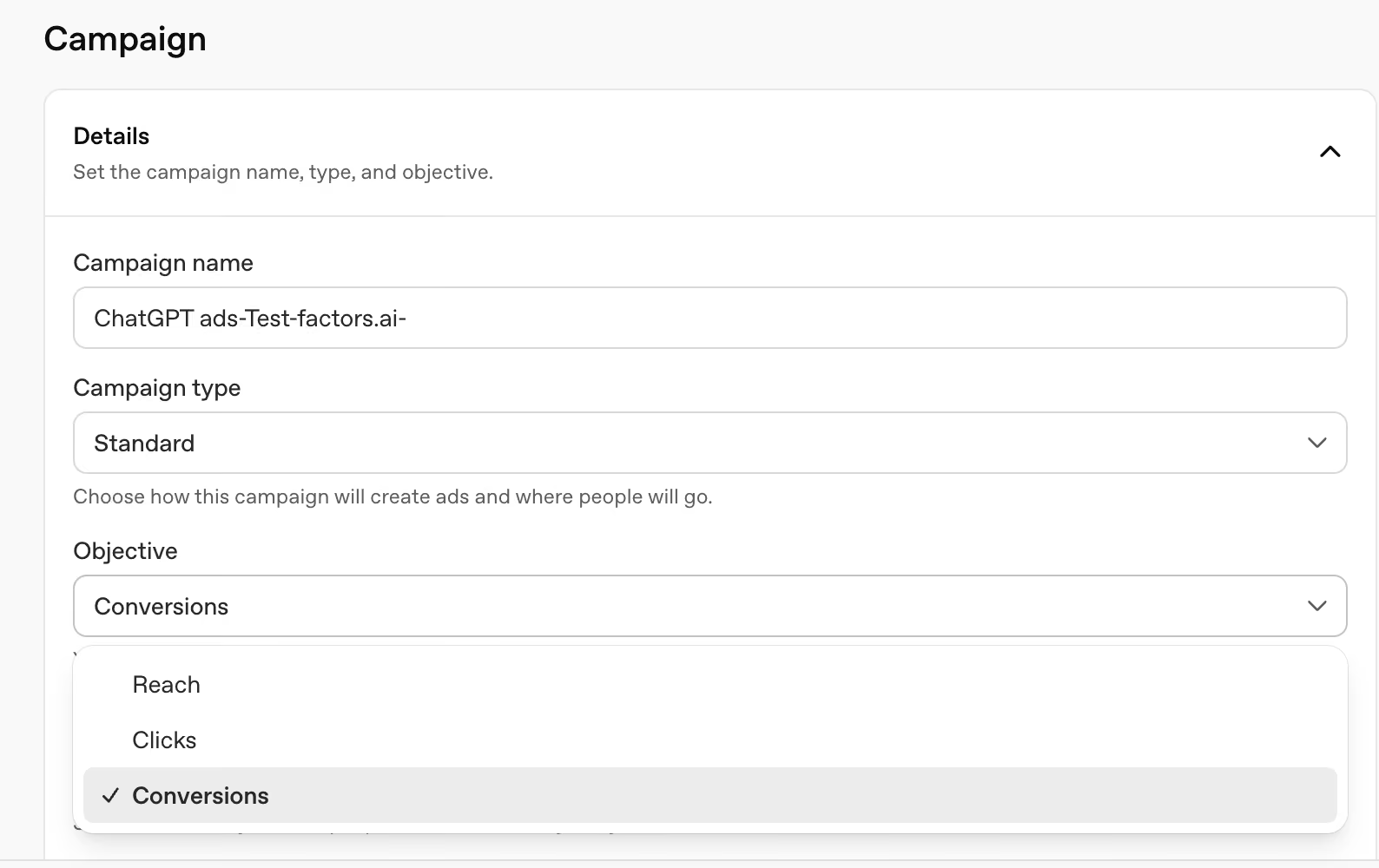
- There are three objectives: Reach: CPM, Clicks: CPC, or Conversions: oCPC. OpenAI's own campaign guide lays these out clearly.
- CPM is for reach and awareness, billed per 1,000 impressions. CPC is for driving clicks, billed per valid click.
- oCPC is the one where you still pay per valid click, but the system prioritizes ad delivery towards the clicks where people are more likely to complete a conversion event you've set up. For a demo request or a signup, this is the objective I'd set up once you have enough tracked conversions for the system to optimize against.
4. Set a daily budget
- Always set a daily budget; do not start with a campaign-total budget while you're learning.
- OpenAI says that campaign-total budgets are paced using the remaining budget and campaign schedule.
- Spend may rise or fall depending on available opportunities. Pacing can prevent early budget exhaustion, but it doesn't guarantee your budget will last or be spent in full.
- A daily budget can vary from day to day but stays within a seven-day average. OpenAI recommends it for new advertisers because it is easier to monitor spending.
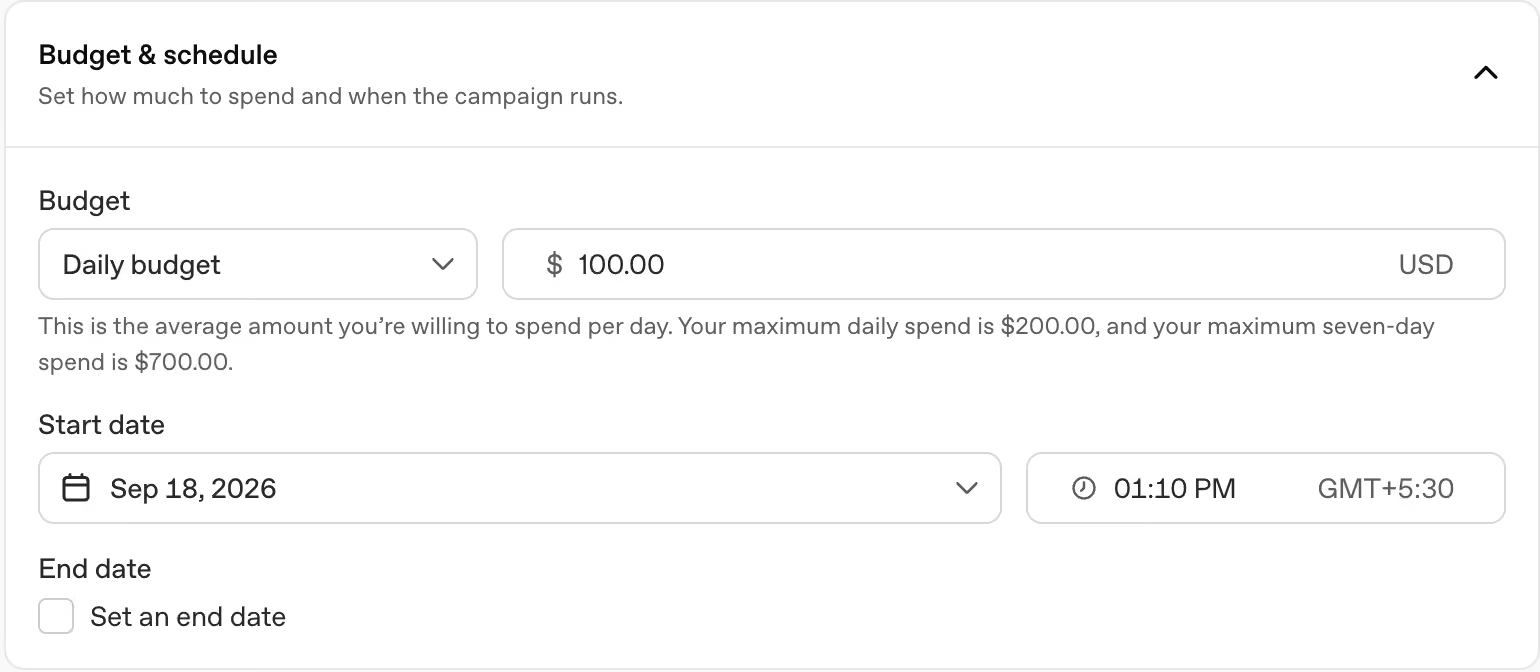
- The current minimum is $25 a day in the US, with different minimums by market currency elsewhere.
5. Write your context hints
- There are no keyword lists like Google Ads. Always write your context hints like a brief. This is where I've seen people get it wrong first. Describe the buyer's situation, not the product category.
- For a product like ours, that could include:
- Buyers comparing tools in the ABM or Attribution category
- Marketers measuring how LinkedIn or paid media affects pipeline
- Teams connecting ABM campaigns and account touchpoints to CRM revenue
- Buyers comparing us with a specific competitor
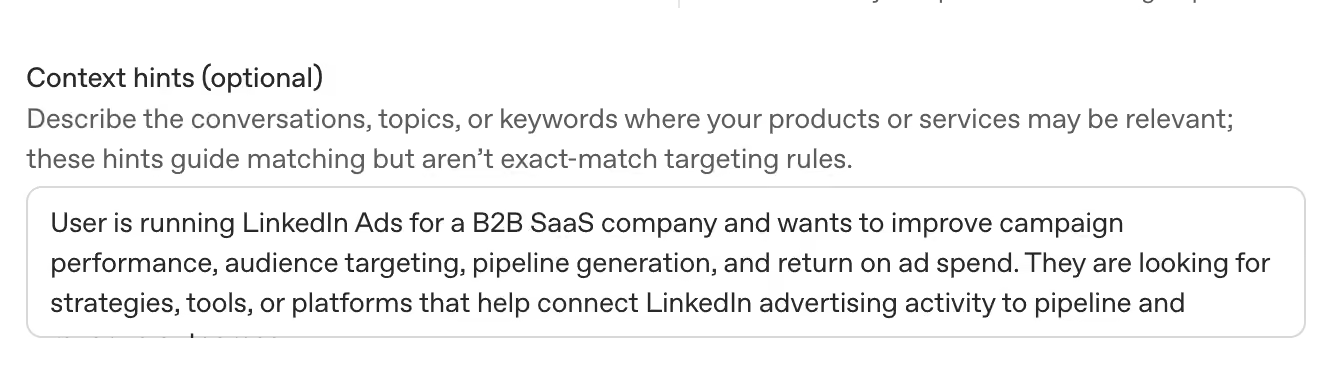
- OpenAI also considers your landing page, ad copy, and, when enabled, signals from a user’s broader ChatGPT activity. The context hint is not the only input, but it is the one you can control most directly.
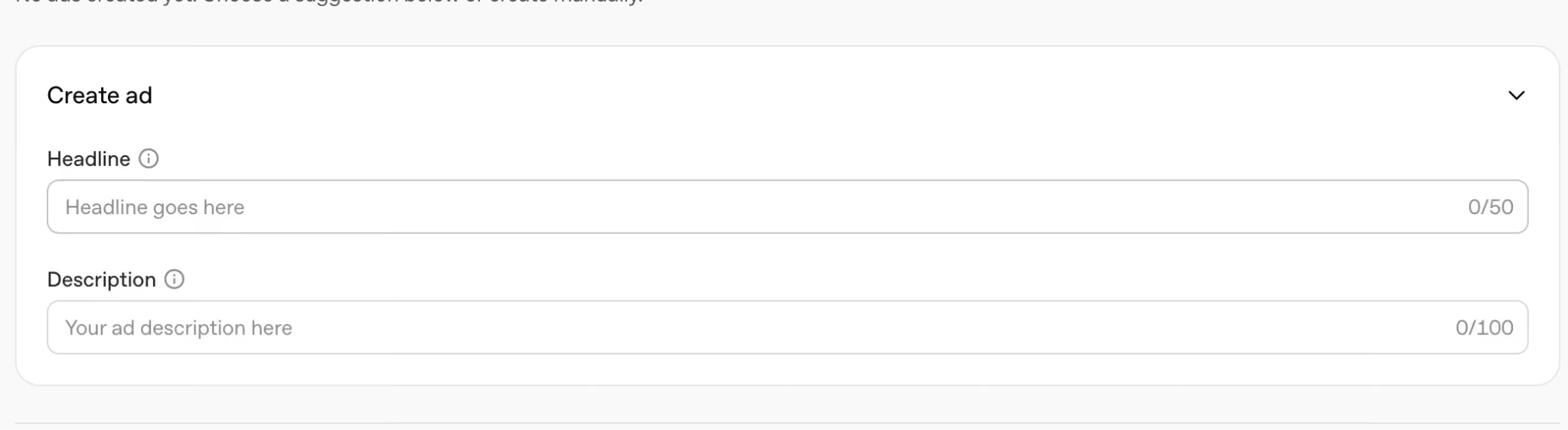
6. Build the ad itself.
- Build the entire ad; add Business name, image, headline, and description.
- There isn't much creative real estate compared to a LinkedIn document ad, so the copy has to do a lot of work in a few words.
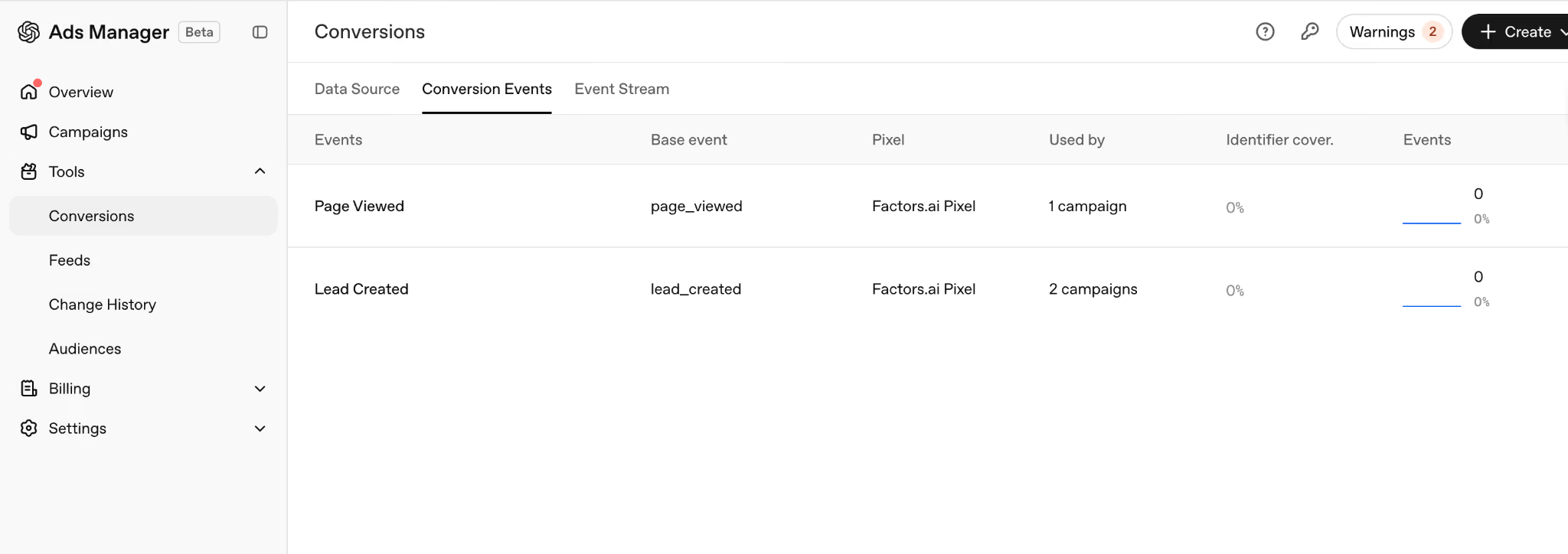
7. Install conversion tracking
- Before you launch your ads, set up conversion tracking.
- Set up the OpenAI Pixel, the Conversions API, or both together; OpenAI recommends combining them for more resilient measurement.
- Track lead submissions, registrations, or signups, along with clicks.
- Reporting lags by several hours, and OpenAI itself recommends not judging performance in the first 48 hours.
ChatGPT Ads for B2B: What They Cost, How They Work, and How to Launch Your First Campaign
The top best practices for running B2B ChatGPT Ads.
1. Don’t confuse richer context with stronger intent
Someone searching “attribution software” on Google gives the platform two words. Someone asking ChatGPT to compare attribution tools for a Series B SaaS company spending $80,000 a month on LinkedIn shares much more context.
However, this does not prove that the user has stronger buying intent than someone reached through Google or LinkedIn. Advertisers, including me, still need to test that. The intent signal is different, not necessarily better.
2. Match the landing page to the conversation
If your ad appears while someone is comparing attribution platforms, send them to a page that addresses that comparison, not your homepage or a generic product page.
For example, when our ad appears in conversations about 6sense, it leads to a dedicated Factors.ai vs. 6sense comparison page.
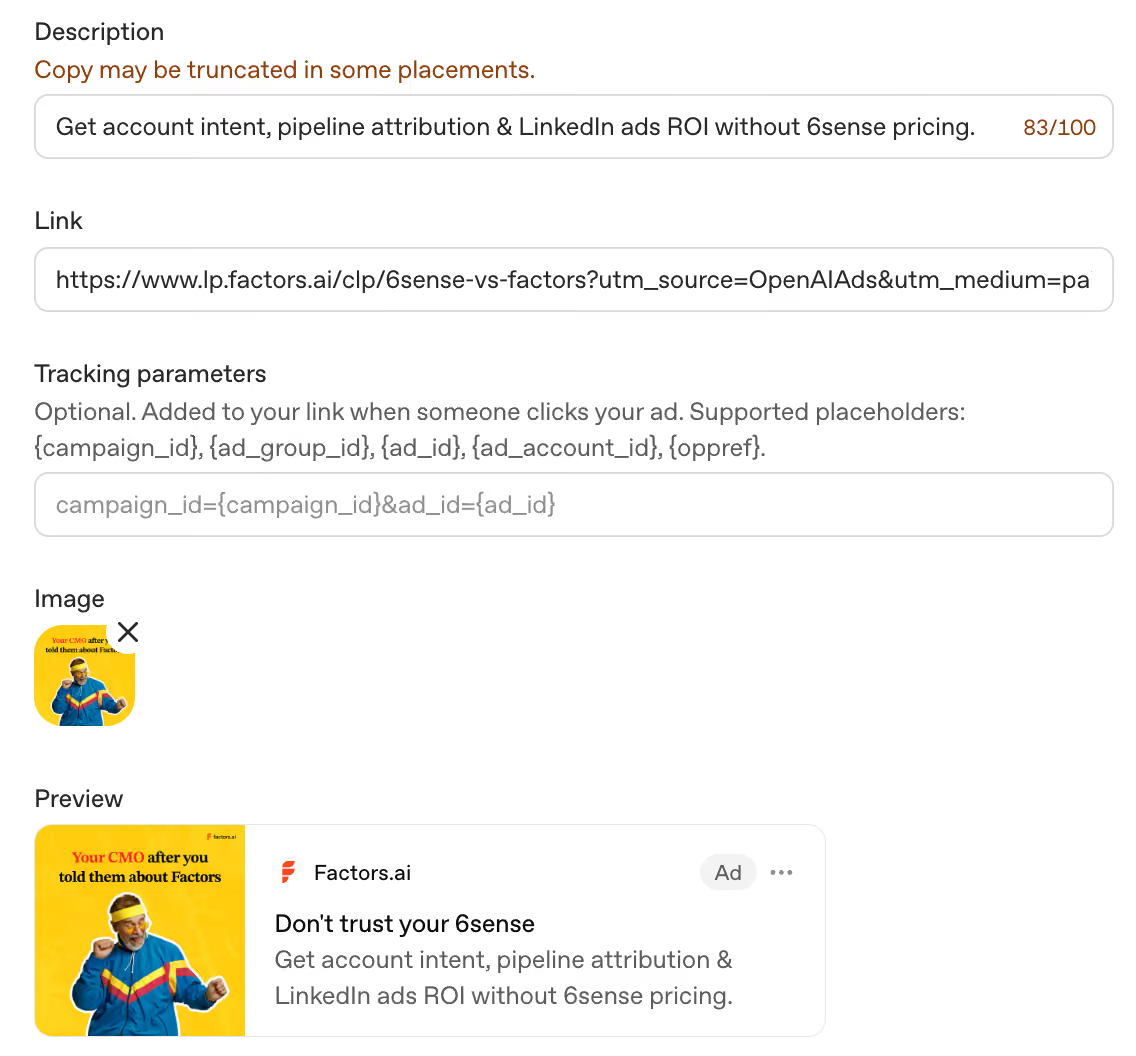
OpenAI considers the landing page when judging ad relevance. A closely matched page could therefore improve both delivery and conversions.
3. Measure everything from click to pipeline
The basic journey is impressions, clicks, and form fills.
For B2B, you should always track the full path:
Impressions → Clicks → Conversions → CRM contact or account → Opportunity → Pipeline
Cost per lead alone will not tell you whether this channel works. Lead and account quality may differ significantly from what you see on LinkedIn or Google.
Use a test budget; ChatGPT Ads is still in beta and has far less historical performance data than Google or LinkedIn Ads.
Set aside enough budget to learn something useful over 30 to 60 days. Don’t move significant spend away from a proven channel like Google or LinkedIn until ChatGPT Ads shows that it can produce relevant traffic and pipeline.
ChatGPT Ads vs. LinkedIn and Google Ads
How I’d run the first ChatGPT Ads test for a B2B SaaS company
I’d test three clear buyer situations instead of running one broad campaign.
- Category evaluation: The buyer is comparing tools in your category. Send them to a category or comparison page. Measure qualified demo rate.
- Specific pain: The buyer describes a problem your product solves. Send them to a relevant use-case page. Measure qualified conversion rate.
- Competitive consideration: The buyer is comparing you with a named competitor. Send them to a competitor comparison or alternatives page. Measure demo-to-opportunity conversion.
Keeping these tests separate shows you which conversations produce business outcomes, not just clicks.
Change one variable at a time. Start by testing the same creative across different contexts. Then test new copy against the best-performing context. Finally, test landing-page variations using the winning combination.
Don’t judge the test too quickly. Reporting can lag, benchmarks are limited, and B2B sales cycles take time. Set a minimum spend or conversion sample before launching, then wait until you reach it before making a decision.
What’s the latest update on ChatGPT Ads: Sponsored Agents and CRM Integrations
On September 16, 2026, OpenAI announced Sponsored Agents, which let a user who sees an ad open a separate, clearly labeled conversation with a business-sponsored agent to ask follow-up questions before clicking through. That conversation stays walled off from both ChatGPT's own answers and the user's original chat. It's currently testing with a select group of US advertisers, not generally available yet.
For B2B teams, the biggest update is the new HubSpot integration, OpenAI’s first CRM partnership. You can connect your ChatGPT Ads account to HubSpot, manage campaigns, and follow up with leads using your existing customer data. Shopify has a similar integration for ecommerce teams.
Earlier, connecting ChatGPT ad spend to closed-won deals required manual UTM tracking and conversion pixels. The HubSpot integration could simplify this, but I’d still test it before calling the attribution problem solved.
The bottom line about OpenAI Ads
I wouldn’t call ChatGPT Ads amazing yet, because there isn't enough evidence about how it works. But at the same time, I also wouldn’t wait for the platform to mature, because you need to get that early-mover advantage. The only way to know whether it works for your business is to test it.
Just don’t treat it like another Google or LinkedIn campaign. Targeting relies on conversational context rather than keywords, companies, or job titles. Most B2B audience lists are too small for direct targeting, and ads only reach users on Free and Go plans.
Run a controlled experiment and connect every click and conversion to opportunities and pipeline from day one. Judge the channel by buyer quality and revenue, not CTR or ChatGPT’s total user count.
FAQs on ChatGPT Ads
Q. How much do ChatGPT ads cost?
OpenAI's official suggested starting bid for CPC is $3 to $5 per click, run through a relevance-weighted auction. There's no published CPM benchmark. The minimum daily budget is $25 in the US and varies by market currency elsewhere.
Q. How do ChatGPT ads work?
Ads appear below a response from ChatGPT, with a 'sponsored' label. OpenAI matches ads to a conversation using the topic, your past chats, and past ad interactions, not a keyword auction like Google or job-title targeting like LinkedIn.
Q. What is oCPC on ChatGPT Ads?
oCPC stands for conversion-optimized cost per click. You pay for each valid click, while ad delivery is optimized toward people more likely to complete your chosen conversion event, such as signing up or requesting a demo.
Q. Is there a minimum spend for ChatGPT ads?
The minimum daily budget for USD accounts is $25 per campaign, as of May 2026. Minimums vary by billing currency, and advertisers can also set a campaign-total budget.
Q. How do you advertise on ChatGPT?
Sign up at ads.openai.com, create your advertiser account, complete verification and billing, and build your campaign using the campaign, ad group, and ad structure. At the ad group level, you can add context hints describing your offering, audience, and relevant use cases. These help OpenAI match your ads with suitable conversations.
Q. What countries can run ChatGPT ads?
Self-service Ads Manager is available to businesses based in 56 countries, including the US, Canada, the UK, Australia, India, Japan, South Korea, Brazil, Mexico, and several markets across Europe, the Middle East, and North Africa. Check OpenAI's advertiser page before planning a regional campaign, since this keeps expanding.
Q. Can I use my ABM list to target ChatGPT ads?
Yes, but inclusion targeting and audience bid adjustments require at least 25,000 matched users. OpenAI recommends an audience of at least 100,000 users.
Q. Can I track ChatGPT ads conversions?
You can track conversion events using the OpenAI Pixel, the Conversions API, or both. As of September 2026, supported events can include leads, sign-ups, purchases, and other actions completed after someone engages with an ad.

AI search marketing: how B2B brands get cited in 2026
AI search marketing means getting cited by ChatGPT and Perplexity, not just ranked on Google. Here's how B2B SaaS teams build real AI search visibility.
.avif)
TL;DR
- AI search marketing isn't a rename of SEO. It's the work of getting your brand cited, recommended, and retrieved by AI engines, which is a fundamentally different goal than ranking on a results page.
- More than half of B2B software buyers now start their research inside an AI chatbot instead of Google, and that number was 29% barely a year ago. This didn't creep up on us slowly.
- SEO isn't dying, it's becoming table stakes. Most AI citations still come from pages that already rank well on Google, so weak SEO fundamentals will sink your GEO efforts too.
- Citation share, category mention rate, and AI-assisted pipeline are becoming the metrics that matter, not because clicks stopped counting, but because a lot of influence now happens before anyone clicks anything.
- Most B2B teams don't have an AI visibility problem so much as a measurement problem. They genuinely don't know if ChatGPT is mentioning them, let alone whether that mention ever turned into revenue.
- The brands winning AI citations right now are, unsurprisingly, the same ones that were already doing original research, clear writing, and consistent brand presence long before "GEO" became a term anyone used.
A few weekends ago, I was helping a friend pick a project management tool for the five-person agency she'd just started. Old habit, I typed the question into ChatGPT instead of Google. It gave me four names, three sentences of reasoning each, and a confident little summary at the end. I didn't open a single one of those blue links you and I grew up trusting.
That's a small, personal moment… and it's also exactly what's happening to your buyers right now, except the stakes are a demo booked or a deal that never enters your pipeline at all. A few weeks later, out of pure curiosity, I asked ChatGPT to recommend account intelligence platforms for B2B marketing teams. Three names came back. Factors wasn't one of them (yet). Nobody had done anything wrong, this is just where research lives now, and most of us haven't caught up to it.
This piece is my attempt to make sense of AI search marketing for B2B SaaS teams. What it actually is, why it's not SEO wearing a new outfit, and what a team can realistically do about it without abandoning everything they've already built.
What does ‘AI search marketing’ actually mean (and what it doesn't)?
Let's get the definition right before anything else. Half the confusion in this space comes from people using GEO, AEO, and "AI SEO" interchangeably, like they're the same thing wearing different hats.
AI search marketing is the umbrella discipline of increasing your brand's visibility, citations, and recommendations across AI-powered search and answer engines. It brings together a few overlapping practices under one roof. AI-enhanced traditional search, GEO (getting cited by generative systems), and AEO (structuring content so AI can extract direct answers) all live inside this one umbrella.
Here's the distinction that actually matters. Traditional SEO optimizes for ranking. You want position one, a healthy backlink profile, and a page that Google's crawler trusts. AI search marketing optimizes for inclusion. You want your brand to show up inside the answer itself, sometimes without a single click ever happening.
That's not SEO 2.0. It's a new layer stacked on top of SEO, with its own inputs and its own scoring logic. Calling it "SEO 2.0" is a bit like calling a podcast "radio 2.0." Related, sure. Same mechanics? Not even close.
Why B2B SaaS teams specifically need to care
B2C brands feel this shift too, but B2B has a more urgent version of the same problem.
The G2 2026 Answer Economy report surveyed over a thousand B2B software buyers. It found that 51% now start their research in an AI chatbot rather than Google, up from 29% just eleven months earlier. That's not early-adopter behavior anymore. That's the majority of your market forming its first impression of your category somewhere you can't see it happen, long before anyone lands on your homepage.
The same report found that 69% of buyers ended up choosing a different vendor than the one they originally had in mind. Purely because of what an AI chatbot told them. One in three bought from a vendor they'd never even heard of before typing that prompt. Read that twice. A third of purchases go to brands that didn't exist in the buyer's head until an AI put them there. That's sooo much bigger than most marketing decks are treating it.
I think about this the way I think about a candidate shortlist for a job. If you're not on the list the hiring manager sees, it genuinely doesn't matter how qualified you are. The AI engine has already decided who gets considered, and your sales team never even finds out they lost a deal they never knew existed.
What this changes in practice:
- Brand recall inside AI answers now drives category ownership. When ChatGPT consistently names three vendors in your space and you're not one of them, that's not a missed click. That's a deal that never entered your pipeline because the buyer never considered you a candidate.
- Self-serve research has quietly moved upstream. Buyers arrive at demo calls already holding an opinion, shaped by a conversation with an AI model rather than by anything your marketing team produced.
- The "day one list" now gets built by a machine. Traditional ABM assumed marketing controlled who made the shortlist. That assumption is getting shakier by the month.
The three layers of the AI search world, explained without the jargon
It has now split into three fairly distinct zones, and B2B marketers need a mental model for each one because they behave differently.
- Standalone AI search engines
ChatGPT, Perplexity, Gemini, Claude, and Copilot each have their own citation habits, their own source biases, and their own favorite content formats. Only about 11% of domains get cited by both ChatGPT and Perplexity at once. That tells you something important: optimizing for "AI search" as a single channel is roughly as useful as optimizing for "social media" without distinguishing LinkedIn from TikTok. They're not the same game.
- AI-powered search (the Google hybrid)
Google AI Overviews and AI Mode have folded generative answers directly into the search results page you already know. These aren't replacing the traditional SERP outright, but they're intercepting a meaningful chunk of informational clicks. When an AI Overview shows up above your result, the click-through rate on the top organic listing tends to drop sharply, sometimes by more than half. You can rank first and still get skipped.
- Community and third-party signals
This is the layer most marketing teams underweight. AI models increasingly learn from Reddit, LinkedIn, YouTube, and industry forums, not just your website. LinkedIn has become the single most-cited domain for professional queries across AI platforms, and Reddit alone accounts for a huge share of Perplexity's top citations. If your LinkedIn messaging contradicts what your blog says, that inconsistency shows up as a lower citation rate. Same story if your presence on the channels AI models actually learn from is too thin. AI doesn't forgive a split personality the way a human reader might.
How does an AI engine actually decide what to cite?
The mechanics are less mysterious than most explainers make them sound. When someone asks a question inside ChatGPT or Perplexity, the system runs through a fairly predictable sequence. It retrieves candidate sources from training data or live web access, evaluates them for authority and topical depth, and synthesizes an answer by pulling from several at once. Then it cites whichever sources gave it the clearest, most trustworthy material to work with.
A few factors consistently tip the odds in your favor:
- Original data wins over recycled opinions. If you're the only source with a number nobody else has, the model has an actual reason to cite you instead of the twelve other posts saying roughly the same thing.
- Definitions written in plain, extractable language get pulled first. A forty-to-sixty word definition that answers the question directly is far more citable than three paragraphs of throat-clearing before you get to the point.
- Freshness matters more than most teams assume. A large share of AI Overview citations come from content published or meaningfully updated within the last two years. A "publish and forget" blog is quietly working against you.
- Entity recognition compounds over time. Does the model already recognize your brand as a credible player in this category, or is every mention starting from zero?
SEO, AEO, and GEO aren't the same thing, even though people keep treating them that way
SEO remains the foundation, whether anyone likes that or not. The overwhelming majority of AI Overview citations still come from pages that were already ranking in Google's top ten before an AI system ever touched them. If your SEO fundamentals are shaky, GEO work built on top of them tends to collapse the moment anyone checks.
AEO, meanwhile, has mostly folded into GEO. It started as a discipline aimed at voice search and featured snippets. But most voice queries now route through the same generative systems as chat search, so the distinction has blurred enough that most practitioners just call it GEO.
Six things a real AI search marketing strategy needs to get right, tho most lists overcomplicate this
I've cut this down from every "pillars" list I've read, because most of them pad the count. Here's what I'd actually prioritize with a limited team and a real quarter.
- Build depth on a few topics, not breadth across many
AI systems evaluate whether a brand has genuine depth on a subject before they'll cite it confidently. A single brilliant post surrounded by twelve mediocre ones doesn't read as authority. It reads as a lucky shot.
- Write content that gives a model a reason to quote you
Statistics, original research, expert commentary, and clear definitions all lift citation rates measurably. If nothing in your piece is quotable, nothing in your piece gets quoted. That's not cynicism, it's just how retrieval works.
- Become a recognizable entity, not just a collection of pages
Brand mentions correlate far more strongly with AI visibility than backlinks do these days. That means author visibility, consistent third-party mentions, and structured data that clearly identifies who you are all matter more than they used to, not less.
- Structure content so a passage can stand alone
AI engines don't read a page top to bottom the way a person does. They break it into passages and score each one independently. Every section needs to answer its own question without leaning on the paragraph before it for context.
- Keep your story consistent everywhere AI is listening
Your LinkedIn posts, your YouTube appearances, your guest articles, and your Reddit presence are all quietly feeding the same training and retrieval systems. If your positioning shifts depending on the channel, you're teaching the model to distrust all of it.
- Actually measure whether any of this is working
Only about a fifth of marketers currently track AI visibility at all. That's a genuinely small number given how much buyer behavior has already moved. You don't need a perfect dashboard on day one. You need a dashboard.
What should you actually be measuring?
Rank tracking alone is quietly becoming the vanity metric of this era, and I say that as someone who still checks rankings weekly out of habit.
The last one is the metric that actually gets you budget in a leadership meeting, and it's also the hardest to build. Most GEO measurement tools stop at "were we mentioned." Almost none of them connect that mention to an account that later showed up in your CRM. That gap is exactly where the next wave of tooling is racing to build something useful.
Tactics that are actually producing citations right now
Enough framework, here's what's working in practice for B2B SaaS teams.
- Publish a benchmark report with numbers nobody else has. Comparison and data-driven articles consistently lead the pack for AI citations, and original numbers are the single easiest way to earn one.
- Build honest comparison pages. "X versus Y" content is one of the formats AI models reach for most often when someone asks which tool fits a specific job. Be specific about tradeoffs instead of pretending your product wins everything.
- Own a definition. Pick a term in your category and write the clearest, most cited explanation of it anywhere on the internet. Do that consistently and the model starts associating that term with your brand.
- Publish a framework people can reuse. Numbered models and decision matrices get cited repeatedly because they give an AI something structured to reference. This piece's six-point framework above is an example of exactly that.
- Build real FAQ sections, not decorative ones. FAQ schema pages punch well above their weight for AI citations in most verticals I've looked at.
- Push author-level authority on LinkedIn. Given LinkedIn's outsized role as a citation source, a named person posting consistently beats a faceless brand account almost every time.
The mistakes I keep seeing B2B teams make
- Treating GEO as a replacement for SEO instead of a layer on top of it. Abandon your SEO fundamentals to chase citations and you'll likely end up with neither.
- Chasing individual prompts instead of building topical authority. Prompts are infinite and constantly shifting. Depth on a category is durable in a way that reverse-engineering one exact ChatGPT phrasing never will be.
- Publishing content that reads like it came from a model, because it did. AI systems are trained to spot and deprioritize exactly that pattern, so mass-producing AI content to win at AI visibility is quietly self-defeating.
- Skipping entity building entirely. Optimizing individual pages while ignoring brand-level recognition is like running perfect landing pages with zero brand awareness behind them. The model has to trust the name before it will confidently recommend it.
- Measuring traffic and only traffic. A buyer who sees your brand recommended by ChatGPT and later types your URL in directly won't show up as a referral in any dashboard you're currently checking. If you only count clicks, you'll systematically undercount AI's real contribution.
Where the AI visibility tooling stack stands today
Notice that nothing in that table does everything well yet (a genuinely unsatisfying thing to admit in a comparison table, I know). Most teams I talk to are stitching together an SEO platform, a dedicated AI visibility tool, and an attribution layer, because no single vendor has closed that whole loop. That'll probably consolidate over the next couple of years, but it hasn't yet.
Where Factors.ai actually fits into this picture
The hardest part of AI search marketing isn't getting mentioned. It's proving that mention eventually mattered to revenue, and that's the gap most teams get stuck in.
Factors.ai sits at the attribution and account-intelligence layer of this problem. When a piece of your content gets cited by ChatGPT, the real question isn't "did that happen." It's whether target accounts showed up on your website afterward. Did they engage with your brand, did they move into pipeline, at all? Factors connects those engagement signals to account-level activity, so a citation isn't just a nice screenshot for a Slack channel, it's a data point you can actually trace toward revenue. That's the operational reality behind an AI visibility strategy that leadership will keep funding past the first quarter.
Where this is all headed…
AI visibility becomes a board-level number. Citation share and AI visibility scores are starting to show up next to MQLs and pipeline velocity in leadership decks. Not everywhere yet, but the direction is unmistakable.
Citation tracking starts replacing rank tracking as the primary search metric. Not because rankings stop mattering entirely, but because citations are becoming the more honest proxy for how search actually shapes a buying decision.
"Search teams" quietly become "visibility teams." The scope of the job now spans Google, AI engines, YouTube, Reddit, and LinkedIn all at once. The org chart hasn't fully caught up to that yet, but it will.
The wall between SEO, content, PR, and social keeps dissolving. AI models don't care which internal team produced your LinkedIn post versus your blog versus your PR mention. They synthesize all of it into one opinion about your brand, so the silos between these functions increasingly work against you.
Mic drop.
AI search marketing isn't a rebrand of tactics you already know, and it isn't a passing trend you can wait out either. It's a real shift in how B2B buyers form opinions before your sales team ever gets a chance to shape the story. The teams treating this seriously right now are building citation-worthy content, strengthening entity signals, and staying consistent everywhere an AI model is listening. They're the ones whose name will actually be in the room when a buyer asks an AI who to talk to next. Everyone else is going to find out about the deals they lost the hard way: never.
FAQs for AI search marketing
Q1. What is AI search marketing?
AI search marketing is the discipline of increasing a brand's visibility, citations, and recommendations across AI-powered search and answer engines like ChatGPT, Perplexity, Gemini, and Google AI Overviews. It combines traditional SEO with newer practices like generative engine optimization and answer engine optimization. All aimed at making a brand discoverable inside the AI conversations where buyers now form early opinions.
Q2. How is AI search marketing different from regular SEO?
SEO optimizes for ranking on a results page. AI search marketing optimizes for being cited or recommended inside a generated answer, which often happens without a click ever occurring. Traditional SEO is still the foundation most AI citations get built on, but ranking well on Google no longer guarantees that an AI model will choose to mention your brand.
Q3. What does GEO mean, and is it different from SEO?
GEO stands for generative engine optimization, the practice of structuring content so generative AI systems cite it when answering a question. It builds on SEO rather than replacing it. GEO-optimized content, using techniques like statistics, clear definitions, and expert quotes, has shown meaningfully higher visibility in AI-generated answers compared to unoptimized content.
Q4. Is AEO still a separate discipline from GEO?
Not really, not anymore. AEO originally targeted voice search and featured snippets specifically. Most voice and answer-seeking queries now route through the same generative AI systems that power chat search. That's why AEO has largely been absorbed into the broader GEO umbrella, and most practitioners use the terms interchangeably at this point.
Q5. How do AI engines decide which sources to cite?
AI engines weigh entity authority, topical depth, content freshness, structural clarity, and third-party trust signals when choosing sources. Content with original statistics, clear definitions, and a recent publish or update date tends to get cited more consistently than generic, outdated, or overly broad content covering the same ground.
Q6. How can a B2B SaaS team start improving its AI visibility?
Start by simply asking ChatGPT, Perplexity, and Google AI Overviews the questions your buyers would ask, and see whether your brand shows up at all. From there, build depth on a handful of category topics and publish something with original data in it. Tighten your entity signals through consistent author and brand mentions, and keep your messaging aligned across LinkedIn, YouTube, and your blog.
Q7. What tools track AI search visibility?
Dedicated AI visibility tools like Profound, Peec AI, and Otterly.ai monitor brand citations across ChatGPT, Perplexity, Claude, and Gemini. Traditional SEO platforms like Semrush and Ahrefs are adding AI visibility features as well. For connecting those citations to actual pipeline and revenue, attribution platforms like Factors.ai fill the gap that most visibility-only tools leave open.
Q8. Does investing in AI search marketing mean I can stop doing SEO?
No, and this is probably the most common misread of the whole trend. The large majority of AI citations still come from pages that already rank well in traditional search. Teams that abandon SEO fundamentals to chase AI citations tend to lose ground on both fronts, since the two disciplines are stacked rather than separate.
Q9. How do I measure whether AI search marketing is actually working?
Track citation share against competitors, category mention rate across relevant AI conversations, and brand inclusion rate across the prompts your buyers are likely typing. The metric that ultimately matters most to leadership is AI-assisted pipeline, meaning revenue tied to accounts that engaged with content an AI engine had already cited.

AI digital marketing examples worth stealing
25 AI digital marketing examples I tested for real transfer value, not virality. What works, what breaks outside its original context, and why.
TL;DR
- Most "AI digital marketing examples" you bookmark online are missing the one variable that actually made them work: the data foundation sitting underneath them.
- I went through 25 of these examples and tested each one against a simple question. Would it survive being copied by a team with a messier CRM than the one it was built for?
- Content generation examples are the easiest to demo on a slide and usually the least likely to move your pipeline number.
- The examples that transfer well tend to sit closer to decisions, like scoring, attribution, and forecasting, than to production tasks like writing or posting.
- A few of these only work because of infrastructure you never see in the case study screenshot. Copy the tactic without the infrastructure, and most pilots quietly die.
- Take the audit framework near the end if nothing else; It'll save you from buying the wrong tool for the wrong problem.
Every marketing team has one.
A folder. A Notion page. A Slack thread. Somewhere there's a growing collection of "brilliant AI marketing examples" waiting for the day someone has time to try them.
Most of them never make it that far because they only tell half the story.
The screenshot shows the output. The LinkedIn post celebrates the result. The case study talks about the lift. What almost never gets mentioned is everything that had to exist before that AI workflow produced anything useful: years of CRM data, clean attribution, disciplined processes, and a team that trusted the output enough to act on it.
That's why copying AI examples feels strangely disappointing. You replicate the workflow, skip the invisible foundation it depended on, and wonder why your numbers barely move.
So instead of collecting another list of impressive demos, let's look at the AI digital marketing examples that actually survive outside the company that first published them.
Why the loudest AI digital marketing examples aren't the useful ones?
Here's a pattern I've noticed after collecting close to a hundred of these. The examples that get shared the most are content examples: an AI-written email sequence, a repurposed video, a chatbot script. They're visual, they're easy to screenshot, and they photograph well on a slide.
The examples that actually change a marketing team's numbers rarely get shared at all, because they're boring to look at. A pipeline forecasting model doesn't make a good carousel post. Neither does an attribution model quietly reassigning credit across forty touchpoints. But those are the ones account teams are budgeting for, not the ones going viral on LinkedIn.
I'm not saying content examples are worthless. I'm saying they're the easiest category to fake. B2B marketers keep confusing "easy to show" with "worth copying." Decide which category you're actually optimizing for before you pick your first example (yes, this means picking one, not five).
The five flavors of AI doing different jobs in your funnel
"AI in digital marketing" gets used as one giant catch-all phrase, which makes it nearly impossible to evaluate any specific example on its own terms. Before the 25 examples, here's the quick map I use to sort them.
The category matters because it tells you what kind of infrastructure the example depends on. Generative AI examples mostly need a decent prompt and a review process. Predictive and recommendation examples need clean, connected data going back months, sometimes years. If you skip that check, you'll spend a quarter chasing an example that was never built for your data maturity level.
25 AI digital marketing examples, sorted by where they sit in the funnel
I've grouped these the way I'd actually explain them to a marketing lead. Not as abstract capabilities, but as things happening at a specific stage of the buyer journey. Each one comes with a note on what it quietly assumes about your setup.
Top of funnel: getting found by the right people
1. Topic clustering that replaces gut-feel planning. Instead of a content calendar built on instinct, clustering tools group keywords by intent and expose the gaps nobody noticed. Assumes: you already have a decent-sized content library to cluster against.
2. Brief generation pulled from live SERP data. Automated briefs pull competitor structure, related questions, and intent signals into one doc. Assumes: someone still edits the brief before a writer touches it.
3. Continuous SEO opportunity scanning. Rather than a quarterly audit, the system flags decay and new openings as they happen. Assumes: you have someone who actually checks the alerts.
4. Competitor content tracking. Crawlers watch competitor pages for messaging shifts and new launches. Assumes: your team actually acts on what it finds instead of archiving it in a folder nobody opens.
5. Repurposing long-form content into social formats. One blog becomes five platform-specific posts. Assumes: your blog is good enough to be worth repurposing in the first place.
Middle of funnel: sorting who's actually worth your time
6. Behavioral audience segmentation. Machine learning clusters contacts by what they do, not just their job title. This one genuinely surprised a client of mine. Their "enterprise" segment and their highest-converting segment barely overlapped once behavior was factored in.
7. Predictive lead scoring. Models weight activities by how closely they actually correlate with closed-won deals, instead of an arbitrary point system someone built in 2019. Assumes: you have enough historical closed-won data to train against. Under a few hundred deals, this gets shaky fast.
8. Adaptive nurture sequences. Content, timing, and channel shift based on individual engagement instead of a fixed drip. Assumes: your email platform can actually branch logic, not just schedule sends.
9. Send-time prediction. Models learn when a specific recipient is most likely to open, rather than batch-sending at 9am for everyone. Small lift, easy to implement, low risk.
10. Chatbot qualification. Bots ask qualifying questions and route warm visitors to a rep instead of a generic contact form. Assumes: someone wrote genuinely good qualifying questions, not a script that annoys every visitor.
Bottom of funnel: closing what's already warm
11. Account intent scoring. Aggregates web behavior, content consumption, and third-party signals into a single score sales can act on. This is the example I see teams botch most often (usually by buying the scoring tool before anyone's agreed internally on what "intent" even means for the business).
12. Pipeline prediction. ML models read deal velocity and engagement patterns to flag which deals are likely to close and when. Genuinely useful for revenue leaders, genuinely useless if your CRM stages are inconsistent between reps.
13. Intent-tiered retargeting. Instead of one broad retargeting pool, audiences split by intent level and get different creative. Cuts wasted spend fast when it's done right.
14. Dynamic website personalization. Headlines, CTAs, and content blocks shift based on who's visiting and why. Assumes: you have enough traffic volume for the personalization engine to learn from. Under a few thousand monthly visitors, it won't have enough signal.
15. Continuous revenue forecasting. Instead of a monthly manual projection, models blend pipeline, seasonality, and deal signals into something closer to real time.
After the sale: growing what you've already won
16. Churn prediction. Flags accounts showing declining engagement or usage drops before they actually churn, giving CS a window to intervene.
17. Expansion signal alerts. Surfaces accounts with usage growth, new logins, or feature exploration that suggest they're ready for an upsell conversation.
18. Composite health scoring. Combines usage, support tickets, and engagement into one number instead of five spreadsheets and a CSM's gut feeling.
19. Upsell recommendations. Matches account patterns against successful upsells from similar accounts. Assumes: you actually have enough successful upsells in your history to build a pattern from.
That's 19. Here are six more that don't fit neatly into a funnel stage because they touch content, ads, and personalization all at once.
AI-powered content examples worth a second look (and the ones that aren't)
The strongest content examples I've come across aren't about the writing itself. They're about planning what to write before anyone opens a doc. Topic clustering and gap detection save real hours.
A research agent pulls competitive data. A brief agent structures the outline. A human actually writes it. A distribution agent schedules it out. That chain is starting to look normal rather than experimental (and honestly, faster than most editorial calendars I've run manually).
Content refresh monitoring deserves more credit than it gets. Instead of manually auditing which posts have decayed, the system watches traffic and ranking shifts continuously and flags what needs an update. Video repurposing follows the same logic, turning a written piece into short-form scripts without a separate production sprint.
Where I'd pump the brakes: thought leadership. AI can gather the research and draft a structure, but the point of view still has to come from someone who's actually lived the problem. I've read enough AI-assisted "thought leadership" pieces that read like a very articulate summary of other people's opinions. That's not leadership. That's a book report.
AI-powered advertising examples that are already mainstream
Google's Performance Max now shifts budget across Search, Display, YouTube, and Discovery based on live conversion signals instead of a manual channel split someone set once and forgot. Meta's Advantage+ does something similar inside its own ecosystem, testing creative, audience, and placement combinations simultaneously.
LinkedIn's audience expansion looks for professionals who resemble your best-converting segment. Predictive bidding goes further, adjusting bids per impression based on predicted conversion probability. Creative testing has also sped up considerably. Rather than running three variants for two weeks, tools test a dozen headline and image combinations and kill the underperformers within hours.
The one B2B advertisers underrate: intent-based audience creation. Building ad audiences off behavioral signals instead of job-title filters is where the real efficiency gains show up, not in the bidding automation everyone talks about.
Also read: AI automation tools: the B2B marketer's guide
AI-driven personalization examples (and why B2B is a different game)
Netflix and Spotify get cited in every one of these lists, and for good reason. Netflix predicts what you specifically will watch based on pauses, rewatches, and time of day. Spotify's Discover Weekly does the same for music you haven't heard yet but are statistically likely to enjoy. These are the consumer benchmark everyone reaches for.
B2B personalization looks different because the "customer" is a buying committee, not one person scrolling on a Tuesday night. Account prioritization models rank target accounts by purchase likelihood using technographic data and engagement history. Website experiences shift based on a returning visitor's prior sessions. Messaging adjusts based on where the account actually sits in its buying journey. That's not the same as where it sits in your CRM stage, and the gap between those two is bigger than most teams want to admit.
The uncomfortable part: none of this actually works without clean, connected data. I've watched teams buy a personalization engine and feed it three months of half-tagged website data, then wonder why the "personalized" experience feels generic. The AI isn't the bottleneck. The plumbing is.
Where the biggest wins actually hide: attribution and revenue examples
This is the category that gets the least airtime and moves the most money.
Most marketing teams don't have a content problem. They have a measurement problem. They're producing plenty, and they genuinely can't tell you which touchpoints influenced a closed-won deal. Multi-touch attribution uses machine learning to split credit across every touchpoint in a journey instead of handing it all to the last click or the first one. Pipeline prediction extends the logic forward, estimating which open deals will close and roughly when.
Opportunity scoring ranks live deals by how likely they are to close, which is genuinely useful for a sales leader deciding where to spend coaching time. Marketing mix modeling zooms out further, looking at how budget across channels affects total pipeline rather than isolated campaign metrics.
Attribution debates in most companies I've worked with resemble a group project where everyone quietly assumes they did the heavy lifting. AI doesn't end the debate. It gives you a data-backed starting point instead of four people's competing opinions in a Slack thread.
AI agents: the example category that's changing shape fastest
Last year's dominant example was "we asked ChatGPT to write our ad copy." This year's is closer to "we have an agent that runs our SEO monitoring without anyone opening a dashboard." The distinction between a tool and an agent is the distinction between answering a question and being handed an entire project.
Content agents research, draft, optimize, and schedule. Analytics agents flag anomalies and recommend budget shifts before a human even notices the dip. The shift isn't really about the individual tasks.
The operating model itself is changing. A marketer used to run six tools by hand. Now a marketer manages a small system of agents that talk to each other.
I'll admit I got this one wayyy wrong about eighteen months ago. Agent examples felt theoretical back then, something for a future roadmap slide. But now… I'm seeing them sitting quietly inside actual client stacks, not just vendor demos.
Also read: How to use AI for marketing: the practical B2B playbook
A quick audit before you copy any of these
Before you take any example from this list back to your team, run it through four questions. This is the part that saved me from three bad recommendations last year alone.
1. What data did this example need before AI entered the picture? If the answer is "years of clean CRM history" and yours is eighteen months of messy tagging, adjust your expectations. Right now, not after the pilot fails.
2. Was the win measured in activity or in pipeline? More content published and more emails sent are activity metrics. More qualified pipeline and shorter sales cycles are the ones that matter.
3. Does your team have someone who owns the output? An AI agent without a human reviewing its decisions is a liability wearing a productivity costume.
4. Would this survive a messier version of your stack? If the example only works with perfect data hygiene and full tool integration, it's a case study, not a plan.
What I'd actually tell a team starting from zero
Skip the temptation to implement five of these examples at once. Pick the one closest to your current biggest bottleneck, not the one with the flashiest screenshot. If your bottleneck is that sales doesn't trust your leads, start with predictive scoring. If your bottleneck is that nobody can explain what drove last quarter's pipeline, start with attribution.
The teams I've watched get real value out of AI are running the right one for their actual data maturity, measuring it honestly, and only then moving to the next.
The marketers who win the next few years won't be the ones who collected the biggest swipe file of AI wins. They'll be the ones who tested a handful of them against their own messy reality and kept only what survived.
FAQs for AI digital marketing examples
Q1. What are the best AI digital marketing examples for B2B teams?
The examples that hold up best for B2B are predictive lead scoring, multi-touch attribution, account intent scoring, and pipeline forecasting. These sit closer to decisions than to content production, and B2B sales cycles reward better decisions more than faster first drafts.
Q2. Are AI content examples actually worth copying?
Some are. Topic clustering, content gap detection, and continuous decay monitoring genuinely save time and improve output quality. Straight AI-written thought leadership without a human point of view is the weakest example in this category, no matter how polished the draft reads.
Q3. Why do some AI marketing examples fail when other teams try to copy them?
Most of the time, the team copied the tactic without the infrastructure underneath it. A scoring model built on three years of clean CRM data won't behave the same way when it's fed eighteen months of inconsistent tagging. The AI isn't the variable that broke. The data foundation was never there.
Q4. What's the difference between AI automation and an AI agent in these examples?
Automation follows a fixed rule: if this happens, do that. An agent makes decisions across multiple steps based on real-time signals and a defined goal, adjusting as conditions change. Automation is predictable. Agents are adaptive, which makes them more powerful and slightly harder to govern.
Q5. How much data do I need before an AI digital marketing example will actually work?
It depends on the category. Generative AI examples need very little, mostly a good prompt and a review step. Predictive examples like lead scoring or forecasting typically need several hundred closed deals at minimum to train against reliably. Under that, a rules-based approach will outperform a thin ML model.
Q6. What AI digital marketing tools show up most often in these examples?
For content and drafting, ChatGPT and Claude are common starting points. For SEO, Semrush and Ahrefs remain standard. For attribution and account-level intelligence, Factors.ai and Improvado are frequently cited. For advertising, Google Performance Max and Meta Advantage+ dominate the paid media examples.
Q7. Should a small marketing team try to replicate enterprise AI marketing examples?
Not directly. Enterprise examples usually assume data volume and headcount a smaller team doesn't have. Scale the example down to match your actual data maturity rather than trying to replicate the full version you saw in a case study.
Q8. How do I know if an AI marketing example actually moved revenue, or just looked impressive?
Check whether the reported win was measured against pipeline or revenue, not against activity metrics like posts published or emails sent. If a case study only reports efficiency gains and never mentions pipeline impact, treat the result with some skepticism.
Q9. What's the biggest mistake teams make when adopting these AI marketing examples?
Buying the tool before diagnosing the actual bottleneck. Most teams reach for a flashy example instead of asking what's genuinely broken in their funnel right now. The example should follow the diagnosis, not the other way around.

AI in digital marketing: why most teams are stuck optimizing the wrong 20%
AI in digital marketing isn't a tools problem anymore. See why most B2B teams are stuck at stage one, what it's costing them, and how to audit where you stand.
TL;DR
- AI in digital marketing is a maturity problem, and most teams are stuck at the stage where AI drafts emails, not the stage where it changes what gets funded.
- Content saturation is the most underrated side effect. When every competitor can publish 40 posts a month, volume stops being a moat and clarity becomes the only thing left to compete on.
- Search itself is splitting into two audiences, human readers and AI systems synthesizing answers, and most content strategies are still written for only one of them.
- Budget data tells the real story here, not adoption stats. Teams are spending more on AI tools every quarter while reporting the same attribution headaches they had two years ago, which means the spend isn't hitting the right layer.
- The gap between "we use AI" and "AI changed our numbers" comes down to one thing. It's whether AI is touching decisions your team makes weekly, or just producing more stuff to review.
- A five-minute audit usually tells you more about your AI maturity than another vendor demo will.
There was a time when ‘using AI’ felt like a competitive advantage.
But… not anymore.
Today, almost everyone has access to the same models, the same writing tools, and the same promises of productivity. If everyone can create content faster, launch campaigns faster, and analyze reports faster, speed stops being the thing that sets you apart.
Now, the question is, where does AI sit in your business? Is it helping people produce more work, or helping them make better decisions?
What does ‘AI in digital marketing’ even mean? (for the hundred-and-first time)
Every guide on this topic opens with a definition, so I'll keep mine short and then move on to the part that actually matters.
AI in digital marketing means using machine learning, predictive models, and language models to inform or execute marketing decisions, not just marketing tasks. That distinction between decisions and tasks is the entire ballgame. A tool that drafts your ad copy faster is handling a task. A system that tells you which twelve accounts are worth your ad budget this week is informing a decision. Both count as "AI in marketing." Only one of them shows up on a revenue dashboard.
Most teams start in the tasks column because it's the easiest entry point. You don't need clean data, integrated systems, or a governance process to ask a model for five subject line variants. You do need all three to trust a model's recommendation about which accounts to prioritize. So teams default to what's easy, call it transformation, and wonder eighteen months later why the P&L doesn't look any different.
The maturity curve nobody is talking about…
Forget the "2024 was content, 2025 was optimization, 2026 is agents" timeline you've probably read four times already this year. Timelines like that describe the industry. They don't describe your team, and your team is the one that has to actually get somewhere.
Here's the version I've found more useful, because it's about where a specific team sits, not where the market sits.
Most B2B marketing teams I've talked to over the last year are sitting somewhere between stage one and stage two. They've got tools. They don't have a connected signal layer. The honest reason isn't a lack of ambition. Stage three requires unglamorous work: fixing CRM hygiene, agreeing on what "qualified" actually means, and getting your ad platform, analytics, and sales data to speak the same language.
Nobody wants to spend a quarter on data plumbing when they could spend an afternoon setting up a new AI writing tool instead. I get it. I've made that same trade myself, more than once (ummm, I'm not proud of it, but here we are).
Where the budget is actually going, and why it isn't matching the results
Adoption numbers get thrown around a lot, and they're genuinely impressive. Somewhere north of 85% of marketers now report using generative AI in at least one recurring workflow. That statistic gets repeated so often it's become wallpaper.
The number that tells you more is the spend one. The median mid-market marketing team's AI tool budget has roughly tripled over the past year and a half. AI tooling now eats up close to a tenth of total marketing spend, the fastest-growing line item most CMOs have had to defend in a budget review.
Here's the part that should bother you more than it usually does. That spend increase hasn't come with a matching drop in the complaints I hear most often. Attribution is still murky, sales still says lead quality hasn't improved, and nobody can confidently name what influenced a closed deal.
That table is uncomfortable to look at, and it should be. It means most of the AI investment is landing in the tool-sprawl and point-solution stages, where it's genuinely useful for individual productivity but structurally incapable of moving a company-level metric. You can't buy your way out of stage one (I've tried; it doesn't work. Ask me how I know). You have to build your way out, and building takes a loooong time when nobody's agreed on what "done" even looks like.
The content flood problem (and why it's not really about content)
I opened this piece with a story about forty blog posts, and I want to come back to it. This is where AI in digital marketing gets genuinely uncomfortable for people like me who write for a living.
Generation is no longer the constraint. Anyone can produce volume now. What's scarce is specificity. The kind that only comes from someone who's actually run the campaign, made the mistake, or sat through the call where the strategy fell apart. That scarcity has a second-order effect that most teams haven't fully priced in yet: search itself is splitting into two separate audiences.
There's the traditional audience, a person scanning ten blue links. And there's a newer one, an AI system synthesizing an answer from a handful of sources and citing none of the rest. Optimizing for the first audience alone is increasingly like optimizing a billboard when half your traffic switched to podcasts. The overlap between what ranks well in traditional search and what gets cited in an AI-generated answer has been shrinking, and teams that only track rankings are flying half-blind.
The tactical overlap between the two is bigger than people assume: clear structure, cited sources, real data, genuine topical depth. What's different is the bar for citation-worthiness. An AI system deciding whether to quote your page is essentially asking one question: does this say something the other sources don't? If the answer is no, more volume just means more pages that never get picked.
This is the part I actually care about in this whole conversation, more than any framework or funnel diagram. The teams winning the AI-search era aren't the ones publishing the most. They're the ones whose fortieth post says something their first thirty-nine hadn't already said.
What AI still can't hand you (no matter how good your prompt is)
I'd be lying if I pretended AI has closed every gap. It hasn't, and pretending otherwise is how teams end up publishing content that reads like it was written by a very polite stranger with no opinions.
Three things AI consistently struggles with, in my experience:
- A genuine point of view. Models can synthesize what's already been said about a topic extremely well. They can't tell you what you think about it, because that requires having sat in the room when the strategy failed or the campaign overperformed for reasons nobody predicted.
- Judgment under incomplete information. Every real marketing decision involves missing data, a budget call before the attribution model catches up, a positioning bet before the market proves itself out. AI is excellent at telling you what happened. It's still weak at telling you what to do when the picture is only 70% clear.
- Trust with a specific reader. A senior VP reading your content can usually tell within two paragraphs whether the writer has actually done the work or is pattern-matching. That instinct doesn't have a workaround yet.
None of this is an argument against using AI. It's an argument for being honest about where the ceiling currently sits, so you stop expecting a model to solve a problem that was never technical to begin with.
A five-minute AI audit that tells you more than another vendor demo
Before you sit through one more AI marketing tool pitch, run your team through these five questions. I've used a version of this with my own team, and it surfaces the maturity gap faster than any framework slide does.
- Can someone in your org answer "which accounts are ready to buy right now" in under a minute, without pulling three reports? If not, you're still at the point-solution stage, regardless of how many AI tools you've bought.
- When AI drafts something, does a subject matter expert actually rewrite the parts that require judgment, or does the draft ship close to as-is? Be honest here. This is usually where content quality quietly erodes.
- Has an AI recommendation ever changed a budget allocation, not just a talking point in a deck? If the honest answer is no, AI hasn't touched a real decision in your org yet.
- Is your CRM, ad, and website data actually unified, or does someone stitch it together manually before a QBR? This single answer predicts almost everything else on this list.
- Could you name the two or three pieces of content that most consistently show up in the paths of your closed-won deals? Most teams can't. That's usually a data problem wearing a content costume.
If you answered no to three or more of these, you're not behind on AI. You're behind on the unglamorous infrastructure work that has to happen before AI can do anything meaningful with your data.
Where this fits into the Factors.ai way of thinking about it
I work at Factors.ai, so take this with the appropriate grain of salt, but this is genuinely the problem we spend most of our time solving, not content generation.
Factors.ai sits at the connected-signals stage of the maturity curve I described earlier. It identifies which companies are visiting your website even when no form gets filled. It layers in intent signals from across the web and ties it back to pipeline through its attribution model. The point isn't that it replaces your judgment. It's that it gives your team the same unified view of account behavior that the five-question audit above is really asking whether you have.
Teams that plug Factors.ai into an already-messy stack still get value from it. But the ones who get the most value have already done some plumbing: agreeing on what "qualified" means, cleaning up CRM fields, deciding who owns the AI governance layer. The tool accelerates a team that already has direction. It doesn't manufacture direction out of nowhere, and honestly, no tool can.
Also read: How to use AI for marketing: the practical B2B playbook
Where I land on all of this
AI in digital marketing isn't a race to adopt the most tools. It was never really about who could publish the most content the fastest. The teams pulling ahead treated AI as an excuse to finally fix the unglamorous stuff, the data plumbing, the shared definitions, the governance nobody wanted to own. Then they let AI operate on top of a foundation that was actually solid.
Everyone else bought the tools, skipped the plumbing, and is wondering why the dashboard still looks the same. If you take one thing from this piece, let it be the audit above, not another framework to admire and forget. Run it this week. The answers will tell you more about your actual AI maturity than any adoption statistic ever could.
FAQs for AI in digital marketing
Q1. What is AI in digital marketing, in plain terms?
AI in digital marketing means using machine learning and language models to inform or execute marketing decisions, not just to speed up tasks like writing ad copy. Most teams stay stuck using AI for drafting and never graduate to decisions like budget allocation or account prioritization. That's where the actual business impact lives.
Q2. Why do so many teams feel like their AI investment isn't paying off?
Most AI spend lands in the tool-sprawl or point-solution stages of the maturity curve. It's useful for individual productivity there, but structurally can't move a company-level metric like pipeline or attribution accuracy. Until the underlying data is unified across CRM, ads, and web behavior, AI has nothing solid to decide from.
Q3. How is AI changing SEO and content strategy specifically?
Search is splitting into two audiences: traditional search engines and AI systems that synthesize answers from a handful of sources. Ranking well in one doesn't guarantee visibility in the other. Content now needs genuine specificity and citation-worthy structure, not just volume, because AI systems are actively selecting which few sources to quote from.
Q4. What's the difference between using AI for tasks versus using it for decisions?
A task is something like generating email variants or summarizing a report, useful, but replaceable by a slightly different prompt. A decision is something like which accounts get ad budget this week or which segment gets prioritized next quarter. AI touching decisions requires trust, clean data, and governance. AI touching tasks requires almost none of that, which is why most teams default there.
Q5. Do I need a huge martech stack before AI marketing tools are worth using?
No, but you do need your existing data connected. A five-tool stack with unified CRM, ad, and web data will get more value from AI than a fifteen-tool stack where nothing talks to anything else. Connection matters more than volume, both in your tools and in your content.
Q6. How do I know if my team is actually AI-mature or just AI-active?
Run the five-question audit in this piece. If you can't name which content shows up in your closed-won deal paths, or if AI recommendations have never actually changed a budget call, you're AI-active, not AI-mature. Activity and maturity are not the same thing, and most vendor demos are designed to make that distinction hard to notice.
Q7. Is content volume still a competitive advantage in 2026?
Not on its own. When competitors can publish dozens of AI-assisted posts a month, volume stops differentiating anyone. What still works is specificity, genuine expertise, and original perspective that a model can't fabricate from someone else's published work. That's also increasingly what determines whether AI search systems choose to cite you.
Q8. What should a B2B marketing team fix first before investing more in AI tools?
Start with data unification: connect your CRM, ad platforms, and website analytics so they're describing the same accounts consistently. Without that, AI recommendations are built on fragmented signal and won't be trustworthy enough to influence real decisions, no matter how sophisticated the tool.
AI email marketing automation: what actually changes for B2B teams
Let’s see how AI email marketing automation actually works for B2B teams, where it earns its keep, and where most programs are wasting it.
TL;DR
- AI email marketing automation is really about deciding who gets an email at all, and most teams haven't touched that part yet.
- Your nurture sequence can't see what a buyer does outside your inbox, and that's usually where the real story is happening.
- The programs I'd actually call "AI-powered" send fewer emails, not more. That's the tell I look for now.
- If open rate is still the headline metric in your weekly report, you're grading yourself on the wrong test, not because opens are meaningless, but because they don't pay anyone's salary.
- Most AI email failures aren't AI problems. They're data problems wearing an AI costume.
- I'd rather you fix your data before you touch a new tool. Unpopular opinion in a guide about tools, I know.
A friend showed me an email he'd received a few weeks ago. It began with, "We noticed you've been exploring solutions for revenue attribution."
He hadn't.
He'd opened one blog post by accident, closed it in under thirty seconds, and somehow been promoted to "high-intent buyer."
That's the strange thing about a lot of email automation today. It's incredibly fast at reacting, but not particularly good at understanding. We celebrate workflows that fire instantly, sequences that never miss a trigger, and AI that writes subject lines in seconds. Meanwhile, buyers are wondering why every inbox seems so convinced it knows them.
The interesting part isn't that AI can send better emails. It's that, when used well, it often decides not to send one at all. That's the shift worth paying attention to.
What does ‘AI email marketing automation’ mean?
Ask five marketers what this phrase means and you'll get five different answers, and at least two of them will just describe ChatGPT drafting subject lines. That's a small, almost cosmetic slice of what's possible here, and honestly a little disappointing given what's on the table.
AI email marketing automation, in the way I use the term, means using machine learning and predictive models to decide which emails go out, to whom, and when. The content adapts based on real behavior, not a schedule someone set up two quarters ago. It's not a fancier drip. It's a system that's actually paying attention.
It helps to separate three layers people tend to mash together. Email automation is the oldest layer: rule-based, if this then that. Marketing automation is broader, stitching together segmentation, scoring, and branching workflows across channels. AI-powered automation sits above both of these, adding a layer that adjusts on its own instead of waiting for someone to edit a workflow diagram.
Most teams I talk to are still living somewhere between the first two layers, running "smart" automation that's really just rules with more steps. The volume of signal available today, website visits, product usage, ad clicks, third-party intent, is more than any human team can process by hand. That volume is exactly why AI stopped being optional and started being infrastructure.
Why the old playbook keeps missing
Most B2B email programs were built for a buyer who barely exists anymore.
The old model assumes a straight line. Someone downloads a guide, drops into a five-email sequence, eventually talks to sales. Neat, linear, easy to diagram on a whiteboard.
Real buyers don't move like that. They read your competitor's comparison page before they've ever heard of you. They watch a webinar replay at midnight. They visit your pricing page three separate times under three different browser tabs, and your CRM has absolutely no idea any of it happened. A static nurture sequence is working off a fraction of the real picture, and it doesn't even know it's missing anything.
The compounding problems are familiar to anyone who's run a lifecycle program. Every lead gets treated the same regardless of how ready they are. Segments are built on job title instead of behavior. Cadences assume a VP checking email at 6 AM behaves the same as an SDR scrolling during lunch. And by the time a human reviews campaign performance, buyer behavior has already moved on twice.
None of that is really an "open rate" problem. It's a blindness problem. A prospect can visit your pricing page three times in one week. They'll still get a "what even is [category]" email, because that's step three in a sequence nobody's touched since it launched.
What changes with AI in the mix: scoring that predicts engagement before you hit send, content that shifts in real time, and send timing tuned to a person's actual habits. Journeys reroute the moment behavior changes, not weeks later.
How does this actually work under the hood?
I think of it as five layers stacked on top of each other, each one feeding the next.
- Data collection. Everything starts here, and it's the layer people underrate the most. Inputs come from your CRM, website behavior like page visits and scroll depth, product usage, ad engagement, and third-party intent data. If this layer is messy, nothing above it can be trusted, no matter how sophisticated the model claims to be.
- Analysis. Once the data's flowing, machine learning does the pattern work. It groups behavior into clusters, predicts who's likely to convert, and flags accounts that look like they're drifting away. Lead scores stay current instead of frozen at whatever someone set two years ago in HubSpot and forgot about.
- Decisioning. This is where I think AI genuinely earns the label. The system weighs multiple signals at once and decides who gets an email, what it contains, and when it lands. It's probabilistic, not a rulebook, which is the actual difference between this and old-school automation.
- Execution. Decisions become action. Workflows trigger, content blocks populate, subject lines and CTAs personalize, and sends go out at the right moment, all without a human clicking "launch" on each one.
- Learning. The layer most teams forget exists. Every send generates fresh data: opens, clicks, replies, bounces, actual conversions. That data flows back into the analysis layer, and the model gets sharper. A well-built AI email system should be measurably better in month six than it was in month one. A static workflow just sits there.
The best way to picture the gap is… a thermostat reacts to one input. A climate control system reads a dozen variables and keeps adjusting. Most email programs are still running the thermostat.
What does the workflow actually look like in practice?
Abstractions are easy to nod along to and hard to picture. Here's the version I'd actually walk a team through.
- Catch the signal. Before any email gets written, the system watches for behavior that suggests something's shifted. Repeat visits to a pricing page. Engagement with a competitor comparison. A spike in trial usage.
- Score the likelihood of engagement. Not every signal deserves an email right now. The system checks how likely this person is to respond based on similar accounts and their own history. High score, send. Low score, wait.
- Build the segment on the fly. Instead of a static list someone updates monthly, segments shift continuously. Someone can be in "evaluating" today and "active opportunity" by Thursday, purely based on what they're doing.
- Generate content that fits the moment. This isn't a first-name merge tag. Case studies, CTAs, and even subject lines adapt to where someone actually is in their journey, not where the workflow assumed they'd be.
- Pick the send time. One person opens everything at 7 AM. Another only engages after 4 PM. The system learns the individual instead of applying a blanket rule to the whole list.
- Watch what happens next. Not just opens and clicks, but what happens after. Did they come back to the site the next day? Did they forward it internally?
- Let the journey adjust itself. If someone clicks through to a case study, the next email should skip the 101 content and go straight to something specific. If they go quiet, the cadence should slow down, not escalate.
Here's what that looks like in a real SaaS demo funnel, roughly how I'd describe it to a founder over coffee. An anonymous visitor browses three pages including a product tour. The system scores them high intent. They come back the next day, hit pricing. A nurture email fires referencing what they actually looked at. Two days later, an SDR gets an alert with full context attached. A meeting gets booked that same week. No drip sequence required, just attention paid at the right moment.
The strongest programs I've reviewed don't send more email. They send fewer, better timed ones. If your AI rollout increased send volume, I'd argue you built the wrong thing.
Where does this show up across the funnel?
The application looks different depending on where a buyer sits, so it's worth walking through each stage separately instead of treating "AI email" as one monolithic thing.
- Top of funnel: getting the first read right
Content recommendations shift from generic newsletter blasts to topic affinity. Send times and subject lines tune per subscriber instead of per list. When someone grabs a lead magnet, the system looks at what similar profiles engaged with historically and builds the follow-up sequence around that. Nobody gets funneled into the same generic welcome series regardless of what actually brought them in.
- Middle of funnel: this is where it earns its keep
Nurture tracks adjust in real time instead of running on a fixed schedule. Rather than sending every lead the same three case studies, the system matches proof points to industry, company size, or whatever specific problem someone's been researching on your site. Intent-based journeys replace the old "drip until they convert or give up" model that's still running quietly in most stacks.
- Bottom of funnel: keeping deals moving
When a deal is live, AI helps surface additional stakeholders from the same account who are showing up on your site. Pipeline acceleration emails fire based on deal velocity, nudging stalled opportunities with relevant proof. Meeting reminders cut down no-shows, and objection-handling content gets pulled up based on what the account's actually been researching.
- After the sale: expansion and advocacy
Post-purchase, AI watches product usage for signs someone's about to hit a ceiling. If an account is bumping against usage limits or poking around a feature they haven't bought, an expansion email triggers with context attached. Renewal outreach starts earlier for accounts flagged as at-risk. Referral and review requests go to the customers with the strongest engagement and satisfaction scores, not the entire base.
First-party behavioral data ties all of this together. Without visibility into what buyers are actually doing on your site and inside your product, AI is just making educated guesses with better math behind them.
Also read: How to use AI for marketing: the practical B2B playbook
Does this actually move the ROI needle?
I'll be direct: this is the section that gets leadership's attention, so it's worth breaking apart properly instead of gesturing at "efficiency" and moving on.
- Efficiency. The manual grind shrinks. Campaign setup, segmentation, A/B testing, list hygiene, weekly reviews, all of it takes less human time when AI is handling the continuous parts. Campaigns launch faster because segments build and personalize themselves instead of waiting on someone to configure every branch by hand.
- Performance. Open rates climb because send-time optimization is catching people when they're genuinely checking their inbox, not when a workflow says they should be. Click-through improves because content matches current interest, not interest from three months ago when someone first entered the funnel. Conversion follows because the right message is landing at the right moment more often.
- Revenue. This is the one that actually matters at the board level. Sales spends time on prospects who are actually in-market instead of everyone who happened to download a PDF once. More pipeline gets built because high-intent accounts get identified and nurtured before they've filled out a single form. Sales cycles compress because by the time a rep gets on a call, the buyer's already been educated by relevant, well-timed content instead of a generic drip.
The metrics worth reporting reflect that hierarchy. Revenue per email sent. Pipeline generated from email. MQL-to-SQL conversion. Meeting booked rate. Opportunity creation. If your dashboard still leads with opens, you're reporting on activity, not impact, and someone on the leadership team has probably already noticed.
A few real patterns I've actually seen work…
I'd rather describe patterns than drop brand names I can't verify with certainty, so here are four shapes I've watched play out across different B2B teams.
- Behavior-based nurturing at a mid-market SaaS company. They had one nurture sequence running for every inbound lead regardless of intent. Once they built dynamic segments based on pages visited and return frequency, high-intent leads got shorter, more direct sequences and low-intent leads got longer educational tracks. Demo bookings went up meaningfully in one quarter, not because they sent more, but because they finally stopped sending the wrong thing to the wrong person.
- Account-level personalization in ABM. An enterprise vendor selling into financial services matched email content to account-level research behavior. When multiple people from a buying committee started visiting compliance-related pages, the nurture shifted to compliance case studies and ROI calculators. The lesson stuck with me: personalizing at the account level, not just the contact level, is what actually moves reply rates. It matches what the whole buying group is worried about, not just one person's inbox.
- Usage-triggered expansion at a PLG company. They tracked feature usage and flagged accounts approaching natural upgrade moments. Once usage crossed a threshold, a contextual email explained the next tier with a personalized ROI estimate built from the account's own data. Expansion revenue attributed to email grew noticeably within half a year.
- Predictive win-back at a B2B marketplace. Thousands of dormant contacts had gone quiet. Instead of blasting the whole list with a generic "we miss you" (we've all deleted one of these without reading it), they scored contacts on likelihood to re-engage. Only the top slice got emailed, with content tailored to their original interest. Re-engagement rates came in several times higher than the old bulk approach, and unsubscribes actually dropped because people who genuinely weren't interested stopped getting bothered.
The thread running through all four: fewer emails, sharper targeting, revenue that's actually traceable. That's the pattern worth copying, not the tooling underneath it.
What tends to go wrong (good news: most of it is fixable)
I've watched enough of these rollouts to notice the same handful of mistakes showing up again and again. The list is looong (I've genuinely lost count of how many times it's the same one).
- Automating a process that was already broken. If your nurture logic doesn't match how your buyers actually buy, AI will just run that flawed logic faster and at greater scale. Fix the workflow before you hand it to a model. Automating a broken funnel doesn't repair it. It just breaks it more efficiently, and with a bigger receipt.
- Personalizing until it feels invasive. There's a line where relevance turns into surveillance, and crossing it costs trust fast. If an email references browsing history someone didn't knowingly hand over, it reads as creepy, not clever.
- Ignoring your own first-party data. Plenty of teams pour budget into third-party intent while their own website behavior sits unused. First-party signals are more accurate, more current, and honestly the foundation this entire approach should be built on.
- Using AI for copy and nothing else. This is the most common one I see, and it's a genuine waste. If AI is only writing your subject lines while segmentation, timing, and targeting are still manual, you're capturing a sliver of what's actually available here. The real leverage sits in the decisioning, not the drafting.
- Skipping attribution entirely. Without a framework connecting sends to pipeline, you can't actually say which emails influenced revenue. You end up defending the channel with opens and clicks because that's all you've got, which convinces nobody with a budget to approve.
- Treating email like its own island. Buyers move across your website, your ads, your webinars, your product, and your sales calls. An email program that can't see any of that is deciding what to send with a blindfold on.
AI doesn't fix a broken funnel. It just helps you reach the wrong conclusion with more confidence, and faster than before.
Where Factors.ai fits into this picture
I want to be precise here, because it's easy to overstate this. Factors.ai isn't an email platform. It doesn't send anything or manage your workflows. What it does is make the email automation you already have significantly smarter by handing it the intelligence layer most programs are missing.
Practically, that breaks down into a few pieces. Factors captures account-level website activity: which companies are visiting, what they're engaging with, how often they're coming back. It also picks up intent signals suggesting an account is actively researching a solution like yours. That's the behavioral layer that turns email from scheduled content delivery into something that's actually timed well.
From there, it builds segments that update continuously. Accounts that visited pricing twice this week but haven't booked a demo. Accounts showing intent around a specific use case. Those aren't static lists someone rebuilds monthly, they exist and update in real time.
On the attribution side, Factors connects email engagement to downstream pipeline and closed-won outcomes, which is the piece that lets you stop reporting opens and start reporting business impact. And on activation, signals from Factors can trigger campaigns directly in your email platform. When an account crosses an intent threshold, a personalized sequence fires automatically. The intelligence lives in Factors. The send happens wherever your email tool already lives.
The biggest shift in email marketing isn't a better subject line. It's knowing who's genuinely in-market before you hit send, and that's the specific gap Factors is built to close.
Also read: AI automation tools: the B2B marketer's guide
Where's this all heading?
The direction feels fairly clear even if the exact timeline is up for debate. AI in email is moving from assisting with content toward orchestrating entire workflows on its own.
Agentic workflows are the next real shift. Instead of a human building if-then logic by hand, an agent works toward a goal you set. Something like "generate 50 qualified demos this quarter." It figures out the audience, content, and sequencing on its own. We're not fully there as an industry, but the pieces are already sitting on the table.
Predictive journey orchestration should eventually replace the linear funnel model most teams still run. Instead of a pre-built sequence, the system constructs a unique path per account based on live signals. Two prospects with an identical ICP profile might get completely different sequences because their actual behavior calls for different approaches.
Real-time personalization will stretch well past content blocks into subject lines, send times, CTA phrasing, and even tone. Manual A/B testing starts to look unnecessary once a system is continuously testing dozens of variables at once, all the time, without anyone setting up a test.
Cross-channel orchestration should pull email out of its silo entirely. It coordinates with LinkedIn ads, website personalization, sales outreach, and in-product messaging as one connected experience, not parallel campaigns that just happen to run at the same time.
I think the marketers who come out ahead over the next few years won't be the ones building workflows by hand. They'll be the ones who define the outcome clearly and let the system figure out the path. That's a genuinely different skill than the one most of us were trained on.
A 90-day starting point, if you're building this from zero
Strategy is the easy part to talk about. Here's roughly how I'd sequence the first three months.
- Days 1 to 30, audit everything first. Start with your data. Is your CRM complete, accurate, current? Are you capturing behavior at the account level or just at the contact level? Map your existing email workflows and be honest about each one: is it generating pipeline, or is it just running because nobody's turned it off yet? Check whether you can trace email engagement to revenue at all. If you can't, that's the actual starting line, not a nice-to-have for later.
- Days 31 to 60, build the foundation. Move segmentation from static lists to behavioral data. Set up predictive scoring that pulls in website activity and content engagement alongside your existing CRM fields. Turn on send-time optimization, one of the fastest wins available since it requires almost no workflow rebuilding and shows lift quickly.
- Days 61 to 90, scale with actual intelligence behind it. Build journeys that respond to real-time behavior, a pricing page visit, a completed product tour. Launch ABM workflows personalized around account-level engagement. Set up revenue reporting that connects email activity to pipeline and closed-won, not just opens. This is the stretch where the program stops being "email marketing" and starts acting like a genuine revenue engine.
The mistake I see most often is skipping straight to day 31 and deploying tools on top of a messy foundation. The results are consistently underwhelming, and the team ends up blaming the tool for a problem the data caused.
Where I'd leave you
AI email marketing automation is a shift from scheduled content delivery to communication that actually responds to what a buyer's doing. The teams getting real value aren't running the shiniest stack. They're running clean data, honest attribution, and workflows that adjust when behavior changes.
Start with the audit, not the tool. Get behavioral tracking working at the account level so your program can see past the inbox. Move your reporting away from opens and toward pipeline and revenue influenced. Use the 90-day sequence above to build in order instead of trying to fix everything at once.
I've been doing this long enough to trust one thing above the rest: automation on its own was never the advantage. Knowing your buyer well enough to know when to stay quiet is. AI email marketing automation earns its place when it makes that judgment sharper, not when it just helps you send more.
FAQs for AI email marketing automation
Q1. What is AI email marketing automation?
It's the use of machine learning and predictive models to decide who receives an email, what it contains, and when it sends. The decisions are based on real-time behavior instead of a fixed schedule. Unlike rule-based automation that follows static if-then logic someone set up once, AI-powered automation keeps learning from engagement data and adjusts on its own.
Q2. How does AI actually improve email marketing ROI?
It helps across three areas. Efficiency improves because manual campaign work shrinks. Performance improves because send times, content, and targeting get sharper. Revenue improves because lead qualification gets better, pipeline grows from earlier nurturing, and sales cycles compress since buyers arrive better educated. The revenue piece is the one that actually gets budget approved.
Q3. What tools are worth looking at for AI email marketing automation?
It depends which layer you're solving for. Execution platforms like HubSpot, ActiveCampaign, and Klaviyo handle sends and workflows. Factors.ai and ZoomInfo sit at the intelligence and data layer, feeding behavioral and intent signals into personalization. OpenAI and Anthropic power a lot of the content generation underneath these platforms. The strongest programs combine tools across layers rather than betting on one platform to do everything.
Q4. Can AI personalize email beyond first-name tokens?
Yes, considerably. It can select content blocks, case studies, CTAs, and subject lines based on someone's actual behavior, interests, and stage in the funnel. That personalization compounds over time as the system learns what each recipient responds to, so each subsequent email gets more relevant than the last one.
Q5. Is this actually a fit for B2B SaaS specifically?
I'd argue B2B SaaS is where it fits best. Long sales cycles, multiple stakeholders per deal, and complex nurture requirements are exactly the conditions AI email automation was built to handle. Tracking engagement across many touchpoints and adjusting journeys based on real signals addresses problems that are specific to how B2B buying actually works.
Q6. How would I actually build one of these workflows from scratch?
Start by identifying intent signals from your website, CRM, and any third-party data you have. From there, layer in predictive scoring to prioritize high-intent accounts and build segments that update as behavior changes. Personalize content per segment, tune send timing per recipient, and monitor engagement so the system can keep adjusting journeys based on what's actually working.
Q7. What data do I need before starting?
At minimum, CRM records, email engagement history, and website behavioral data. For stronger results, add product usage, ad engagement, intent data, and firmographic details. The quality of your data sets the ceiling on how good your AI's decisions can be, which is exactly why the audit should always come before the tooling.
Q8. Does AI change how lead nurturing works?
It moves nurturing from a static drip to something that actually adapts. Instead of every lead getting the same emails in the same order, the system evaluates behavior, predicts engagement likelihood, and adjusts content, timing, and pace accordingly. High-intent leads can fast-track to sales-ready content while early-stage leads get more educational material matched to their specific interests.
Q9. Can AI actually help with deliverability, not just personalization?
It can. Send-time optimization gets emails delivered when someone's most likely to open them. On the deliverability side, AI protects sender reputation by cutting sends to unengaged contacts and catching patterns that lead to spam complaints or bounces. The combined effect is more emails reaching the inbox at a moment someone's actually paying attention.
Best AI email marketing platforms for B2B teams in 2026
I compared the AI email marketing platforms B2B teams actually use in 2026, what their AI really does, and which one fits your stage.
TL;DR
- The best AI email marketing platforms in 2026 don’t just draft your copy. They decide who gets an email, when, and whether that email should exist at all.
- HubSpot and ActiveCampaign lead for B2B, not because their AI writes better subject lines but because they're wired directly into CRM and engagement data instead of sitting off to the side.
- Content generation is table stakes now. Every platform on this list writes a decent first draft. The separation happens in segmentation, prediction, and attribution.
- Brevo and MailerLite are genuinely solid for early-stage teams, though you’ll likely outgrow them once your automation needs get more layered.
- Your AI email tool is only as smart as the data sitting underneath it. Feed it a messy list and it will optimize the mess faster, not fix it.
A few months ago, someone proudly told me they'd "AI-ified" their email marketing.
Naturally, I asked what had changed.
"We generate subject lines with AI now."
That was it.
It's funny how quickly we've lowered the bar. Somewhere along the way, we started treating AI copywriting as the finish line, when it's probably the least interesting thing AI can do inside email marketing.
The better platforms are winning because they're deciding who should receive that email, when it should arrive, and whether it's worth sending at all. That's a much harder problem to solve and a much more valuable one.
If you're comparing AI email marketing platforms in 2026, that's the lens I'd use. Not who writes the cleverest subject line, but who helps your team send fewer, smarter emails that actually move pipeline.
What’s an AI email marketing platform?
A few years back, an email service provider was basically a sending engine. You uploaded a list, built a template, hit send, and checked your open rate the next morning over coffee. Back then, “AI” mostly meant a subject line suggestion or a basic send-time nudge. That was the entire ceiling.
That ceiling has moved. AI email marketing tools now analyze buyer behavior across every touchpoint, recommend the next-best action in real time, and push personalized outreach into channels your team is already using. A platform earns the label “AI-powered” today when at least three of these are actually working together, not bolted on as marketing copy:
- AI content generation. Drafts, subject lines, and CTA copy that give you a real starting point instead of a blank page.
- AI segmentation. Dynamic audience creation and predictive clustering that update as behavior changes, not a static list you built in March.
- AI optimization. Send-time selection and engagement prediction tuned to each individual contact.
- AI workflow automation. Auto-generated journeys and nurture paths that suggest a structure instead of making you build one from scratch.
- Predictive analytics. Churn scoring, purchase likelihood, and lead scoring that tell you what’s likely to happen, not just what already did.
If a platform’s “AI” starts and ends with writing subject lines, I’d argue that’s not an AI platform. That’s a copy assistant wearing a nicer badge. The distinction matters more than it sounds, because a gorgeous email sent to the wrong segment still wastes your budget and your contact’s patience. Both are finite. Neither comes back.
Why plain automation stopped being enough
B2B teams in 2026 are dealing with a genuinely harder version of the same problem. Databases are bigger, buying committees have more people in them, and sales cycles keep stretching in the wrong direction. Meanwhile, the average inbox has become a war zone. Your prospects are getting well over a hundred emails a day and deciding whether to open or delete in under two seconds.
According to HubSpot’s 2026 State of Marketing report, 67% of marketing teams say AI saves them 10 or more hours a week, and 68% say it’s meaningfully improved their productivity. Those numbers stop being surprising once you picture what manual email operations actually look like. Building segments by hand. Writing variant after variant because someone read that testing helps. Scheduling sends on a hunch. Then stitching a report together from three dashboards that don’t talk to each other.
The harder problem shows up later, once you notice email can’t work in isolation anymore. A prospect reads your blog post on Tuesday, clicks a LinkedIn ad Thursday, checks your pricing page Saturday, and opens your nurture email the following Monday. If your email platform can’t see the website visit, the ad click, or the CRM stage, you’re marketing with one eye closed. Literally half the picture. The strongest platforms in 2026 treat email as one node in a bigger orchestration system, not a channel that operates on its own.
The AI email features that actually separate the winners
Most roundup articles hand you a feature checklist with zero context, so here’s the version I actually use when I’m evaluating a tool for a client.
- Content generation is the entry fee, not the edge
AI-generated subject lines, body drafts, and CTA variants save real time, and generative models can now draft copy based on your campaign goal and historical engagement data. But this is the layer every serious platform has solved. It’s the table stakes feature, not the reason to pick one tool over another.
- Segmentation is where the real gap opens up
Dynamic audience creation and behavior-based grouping mean the platform is deciding who sees a message, not just how the message reads. AI-suggested segments dig into your customer data to surface audiences you’d never have found manually, like likely repeat buyers or accounts quietly showing churn signals. The gap between a segment you built last month and one updating in real time is often the gap between a 2% and a 12% click rate.
- Send-time optimization is a free performance lift
Individual send timing based on engagement history is standard on most mid-tier plans now. Predictive sending studies each contact’s open patterns and schedules delivery for their personal peak window, and platforms report open-rate lifts of 10 to 15% from that alone. It’s rare to find a feature this easy to turn on that pays for itself this fast.
- Predictive analytics tells you what’s coming, not what happened
Churn prediction, purchase likelihood, and lead scoring sit at the intelligence layer. For B2B teams running long sales cycles, predictive lead scoring alone can reshape how marketing and sales work together. Suddenly both teams are looking at the same signal instead of two separate spreadsheets.
- Journey automation kills the blank canvas problem
Workflow recommendations and auto-generated nurture paths mean you’re not building a seven-step drip from nothing. The platform proposes a structure based on your goal, your audience, and what’s actually worked before.
- Revenue attribution is the layer teams skip and regret
Connecting email activity to pipeline and actual revenue is the capability most teams gloss over during evaluation, then wish they hadn’t. Reporting on the higher tiers of platforms like HubSpot lets you tie engagement directly to pipeline, which is exactly the evidence a marketing lead needs walking into a budget conversation.
The biggest mistake I see marketers make is picking a platform because it writes nice emails. The real value shows up in who receives that email in the first place, and whether you can prove it mattered.
Comparing the best AI email marketing platforms
Here’s a quick-scan comparison of the platforms that keep showing up across industry reviews, and that I’ve personally evaluated for B2B fit.
This table tells you what exists on paper. What it’s actually like to use these day to day is a different conversation, so let’s have it.
Detailed reviews of the top AI email marketing tools
- HubSpot
Best for: Scaling B2B SaaS teams that need email marketing baked into their CRM, not bolted on beside it.
HubSpot’s advantage is that email marketing is CRM-native. Every send gets logged against the contact record automatically, and the AI pulls in deal stage, last activity, and lifecycle stage to shape both content and timing. That sounds like a small detail until you’ve lived the alternative. You export a segment from one tool, import it into another, and quietly hope the sync doesn’t break something.
Breeze is HubSpot’s AI suite, rebranded from a handful of scattered AI features in late 2024. It’s the more interesting story here, partly for what it does and partly for how it’s priced. The AI Email Writer drafts subject lines and body copy inside Marketing Hub, and predictive lead scoring runs on your real engagement data rather than a generic model. The copy drafting is a decent first pass you’ll end up rewriting anyway. The subject line suggestions are genuinely useful for breaking writer’s block. The predictive features are quietly the more valuable part, because they’re learning from your actual pipeline instead of guessing.
• Pros. CRM-native architecture, strong attribution and reporting, a broad integration ecosystem, and Breeze AI that’s gotten meaningfully better through 2026.
• Cons. The jump from Starter to Professional is steep: Marketing Hub Starter runs about $9 per seat a month, Professional jumps to $800 a month, and Enterprise sits at $3,600 a month. The onboarding fee on higher tiers is also non-refundable, which I’d flag before you sign anything.
• Best use cases. B2B SaaS teams with three or more departments logging into the CRM weekly, companies that need email tied directly into pipeline reporting, and teams ready to commit to a platform they won’t outgrow for years.
- ActiveCampaign
Best for: Automation-heavy teams that want enterprise-grade logic without enterprise pricing.
ActiveCampaign has the most granular automation builder in this category, full stop. Its AI layer adds predictive sending, win probability scoring, and content recommendations on top of automation logic that was already powerful before AI touched it. If you think in branching workflows and conditional paths, this platform will feel like home almost immediately.
Its newer AI Performance Intelligence continuously analyzes campaign and automation performance against billions of signals across the platform, flagging what’s outperforming, what’s underperforming, and why. It alerts you when a campaign deviates from sector benchmarks and points to the specific creative, timing, or audience factor driving the shift.
• Pros. The deepest automation builder in the category, predictive sending that genuinely lifts open rates, a built-in CRM with deal pipelines, and AI-suggested segments that surface audiences you’d miss doing this manually.
• Cons. Pricing scales with contact count and climbs quickly. A business with 10,000 contacts pays $29 monthly for Starter, $99 for Plus, $159 for Pro, or $279 for Enterprise. The learning curve is also steeper than most of the tools on this list.
• Best use cases. B2B teams running complex, multi-step nurture sequences, SaaS companies with 1,000 to 10,000 leads, and agencies juggling several client accounts at once.
- Mailchimp
Best for: Small and mid-sized teams that want ease of use with basic AI support layered on top.
Mailchimp is still the default starting point for most teams, and its AI has genuinely improved. The AI Content Optimizer checks your draft against industry benchmarks and suggests subject lines, send times, and length adjustments before you hit send. It’s the platform most teams start with, and one many outgrow within 12 to 18 months once their automation needs get more layered than a simple drip.
Intuit Assist is Mailchimp’s AI layer, and it handles content generation and basic journey building competently enough. The drag-and-drop editor is polished, and the template library is one of the largest around. Where it falls short is deeper AI segmentation and predictive analytics, both of which stay noticeably thinner than what ActiveCampaign or Klaviyo offer.
• Pros. An intuitive interface, an extensive template library, strong brand recognition, and a genuinely usable free plan.
• Cons. AI personalization stays surface-level (merge tags and segment variants, not true individual-level adaptation), and pricing climbs fast as your list grows.
• Best use cases. Small businesses sending their first campaigns, teams that care more about design polish than automation depth, and marketers who want simplicity over complexity.
- Klaviyo
Best for: Data-rich teams that want predictive analytics and revenue attribution built into every workflow, not added as an afterthought.
Klaviyo is built for lifecycle automation and retention, designed around first-party data and event-triggered workflows. Its AI sits embedded inside segmentation, flows, and campaign optimization rather than living as a standalone feature you toggle on separately. K:AI, its built-in agent system, goes noticeably further than standard automation.
Predictive analytics is Klaviyo’s clearest differentiator. Customer lifetime value predictions, churn risk scores, and revenue attribution flow directly into segmentation and automation without you having to stitch anything together yourself. For teams feeding it clean behavioral data, the personalization it delivers is genuinely impressive.
• Pros. Best-in-class predictive analytics, deep ecommerce integrations, strong revenue attribution, and behavior-based segmentation that actually behaves.
• Cons. Pricing gets expensive at scale since it’s contact-based, and the platform leans heavily ecommerce, so B2B SaaS teams may find a chunk of the feature set less relevant to them.
• Best use cases. Ecommerce and DTC brands, B2B teams running product-led growth motions, and anyone who treats customer lifetime value as a north star metric.
- Brevo
Best for: Budget-conscious teams that need multi-channel marketing without an enterprise price tag attached.
Brevo prices around monthly email volume rather than contact count, which makes it one of the more affordable options for teams with large lists but moderate sending needs. That’s a genuine structural advantage if you’re early-stage and your list is growing faster than your budget.
Its AI content generator drafts subject lines and copy with tone adjustment, and its segmentation lets you filter by demographics, website activity, campaign engagement, and custom events. AI send-time optimization automatically delivers each email when that specific contact is most likely to engage, which is a small thing that adds up over a few hundred sends.
• Pros. Volume-based pricing that saves real money for large lists, a genuinely generous free plan, multi-channel support including SMS and WhatsApp, and a built-in CRM.
• Cons. AI features like send-time optimization need the Standard plan or higher, automation depth doesn’t match ActiveCampaign, and the free plan caps out at 300 emails a day.
• Best use cases. Startups and small businesses testing email marketing for the first time, teams needing affordable multi-channel reach, and anyone migrating off Mailchimp to cut costs.
- MailerLite
Best for: Small teams and creators who want something clean and affordable with basic AI support.
MailerLite has been named Best Email Marketing Tool for Ease of Use every year from 2023 through 2026, and using it, that tracks. The interface doesn’t fight you on formatting, which is rarer than it should be in this category.
AI features are more limited than the bigger platforms. They still include a helpful writing assistant in up to 30 languages and an MCP protocol for automating tasks through Claude and similar tools. There’s also a smart send option that picks optimal times based on subscriber history.
• Pros. Best-in-class ease of use, affordable pricing starting around $10 a month, a generous free plan, and a clean drag-and-drop editor.
• Cons. Limited AI capability compared to the larger platforms, no predictive analytics, and automation depth plateaus quickly once workflows get complex.
• Best use cases. Creators, bloggers, solopreneurs, and small teams who want to start email marketing without a steep learning curve.
- Mailmodo
Best for: Teams that want interactive email experiences powered by AMP technology.
Mailmodo entered the market with a genuinely different angle: interactive AMP emails that let subscribers fill out forms, take surveys, or complete purchases without ever leaving their inbox. That’s a real UX advantage when your whole funnel depends on reducing friction between reading an email and actually acting on it.
Its AI template generator takes a prompt and produces a full email template, complete with layout, copy blocks, and AMP widget placement. Unlike a generic AI writer, it understands AMP constraints and places interactive elements where they won’t break fallback rendering.
• Pros. Genuinely unique interactive AMP capabilities, AI-assisted campaign planning and template generation, and natural language segmentation.
• Cons. AMP emails aren’t supported in Outlook or Apple Mail, though fallbacks work, and the platform is earlier-stage compared to established competitors.
• Best use cases. Teams focused on in-email conversions, B2C brands with Gmail-heavy audiences, and SaaS companies collecting in-app surveys or feedback through email.
Which platform actually fits your team tho?
The right answer depends less on which platform has the most AI features and more on where your team sits operationally right now.
• Startups. Brevo and MailerLite give you the best feature-to-cost ratio at the earliest stages. Start here, learn what you actually need, and migrate once complexity forces your hand.
• SMBs. Mailchimp and ActiveCampaign cover the middle ground well. Mailchimp when simplicity matters more, ActiveCampaign once automation depth outweighs interface polish.
• B2B SaaS companies. HubSpot, Customer.io, and ActiveCampaign are the strongest options. HubSpot wins when CRM integration and attribution are non-negotiable. Customer.io wins for product-led teams that need messaging triggered by real app events.
• Enterprises. HubSpot Enterprise and Salesforce Marketing Cloud sit at the top of the stack. The investment is significant, but so is the infrastructure backing it.
The best platform isn’t the one with the longest AI feature list. It’s the one that matches your operational maturity, meaning your data complexity, your team’s sophistication, and the scale you’re actually building toward, not the scale on your pitch deck.
How B2B teams are actually using this stuff
Enough about the tools themselves. Here’s what the sharper B2B teams I work with are doing once they’ve picked one.
- Intent-driven nurture campaigns. Instead of dropping every new lead into the same drip, teams trigger different nurture paths based on account intent signals. A contact from a company showing high intent on pricing pages gets a case study sequence. A contact still browsing the category gets educational content instead. AI segmentation makes this possible without manually tagging every single contact by hand.
- Lifecycle automation running quietly in the background. Onboarding, activation, retention, and winback flows run continuously. The AI layer optimizes send times, subject lines, and content variants based on individual engagement patterns. The marketer sets the strategy. The platform handles the execution.
- Lead scoring that actually pulls from everywhere. AI-powered scoring pulls signals from email engagement, website visits, content downloads, and CRM activity to rank contacts by sales-readiness. Once a lead crosses a threshold, the platform triggers a handoff to sales, complete with context on which emails they’ve actually opened.
- Customer expansion campaigns. Post-sale teams use AI segmentation to spot accounts showing expansion signals, like rising product usage or engagement with advanced feature docs. Targeted campaigns introduce upsell opportunities without the awkwardness of what basically amounts to a cold email to someone who already trusts you.
- Account-based email sequences. ABM-focused teams sync account-level intent data with their email platform to trigger personalized sequences the moment target accounts show buying signals. The email becomes one touch in a coordinated play that includes SDR outreach and retargeting, all triggered by the same underlying signal.
Where an intent layer like Factors.ai fits into all this
Here’s something most “best email tool” articles skip entirely, and it’s the part I’d actually argue matters most. An email platform, however good its AI is, only knows what happens inside email. It sees opens, clicks, and replies. It doesn’t see the LinkedIn ad someone clicked, the pricing page they lingered on, or the fact that three other people from the same company visited your site last week.
That’s the gap account-level intent data closes. Factors.ai tracks account engagement across your website, LinkedIn ads, and CRM data. It surfaces which accounts are actually showing buying behavior right now, not three weeks ago when someone last opened a newsletter. Feed that signal into your email platform’s segmentation and the nurture logic changes completely. You’re no longer targeting “downloaded an ebook once.” You’re targeting “this account has four people actively researching your category this week.”
I’ve watched teams pair Factors.ai’s intent signals with a platform like HubSpot or ActiveCampaign specifically for this reason. The email tool still handles the sending, the sequencing, and the AI-assisted copy. Factors.ai handles deciding which accounts deserve that sequence in the first place, which is arguably the harder problem of the two.
Also read: AI in marketing and sales: marketing automation examples
Common mistakes teams make choosing this kind of software
- Buying AI for the copywriting alone. If you’re picking a platform because it writes good emails, you’re solving the easiest part of this job. Writing is a commodity skill once AI can handle a first draft. Segmentation, timing, and attribution are where the actual advantage lives.
- Ignoring data quality. Your platform can only be as intelligent as what you feed it. Duplicate contacts, stale lifecycle stages, and inconsistent tagging create a garbage-in, garbage-out loop that no amount of AI fixes on its own. Clean the data before you upgrade the tool, not after.
- Skipping attribution entirely. If you can’t connect email engagement to pipeline and revenue, you can’t defend your budget when the quarterly review rolls around. (I’ve sat through enough of those reviews to know that “engagement felt strong” doesn’t survive contact with a CFO.)
- Choosing off a feature list. A platform with 47 AI features looks impressive on a comparison page. In practice, you’ll use maybe five of them regularly. Evaluate the three or four capabilities that map to your actual bottleneck, not the total count sitting on a pricing page.
- Underestimating workflow complexity. Some platforms look beautiful in a demo and turn into a genuine headache once you’re building your fifteenth automation with conditional branching. Ask vendors about their automation ceiling, not just the automation floor they show you in the sales call.
Most failed email programs I’ve reviewed weren’t caused by bad writing. They were caused by sending a perfectly good email to the wrong person entirely.
My five-layer framework for evaluating these platforms
This is the framework I’ve built over years of evaluating martech stacks for B2B clients, and I’ll admit upfront that it’s opinionated.
1. Data. Can the platform ingest behavioral data, CRM data, product usage, and website engagement into one unified profile? If it treats contacts as flat records instead of dynamic profiles, you’ve already found the ceiling.
2. Intelligence. Can it predict behavior instead of just reporting on it after the fact? Predictive lead scoring, churn risk, and engagement forecasting are what separate a real AI platform from an expensive sending engine.
3. Automation. Can it act on what the intelligence layer surfaces, without someone manually building each next step? Auto-generated workflows and AI-suggested next-best actions live here.
4. Attribution. Can it trace a single email to a pipeline opportunity, and eventually to closed revenue? Without that, you’re operating on faith, which is lovely for a personal life and useless for a marketing budget.
5. Scalability. Will it hold up at 100,000 contacts, or does it start creaking well before that? Some platforms are wonderful at 5,000 contacts and collapse under their own weight at scale. Ask about performance at 10x your current volume before you sign anything long-term.
I score each layer on a scale of 1 to 5 for every platform I evaluate. A tool scoring 5 on data and intelligence but a 2 on attribution might still be the right call if attribution isn’t your current bottleneck. Context beats checklists, every single time.
Where this is heading…
The direction is clear even if the exact timeline isn’t. We’re moving toward what I’d call agentic marketing, where AI doesn’t just assist with individual tasks. It starts creating and adjusting entire customer journeys with far less oversight than it needed even a year ago. ActiveCampaign is already positioning itself around autonomous marketing, with AI agents that strategize, execute, and optimize across channels without someone checking in at every step.
Predictive lifecycle marketing will keep replacing static drip campaigns. Cross-channel orchestration, where email, SMS, retargeting, and sales outreach are coordinated by the same intelligence layer, is becoming the default rather than the exception. Attribution will get significantly more granular too, moving from “which email touched this deal” to “which specific line in which email influenced the person who championed it internally.”
We’re not just automating email anymore. We’re automating the decision about whether that email should have been sent at all.
The teams that win the next few years won’t be the ones sending the most email. They’ll be the ones sending noticeably less, aimed noticeably better.
Where I’d land, if you’re deciding right now
If you’ve read this far, here’s what I’d actually want you to walk away with. The free plans from Brevo and MailerLite are genuinely good starting points if you’re early-stage. You won’t get deep AI capability yet, but you’ll learn what your business actually needs before spending real money finding out the hard way.
For B2B SaaS teams serious about tying email to pipeline, HubSpot’s CRM-native setup and ActiveCampaign’s automation depth are the two strongest options. Which one you pick depends on whether CRM integration and attribution matter more to you (HubSpot), or automation sophistication at a friendlier price point does (ActiveCampaign).
Run every platform through the five-layer framework: data, intelligence, automation, attribution, scalability. If a vendor can’t clearly explain how their AI handles segmentation and prediction, and only wants to talk about content generation, that’s worth noticing.
The marketers who win the next several years won’t be the ones sending the most email. They’ll consistently match the right message to the right person at the right moment. And they’ll be able to prove it in a pipeline report, not just claim it in a QBR slide.
FAQs for AI email marketing platforms
Q1. What is the best AI email marketing platform in 2026?
For B2B SaaS teams, HubSpot and ActiveCampaign consistently lead because their AI connects directly to CRM data and automation workflows. HubSpot is the stronger pick when attribution and CRM integration are non-negotiable, while ActiveCampaign wins on automation depth at a friendlier price point. The honest answer is that “best” depends on your team’s operational maturity and how clean your underlying data already is.
Q2. Which AI email marketing tools offer free plans?
Brevo, MailerLite, Mailchimp, Mailmodo, and HubSpot all offer free plans with varying AI features included. Brevo’s free plan includes 300 emails a day and up to 100,000 contacts, making it one of the more generous options in the category. MailerLite’s free tier covers up to 500 subscribers with 12,000 monthly emails and basic automation.
Q3. Can AI actually improve email open rates and conversions?
Yes, and the evidence is strongest around send-time optimization and segmentation specifically. Predictive sending alone can lift open rates by 10 to 15% by delivering emails at each contact’s individual peak engagement window. AI segmentation improves conversions further by making sure messages reach the right audience instead of broadcasting to an entire list at once.
Q4. What AI features should I actually prioritize in an email platform?
Prioritize segmentation, predictive analytics, and send-time optimization well above content generation. Content generation is available on nearly every platform now, so it’s not a real differentiator anymore. The features creating measurable performance differences are the ones deciding who receives an email, when they receive it, and how that engagement eventually connects to revenue.
Q5. Which AI email marketing platform is best for B2B SaaS companies specifically?
HubSpot is the strongest all-around choice for B2B SaaS, thanks to its CRM-native architecture, attribution capability, and the Breeze AI suite. Teams with tighter budgets but complex automation needs often find ActiveCampaign offers comparable intelligence at a lower price point. Pairing either platform with an intent data layer like Factors.ai adds account-level buying signals that make the resulting campaigns noticeably more targeted.
Q6. How does AI segmentation actually work in email marketing?
AI segmentation analyzes behavioral data, engagement patterns, purchase history, and demographic information to automatically group contacts into dynamic segments. Unlike a static list you build once and forget about, AI-created segments update continuously as new data comes in. Some platforms now support natural language queries too, where you describe the audience you want in plain English and the AI builds it for you.
Q7. Are AI email marketing tools actually worth the investment?
For teams sending more than a few thousand emails a month, the productivity gains alone usually justify the cost. HubSpot’s 2026 State of Marketing report found the majority of teams using AI report saving 10 or more hours a week. The return improves further once you factor in better segmentation, improved deliverability from cleaner lists, and the ability to tie email engagement directly to revenue.
Q8. What’s the actual difference between email automation and AI email marketing?
Email automation follows rules you set manually, like “if a contact opens email A, send email B three days later.” AI adds a prediction layer on top of that. The platform decides which email to send and when, and to whom, based on patterns it’s learned from your data. Automation executes your plan. AI helps build and continuously adjust the plan itself.
Q9. Can AI genuinely personalize emails at scale, or is that mostly marketing language?
Yes, and this is one of the clearer value propositions of AI-powered email platforms today. AI personalizes subject lines, body content, product recommendations, and send timing at the individual contact level without requiring anyone to manually build out variants. A single campaign targeting 50,000 contacts can render differently for each recipient based on their engagement history, lifecycle stage, and predicted interests.

AI email marketing: the parts that actually move pipeline
AI email marketing for B2B teams, explained without the hype. Segmentation, personalization, timing, and the metrics that actually matter.
TL;DR
- Most teams think they've ‘done’ AI email marketing once they've used ChatGPT for subject lines, but that's the smallest, least interesting piece of it.
- The real leverage sits upstream of the copy, in segmentation, send timing, and knowing which 200 people out of your 40,000-contact list are actually worth emailing this week.
- Inbox providers got smarter faster than most B2B senders did. Gmail sorts you into tabs, Apple summarizes you before anyone reads a word, and your batch-and-blast newsletter is losing to an algorithm you can't see.
- Some teams have tripled demo bookings from a single mid-funnel sequence (not by writing better emails), but by triggering the right email to the right account at the right moment)
- AI-powered analytics can tell you who's about to convert and who's checking out. Most teams are still staring at open rates, which stopped meaning much the day Apple started prefetching every email automatically.
- All of this points to one thing: bad strategy now fails faster and more expensively, which is either terrifying or clarifying depending on how prepared you are.
Every Sunday night I do the same small ritual. I open my personal inbox, scroll past forty-odd emails without reading a single subject line, and delete all of them in one long swipe. I didn't decide to become someone who does that. B2B senders trained me into it, one generic "quick question" email at a time.
I think about that ritual a lot in my day job. It's the exact behavior every AI email marketing pitch claims to solve, and the exact behavior most AI email marketing implementations completely fail to touch. Teams add a writing tool, generate cleverer subject lines, and then wonder why their swipe-to-delete rate hasn't moved. It hasn't moved because the copy was never really the problem.
This piece is about the parts of AI email marketing that actually change whether someone reads what you send. Who you're sending to, when you're sending it, and whether you can tell, with real confidence, which of it is working. Copy shows up too, but it shows up last, which is precisely where it belongs.
For the hundredth time, what do people actually mean by "AI email marketing’?
Let's get the definition out of the way cleanly, because half the confusion in this space comes from people using "AI" and "automation" like they're the same thing. They aren't.
Automation follows a rule you wrote. If a lead downloads a whitepaper, send sequence B. If they don't open email two, wait three days and try again. You built the logic yourself, and the system just executes it faithfully, forever, without judgment.
AI email marketing is different because the system is making a probabilistic call you didn't explicitly program. A rules-based workflow sends the identical nurture to every whitepaper downloader on your list. An AI-driven one might notice that downloaders from mid-market SaaS companies who also visited your pricing page convert three times faster. It can route them onto a shorter, more direct sequence, without anyone on your team writing that rule by hand.
That distinction matters because it changes what you're actually buying when you invest in this stuff. You're not buying faster writing. You're buying a system that gets better at guessing what a specific person needs, based on patterns your team would never have the time to spot manually.
Why is the old email playbook breaking down right now?
Here's the uncomfortable part. It isn't only that AI made things better. It's that the old approach was already failing, and AI just made the gap impossible to ignore.
Most B2B email programs are still built on the assumption that everyone in a segment behaves the same way. Industry, company size, job title, geography, that's the whole model. It made sense back when those were the only signals available. It doesn't make sense anymore. Two VPs of Marketing at similarly sized SaaS companies can be in completely different places in their buying journey, and a static segment has no way of knowing that.
Layer onto that the fact that inboxes got smart without asking permission. Gmail filed your carefully written nurture email into the Promotions tab. Apple Mail started summarizing your subject line before a human ever opened it. Outlook's Focused Inbox decided, on its own, whether your message was worth a person's attention.
None of these providers asked marketers first. They just started making the call. Your email isn't competing with other marketing emails anymore, it's competing with an invisible gatekeeper that's already decided whether you're worth showing at all. If your program isn't at least as smart as that gatekeeper, it won't clear the bar (a strange sentence to write about your own inbox, but here we are).
Where AI email marketing actually pays off
I'll say the unpopular thing directly: writing subject lines faster is the least valuable thing AI does for your email program. Here's where the real return actually shows up.
• Segmentation that reflects behavior, not just firmographics. Instead of emailing "every marketing director at a mid-market SaaS company," target the ones who visited pricing twice this month and clicked a competitor ad. Smaller list. Dramatically higher relevance.
• Personalization that goes past the first-name token. AI can swap entire content blocks, CTAs, and messaging angles based on lifecycle stage and predicted interest, not just drop a name into a template.
• Send-time decisions made per person, not per list. One contact reliably opens at 7am on Tuesdays. Another only engages Thursday afternoon. A model can learn that pattern individually instead of guessing one "best time" for everyone.
• Conversion lift that comes from relevance, not volume. When the right email lands at the right moment, fatigue drops and people actually act on it. You're not sending more. You're sending fewer emails that each earn more attention.
• Analytics that forecast instead of just reporting. A model can flag which accounts are likely to convert and which ones are drifting toward churn. That's a genuinely different capability than staring at a dashboard of clicks after the fact.
• Real time back for the humans running the program. When a system handles segmentation and timing, your team spends less time building lists by hand and more time thinking about what the program should actually say.
The through-line across every one of these: AI is best at the decisions humans don't have the bandwidth to make well at scale, not at the writing itself.
AI email marketing use cases across the funnel, not just at the top
Most content on this topic lives entirely at the top of funnel, welcome sequences and educational nurtures. That's fine, but it's not where the biggest wins live.
I've personally watched a team triple their demo booking rate off a single mid-funnel change. The email only fired when a champion re-visited the integrations page for the second time in a week. That's not a bigger list. That's a smarter trigger, sitting exactly where a buying committee is actually forming.
AI-powered segmentation, or how to stop guessing who's ready
This is where most of the strategic upside actually lives, so it earns its own section instead of a bullet.
Traditional segmentation works off what you already know about someone. AI segmentation surfaces patterns you never thought to look for in the first place. Buying-committee identification notices when several people from the same account start engaging around the same time, which is usually the first real sign a deal is forming. Intent-based cohorts group people by what they're doing right now (visiting competitor pages, engaging a specific ad topic) rather than by static attributes on a spreadsheet. Product-interest clustering figures out which feature or use case someone actually cares about, based on what they've read and clicked.
Picture a segment built automatically: every account researching attribution, engaging LinkedIn ad content about it, and showing a visible uptick in website activity over the last two weeks. A model can assemble that list and fire a relevant sequence before your SDR team even knows those accounts exist. That's the real shift, from "who should we email" to "who is actually ready to hear from us."
Personalization beyond "Hi [First Name]" (because that is SO passé)
I've said some version of this in more internal reviews than I can count. Most personalization today is still just a mail-merge field wearing a fancier outfit. Real personalization works on a few different layers at once.
Content personalization swaps the actual substance of an email, different headlines, CTAs, different angles, based on what you actually know about the reader instead of what you'd like to say to everyone. Journey personalization goes a layer deeper and adjusts the sequence itself. A VP evaluating your product has a completely different set of questions than the ops manager who'll be the one implementing it. And recommendation logic borrows straight from e-commerce, using product usage data to suggest the next feature, integration, or upsell a specific account is most likely to need.
That last one is especially strong in product-led companies, where usage data already tells you almost everything about what someone's ready for next. You just have to build the email around it instead of around a generic send calendar.
What AI actually optimizes, once the writing part is done
Most teams assume AI's job in email is generating the message. Its more valuable job is helping you send fewer emails to the right people.
Subject line testing at scale goes past a simple A/B split, evaluating dozens of variants and predicting performance before a full send even goes out. Per-recipient send-time optimization consistently beats one blanket send time for the whole list. Across hundreds of thousands of sends a quarter, even a modest lift in open-to-click rate turns into real pipeline. Frequency tuning catches the contacts who are drowning in your cadence before they unsubscribe, and also the ones who'd happily take more. Deliverability monitoring flags reputation risk early enough to suppress a low-quality segment before it damages your whole domain. And predictive engagement scoring means your best-fit contacts get the full campaign, while your long shots get something lighter instead of the identical send everyone else gets.
That last shift, from sending everyone the same thing to sending each person roughly what they've earned, is the whole game.
From reporting to prediction: what AI analytics actually changes
Reporting tells you what already happened. Prediction tells you what's likely to happen next, and that gap is the single biggest shift AI brings to email analytics.
When your analytics can flag which accounts are likely to close this quarter, your email program gets to prioritize those accounts with a higher-touch sequence today instead of next month. When it can flag early churn signals, you get to trigger a save campaign before the renewal conversation turns tense. That's the point where email stops being a broadcast channel and starts behaving like a genuinely responsive system.
Building an AI email marketing strategy that doesn't collapse in month two
A real strategy here doesn't start with picking a tool. It starts with getting the underlying data honest.
1. Start with first-party data. Your CRM, product usage, website behavior, and email history are the raw material. If that data is messy, no model fixes it for you. Clean it first.
2. Connect the behavioral signals. Link website visits, downloads, ad engagement, and email activity into one view per account, usually through a CDP or a direct integration layer.
3. Build segments around intent, not just identity. Accounts showing research activity, contacts re-engaging after going quiet, stakeholders clustering around a specific page. Each deserves different treatment than a static list could ever give it.
4. Personalize by where someone actually is, not just who they are. A cold inbound lead's first touch should look nothing like the email a champion gets after their third demo.
5. Layer in optimization once the foundation holds. Send-time, frequency, subject line testing, predictive scoring, all of it amplifies a good strategy. None of it repairs a broken one.
6. Measure against revenue, not activity. Track pipeline influence and deal velocity, not just opens. That's the only way to justify the next quarter's budget with a straight face.
This is genuinely where a platform like Factors.ai earns its place. Website visitor intelligence and account identification give your email program context it wouldn't otherwise have. A sequence can fire because an account is actually surging on your site, not because an arbitrary three-day timer ran out.
Also read: How to use AI for marketing
AI email marketing best practices worth actually following
The strongest email programs I've come across aren't fully automated. They're closely supervised.
- Don't automate a lazy strategy. AI accelerates whatever you feed it. Generic segmentation plus AI just produces generic emails faster.
- Use AI for decisions, not only content. Writing is the least interesting thing it can do here. Point it at segmentation logic and timing decisions instead.
- Build on first-party data. Third-party signal keeps getting less reliable every year. Your own product and website data is the most defensible thing you own.
- Keep a human on anything high-stakes. Routine nurtures can run on AI-generated copy fine. Product launches and renewal sequences deserve a person reading them before send.
- Test continuously, not once. More data makes the model better. Static campaigns are the one thing guaranteed not to improve.
- Report on outcomes, not activity. Opens and clicks measure effort. Pipeline and revenue measure whether any of it mattered.
The mistakes I see the most often
Understanding the theory is one thing. Avoiding the predictable traps is another, and I watch teams walk into the same few, repeatedly.
The most common one, by a wide margin, is using AI purely for copy generation and calling the whole program "AI-powered" while segmentation and measurement stay exactly as they were (I've sat through that exact status update more times than I'd like to admit). It's the equivalent of buying a genuinely fast car and only ever driving it to the grocery store.
Right behind it is skipping segmentation entirely and jumping straight to AI-written content. That produces beautifully worded emails sent to people who were never the right audience in the first place. Relevance starts with who, not with copy quality.
Then there's the personalization line that gets crossed without anyone noticing. There's a real difference between an email that feels relevant and one that feels like it's watching you. Referencing someone's exact browsing history in the body copy tips into the second category for most readers. Use the behavior for targeting decisions. Keep it out of the actual sentence.
Not tracking revenue impact is its own quiet failure mode. If your reporting stops at open rate and click-through, you're measuring effort, not outcome, and you'll juuust never know if the AI layer is earning its keep.
And the deepest one: treating AI as a replacement for strategy rather than a multiplier on top of it. It can optimize timing and personalize content extremely well. It cannot tell you what your positioning should be or which persona actually matters most this quarter. That's still your job.
Where this is heading… (nobody's fully there yet)
The direction of travel is fairly clear if you're paying attention to what's already shipping across the major platforms.
Static drip sequences are giving way to journeys that actually adapt in real time to how someone engages, rather than marching through a fixed timeline regardless of behavior. AI-generated copy itself is becoming a commodity, which means the real differentiator shifts to data quality and segmentation sophistication instead of who can write the cleverest subject line. Intent-based segmentation is turning from a nice-to-have into table stakes, and firmographic-only targeting is starting to look genuinely dated next to it.
Recommendation engines, long an e-commerce staple, are showing up in B2B feature-adoption and expansion emails. Deliverability intelligence is becoming a standard part of the stack rather than an afterthought, because inbox providers keep getting harder to read. Privacy-first personalization is gaining ground fast, too, as third-party cookies fade and first-party data becomes the only defensible foundation left. Underneath all of it, revenue attribution is finally becoming AI-powered in its own right. The conversation is shifting from "how many people opened this" to "how much pipeline did this actually touch."
The teams that win the next few years of email won't be the ones sending the most messages. They'll be the ones who can prove which of their emails actually moved revenue.
How Factors.ai fits into where email is heading
Email doesn't run in isolation anymore, and the strongest programs I've seen are informed by signals from well outside the inbox.
Factors.ai surfaces which accounts are visiting your site and what they're actually researching there, including the ones who never filled out a form. It maps that activity, alongside LinkedIn ad engagement and broader content behavior, into a single account-level view.
That context sharpens an email program in a few concrete ways. Segmentation gets built on live account activity instead of a static list. Triggers fire because of a real intent spike instead of an arbitrary delay. And attribution finally connects an email touch to the pipeline and revenue it actually influenced.
That combination, account intelligence feeding directly into email execution, is where the next real gains in this space are going to come from.
Where this leaves you…
AI email marketing was never really about sending faster. It's about making every email you do send earn its place in someone's inbox, through better segmentation, sharper timing, and measurement that tells you the truth about what's working.
If you're building this out, start with the data foundation before you touch a tool. Connect your behavioral signals into one account view. Then layer AI into the decisions, not just the drafting. The programs that hold up aren't the ones chasing every new feature. They're the ones building the judgment to use these capabilities with an actual point of view, checked constantly against revenue.
FAQs for AI email marketing
Q1. What is AI email marketing?
AI email marketing uses machine learning, predictive modeling, and natural language processing to automate decisions that used to require a human's judgment call. That includes who to email, what to show them, when to send it, and how to measure the result. It differs from basic automation because it learns from patterns in your data rather than following a fixed if-then rule someone wrote by hand.
Q2. How is AI actually changing email marketing strategy?
It's shifting email from a broadcast channel into a responsive system that adjusts per recipient. Instead of one message going to an entire list, content, timing, and frequency can all flex to the individual. Analytics move the same direction, from reporting what already happened to forecasting who's likely to convert or churn next.
Q3. What are the real benefits of using AI in email marketing?
The core gains are behavioral segmentation instead of firmographic guesswork, personalization that adapts per contact instead of stopping at a first-name token, and send-time and frequency decisions made per person. Add predictive analytics that flag what's coming next and real time saved for the team running the program, and conversion lifts without requiring more volume.
Q4. Can AI meaningfully improve email personalization?
Yes, well past inserting a name into a greeting. It can swap entire content blocks, CTAs, and messaging angles based on lifecycle stage and predicted interest. Recommendation logic can also surface the specific feature or integration a given account is most likely to need next, based on their actual usage patterns.
Q5. How does AI improve segmentation specifically?
It finds patterns manual segmentation would miss entirely, buying-committee activity across an account, intent-based cohorts built from what people are doing right now, and engagement scores that update automatically. These segments stay current as behavior changes instead of needing a manual rebuild every quarter.
Q6. What does AI-powered send-time optimization actually do?
It predicts the best time to reach each individual recipient based on their own engagement history, rather than picking one "best" time for an entire list. Delivery staggers per person so each contact gets the email closer to when they're actually likely to open it.
Q7. Does AI email marketing genuinely move ROI, or is that overstated?
It can, and the effect compounds. Better segmentation cuts wasted sends. Sharper personalization lifts engagement. Smarter timing improves opens and clicks. Predictive scoring keeps effort focused on the contacts most likely to convert. Across thousands of sends a quarter, those small lifts add up to a real pipeline difference relative to the effort involved.
Q8. What tools actually do this well?
Most major platforms, HubSpot, Salesforce Marketing Cloud, Braze, Klaviyo, now build AI-native features directly into their core product. Specialized point tools exist too, for send-time optimization or predictive scoring specifically. The right choice depends more on your existing stack and data maturity than on any single tool being universally "best."
Q9. What should I actually expect from AI email marketing?
Expect static drip sequences to keep losing ground to journeys that adapt in real time. Expect AI-generated copy to become a commodity rather than a differentiator, and intent-based segmentation to become the baseline rather than the advanced move. Revenue attribution tied to email is also becoming genuinely AI-powered, which means the conversations budget holders are asking are shifting from opens to pipeline.

AI content marketing trends: what's actually changing for B2B teams
AI search, brand POV, agents, and attribution are reshaping B2B content. Here's what I'm actually seeing work, and what to fix first.
TL;DR
- With Google AI Overviews appearing on nearly half of all queries, search has pivoted from a fight for ten traditional blue links to a highly competitive battle for a handful of explicit AI citations.
- Although zero-click rates are skyrocketing, users who do click through via conversational AI engine referrals are highly qualified, converting at 4.4x the rate of traditional organic traffic.
- To secure AI citations, content must move away from generic summaries and instead prioritize highly structured layouts, proprietary research data, and verified expert bylines.
- Modern search engines crawl multimedia seamlessly; a single content pillar must be adapted into at least five distinct formats (video, text, graphics, etc.) to maximize AI indexing surfaces.
- Traditional last-click attribution models undercount content's dark-funnel influence by up to 80%, requiring a shift toward multi-touch attribution that measures revenue over raw traffic.
Nobody's arguing about whether AI writes content anymore
For a while, every AI content marketing trends article obsessed over the same question: which model writes the best first draft? Is Claude better than ChatGPT for long-form? Which tool generates outlines fastest?
Those questions stopped mattering somewhere around mid-2025. Every B2B team on the planet can now produce competent prose in seconds. Saying "we use AI for content" is about as differentiating as saying you use email.
What I've stopped caring about is who drafts faster. What I actually care about now is who makes their content findable, credible, and tied to something a CFO would recognize as revenue. That's an entirely different skill set than writing, and it's the one most teams haven't built yet.
The shift, in plain terms, is from production to orchestration. Less energy on the writing itself, more energy on the system wrapped around it. That means how content gets structured so AI engines can retrieve it. It means how it earns citations, how it maps to what a buyer is trying to figure out, and how it eventually shows up on a pipeline report. AI didn't really change content. It changed how content gets found. Understanding that one distinction is the whole game right now.
AI search is quietly rerouting how buyers find you
Here's a number that stopped me mid-scroll: Google AI Overviews now appear on approximately 48% of queries, reaching an audience of over 2 billion monthly global users. That’s a massive expansion from a mere 6.49% baseline documented just fourteen months prior. Pair that with Forrester’s finding that 89% of B2B buyers were utilizing generative AI somewhere in their purchase research process (a figure that has since grown to 94%), and you've got a discovery landscape that looks almost nothing like it did two years ago.
Buyers are starting research in ChatGPT, Perplexity, and Google's AI Overviews well before they ever hit a vendor's website. Your next customer might already have an opinion about your competitor, formed entirely from a synthesized answer they read in thirty seconds, before they've clicked a single link.
This is the discipline everyone's suddenly circling: Generative Engine Optimization, or GEO. In plain language, GEO is structuring your content and your digital footprint so AI platforms can actually retrieve, cite, and recommend you when they're answering someone's question. Traditional SEO was a fight for one of ten blue links. GEO is a fight for one of maybe two to seven citations inside a single generated answer. That's a much tighter room.
Zero-click search has quietly turned into something closer to zero-visit search. Around 60% of Google searches now end without a click at all, because the AI-generated summary already answered the question. For B2B marketers, getting cited inside that summary matters more than the click that never comes. If your content gets referenced, you enter the buyer's consideration set. If it doesn't, you're simply not part of the conversation, and nobody tells you that's happening.
What actually earns a citation? Statistics, direct quotations, clear headings, original data, and language that reads as genuinely authoritative rather than generically confident. This isn't new content hygiene advice dressed up in new language. It's the exact criteria deciding whether your page becomes part of the machine's answer or gets skipped entirely.
Everyone sounds the same now, and that's the opportunity
Give a hundred B2B teams the same AI writing tool and you get a hundred nearly identical "Complete Guide to X" posts. I've read enough of them this year to recognize the pattern within the first paragraph. When any SaaS company can produce a comprehensive guide in an afternoon, the guide stops being a differentiator. It becomes wallpaper.
Here's what's actually working, based on what I've watched perform well across our own content and our competitors'. Strong opinions backed by real experience. Contrarian takes that risk being wrong. Frameworks built from actual client work rather than borrowed from a template. Specific numbers pulled from real customer stories.
Look at who consistently earns attention in crowded B2B categories. HubSpot built something closer to a media company than a software business. Gong turned conversation intelligence into its own content category. Clay turned GTM automation into a genuine movement through community-first content, not just feature announcements. What connects all three isn't tool sophistication (they all have decent tools, that's table stakes now). It's a point of view you'd recognize even with the logo covered up.
Buyers can spot generic AI output almost instantly at this point, and their patience for it is thinning fast. What holds their attention is content written by people who've actually been in the room where the problem happened. AI can replicate information all day long. It genuinely cannot replicate perspective, and the teams who invested in expert-led, founder-led content early are the ones compounding that advantage right now while everyone else catches up.
Content agents are handling the research grind, not the strategy
There's a distinction I keep having to explain to people, so I'll explain it here too. AI assistants answer when you ask. Workflows automate a sequence you've already defined. Content agents do something a little different: they monitor, research, and surface findings with very little hand-holding.
In a content operation specifically, this shows up as agents that track competitor publishing patterns and flag emerging topics before they peak. They also pull together SERP and citation research that used to take a full afternoon. That's a meaningfully different job than the sales and campaign automation I've written about elsewhere. My guide to AI automation tools gets into that side in more depth, if you want the workflow-and-pipeline version of this conversation.
McKinsey estimates agentic AI could power up to two-thirds of current marketing activities, everything from automated drafting to synthetic audience testing. For content teams specifically, the practical upside isn't replacing writers. It's freeing up the hours that used to go into competitive scanning and research so a human can spend that time on the argument, not the assembly.
Personalization finally means something other than a mail merge with extra steps
I'll say this plainly because it's true of almost every team I've worked with, including my own past self. Most "personalized" B2B campaigns are a company name swap and a subject line tweak, dressed up in nicer language.
The old model grouped prospects by industry, headcount, and job title. The model that's actually working now pays attention to behavior, buying signals, page-level activity, and third-party intent data. A prospect who moves from reading thought leadership to reviewing your pricing page should shift segments automatically, the same afternoon it happens, not at the next quarterly review.
Tools like 6sense process well over a trillion intent signals daily, connecting anonymous activity to pipeline creation before a single form gets filled out. What separates real personalization from a fancier mail merge is exactly this. Messaging reaches an account because the data showed genuine, current interest, not because someone guessed the segment right.
One piece of content, five different formats, five different chances to get found
Yesss… blogs alone don't cut it anymore, and the engagement data backs that up plainly. According to platform data published in the PathFactory Content Engagement Benchmarks Study, blog posts make up 17.3% of the average B2B content library. While they remain a foundational piece of the publishing mix, they register relatively modest engagement compared to higher-intent formats. For instance, case studies, which make up just 5.8% of libraries, and videos at 13.4% demonstrate significantly stronger ‘binge rates’ (the percentage of unique visitors viewing multiple assets in a single session), particularly among known prospects who are already identified in the sales funnel.
The reason goes beyond human preference. AI engines are increasingly ingesting video transcripts and multimedia assets right alongside plain text, and each format becomes its own citation surface. A buyer asking Perplexity about your category might get pulled from your blog post, your podcast transcript, and your LinkedIn carousel in the same answer.
I've started thinking about every pillar piece as five assets, not one. The article becomes a carousel. The carousel talking points become a short video. The video becomes a podcast segment. The podcast becomes a quote graphic. The goal is giving one piece of real thinking more surfaces to get discovered on. That's across every format your buyers actually consume, not just cranking out more raw content for its own sake.
Attribution stopped being a guessing game dressed up in a dashboard
For years, content marketers celebrated traffic while finance quietly asked where the pipeline was. It always reminded me of a group project where three people claim credit for the slide deck nobody actually reads.
The core problem was always structural. Ad platforms, CRM, and web analytics lived in separate systems that never talked to each other. So the most important question in B2B marketing, whether the spend is creating pipeline, required manual reconciliation nobody had time for consistently. Budget decisions got made off platform metrics instead of pipeline contribution, and channels that quietly influenced long deals got cut because a last-touch report couldn't see them.
That's finally changing. A newer generation of attribution tooling stitches together touchpoints across ad platforms, CRM records, and website behavior to show which activities actually move deals forward. Multi-touch attribution, meaning multiple interactions share credit instead of one channel hoarding it, is becoming realistic for teams that couldn't have afforded a dedicated analytics engineer two years ago.
The gap is bigger than most people assume. According to B2B performance data analyzed by Dreamdata, single-touch attribution models undercount content's pipeline contribution by 60% to 80%. If you're still running last-click attribution, you're almost certainly undervaluing the exact top-of-funnel and mid-funnel content driving your pipeline, while vastly overvaluing whatever random asset happened to sit right before the final form fill.
As noted in Factors.ai's multi-touch attribution analysis, AI-powered attribution won't magically settle every single marketing argument, no model captures the human buyer journey perfectly, and you should be inherently suspicious of anyone claiming otherwise. But by dynamically weighting every historical interaction, it makes the revenue conversation between marketing, sales, and finance considerably more honest than it's been in years.
Speed stopped being the bottleneck a while ago
According to global research from HubSpot, marketers are saving an average of 3 hours per piece of content and roughly 2.5 hours a day overall by integrating AI tools into their workflows. Furthermore, benchmark reports track that AI-assisted content teams are delivering assets up to 84% faster than teams relying strictly on manual, legacy processes. Those are massive operational gains, and they have genuinely reshaped how modern content engines function.
But here's the part that matters more than the speed stat. When you can produce ten drafts in the time it used to take to write one, production stops being the scarce resource. Judgment becomes scarce instead. Someone still has to decide which draft is worth real investment, verify the claims inside it, and make sure it actually serves a business goal rather than just existing.
The teams pulling ahead won't be the fastest producers. They'll be the ones pairing that speed with sharp editorial instincts and a clear line between what they publish and why it matters for pipeline.
Trust signals are turning into ranking signals, whether we like it or not
AI search systems reward content they can trust, and their read on "trustworthy" is getting more sophisticated by the month. Expertise, named authorship, third-party citations, and credibility markers all factor into the decision. A generative engine has to pick your page as a reference over the dozen other pages saying roughly the same thing.
Original research and proprietary data attract citations in a way that recycled advice never will. If you publish a benchmark study, a genuinely unique dataset, or a framework built from your own experience, an AI engine has an actual reason to point to you specifically. This ties directly into Google's E-E-A-T framework, which mattered for traditional search and now matters just as much for AI-generated answers.
The brands winning in AI search aren't publishing the most; they're proving the most. They lean heavily on clear trust vectors: named authors with verifiable credentials, robust customer proof, and an editorial voice willing to admit real product trade-offs instead of pretending everything is perfect. If your content never risks taking a definitive stance, it probably isn't earning much algorithmic trust either.
This is exactly why proprietary research has become a critical priority for go-to-market teams. According to a global study by the Content Marketing Institute, 86% of marketers who utilize original research plan to maintain or aggressively grow their research budgets, specifically because proprietary data directly correlates with stronger conversion rates, authoritative backlinks, and organic visibility inside AI discovery engines.
Planning is moving from ‘what performed last quarter’ to ‘what's about to matter next’
The old planning ritual: brainstorm topics in a quarterly meeting, build a calendar, publish on schedule, hope. The newer approach: watch intent signals, catch topics before they peak, and forecast demand instead of reacting to it after the fact.
Predictive analytics is the piece making this possible. Marketers used to look backward almost exclusively, reviewing what already happened and trying to extrapolate forward from there. Now teams can model which topics are likely to gain traction and which content is likely to convert before they've spent a single hour writing it.
Intent data, behavioral signals, and search trend analysis are replacing the static content calendar with something closer to a living content ecosystem. It shifts as the signals shift instead of waiting for the next planning meeting to catch up.
What an AI-native content operation actually looks like day to day
An AI-native operation isn't one person using ChatGPT to draft faster. It's AI genuinely embedded across the whole workflow.
- Research. AI surfaces topics, tracks competitors, and pulls intent data before a brief ever gets written.
- Drafting. AI produces first drafts that a human editor reshapes with real voice and real expertise.
- Distribution. AI handles scheduling and format adaptation across channels.
- Attribution. AI connects the resulting touchpoints back to pipeline.
- Optimization. AI flags underperforming assets and recommends what to refresh, based on actual engagement rather than a hunch.
According to workflow data published by Hashmeta and Averi AI, 73% of marketers who report AI content outperforming traditional baselines utilize a highly structured, human-edited hybrid workflow. Companies implementing this systematic approach, where artificial intelligence accelerates the research, data gathering, and initial drafting phases while human editors retain exclusive control over strategy, tone, and fact-verification, realize a 40% increase in content production speed alongside 67% better overall content performance compared to teams running either approach completely alone.
Where does ALL of this fit inside a modern content stack?
No single tool covers every layer here, which is exactly why the smartest teams build a connected system instead of collecting disconnected point solutions.
What actually matters here isn't the specific tools, since those change constantly. It's the layers. Intelligence feeds production, production feeds distribution, distribution feeds measurement, and measurement feeds back into intelligence. Factors sits naturally where attribution and intent overlap, connecting what your content produces to what your pipeline actually shows.
Where to start if you want to act on any of this
In the next 30 days
- Run an AI visibility audit. Put your top 20 commercial queries through ChatGPT, Perplexity, and Google AI Overviews. Note where you get cited and where a competitor shows up instead.
- Check what's actually influencing pipeline. Pull your multi-touch attribution data, or set it up if it doesn't exist yet, and see which content assets show up most often in closed-won journeys.
- Automate one research task. Pick a single repetitive job, like brief generation or competitive scanning, and hand it to an agent.
- Publish one expert-led piece. Interview a founder, customer, or genuine subject matter expert and publish it under their real name.
- Connect intent data to your CRM. Find out which accounts are showing buying signals in your category right now.
In the next 6 months
- Build full-funnel attribution that connects content to pipeline and closed revenue, not just leads.
- Deploy specialized agents for research, competitor monitoring, and reporting.
- Structure your best content for GEO. Clear headings, direct answers, original data, real bylines.
- Build a repurposing system so every pillar piece becomes at least five format variations.
In case you missed the memo… the future is NOT AI-generated content. It's AI-discoverable content, and that's a genuinely different skill to build. The teams that get this will own a real share of buyer attention over the next few years. The ones still optimizing purely for speed are going to publish more than ever and quietly wonder why the traffic isn't turning into pipeline.
The marketers who come out ahead here won't be the ones who published the most, but the ones who built a better system around the exact same AI tools everyone else already has.
FAQs for AI content marketing trends
Q1. What are the biggest AI content marketing trends?
The clearest shifts: traditional SEO giving ground to Generative Engine Optimization, brand perspective outperforming raw content volume, and AI agents taking over research and monitoring work. Add intent-based personalization replacing static segments, and attribution finally connecting content to pipeline revenue. Together, these point to one theme. Content orchestration and discoverability now matter more than production speed.
Q2. What is GEO and how is it different from SEO?
GEO, or Generative Engine Optimization, is the practice of structuring content so AI platforms like ChatGPT, Perplexity, and Google AI Overviews can retrieve and cite it inside a generated answer. Traditional SEO competes for a spot among ten ranked links. GEO competes for one of a handful of citations inside a single AI response. That's a much smaller, more competitive space.
Q3. Will AI replace content marketers?
Not the ones doing work AI genuinely can't replicate. AI is very good at producing generic, information-dense drafts quickly. It's much weaker at editorial judgment, subject matter expertise, and the kind of point of view that comes from real experience. Teams running AI-human hybrid workflows consistently outperform teams relying on either approach alone.
Q4. How is AI changing content discovery specifically?
Discovery is fragmenting across more surfaces than it used to. Traditional Google rankings still matter, but AI Overviews, ChatGPT answers, and Perplexity responses now function as parallel discovery channels with their own requirements. Content needs clear structure, original data, and direct answers to get pulled into any of them.
Q5. What should a B2B content stack include?
Five layers matter most: intelligence and research, content production, distribution, attribution, and GEO monitoring for tracking AI citations. The specific tools matter less than making sure these layers actually talk to each other.
Q6. How do I know if my content is showing up in AI search results?
Run your most important commercial search terms through ChatGPT, Perplexity, and Google AI Overviews directly and read the citations. There isn't yet a single dashboard that reliably tracks this across every platform, though tools like Profound and Peec AI are built specifically for this kind of monitoring.
Q7. What role do AI agents play in a content marketing team?
Content-specific agents mostly handle research and monitoring rather than strategy: tracking competitor publishing, surfacing intent data, and pulling together SERP research that used to eat an afternoon. That's a narrower job than the sales and campaign automation agents I cover in my AI automation tools guide. It's worth keeping the two distinct when you're planning where to invest.
Q8. How should marketers measure content ROI in an AI-driven search landscape?
Pair pipeline-level attribution with AI citation tracking. Attribution tells you which pieces of content actually show up in closed-won journeys. Citation tracking tells you whether AI platforms are surfacing your brand at all during the research phase. Together they give a far more complete picture than pageviews ever did.
Q9. What's the single highest-leverage thing a content team can do right now?
Run the AI visibility audit before anything else. Put your most important commercial queries through ChatGPT, Perplexity, and Google AI Overviews, and see whether you're cited or whether a competitor is standing in your spot. That one exercise tells you more about your actual competitive position than a traffic dashboard ever will.
AI content personalization for B2B: what actually works when you're selling to a committee, not a person
AI content personalization for B2B marketers, built for buying committees instead of single buyers. Segmentation, email, ABM, and measurement, explained.
TL;DR
- Most "AI personalization" in B2B is still built for a single buyer. Meanwhile, the average deal runs through six to ten people who never see the same email twice, let alone the same content.
- The technology to personalize by behavior instead of by job title has existed for a while. Most teams still aren't using it, not because it's hard to buy, but because nobody owns turning the data into an actual experience.
- Real personalization runs on four layers stacked together: who sees it, what they see, where they see it, and when. Most programs stop at layer two and call it a win.
- AI customer segmentation replaces the quarterly list refresh with something that updates while you're still in the meeting where you decided to refresh it.
- Measuring personalization by open rate is measuring the wrong thing entirely. Pipeline influence and win rate are the only numbers that tell you if it's working or just looking busy.
- The teams pulling ahead here aren't writing more content. They're getting sharper at knowing which of the eight people on a deal needs to see what, and that's a genuinely hard thing to copy.
Marketing has become remarkably good at remembering people's first names.
Less good at remembering they're part of a buying committee.
We've spent years celebrating personalized subject lines while sending exactly the same story to a CFO, a security lead, a product manager, and the person who'll actually use the software every day. That's less personalization and more enthusiastic mail merge.
The interesting part isn't that AI can generate content. Plenty of tools can do that now.
The interesting part is that AI can finally help marketers stop treating every account like one person with eight email addresses.
That changes almost everything about how B2B personalization should work.
What does AI content personalization actually mean (once you strip the buzzwords)?
Strip away the vendor language, and it comes down to this: using behavioral data and machine learning to change what a buyer sees, when, and where. The change is driven by what they're actually doing, not by what a form field says about them.
The old version of personalization was a spreadsheet dressed up as a strategy. Industry equals healthcare; send the healthcare case study. Job title contains "VP," add "Dear Leader" energy to the subject line. It wasn't wrong, exactly. It was just static, and static stopped being good enough the moment buying journeys got messy.
AI-driven personalization is different because it doesn't wait for someone to fill out a form to guess what they need. It watches what's actually happening. Repeat visits to a comparison page, three people from the same domain hitting your pricing page in the same week, and engagement that's accelerating instead of flatlining. Those are the signals that predict intent, and none of them live in a dropdown menu.also the part that gets genuinely interesting whenting once you connect it to who's doing the watching. A single visitor behaving a certain way is a data point. Five people from one account behaving that way in the same ten days is a buying committee waking up, and that distinction changes what you should be sending completely.
Why the old segmentation model stopped working…
For a long time, segment-by-industry-and-refresh-quarterly was a perfectly reasonable system, mostly because buyers had fewer places to research and less information before they ever spoke to a rep.
That system assumed behavior followed demographics closely enough that demographics were a decent proxy. It doesn't anymore. A fintech buyer three clicks from your ROI calculator and a cybersecurity buyer doing the exact same thing behave more alike than two people in the same industry. Industry stopped being the useful signal here. What predicts intent now is what someone is doing, not what box they checked on a form six months ago.
I think of this as the gap between what teams collect and what they actually use. Every team I've worked with has more data than they know what to do with: CRM fields, ad engagement, intent signals, page-level analytics. Almost none of it changes what the buyer sees. The dashboards get built, the segments get named, and then the email goes out looking exactly the same as it did before anyone built anything. It's a bit like commissioning a tailor and then wearing the same off-the-rack suit anyway (the tailor, understandably, would have questions).
How the mechanics actually work (end-to-end)
Four steps, each one feeding the next.
- Data collection pulls from every system your GTM stack touches: CRM, website behavior, ad platforms, intent tools, and product usage where relevant. The hard part isn't gathering it. It's stitching disconnected sources into one coherent view of an account, which is a job that kills more personalization projects than any technology limitation does.
- Analysis is where machine learning earns its keep. It spots correlations a person reviewing spreadsheets would never catch: this exact sequence of page visits, from this account size, tends to close in under 40 days. Predictive scoring assigns a likelihood of conversion. Behavioral clustering groups accounts by what they do, not who they are on paper.
- Segmentation flows straight out of that analysis, and this is where it stops looking like the quarterly list. Groups form based on shared behavior and shared buying signals, and they update continuously. An account can move segments mid-week if their engagement changes, which is a genuinely different cadence than "we'll revisit this at the next planning offsite."
- Delivery is the part the buyer actually experiences. Website blocks shift based on who's visiting. Ad creative adjusts by funnel stage. Nurture sequences branch instead of running everyone through the same seven emails. Sales gets a nudge on which asset to send based on what the account has already consumed.
None of this is a one-time setup you configure and walk away from. It keeps adjusting as new behavior comes in. That's the real advantage over static segmentation. It gets sharper with time instead of going stale the moment your org chart changes.
The four layers most teams only half-build
Conversations about personalization tend to collapse into "show the right content to the right person," which is true and also not remotely the whole picture.
Content personalization is where almost every team stops. Timing is where the real advantage sits, and it's the layer nobody talks about at conferences because it's less visually impressive than a slick email template. Knowing an account's engagement jumped this week and reaching them within hours instead of whenever the next scheduled send lands, changes everything. It's the difference between feeling useful and feeling like background noise nobody asked for.
AI customer segmentation: building blocks that actually update
You can't personalize what you haven't segmented well, and quarterly list-building was never built to keep pace with how fast intent shifts now.
Behavioral segments group people by what they do on your properties: page views, time on site, demo requests, repeat visits. Intent segments layer in research activity and third-party signals, the kind that tell you someone's actively comparing you to a competitor before they've said a word to your team. Account-based segments combine firmographic fit with engagement to surface who's worth prioritizing right now, not who fit your ICP spreadsheet in Q1.
Predictive segments are the one that actually changes how a team operates, because they're forward-looking instead of a rearview mirror. Grouping accounts by likelihood to convert, likelihood to churn, or expansion potential means your personalization effort chases where the revenue is heading, not where engagement happened to spike last month.
Segmentation used to be a task marketers did once a quarter and then mostly ignored until the next planning cycle (no judgment, I've done exactly this). AI-driven segmentation turns it into something closer to a living system. An account can move from one group to another between Monday and Thursday if their behavior shifts that fast.
Personalizing across the funnel, and across the committee at every stage
Personalization isn't only a top-of-funnel play, and it shouldn't stop looking like a buying committee just because a deal moves further along.
- At the top, it's about discovery. Blog recommendations shift based on what someone's already read. Educational content surfaces around the problem an account seems to be researching. Early-stage LinkedIn ads lean toward thought leadership rather than a pitch, because nobody three clicks into their first visit wants a demo link shoved at them.
- In the middle, the tone changes toward evaluation. Someone who's consumed educational content starts seeing case studies from their own industry. Comparison content appears for accounts showing competitive research signals. This is exactly where the committee reveals itself. The account that got a broad awareness ad two weeks ago might now have three different people looking at three different assets. Treating that as one undifferentiated "account stage" misses the point entirely.
- Near the bottom, everything tightens around decision support. ROI calculators pre-populate with numbers relevant to the account's size. Battlecards surface based on which competitor the account has actually been researching, not a generic list. Demo experiences shift toward the features the buying committee has shown the most interest in. A security-focused stakeholder and a budget-focused one are watching the same demo for entirely different reasons.
Post-sale personalization is where most programs stop existing, and then everyone acts surprised when expansion revenue is flat. Product education adapts to what's actually being used. Expansion campaigns target accounts showing signs of outgrowing their current plan. Customer success content shows up before someone has to file a ticket asking for it, not after.
Email personalization beyond a first name
Email is still one of the highest-leverage channels in B2B, and most teams are wayyy behind, barely past the merge-tag stage I embarrassed myself with earlier.
Send-time optimization learns when a contact tends to actually open things, instead of defaulting to a blanket 9am send. Subject lines adapt too, based on language patterns that have historically driven opens for similar accounts. Dynamic content blocks let one email template show different sections to different recipients depending on stage or interest. Industry framing shifts the proof points without rewriting the whole email from scratch.
Intent-based nurtures are the biggest departure from the old playbook. Instead of "everyone who downloaded this PDF gets the same seven emails," the sequence branches. Someone showing competitive research gets comparison content. Someone spending time on pricing gets ROI framing. Someone who's gone quiet gets something closer to a nudge than a pitch.
My honest opinion here: if every person in your nurture receives the identical email regardless of what they've done, it isn't a nurture sequence. It's a newsletter masquerading as a nurture sequence, and buyers can tell the difference even if they can't articulate why.
Where this shows up in practice
Theory is fine, but seeing it applied makes the point land harder.
In ABM, personalization touches every surface at once. Ads reference the specific challenge an account is likely facing based on its intent signals. Landing pages shift headline copy and social proof based on the account profile. Sales outreach references content the account has already engaged with instead of opening cold, which, frankly, is the bare minimum a buyer should expect by now.
On the website, a mid-market SaaS visitor sees mid-market proof points and pricing framed for their size. An enterprise account sees enterprise case studies and security documentation up front. Someone returning to read about integrations sees related content instead of the same homepage everyone else lands on. That sounds obvious until you check how many sites still show every visitor the identical hero banner.
In paid media, creative shifts by stage: educational content for early awareness, sharper calls to action once someone's clearly evaluating, objection-focused creative once they're close to a decision. It's the difference between a campaign that feels considered and one that feels like wallpaper someone forgot to update.
Content recommendation engines suggest the next asset based on what's already landed. It's the B2B equivalent of a streaming service's "recommended for you" row, except the stakes are a six-figure contract instead of a Friday night rewatch.
Building a dashboard that actually earns its keep
Personalization throws off a lot of data, and without a clear read on what's working, teams end up personalizing for the sake of it rather than for pipeline.
A dashboard worth checking daily organizes around six things: growing or shrinking segments, accounts heating up or cooling off, content that's resonating versus getting ignored, and engagement that's genuinely meaningful. Real pipeline touched and closed revenue matter most of all.
The point of a dashboard isn't knowing everything about a buyer. It's knowing enough that your next interaction is more useful than your last one. I've watched teams build genuinely impressive reporting stacks that track a dozen personalization metrics and never once change a campaign based on what any of it says. A dashboard that doesn't drive a decision is just a very well-designed screensaver.
What actually matters when choosing tools
Skip the feature checklist. Most vendor comparisons blur together by the third row anyway.
- Data quality sets the ceiling. A tool built on messy inputs produces messy personalization, no matter how good the model behind it is.
- Real-time processing matters more than it sounds. The gap between reacting to yesterday's behavior and reacting within the same session is the gap between relevant and stale.
- CRM integration needs to run both ways. A one-way sync that only pushes data in without pulling context back isn't integration, it's a data dump.
- Attribution should tie to pipeline, not just engagement. A tool that only reports clicks is answering a question nobody with a revenue target actually asked.
- Recommendation depth varies wildly. Some platforms genuinely learn from behavior. Others are rules dressed up with an AI label, and it shows the moment volume scales past what a human configured manually.
- Granularity determines usefulness. Can it personalize down to the individual stakeholder, or does it stop at "segment," which brings you right back to the demographic problem you were trying to escape?
- Scalability matters once you're running this across hundreds of accounts at once, not just the twenty you piloted with.
Where Factors.ai fits into all of this
Personalization falls apart at the first step if the signal underneath it is invisible, and that's the wall most B2B teams hit before they even start building anything dynamic. You can't personalize an ad for an account you don't know is on your site. You can't branch a nurture sequence if you don't know which member of the buying committee is actually engaged.
Factors.ai works by making that signal layer visible in the first place. It identifies anonymous website traffic at the account level, so you know a company is engaging before anyone fills out a form. It pulls intent signals from across the journey, ad engagement, site visits, content consumption, into one view instead of six disconnected tabs. And it maps buying committee activity specifically. That's the difference between one curious person poking around and five stakeholders from the same account showing up in the same week, which calls for a completely different response.
Once that foundation exists, personalizing stops being a data-hunting exercise and becomes a content decision. Ads can target based on account-level intent instead of a static list. Website experiences can adapt to what's actually known about the visitor. Email can branch on real behavior instead of guesses dressed up as strategy.
Here's the thing I keep coming back to after years of running demand gen programs: personalization was never really a content problem. It's a visibility problem. Teams that win aren't necessarily writing more. They're seeing more, clearly enough to know what to send and to whom, and that kind of visibility is genuinely hard for a competitor to copy overnight.
Measuring whether any of this is actually working
The single most common mistake in this whole conversation is stopping the measurement at engagement. Higher click-through rates feel good. They don't pay anyone's salary.
A framework that actually holds up covers three tiers. Engagement metrics, like CTR and time on page, confirm the content is landing at all. Pipeline metrics, like MQL-to-SQL conversion and how fast opportunities get created, tell you whether personalization is actually accelerating anything. Revenue metrics, like pipeline sourced from personalized campaigns versus generic ones, win rates on personalized touchpoints, and CAC efficiency, are the only numbers that settle the argument.
I've sat across the table from teams celebrating a jump in open rates while pipeline contribution stayed completely flat. That's not a result. That's a vanity metric that learned to dress up nicely for the board deck.
Where this goes wrong, and it does go wrong
There's a real line between "this feels relevant" and "how exactly do you know that about me," and it's thinner than most teams assume.
Over-personalizing is the most common failure. Referencing something hyper-specific in outbound, the exact minute someone spent on a pricing page, reads as surveillance rather than relevance. The signal should shape what you send, not become the subject line itself.
Bad data creates a quieter but nastier version of the same problem. Wrong firmographic data means showing enterprise messaging to a twenty-person startup, or a battlecard for a competitor the account was never evaluating. Wrong personalization actively erodes trust faster than no personalization ever would.
Consent is the risk that keeps compounding as regulation tightens and buyers get more literate about how their data gets used. And the subtlest mistake of all is personalizing everything, when sometimes a well-written, broadly useful piece of content is exactly what someone needs. Relevance doesn't always mean specificity. Sometimes it just means not overthinking it.
Also read: Will AI replace digital marketers?
Where is this headed?
The direction is clear enough, even if the exact timeline isn't. Predictive content journeys are starting to move past "what should this person see next." The new question is what sequence of experiences gets this specific committee to a decision fastest. Agentic systems that execute and adjust campaigns on their own are already in early production for a handful of teams. That's not just a slide in someone's roadmap deck anymore. Real-time website adaptation is trending toward default rather than novelty, with each visit assembling something closer to a unique page than a shared template.
The segment-of-one idea, where every stakeholder on a committee gets something built specifically for them, sounded closer to science fiction five years ago than it does now. The infrastructure to make that affordable at scale is arriving faster than most teams' internal processes are ready for it.
For most of the last decade, marketers optimized for scale. The next stretch belongs to whoever can scale relevance instead, and that's a much harder thing to fake. AI content personalization was never really about producing more. It's about shrinking the gap between what a specific person on a specific buying committee needs right now and what your marketing actually puts in front of them. Teams that build that muscle early aren't just running slightly better campaigns. They're building something structurally difficult for a competitor to replicate with a bigger budget alone.
FAQs about AI content personalization in B2B
Q1. What is AI content personalization?
It's the use of machine learning and behavioral data to change what content a buyer sees, when, and through which channel. The change is driven by what they're actually doing, not static fields like industry or job title. It spans website content, email, ad creative, and sales outreach, and it keeps adjusting as new behavior comes in instead of staying fixed after setup.
Q2. How is this different from the personalization B2B teams have used for years?
Older personalization relied on rules a person set manually: if industry equals X, send asset Y. AI-driven personalization learns from patterns across thousands of interactions instead. It picks up on intent signals and engagement velocity that a person reviewing spreadsheets would never catch at the same scale.
Q3. What data does a team actually need to start?
CRM records, website behavior, ad engagement, email interaction data, and third-party intent signals where available. You don't need every source connected on day one. You need whatever sources you have stitched into one coherent view of each account, because fragmented data is worse than incomplete data.
Q4. How is AI customer segmentation different from a standard quarterly refresh?
Traditional segmentation groups people by static attributes and gets updated on a schedule, usually quarterly. AI-driven segmentation groups by behavior and predicted outcome, and it updates continuously, sometimes moving an account between segments within days based on a shift in engagement.
Q5. How do you personalize for a buying committee instead of one person?
You track engagement at the individual stakeholder level within an account, not just at the account level. When multiple people from the same company start engaging in the same window, that's a signal the committee is forming. It calls for coordinated content across roles, not one generic sequence sent to everyone who happens to share a company domain.
Q6. Does AI email personalization actually improve conversion?
It does, mainly because it moves past first-name insertion into send-time optimization, dynamic content blocks, and intent-based branching. A nurture that adapts based on what someone's actually done converts differently than one that treats every recipient identically, and the gap tends to show up clearly in reply rates.
Q7. Can this work for account-based marketing specifically?
It's arguably where personalization matters most. AI can identify which target accounts are showing live buying signals, then personalize ads and landing pages for those accounts. It also helps sales tailor outreach around what the buying committee has already engaged with. That turns a static target list into something that actually adapts.
Q8. How should teams measure ROI from personalization?
Across three tiers. Engagement (CTR, time on page) confirms it's landing. Pipeline (MQL-to-SQL rate, opportunity velocity) confirms it's accelerating anything. Revenue (pipeline sourced, win rate, CAC efficiency) confirms it's actually worth the investment. Stopping at engagement alone tends to produce a misleadingly rosy picture.
Q9. What are the biggest risks of getting this wrong?
Over-personalizing to the point it feels invasive, acting on inaccurate data that misreads a buyer's needs entirely, and using data without clear consent as privacy regulation keeps tightening. Wrong personalization erodes trust faster than no personalization would, so accuracy matters more than volume.
AI content optimization: how B2B teams get found by search and by AI
AI content optimization now spans search engines, AI answer engines, and buyer research tools. Here's how B2B teams actually structure content to win at both.
TL;DR
- AI content optimization isn't feeding a blog into ChatGPT and asking it to "make this rank." It's a structural discipline spanning search engines, AI answer engines, and the third-party sites your buyers trust more than your own homepage.
- Only 12% of AI citations overlap with Google's top 10 results. Your ranking strategy and your AI visibility strategy have quietly become two different jobs with two different scorecards.
- Most content teams still optimize for search intent and call it done. The teams actually showing up in pipeline reports are optimizing across seven distinct layers, from citation design to distribution to the conversion path after someone reads the thing.
- A page can pull 500 visits and generate 20 real opportunities, and that's not a fluke. It's what happens when you stop treating traffic as the only proof of a piece working.
- Content refreshed inside the last 30 days earns roughly 3x more AI citations than content nobody's touched. That makes your "old blog" pile a bigger opportunity than your content calendar.
- AI referred visitors convert at multiples of standard organic traffic. By the time someone clicks through from an AI answer, the AI has usually already done the shortlisting for them.
Imagine spending months preparing for a marathon, only to discover halfway through that the finish line has moved.
That's what content marketing has felt like over the past year.
Most teams are still training for Google's race while buyers have quietly started asking AI tools to do the running for them. The destination hasn't changed; people still need answers before they buy. The route has.
Which means optimizing content today isn't just about getting found. It's about giving AI enough confidence to recommend you in the first place.
What is AI content optimization, actually
Let's clear the fog first. AI content optimization is not asking a language model to sprinkle keywords into a finished draft and calling it a strategy. That's content generation cosplaying as optimization, and the output tends to look exactly like what it is.
Old-school content optimization had a rhythm to it. Research your keywords, place them where the algorithm expects to find them, tidy up your meta tags, build a few internal links. Then wait for Google to notice you did your homework. It worked because search engines ran on rules that changed slowly enough for a marketer to keep up.
AI content optimization asks for something wider, and it keeps getting wider by the quarter. It means shaping content so it holds up across multiple discovery surfaces at once. That's Google's organic results, sure, but also AI Overviews, ChatGPT, Perplexity, Claude, Gemini, and a growing shelf of industry-specific AI agents. Buyers are already trusting those agents with real vendor research. Forrester puts the number of B2B buyers using tools like these at 94%, which tells you this stopped being a fringe behavior a while ago.
There are three ideas that get mashed together constantly, and pulling them apart helps. AI content generation is about producing a draft. AI content optimization is about making that draft perform, improving its structure, depth, and discoverability across both traditional and AI-native surfaces. AI visibility optimization is a step further still, focused on whether your brand actually gets named when an AI system synthesizes an answer for your buyer.
Most marketers I talk to treat these as one blob. It's the equivalent of joining a gym and expecting a six-pack by Thursday. Real optimization happens before a word gets written, continues while it's being drafted, and never really stops once it's live.
Why this stopped being a nice-to-have
Search fractured faster than most content teams planned for, and the numbers back that up in a way that is hard to argue with.
A study covering 21.9 million searches found AI Overviews showing up on 25.11% of Google queries, and that share continues to climb. ChatGPT alone handles more than a billion searches a week now, while Perplexity crosses a billion queries a month. These are no longer digital curiosities; they are structural shifts.
The traffic model upon which B2B content marketing was built is starting to creak. For a decade, the playbook was clean: find a keyword, write for it, rank for it, get the click, and turn that click into a lead. That whole chain assumed the click was the exact moment influence happened. Increasingly, it isn't.
The new sequence looks more like this: a buyer asks a question, an AI engine synthesizes an answer, and your brand either gets a mention or it doesn't. That mention, or its absence, shapes trust before anyone has even opened a tab to your site. On the upside, visitors who do arrive via an explicit AI referral convert at roughly 4.4x the rate of standard organic traffic. This is primarily because they show up pre-qualified, highly informed, and significantly further along than a typical cold visitor.
However, the drop-off data is sobering. Organic click-through rates fell 61% on queries where an AI Overview appeared, according to a seminal Seer Interactive search study. Broadly speaking, roughly 60% of traditional Google searches now end without a click at all. Inside Google's interactive AI Mode specifically, that zero-click rate hits a staggering 93%. This directly fulfills a long-standing Gartner forecast predicting traditional search volume dropping 25% as conversational AI chatbots absorb query share.
For most of the last decade, content marketing was a traffic acquisition game, plain and simple. It is rapidly becoming a visibility and influence game instead. The strongest piece you write might never earn a single click and still entirely shape the purchase, which means treating this as tomorrow's problem means you are already a year or two behind.
SEO and AI search optimization aren't the same job anymore
Traditional SEO rewarded a fairly narrow set of behaviors. Target keywords, build backlinks, run technical audits, climb the results page. It was legible. You could point at a rankings report and say, plainly, "we're winning here."
AI search optimization rewards something different. Modern AI systems map entities, relationships, and context to decide what belongs in an answer. They read people, products, and ideas as connected nodes. The clearer you make those relationships, the easier it is for an engine to pull an accurate, quotable fact out of your page.
The shift is subtle on paper and enormous in practice. Traditional SEO's job was to get you discovered. AI search optimization's job is to get you selected, the specific source an engine reaches for when it's assembling an answer. One study found only 12% of ChatGPT citations matched a URL sitting on Google's first page for the same query. Ranking well on Google buys you nothing automatically in an AI answer.
You'll see a handful of terms thrown around here: Generative Engine Optimization (GEO), AI Optimization (AIO), Answer Engine Optimization (AEO). As of early 2026 there's still no agreed-upon academic line between them, and in practice people use them interchangeably. The label matters less than the principle underneath it: optimize to be cited, not just indexed.
The seven layers most guides skip past
Most articles about AI content optimization software stop at content scoring and call it a wrap. That covers roughly one and a half of the seven layers that actually decide whether a piece performs. The other five sit outside the corner Surfer or Clearscope can even see.
1. Search intent optimization
Every piece needs to sit at a specific point in buyer awareness. Problem-aware, solution-aware, or buyer-aware. That answer changes the angle, the depth, and what you put at the bottom as a next step. Most teams default to problem-aware content because it pulls the most search volume, then wonder later why it never converts.
2. Topic cluster optimization
Single-page SEO is basically a relic at this point. AI systems weigh context and relationships between concepts, so surface-level coverage carries less weight than it used to. Building semantic depth across a cluster, pillar content supported by entity-rich subtopics, signals real expertise to both Google and AI engines. Scattered posts don't.
3. AI readability optimization
LLMs don't read the way humans do. They extract clean, structured, skimmable chunks. Getting cited inside Google AI Overviews, ChatGPT, or Perplexity means your content needs question-based H2s followed by tight, extractable summaries. FAQ sections, comparison tables, and clear definitions all raise your odds of getting pulled into a generated answer.
4. Citation optimization
This is where the game actually changes. A Princeton and Georgia Tech study presented at KDD 2024 found that adding expert quotes lifted visibility by 41%, statistics by 32%, and authoritative source citations by 30%. If your content skips original data, expert commentary, or properly sourced research, an AI engine has no reason to reach for it over a competitor's.
5. Entity optimization
AI engines don't judge your content in a vacuum. They weigh whether your brand, product, and people exist as recognized entities across the wider web. Research has found AI search leans noticeably toward earned media over brand-owned content. If you're not showing up on Reddit, G2, Capterra, or trusted trade publications, an engine has little external corroboration to cite you confidently.
Companies like HubSpot and Salesforce sit on years of entity graph depth. For a growing brand like Factors.ai, building that same presence across reviews, communities, and editorial mentions is a deliberate, ongoing investment, not a one-time checkbox.
6. Conversion optimization
Getting cited but never converting is expensive thought leadership. Every piece still needs a clear next step, aligned to where the reader actually is in their journey, not a generic "book a demo" bolted on at the bottom. The strongest content earns the citation and the click.
7. Distribution optimization
Publishing and praying was never a strategy, even though a surprising number of content calendars still treat it like one. LinkedIn, newsletters, communities, podcasts, and cross-promotion all widen the surface area where an AI engine might actually encounter your brand in the first place.
Most teams stop at layer one and then wonder why growth stalls. The ones actually compounding are working all seven at once, and the difference in output is far larger than any single layer would suggest on its own.
How B2B teams are actually using AI for content strategy
The conversation around AI for content strategy gets interesting the moment you stop treating AI as a drafting tool and start treating it as an intelligence layer instead.
Smart teams run intent signals, search trends, and real customer conversations through AI for topic discovery. That surfaces the questions buyers are asking before those questions turn into competitive keywords everyone's chasing. Planning shifts from a content calendar built on gut feel to one built on gap analysis and editorial plans tied to specific pipeline stages.
Competitive intelligence is where these tools genuinely earn their subscription cost. Tracking share of voice inside AI-generated answers, watching which competitors get cited for your queries, spotting content gaps that represent real opportunity. None of that scales through manual research alone anymore.
Refreshing old content is the unglamorous part that separates a decent content program from a genuinely good one. Content updated inside the last 30 days pulls roughly 3.2x more AI citations than content nobody's touched. And it's not just swapping in a newer statistic. Stale posts often need structural rework, not just a date change, to become citable again.
This is where a platform like Factors.ai earns its place in the picture. Connecting intent data to account intelligence means a team can see what prospects are actively researching. It shows which topics correlate with real pipeline movement, and which content assets are actually influencing revenue. That beats collecting pageviews that look nice in a slide, and it's the difference between guessing and knowing.
Sorting through the AI content optimization tools out there
The AI content optimization tools landscape has gotten crowded enough that grouping by function matters more than another feature-by-feature list.
- Content optimization tools. Platforms like Surfer, Clearscope, Frase, and MarketMuse focus on scoring, semantic analysis, and on-page suggestions. They're genuinely good at that specific job, helping writers hit search-optimized targets. Most were built for traditional SEO first and are still catching up on AI visibility.
- AI search visibility tools. Semrush's AI Visibility Toolkit, Ahrefs' AI Content Helper, and OtterlyAI track how (and whether) your brand shows up inside AI-generated answers. It's a newer category, and it's moving fast as AI search behavior becomes something you can actually measure instead of guess at.
- Content intelligence platforms. Factors.ai, HubSpot, and Semrush sit at the intersection of content performance and business intelligence, connecting content data to pipeline data. This is where AI content optimization marketing platforms start pulling ahead of tools built purely for SEO scoring.
The mistake isn't picking the wrong tool from that table. It's expecting any tool to compensate for a content strategy that was weak to begin with. I've watched teams stack three AI content optimization platforms at once and still produce content nobody reads, cites, or converts from, because the tools were never the bottleneck.
A framework for building an AI-ready content engine
Frameworks earn their keep when they're actually usable, so here's a seven-step process that ties AI content optimization back to something a CFO would recognize as a business outcome.
1. Map content to revenue stages. Every piece should connect to a specific pipeline stage, from awareness through evaluation to decision. If you can't say out loud how a piece ties to revenue, it probably shouldn't be on the calendar.
2. Build topic clusters, not one-off posts. Group related content around core topics instead of isolated keywords. Each cluster needs a pillar page and supporting articles that cover the angles a buyer will actually explore.
3. Use AI for research acceleration, not the writing itself. Let it handle competitive scans, trend spotting, and first-pass research. Save the human time for interpretation, original thinking, and framing that actually differentiates.
4. Add proprietary insight AI can't fake. Original data, internal benchmarks, customer stories, and lived expertise are exactly what a generic model can't replicate from public sources. AI rewards what it can't easily synthesize elsewhere.
5. Structure for citation from the start. Clear definitions, statistics, tables, and concise answers near the top of each section. Treat every H2 as a potential extraction point for an AI engine skimming your page.
6. Distribute like it matters, because it does. LinkedIn, newsletters, Slack communities, podcasts, syndication, all of it adds touchpoints where AI systems can encounter and index what you've built.
7. Measure influence, not just traffic. Track citations, brand mentions inside AI answers, assisted pipeline, and influenced revenue right alongside your traditional metrics.
Before anything ships, I run it against a short list:
● Does topic coverage across the cluster feel genuinely comprehensive?
● Is there at least one expert opinion or original data point in here?
● Are statistics cited with a real source and date?
● Does the FAQ section answer what buyers are actually asking?
● Is schema markup applied correctly?
● Do internal links connect to related cluster content?
● Is there at least one clear conversion path?
Where Factors.ai fits into all of this
If your content generated 20 qualified opportunities off just 500 visits, did it fail? Most B2B marketers still answer that wrong, and honestly, it's not really their fault. It's a measurement problem the whole industry inherited from a decade of treating traffic as the finish line.
Traditional metrics, traffic, rankings, click-through rate, still matter. They're just not sufficient on their own anymore. The metrics separating sophisticated content programs from everyone else include AI citation frequency, AI visibility share relative to competitors, brand mentions across AI platforms, assisted pipeline, and influenced opportunities.
That last part is where AI for content marketing ROI turns into a real strategic conversation instead of a quarterly reporting chore. Attribution debates have a habit of feeling like group projects where everyone wants credit for the final grade (my sincere condolences to anyone who's sat through one of those meetings). Multi-touch attribution tooling has matured enough now to give teams something genuinely useful to work with.
Factors.ai approaches this by connecting content engagement data with pipeline and revenue data directly. Instead of guessing which blog post "caused" a deal, a team can see which content assets actually showed up in the journey of accounts that went on to close. It's pipeline attribution, revenue attribution, and content influence reporting rolled into one workflow. That's something a content team can actually use during planning, not just during the quarterly scramble to justify the calendar.
The mistakes that quietly tank AI content performance
- Publishing AI-generated content with no expertise behind it. The internet doesn't need another rearranged "10 best CRM tools" post. It needs original thinking. Content with no subject-matter depth reads like a slightly reshuffled Wikipedia entry, and both readers and AI engines are getting sharper at spotting it. Google's AI Overviews specifically reward expert-led, well-sourced content, and authority plus transparency are what drive inclusion there.
- Over-optimizing for a content score. A 95 on your optimization tool of choice doesn't mean the content is good. It means the right semantic terms showed up at the right density. Those are related ideas, not the same idea, and confusing them produces content that technically scores well while reading like it was assembled by committee.
- Ignoring AI visibility tracking entirely. If you don't know whether ChatGPT mentions your brand when someone asks about your category, you're flying blind. That's a genuinely important discovery channel to be guessing about. New research from Position Digital found only 12% of URLs cited across ChatGPT, Perplexity, and Microsoft Copilot rank in Google's top 10. Your Google rankings and your AI visibility are, plainly, two different scoreboards.
- Creating content nobody actually needed. Volume-driven strategies fill a calendar without filling a pipeline. Before writing anything, ask honestly whether a real buyer in your ICP would spend ten minutes reading it. If the answer's no, the fix isn't a better draft. It's not writing it.
- Optimizing for traffic instead of revenue. Traffic is a leading indicator, not a business outcome on its own. The strategy that actually produces results ties every content investment back to pipeline influence, even when that path isn't a straight line from post to closed deal.
- Treating AI as a writer instead of a strategist. AI is sooo much more useful as a research accelerator and analysis partner than as a ghostwriter. Teams using it to think better consistently outproduce the teams just using it to type faster.
Where AI content optimization is headed next…
AI agents are quietly becoming search intermediaries. Buyers are increasingly asking one something like "which platform handles account intelligence best for a mid-market team." That agent pulls its answer from sources your SEO dashboard might never surface.
Generative engines don't run on a ranking system the way traditional search does, so there isn't really a "position" to fight for anymore. The whole focus shifts to getting cited or mentioned at all. That's reshaping what "winning" even means. Brand authority is starting to outweigh keyword authority. First-party data is becoming a genuine competitive edge in content creation. Revenue-tied content optimization is replacing traffic-tied optimization as the standard sophisticated teams hold themselves to.
Emerging research around Generative Engine Optimization suggests the disruption that started reshaping content marketing back in 2024 was really just the opening act. AI-referred visitors convert at an average of 14.2%, against 2.8% for standard Google organic traffic. Buyers arriving via an AI answer often already have a shortlist and a rough budget in mind. The channel is smaller. It's also considerably more qualified, and it's growing quickly.
I don't think SEO is dying, whatever the panic-headlines say. I think content is finally being held accountable to actual business outcomes again, though it took a genuinely disruptive shift in how people search to get us there.
In a nutshell…
AI content optimization spans search intent, topic architecture, readability for machines, citation design, entity presence, conversion paths, and distribution, all at once, not sequentially. The teams generating measurable pipeline from content are the ones working all seven layers together, not the ones with the prettiest traffic dashboard in the quarterly deck.
The old model, publish a keyword-targeted post and wait for Google to hand you conversions, is giving way to one where AI engines mediate discovery. Your brand either earns a mention or gets skipped entirely. Only 12% of AI citations overlap with Google's top 10. Treating search optimization and AI visibility as the same problem is a mistake that shows up as missed pipeline six months later.
If you're leading content for a B2B team, start here. Audit your top 20 assets for AI readability, structure, statistics, expert quotes, real FAQs. Set up AI visibility tracking across ChatGPT and Perplexity, then connect content performance to pipeline through something like Factors.ai. The marketers who come out ahead over the next few years won't be the ones producing the most content. They'll be the ones producing content genuinely worth citing, distributing it relentlessly, and measuring it closer to revenue than everyone else in their category bothers to.
FAQs for AI content optimization
Q1. What is AI content optimization?
AI content optimization is the practice of structuring, improving, and distributing content so it performs well across search engines and AI-powered discovery platforms. Think ChatGPT, Perplexity, Google AI Overviews, and Claude. It goes beyond keyword placement to include citation design, entity recognition, structured formatting, and AI readability. The goal is content that's both discoverable by search engines and citable by AI systems synthesizing an answer.
Q2. How is AI content optimization different from regular SEO?
Traditional SEO focuses on ranking inside search engine results pages through keywords, backlinks, and technical fixes. AI content optimization includes all of that but adds a separate dimension: getting included in AI-generated answers. That requires structured content, original data, expert perspective, and entity-level authority an AI engine can extract and cite. Ranking on Google no longer guarantees any visibility inside an AI-generated answer.
Q3. What are the best AI content optimization tools right now?
It depends on what you're solving for. For on-page optimization, Surfer, Clearscope, Frase, and MarketMuse are the established names. For AI search visibility tracking specifically, Semrush's AI Visibility Toolkit and OtterlyAI are emerging as leaders. For connecting content performance to actual pipeline and revenue, Factors.ai provides the content intelligence layer that ties engagement to business outcomes. Most strong programs end up using a combination across these categories rather than one tool that does everything.
Q4. Can AI genuinely improve content marketing ROI?
Yes, when it's used as a research accelerator, competitive intelligence layer, and planning tool rather than a replacement for strategic thinking. It helps teams identify higher-impact topics, refresh existing content for better citation odds, and scale distribution without scaling headcount. The teams seeing the biggest ROI gains are using AI to make smarter content decisions, not just to produce more content faster.
Q5. How do I optimize content specifically for ChatGPT and other AI search engines?
Focus on clear definitions, concise answers placed near the top of each section, properly cited statistics, expert quotes, real FAQ sections, and comparison tables. Build your brand's entity presence across third-party platforms like G2, Reddit, and relevant industry publications too. AI engines lean toward content that's corroborated externally, not just written well on your own domain.
Q6. What is Generative Engine Optimization, and how is it different from AEO?
Generative Engine Optimization, or GEO, is the practice of structuring content and managing your broader online presence to improve visibility inside AI-generated responses. It overlaps heavily with Answer Engine Optimization (AEO) and AI Optimization (AIO), and as of now there's no firm academic consensus separating the three terms. In practice, they all point at the same goal: getting cited, mentioned, or recommended when an AI engine synthesizes an answer to a user's question.
Q7. Is AI search going to replace SEO entirely?
Not replace, expand. Traditional SEO still matters for organic visibility, but it's no longer sufficient by itself. B2B teams increasingly need to optimize for traditional search and AI-powered discovery simultaneously, which means the skill set content teams need is growing, not disappearing.
Q8. How should a B2B company get started with AI content optimization?
Start by auditing existing content for AI readability and citation potential. From there, build topic clusters that demonstrate real depth and add proprietary data and expert perspective where you can. Set up AI visibility tracking, then connect content performance to pipeline through an attribution tool. The underlying goal is making content strategy accountable to revenue, not just to a traffic dashboard.
Q9. What's the best way to measure AI content performance?
Keep traffic, rankings, and click-through rate, but pair them with AI-specific metrics. Track citation frequency across AI platforms, AI visibility share relative to competitors, brand mention tracking inside AI-generated answers, and pipeline attribution connecting content engagement to actual revenue influence. Tools like Factors.ai help bridge the gap between what content is doing and what it's actually worth.

AI content planning: how B2B teams plan smarter without drowning in output
A practical look at AI content planning for B2B marketers: the signal-first framework, prompts that actually work, and how to measure if the plan is working.
TL;DR
- AI content planning has nothing to do with generating blog ideas faster. It's about using AI to spot signals, prioritize the right topics, and connect a content calendar to actual pipeline.
- Most teams default to volume because volume is easy to show in a Monday standup, not because they lack tools, but because they've skipped the strategy layer entirely.
- The best AI prompts for marketing don't work because they're clever. They work because of the context stuffed into them: role, constraints, audience data, business objective.
- A signal-first framework (signal, theme, cluster, campaign) consistently beats keyword-first planning, especially once you layer in first-party intent data.
- Prompt engineering for marketing is turning into an actual skill, not a party trick, and the teams sharpening it now will out-plan everyone else within a year.
- Most AI-built content calendars still look interchangeable. The ones that don't start with a CRM export and a stack of sales call notes, not a blinking cursor in ChatGPT.
Picture someone walking into an airport with no ticket, no destination, and just enough money to buy a seat on every flight leaving that afternoon. That's most AI content planning right now. Boards full of departures, nobody checking which gate actually leads somewhere useful.
I say this with love, because I've done it too. Handed a topic to a model, gotten back forty headline options in ninety seconds, and felt genuinely accomplished for about eleven minutes. Then reality showed up: none of those forty topics answered a question my buyers were actually asking, and I'd spent the morning generating noise dressed up as a strategy document.
That's the gap I keep circling back to. Everyone's excited about AI content planning. Almost nobody is using it where it actually earns its keep, which is the planning itself, not the output.
What does AI content planning even mean?
Say "AI content planning" out loud in most marketing meetings and someone immediately pictures a list of blog titles spat out by ChatGPT. That's probably the least valuable thing AI can do for you here. Done properly, AI content planning means using AI to spot content opportunities and decide what's worth making. It also means mapping topics to where a buyer actually sits in their journey, and predicting what's likely to perform before you've spent a single hour writing it.
There's a real difference between AI content creation and AI content planning, and the two get blurred constantly. Creation is the writing, the design, the production line. Planning is the layer sitting above all of that, deciding what gets made, for whom, in what order, and how it eventually shows up in a pipeline report. Planning creates faaaar more leverage than production ever will. A well-planned piece of decent content will consistently beat a beautifully written piece nobody asked for.
The content teams I respect most have quietly stopped thinking of themselves as factories and started thinking of themselves as systems. Instead of churning assets, they've built repeatable loops where AI handles topic discovery, competitive scanning, and first-draft prioritization. A human still owns the differentiation and the judgment calls that actually matter. AI does the grunt work that used to eat entire planning weeks.
After close to a decade doing this, here's what I've noticed: most teams don't have a content problem… they have a planning problem. AI doesn't fix bad writing. It exposes bad strategy faster. You can generate and throw away ten mediocre directions in one afternoon instead of discovering they didn't work three months and a content calendar later. That's genuinely useful, if you're willing to act on what it shows you.
Why most AI content plans still look the same
Everyone's busy talking about producing a hundred posts with AI. Almost nobody's talking about producing the right ten. The volume obsession is real, and it's flooding content libraries with posts that rank for nothing, convert nobody, and quietly drag down the pages that used to perform.
Four mistakes keep showing up, across teams of every size.
- Using AI to replace thinking. Paste a keyword into a chatbot, publish whatever lands, and you haven't planned anything. You've outsourced judgment to a model with zero context on your buyers, your sales objections, or where you sit against competitors.
- Skipping audience insight entirely. If your prompt doesn't include who you're writing for and where they sit in the buying journey, the output is generic by default. That's not a flaw in the model. That's just what happens when you ask a vague question.
- Optimizing for volume instead of revenue. A calendar packed with keyword-targeted posts looks productive on a Monday. Pipeline doesn't care about your publishing cadence (ummm… actually it really doesn't).
- Treating prompts as if they were the strategy. Prompts are inputs. Strategy is the thinking that decides which prompts to run and what to do with what comes back. Confuse the two and you get busywork that feels efficient and produces nothing.
All four mistakes funnel into what I've started calling the AI slop trap. Generic content, zero unique insight, no first-party data anywhere in sight, nothing that couldn't have been written by any other company in your category on the same Tuesday. There's a growing premium on content that reflects lived, specific expertise right now, mostly because so little AI output actually has any.
Where AI genuinely helps in the planning process, and where it doesn't
The temptation is to hand AI the whole planning process and walk away. Resist that. AI is excellent at some planning tasks and genuinely weak at others. Knowing the difference is what separates a content system that scales from one that produces polished, forgettable output.
The marketers who use this well aren't outsourcing strategy to AI. They're using it as a research analyst that never sleeps, one that pulls patterns from data faster than any human could, but still needs someone to decide what matters. That distinction shows up in every team I've watched do this properly.
Building a content planning framework that actually holds up
Frameworks in marketing have a bad reputation, mostly because so many of them are just common sense wearing a name tag. This one earned its place because it reflects a workflow I've watched work, repeatedly, across B2B teams that plan around revenue instead of rankings. I call it signal, theme, cluster, campaign.
- Find the signals. Before brainstorming a single topic, look at what your buyers are already telling you. Website visitor data, intent signals from a tool like Factors.ai, shifts in search behavior, recurring themes from sales calls, and CRM notes all count. First-party buying signals build stronger plans than generic keyword tools, because they reflect what your specific audience cares about this month, not what the internet cared about last spring.
- Turn signals into themes. An intent spike around "attribution" might become a theme like "proving marketing's revenue impact." A jump in competitor comparison searches might turn into "content for buyers actively comparing platforms." Group themes by industry, pain point, or funnel stage. Whatever makes sense for how your team actually plans.
- Build the clusters. Each theme becomes a cluster: a pillar page, supporting posts, a case study, comparison pages where relevant. Clusters give search engines context and give your audience a reason to stick around your site instead of bouncing after one page. One tight cluster of five connected pieces will consistently outperform fifteen unrelated posts scattered across a calendar.
- Turn clusters into campaigns. Clusters aren't just SEO scaffolding. They're campaign fuel. Each one can become an email sequence, LinkedIn content, a paid angle, and a sales enablement asset. At that point, your content plan and your demand gen plan stop being two separate documents, which is exactly where most B2B teams are trying to get.
Prompts worth stealing for content strategy
"AI prompts for marketing strategy" is one of the most searched phrases in this whole category. Most of the prompt libraries floating around online are shallow enough to be useless. A prompt is only as good as the context behind it, so here's what genuinely structured ones look like.
Prompts for audience research
Start with the people you're trying to reach. Something like: "Act as a VP Marketing at a B2B SaaS company doing $20M ARR. List your top ten frustrations around attribution and measurement. For each one, explain why it's persisted and what you've already tried that didn't work." That specificity, role, company size, pain point, is what separates this from a generic list you could've written yourself over coffee.
Prompts for topic research
Topic generation works best anchored to a persona and a specific decision they're making. Try: "Generate fifty content topics for a demand gen leader evaluating account-based marketing platforms. Organize by awareness, consideration, and decision stage." The funnel mapping forces the model past top-of-funnel listicles, which is where most raw prompt output tends to get stuck.
Prompts for content gap analysis
This is genuinely one of AI's strongest use cases. Feed it a list of competitor blog topics, pulled from their sitemaps, and prompt: "Compare these competitor topics and flag opportunities they haven't covered. Focus on what would matter to a mid-market B2B buyer in the evaluation stage." That constraint on buyer stage and company size keeps the output usable instead of aspirational.
Prompts for campaign planning
Campaign-level prompts need more scaffolding. Try: "Build a 90-day integrated content campaign around first-party intent data for a B2B SaaS company. Include blog topics, LinkedIn angles, email nurture themes, and one webinar concept per month. Map every asset to a funnel stage." Specify the timeline, the asset types, and the underlying goal, and the output stops reading like a brainstorm.
Prompts for executive thought leadership
Thought leadership is where AI struggles most, because opinions require lived experience it doesn't have. Use it as a structuring tool instead: "Turn these five customer insights into LinkedIn content themes for a B2B SaaS founder. For each one, suggest a contrarian angle and a prompt for a personal anecdote." You'll still supply the actual opinion and the actual story, but the structure saves real time.
A genuinely useful prompt library runs twenty to twenty-five entries deep across research, ideation, gap analysis, distribution, and measurement. The pattern across all of them stays the same: role, context, objective, constraints. Drop any one of those four and output quality falls off a cliff.
AI content planning tools worth a look
The tooling landscape here is crowded and it reshuffles every quarter, so rather than crown a winner, here's how I'd sort them by the job they're actually good at.
The mistake most teams make isn't picking the wrong tool. It's expecting any tool to invent strategy without customer context behind it. I've watched teams with a full enterprise tech stack produce weaker content plans than a solo marketer armed with just a Google Doc and five customer interview transcripts. (Wow, never thought I'd type that sentence, but here we are.) Tools accelerate planning. They don't replace the thinking that makes the plan worth following.
Building a 90-day B2B content calendar with AI
Let's make this concrete. Say you're the content lead at a B2B SaaS attribution platform, and your goal for the quarter is pipeline, not vanity traffic. Here's roughly how you'd use AI to build a calendar that actually maps to how someone buys.
Month 1, awareness. The goal is attracting demand gen and marketing ops leaders who are just starting to question their current measurement setup. Prompt AI for blog topics around common attribution frustrations, LinkedIn angles on measurement myths, and a newsletter theme around what attribution tends to get wrong. You're not selling yet. You're earning attention by naming the problem better than anyone else in the feed.
Month 2, consideration. Now you're speaking to people who know they have an attribution problem and are actively looking at solutions. Use AI to draft comparison outlines (multi-touch versus single-touch, for instance), plan a webinar on building a measurement framework, and shape email nurture content around real customer insight. One prompt worth running: "Draft a webinar outline comparing five attribution approaches for B2B teams with sales cycles longer than ninety days."
Month 3, decision. Content here needs to reduce friction, not build awareness. Case studies, comparison pages, ROI calculators, sales enablement one-pagers. Ask AI to draft case study interview questions, sketch comparison page structures, and outline a "switching from competitor X" guide. Every single asset should answer an objection your sales team hears on repeat.
The calendar itself is just a grid, blogs, LinkedIn, newsletters, webinars, and case studies mapped across three months. AI can draft that grid in under an hour. The human work is editing it against your actual pipeline goals, your sales team's real feedback, and whatever your intent data is telling you that week. That editing pass is where a calendar stops being generic and starts being genuinely useful.
Prompt engineering is becoming a real marketing skill
Prompt engineering for marketing isn't magic, and it never was. It's becoming a real skill because better context reliably produces better output, and teams investing in that capability now are quietly building a speed advantage that compounds.
I use a five-layer framework, and skipping any single layer noticeably tanks the quality of what you get back.
- Role. Tell the model who it's acting as. "You are a demand gen director at a mid-market SaaS company" produces wildly different output than "you are a content writer."
- Context. Give it what it needs to know: your ICP, your sales cycle length, your competitive landscape, how your last campaign performed. More relevant context, less generic output. Every time.
- Objective. State the actual outcome you want. "Generate blog topics" is vague to the point of uselessness. "Generate fifteen bottom-of-funnel blog topics addressing common CFO objections during procurement" is specific enough to be worth running.
- Constraints. Tell it what to avoid. No beginner topics, no repeats of what you've already covered (attach the list), no jargon your audience wouldn't actually say out loud. Constraints are where most prompts quietly fall apart.
- Examples. Show it what good looks like. Paste a past outline that performed well, or a LinkedIn post that actually drove engagement. Examples are the single most underused layer in most marketing prompts, and they make a disproportionate difference to what comes back.
The teams treating prompt craft as a shared skill end up with noticeably more consistent output across their whole content operation. That means documenting good prompts and revisiting them monthly, not leaving it as one person's side project. It's a muscle. It atrophies fast without practice.
Using AI for campaign planning, not just content planning
Content planning and campaign planning are converging, and AI is speeding that up. Whether you're launching a product, running an ABM push, or planning a webinar series, AI can support the planning layer underneath all of it.
Take a concrete example. Say you're launching a LinkedIn Ads attribution guide. Instead of starting from a blank brief, prompt AI for five campaign angles built on the guide's core argument. Ask it to draft a distribution plan across LinkedIn organic, paid, email, and sales outreach. Have it build a follow-up sequence for webinar attendees who downloaded the guide. Then ask it to suggest repurposing paths, how the guide becomes a blog series, a LinkedIn carousel, an email course.
The real ROI here doesn't come from writing faster. It comes from collapsing planning cycles from weeks into hours. I've watched teams go from "let's plan a campaign next quarter" to "here's a draft we can pressure-test this week," and that speed compounds across every launch, every quarter. The teams building this muscle earliest aren't just planning faster. They're learning faster, because they're running more experiments on the same budget.
Where Factors.ai fits into this whole picture
None of this framework matters much if you're planning content in the dark. This is where a tool like Factors.ai earns a mention. Not as a magic answer, but as the layer that turns anonymous website behavior and account-level intent into signals your planning process can actually use.
Instead of guessing which topics matter based on last quarter's keyword rankings, Factors.ai shows you which accounts are actively researching your category right now. It tracks which pages they're revisiting, and how that content engagement eventually shows up in deals that close. That's the difference between planning on vibes and planning on evidence your sales team will actually trust.
Measuring whether your AI content plan is actually working
If you can't measure it, you can't improve it. Most AI content planning efforts stall out at vanity metrics like "we published thirty posts this month." That's an output metric, not a results one. I'd structure measurement in three layers.
- Content metrics cover traffic, keyword rankings, AI Overview visibility (increasingly relevant now that generative search exists), and on-page engagement like scroll depth and time on page. These tell you whether the content is being found and actually read.
- Pipeline metrics are where it gets interesting. Track MQLs, SQLs, opportunities created, and revenue influenced by content. If your plan doesn't eventually connect to a pipeline number, you're measuring activity, not impact (and those are, in fact, not the same thing, no matter how the slide deck is titled). This is where a tool like Factors.ai earns its keep. It connects content engagement data to pipeline signals, so you can see which pieces are actually showing up in the journeys of deals that close.
- Strategic metrics capture the operational side: content production velocity (idea to published), campaign launch speed, topic coverage breadth. These rarely make it onto a dashboard, but they're the ones that tell you whether your planning system is actually getting better over time, or just busier.
The mistakes I keep seeing (on repeat)
Some of these already showed up earlier, but they're worth naming directly because I watch the same patterns recur across teams that should know better by now.
Building calendars from keywords alone ignores the buyer context that makes content worth reading in the first place. Ignoring buyer signals means you're planning in the dark and hoping. Reusing the same three prompts for six months produces diminishing returns, because you're quietly training yourself to accept average output as good enough.
Skipping human review is probably the most dangerous one on this list. AI can produce confidently wrong content that reads perfectly fine on the surface. Without someone who actually knows the subject checking it, that content goes live and slowly erodes the trust you spent years building. No distribution strategy means you're investing in creation without investing in reach, like cooking a full meal and leaving it in the kitchen. Publishing without differentiation just means your content sounds identical to everyone else's, and readers can tell within a sentence or two.
AI can generate answers. It cannot generate experience. That part is still entirely yours.
Where content planning goes next as AI search grows up
Content planning is going through a real shift, not a hypothetical one. The old model was search-first, keyword-first, traffic-first. What's replacing it is signal-first, audience-first, revenue-first, and it's already showing up in the teams building content systems instead of content calendars.
AI search is accelerating this. Generative search experiences and AI Overviews are changing how buyers discover and consume content in the first place. GEO, generative engine optimization, is becoming a genuine discipline with its own structures and authority signals, distinct from what traditional SEO ever asked for. First-party data matters more here, not less, because generative search engines are learning to reward content that reflects real expertise over content that reflects a well-optimized template.
The next wave of content marketers won't win by publishing more. They'll win because they understand buyer intent better than the team next door and have built systems that turn that understanding into pipeline. The teams investing in signal-first planning now, sharpening their prompt engineering, measuring against revenue instead of rankings, are building a moat that gets a little wider every quarter.
In a nutshell…
AI content planning was never about producing more content, faster. It's about building a system that connects buyer signals to content decisions to pipeline outcomes, in that order. Start with first-party data and intent signals instead of a blank prompt window. Use signal, theme, cluster, campaign to organize planning around revenue instead of vanity metrics. Treat prompt engineering as a team capability worth documenting, because your AI output is only ever as good as the context you feed it. Measure against pipeline, not just traffic. And remember that AI hands you the research and the structure brilliantly, but the differentiation, the experience, the actual judgment calls are still entirely yours to make. The teams treating AI as a planning accelerator instead of a content replacement are the ones building systems that actually compound.
FAQs for AI content planning
Q1. What is AI content planning?
AI content planning is using artificial intelligence to support the strategic decisions behind content, things like topic discovery, audience research, competitive analysis, prioritization, and distribution planning. It's distinct from AI content creation, which is about the actual writing and production. Planning is where AI creates the most leverage for B2B teams, because it compresses weeks of research into hours and surfaces opportunities manual processes tend to miss entirely.
Q2. How is AI content planning different from just using AI to write blog posts?
Writing is production. Planning is the strategic layer that decides what gets written, why, for whom, and in what order before a single word gets drafted. A team can be excellent at AI-assisted writing and still fail completely at planning if they're producing content nobody asked for. Planning is what makes the writing worth doing in the first place.
Q3. What are the best AI prompts for marketing teams to start with?
The strongest prompts include a clear role for the model, business context, a specific objective, constraints on what to avoid, and an example of what good output looks like. A prompt like "act as a VP Marketing at a $20M ARR SaaS company and list your top frustrations around measurement" works because it's specific enough to produce something actually usable, not because it's clever phrasing.
Q4. Which AI content planning tools are worth it for B2B teams?
It depends on the job. Research tools like ChatGPT, Claude, and Perplexity are strong for ideation and analysis. SEO platforms like Ahrefs, Semrush, and MarketMuse handle keyword and gap analysis well. Intent intelligence platforms like Factors.ai connect content engagement to actual buyer signals and pipeline. Most teams end up needing at least one tool from each category, not one tool that claims to do everything.
Q5. Can AI build an entire content calendar on its own?
It can draft one in under an hour, complete with topic suggestions, funnel-stage mapping, and asset types. What it can't do is align that draft to your actual pipeline goals, your sales team's real objections, or campaign timing without a human editing pass. Treat the AI output as a strong first draft that saves you a planning week, not a finished calendar ready to publish.
Q6. How do you use AI specifically for campaign planning?
AI supports campaign planning by generating campaign angles, drafting distribution plans across channels, building follow-up sequences, and suggesting how one asset repurposes into five others. A useful prompt might ask for a 90-day campaign plan around a launch, including blog topics, LinkedIn angles, and email nurture themes, all mapped to funnel stage. The real value is collapsing weeks of planning into a single working session.
Q7. What is prompt engineering for marketing, exactly?
It's the skill of writing structured, context-rich prompts that reliably produce useful output, built around five layers: role, context, objective, constraints, and examples. Teams that treat this as a shared, documented skill rather than one person's private trick produce noticeably more consistent content across their whole operation.
Q8. How should you measure ROI from AI content planning?
Measure across three layers: content metrics like traffic and AI Overview visibility, pipeline metrics like MQLs, SQLs, and revenue influenced, and strategic metrics like production velocity and campaign launch speed. Connecting content engagement to pipeline through a tool like Factors.ai is what turns "we think this content helped" into an actual, defensible number.
Q9. Is AI search changing how content planning should work?
Yes, meaningfully. Content planning is shifting from keyword-first to signal-first, and from traffic-first to revenue-first, partly because generative search experiences are changing how buyers discover content in the first place. First-party data and genuinely original expertise matter more now, since generative engines are getting better at telling authoritative content apart from well-templated filler.

Factors.ai vs ZenABM: Which ABM platform drives real pipeline growth?
Compare Factors.ai vs ZenABM across ABM, attribution, visitor identification, CRM workflows, LinkedIn Ads, AI agents, analytics, and compliance to see why Factors.ai is the stronger GTM platform.
If you're caught between a full-funnel GTM system and a lean, LinkedIn-focused ABM tool, you're probably asking the right question: Do I need everything or just what works?
Factors.ai combines LinkedIn ABM precision with full-funnel GTM execution. You get company-level ad engagement, web visitor identification, multi-touch attribution, CRM orchestration, predictive scoring, account scoring, product and intent signals, plus Scout AI agents that execute GTM workflows once your team approves.
ZenABM focuses heavily on LinkedIn engagement visibility and account-level scoring.
Now, I can’t help but add that Factors does that too but extends it across your entire revenue journey: ads, website, CRM, outbound workflows, pipeline attribution, buying committee mapping, and automated GTM actions in one system.
One of the above tools builds a system, and the other solves a short-term problem.
This guide compares both platforms across functionality, pricing, compliance, and support, so you can decide if you need comprehensive GTM orchestration or a streamlined LinkedIn-to-revenue engine.
TL;DR
- Factors.ai is a full-funnel ABM platform powered by Scout AI agents. It identifies 75%+ website visitors, captures intent from six signal sources, activates LinkedIn and Google Ads dynamically, and measures revenue impact across every touchpoint. Pricing starts at a free tier and scales to enterprise.
- ZenABM is a LinkedIn-native ABM tool with Zena AI agent. It deanonymizes LinkedIn ad engagement, scores accounts, stages them automatically, and syncs everything to your CRM. Pricing starts at $59/month with a 37-day free trial.
- Factors.ai excels at cross-channel visibility, predictive scoring, and omnichannel activation. Best for mid-market and enterprise teams running multi-source GTM motions.
- ZenABM excels at simplicity, speed, and LinkedIn-specific depth. Best for teams whose ABM motion centers entirely on LinkedIn Ads.
Factors.ai vs ZenABM: Functionality and features
The moment you compare these two, the positioning becomes clear. They're not really competitors, they solve different problems for different GTM maturity levels.
Factors.ai vs ZenABM: Quick feature overview
Factors.ai: Full-funnel architecture
Factors.ai operates on a single principle: every signal matters, and they should all talk to each other.
- Account Identification and Intent Capture
Factors identifies 75%+ of anonymous website visitors through waterfall enrichment across Bombora, RB2B, Leadfeeder, 6sense, Demandbase,Clearbit and Snitcher. Each visitor gets matched sequentially until a match surfaces.
This is just the entry point. Factors captures intent from six distinct sources:
- First-party signals come from your own systems: website behavior, CRM engagement, product usage, form interactions.
- Second-party signals come from trusted partners: LinkedIn organic reach, G2 buyer intent, paid ads (Google, Meta, Bing, LinkedIn).
- Third-party signals come from external providers: Bombora company-level intent data and enrichment.
All six signal types converge at the account level. Factors unifies them into a single score, updates it in real time as new signals arrive, and segments accounts based on intent intensity and funnel readiness.
- LinkedIn and Google AdPilot
Both ad platforms integrate natively as activation layers, not just reporting dashboards.
LinkedIn AdPilot operates at the account level. It syncs high-intent accounts to your LinkedIn campaigns daily, controls how many times each account sees your ads (preventing overexposure), suppresses accounts that don't fit your ICP, and sends conversion data back to LinkedIn's algorithm, both online conversions (form fills, demo bookings) and offline conversions (closed deals from your CRM).
Google AdPilot does the same for Google Search and Display, with Conversion API integration so conversion events hit Google with rich account-level context.
The outcome: your ad platforms stop optimizing toward generic engagement metrics (clicks, impressions) and instead optimize toward accounts that actually buy.
- Multi-Touch Attribution and Funnel Analytics
Factors tracks every account from first anonymous web visit through closed deal closure. It answers the questions leadership asks:
- Which campaigns actually influenced this opportunity?
- Was the first touchpoint a web visit or a LinkedIn ad?
- Did organic search or paid advertising drive initial awareness?
- How long was the actual sales cycle from first signal to signature?
Funnel analytics visualize progression across MQL → SQL → Opportunity → Closed Won. The platform flags bottlenecks, e.g., "Your opportunities stall 60% of the time before close; typical stall point is day 30", and shows which signals (web engagement, product usage, CRM stage movement) typically push deals forward.
- Scout AI Agents
Scout operates across the full revenue cycle without being asked.
- Account Intelligence: Scout automatically researches target accounts, identifies buying committees within each account, maps stakeholder influence and decision-making power, and flags which accounts are ready for immediate outreach.
- Engagement Orchestration: Scout monitors account movement through your funnel in real time. When a key account hits a buying signal threshold, Scout triggers a sales alert. It recommends next-best actions based on the account's intent level and current funnel stage, e.g., "This account just moved to Interested; recommend CEO-level outreach."
- Deal Acceleration: Scout tracks post-meeting activity, detects when deals stall (no activity for 14 days), and suggests reactivation plays for closed-lost opportunities, e.g., "Competitive loss; suggest product roadmap conversation to rebuild interest."
Unlike Zena (which answers questions when asked), Scout agents run continuously, surfacing insights and recommendations without waiting for you to query the platform.
ZenABM: LinkedIn-Specific ABM Execution
ZenABM solves one problem extremely well: turning LinkedIn ad engagement into actionable account intelligence.
- LinkedIn Ad Deanonymization
ZenABM connects to LinkedIn Campaign Manager and pulls engagement data at the company level. When someone from Acme Corp views or clicks your LinkedIn ad, ZenABM ties that back to Acme's account record.
This happens at impression, click, and engagement level, across all your LinkedIn campaigns. The platform groups campaigns into "ABM initiatives" so you can organize by product, persona, or region.
- Automatic Account Staging
ZenABM scores accounts on engagement intensity (how many interactions) and stage progression (are they moving deeper into your defined stages?).
Out-of-the-box stages include: Aware → Engaged → Interested → Selecting → Piloting → Customer.
Accounts move automatically as their engagement changes. An account that suddenly goes quiet drops back down. One that intensifies activity moves forward.
This creates a live, engagement-based funnel that's easy for stakeholders to visualize.
- Zena AI Agent
Unlike Scout (which runs autonomously), Zena responds to natural language queries:
- "Which campaigns drove the most pipeline?"
- "Show me accounts in Interested stage from tech companies"
- "What's our engagement score trend over the past 30 days?"
Results appear as instant reports, eliminating the need to manually build dashboards.
- CRM Sync and Webhooks
ZenABM pushes account scores, stages, intent signals, and engagement timelines directly to HubSpot or Salesforce custom properties.
SDRs see engagement data on account records. They can filter their outreach list to only "Interested" stage accounts. They can sort by engagement score to prioritize warm accounts.
The sync is bi-directional: if an SDR marks an account as qualified, that flows back to ZenABM and affects scoring and reporting.
- Analytics Dashboard
ZenABM's dashboard shows:
- Campaign performance (reach, engagement rate, cost per engagement)
- Account-level view (which campaigns each account engaged with, timeline of interactions)
- Revenue attribution (which accounts became opportunities, which influenced deals, deal size)
- Zena-powered natural language reporting
The focus is tight: LinkedIn data only. No web visitor tracking, no Google Ads, no product analytics.
Factors.ai vs ZenABM: Functionality Verdict
Factors.ai is built for GTM teams that are mature enough to think in systems. If your funnel involves website, ads, CRM, and product, and you need those signals to drive decisions, Factors.ai connects them.
ZenABM is built for teams that have already decided: LinkedIn Ads are our ABM channel. They want the cleanest, fastest way to get from "Company X engaged" to "Sales team, here's your target list."
In short:
- Factors.ai = Full-funnel visibility with Scout AI orchestration
- ZenABM = LinkedIn analytics with Zena AI reporting
Factors.ai vs ZenABM: Pricing comparison
Pricing reveals intent. Factors.ai prices for scale and multi-function. ZenABM prices for accessibility and simplicity.
Factors.ai vs ZenABM: Pricing
Factors.ai pricing strategy
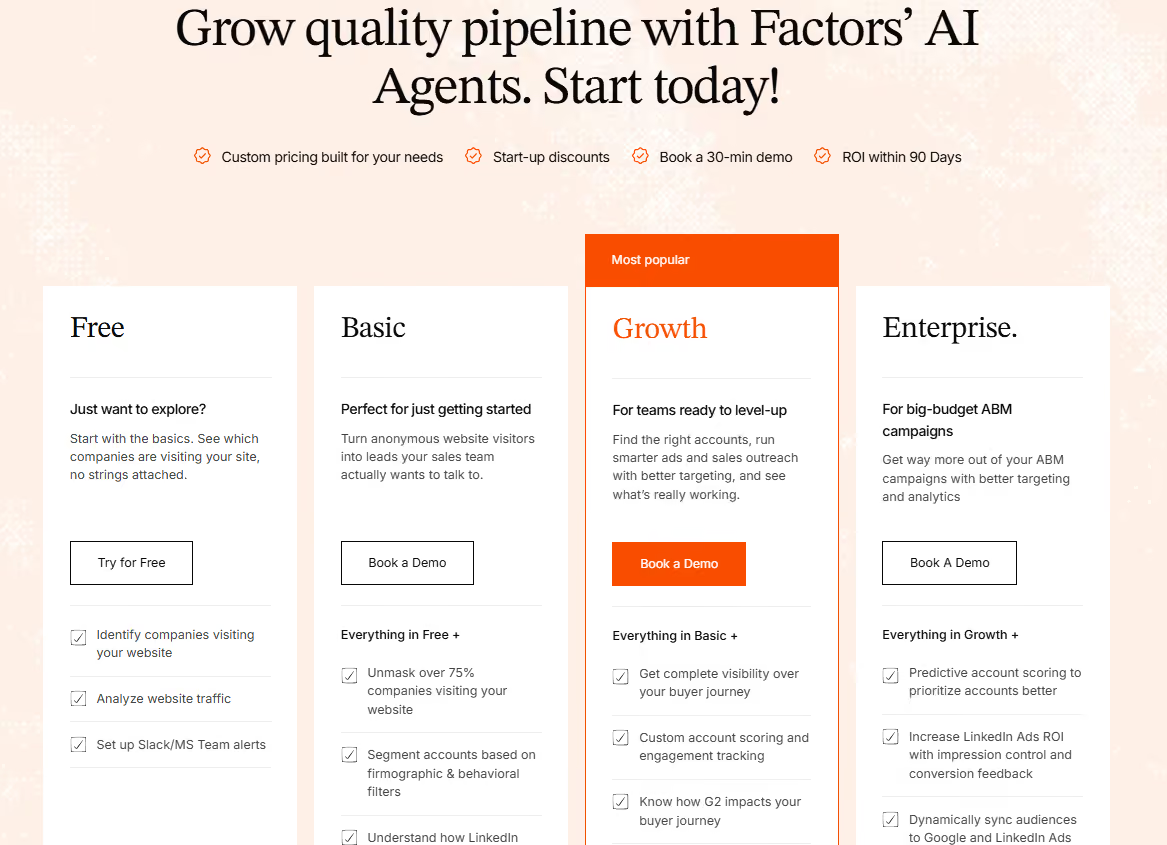
Factors doesn't charge per user seat or per company identified at the lowest tiers. Instead, it bundles identification, enrichment, CRM sync, analytics, and alerts into usage-based plans.
Think of it as: the more companies you want to identify and activate, the higher the plan.
The entry price includes:
- Visitor identification for 8,000 companies/month
- Multi-source intent signals
- CRM bidirectional sync
- LinkedIn and Google Ads integrations
- Dedicated customer success manager
- 100+ custom reports
- Workflow automation
For teams replacing four-point tools (visitor ID tool, enrichment provider, analytics platform, ad activation tool), the ROI stacks quickly.
GTM Engineering Services (optional) start at a separate cost. These include custom ICP modeling, RevOps workflow design, SDR enablement, and buying group mapping. This is where Factors extracts additional value for teams without in-house RevOps bandwidth.
ZenABM Pricing strategy
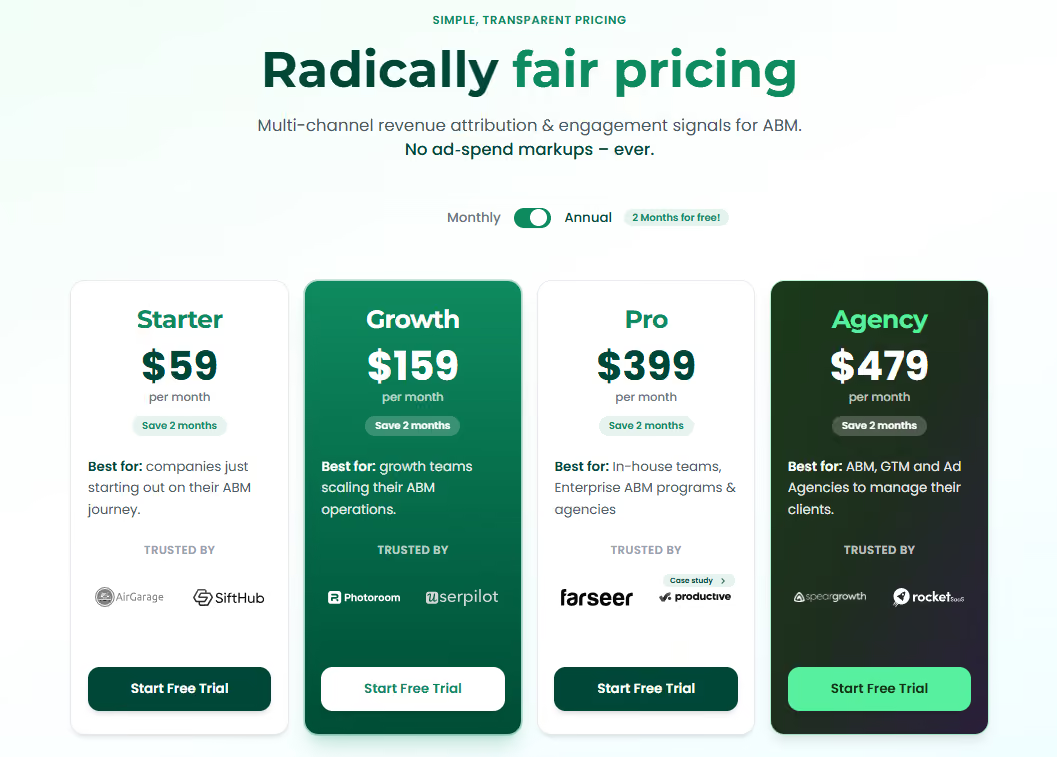
ZenABM prices for entry-level adoption. The $59 starter plan is genuinely accessible; it's where a single marketer or small team can trial the product with minimal commitment.
The catch: the $59 plan caps at 1 ABM campaign and 10 Zena chats per day.
To unlock multi-campaign support (which most growing ABM programs need), you move to Growth ($159/mo) or Pro ($399/mo). The Agency plan ($479/mo) adds multi-client support for agencies.
All plans include:
- HubSpot and Salesforce integration
- Webhooks for custom automation
- Zena AI (with daily chat limits)
- API access (on higher tiers)
No hidden per-company or per-seat overages. You pay the monthly fee and get access.
The 37-day free trial is notable, it's longer than Factors' 14-day trial and signals ZenABM's confidence in product stickiness.
Factors.ai vs ZenABM: Pricing Verdict
ZenABM wins on affordability. At $59/mo with unlimited seats, it's the lowest entry price for ABM analytics on the market.
Factors.ai wins on value consolidation. If you're stacking multiple tools, the all-in-one approach saves money and complexity over time.
For a single-channel LinkedIn ABM motion: ZenABM at $159-399/mo is hard to beat.
For a multi-channel GTM motion: Factors.ai's bundled approach is more cost-efficient than the alternative of buying visitor ID + enrichment + attribution + activation separately.
In short:
- ZenABM = Accessible LinkedIn-first pricing
- Factors.ai = Enterprise GTM consolidation
Factors.ai vs ZenABM: CRM integration and pipeline mapping
This is where the philosophies diverge sharply.
Factors.ai vs ZenABM: CRM integration comparison
Factors.ai: Bi-directional CRM alignment
Factors.ai reads from your CRM and writes back to it. This creates a feedback loop.
- When an account is in SQL stage in Salesforce, Factors knows that. It weights intent signals differently for SQLs vs. MQLs. It tells Scout AI to focus on deal acceleration plays for SQLs, not lead nurturing plays for MQLs.
- Factors pushes enriched account records, engagement timelines, buying group maps, and deal influence data back to Salesforce. It creates custom objects for buying committees, so your sales team doesn't have to manually find stakeholders.
- Every account record in your CRM becomes a hub. Marketing sees which campaigns drove engagement. Sales sees the full timeline of interactions. RevOps sees exactly which signal (web visit, form fill, ad click, G2 review) moved the deal forward.
- SDRs can build automation: "If account is in Interested stage AND has had 3+ web visits in the past week AND comes from our target industry, send me a Slack notification."
With this, CRM becomes the operating system for GTM, not just a transaction ledger.
ZenABM: Push-only CRM sync
ZenABM pushes engagement data into your CRM but doesn't read back from it.
This is a deliberate trade-off: simplicity over bi-directionality.
- What flows into CRM: Account scores (1-100), stage labels (Aware/Engaged/Interested/Selecting), engagement history (timeline of LinkedIn touchpoints), and intent signals (which content each account engaged with).
- What doesn't flow back: ZenABM doesn't know if an account is already in SQL stage. It doesn't adjust scoring based on CRM pipeline position. It treats all LinkedIn engagement equally.
- SDR Workflow: SDRs see the engagement data in Salesforce or HubSpot, use it to decide whom to outreach, and manually mark accounts as qualified. Those qualifications can flow back via webhooks, but ZenABM doesn't natively use them to recalibrate scoring.
This design keeps ZenABM lightweight and fast. You get clean, actionable data without RevOps orchestration overhead.
Factors.ai vs ZenABM: CRM Integration Verdict
Factors.ai treats CRM as the center of your GTM system. Every signal flows through it. Every decision pulls from it. This requires more setup but enables true omnichannel GTM orchestration.
ZenABM treats CRM as the handoff point. Marketing identifies engaged accounts on LinkedIn, pushes them to CRM, sales takes it from there. It's simpler and faster but creates a data silo: LinkedIn insights don't inform email campaigns, product usage doesn't inform LinkedIn retargeting.
For teams with simple GTM motions (LinkedIn Ads → CRM → Sales): ZenABM's one-way sync is sufficient.
For teams with complex GTM motions (Website + Ads + Product + Email + CRM, all informing each other): Factors.ai's bi-directional architecture is necessary.
In short:
- Factors.ai = CRM as GTM command center
- ZenABM = CRM as outreach handoff point
Factors.ai vs ZenABM: Intent signals and ad activation
This comparison gets at the heart of how each platform thinks about ABM.
Factors.ai vs ZenABM: Intent and activation comparison
Factors.ai: Multi-signal intent orchestration
Factors treats intent as a blend of signals, not a single data point.
An account might show high web engagement but low G2 intent. Another might have moderate LinkedIn activity but sudden CRM stage movement. A third might have Bombora signals indicating active buying but no outreach yet.
Scout AI synthesizes these and decides: which accounts need nurturing, which need sales outreach, which need different messaging?
- LinkedIn AdPilot operates within this context. Instead of running generic LinkedIn Ads campaigns, you run intent-based campaigns:
- Retarget accounts with high website engagement (warm traffic)
- Suppress accounts already in your sales pipeline (don't waste impression on known leads)
- Control impression frequency for high-value accounts (avoid ad fatigue)
- Test different messaging with different intent clusters
- Google AdPilot scales this to paid search, enabling remarketing to accounts showing search intent.
- Conversion Feedback: When an SDR marks a lead as qualified (CRM conversion), that signal flows back to your ad platforms. Over time, LinkedIn and Google learn which accounts are most likely to convert and bias their optimization accordingly.
The result: every dollar of ad spend optimizes toward accounts that actually buy, not just those that click.
ZenABM: LinkedIn Engagement as intent proxy
ZenABM operates on a simpler model: LinkedIn engagement = intent signal.
If an account viewed your LinkedIn Ads, it signals interest. If it clicked multiple ads, that signals higher intent. If it engaged with organic posts, add that to the mix.
Zena scores accounts on this engagement, stages them on movement velocity, and pushes the results to your CRM.
This works for LinkedIn-first teams because it mirrors their ABM motion: you run LinkedIn Ads, monitor who engages, and prioritize them for outreach.
The limitation: engagement on LinkedIn doesn't capture the full market picture. An account might be actively in-market but hasn't seen your ads yet. An account might be researching you on G2 or your website but never touched your LinkedIn Ads. ZenABM misses both signals.
- No autonomous recommendations: Zena answers questions; it doesn't suggest which accounts to prioritize for outreach or which messaging to use. You make those decisions based on the engagement data.
- No ad optimization: ZenABM doesn't optimize your LinkedIn Ads automatically. You manage campaigns, monitor which ones engage accounts, and manually adjust spend or messaging.
Factors.ai vs ZenABM: Intent and Activation Verdict
Factors.ai wins for teams running sophisticated ABM motions across multiple channels. The multi-signal approach catches accounts early (before they engage with your ads), and the autonomous activation keeps your ads spending smart.
- ZenABM wins for teams whose ABM motion is laser-focused on LinkedIn Ads. If LinkedIn is your channel and engagement is your metric, ZenABM is precise and fast.
- The philosophical difference: Factors.ai asks, "How do we find and activate every account in-market, regardless of channel?" ZenABM asks, "How do we maximize value from the accounts engaging with our LinkedIn campaigns?"
Both are valid. Your choice depends on whether you're optimizing a single channel or orchestrating a multi-channel motion.
In short:
- Factors.ai = Multi-channel intent orchestration with Scout autonomy
- ZenABM = LinkedIn engagement precision with Zena insights
Factors.ai vs ZenABM: Analytics and reporting
Analytics separate tactical visibility from strategic clarity.
Factors.ai vs ZenABM: Analytics and reporting comparison
Factors.ai: Full-funnel attribution
Factors answers: "Which campaigns, channels, and signals actually drove this deal?"
The platform tracks every interaction from first anonymous web visit through closed deal. It shows:
- First-touch channel (which campaign introduced this account?)
- Last-touch channel (which campaign was the final push?)
- Multi-touch influence (which channels contributed throughout the journey?)
- Cycle time (how long from first touch to close?)
- Funnel drop-off detection: Factors visualizes where deals stall. If 50% of SQLs convert to opportunities but only 20% convert to closed deals, the platform flags the opportunity → closed deal stage as a leak. Scout AI recommends intervention (e.g., executive outreach, product demo, pricing negotiation).
- Custom dashboards: You can build dashboards by industry, geography, persona, or campaign. Each tells a different story about what drives pipeline in your market.
- Scout-powered insights: Scout synthesizes the data. Instead of you reading dashboards, Scout tells you: "This week, web engagement drove 40% more pipeline than LinkedIn Ads. Your target accounts in healthcare are 30% more likely to convert than in finance. Inbound motion is stalling at the SQL stage."
The limitation: Factors doesn't natively offer lift analysis (incrementality testing), which proves whether your ads actually moved the needle or would have closed anyway.
ZenABM: LinkedIn campaign reporting
ZenABM answers: "Which LinkedIn campaigns are driving engagement and which accounts are closest to converting?"
The dashboards show:
- Campaign performance: reach, engagement rate, cost per engagement
- Account performance: which accounts engaged, engagement timeline, movement through ABM stages
- Revenue correlation: which engaged accounts became opportunities, average deal size, pipeline influenced
- Account cards: Click on an account and see everything ZenABM knows: all campaigns they engaged with, engagement timeline, current stage, engagement score, intent signals inferred from ad content.
- Zena natural language queries: Ask Zena questions like "Which accounts just moved to Interested?" or "Show me Q2 campaigns ranked by pipeline influence." Results appear as instant reports.
- Stage velocity: Track how fast accounts move through your stages. If accounts are getting stuck in Interested, Zena alerts you and you can adjust messaging or timing.
The limitation: all insights are LinkedIn-specific. You can't see if these accounts are also engaging with Google Ads, your website, or G2. You get a clean picture of one channel, not the whole market.
Factors.ai vs ZenABM: Analytics Verdict
- Factors.ai for CMOs and RevOps leaders who need to prove multi-channel ROI to leadership. If your CFO asks, "Which campaigns actually drove revenue?", Factors gives you the audit-ready answer.
- ZenABM for performance marketers and demand gen teams who live in LinkedIn Ads and want instant clarity on what's working. If your question is "Which LinkedIn campaigns should I double down on?", ZenABM is faster.
In short:
- Factors.ai = Full-funnel attribution for strategic GTM decisions
- ZenABM = LinkedIn campaign reporting for tactical optimization
Factors.ai vs ZenABM: Onboarding and support
How quickly you go live, and how much hand-holding you need, shapes the true cost of adoption.
Factors.ai vs ZenABM: Onboarding and support comparison
Factors.ai: Structured onboarding
Factors treats onboarding as part of the product. Every customer gets a dedicated CSM and a structured process.
- Week 1: ICP definition and enrichment strategy. What companies are you targeting? Where does your data come from? Which enrichment providers should we layer?
- Week 2: CRM and ad platform setup. Connect your Salesforce or HubSpot, map custom properties, set up LinkedIn and Google Ads integrations.
- Week 3: Build automations and alerts. Define workflows: "If account shows intent spike, alert SDR. If account moves to SQL, pause LinkedIn retargeting."
- Ongoing: Weekly 30-minute strategy calls. Your CSM reviews adoption, identifies gaps, and optimizes configurations based on what's working.
This takes more time upfront but ensures Factors integrates into your GTM operating rhythm, not sitting idle as a reporting tool.
GTM Engineering Services (optional): If you don't have in-house RevOps, Factors can design your entire GTM workflow, from ICP modeling to alert triggers to enrichment logic. This accelerates time to ROI but adds cost.
ZenABM: Plug-and-play activation
ZenABM's onboarding is intentionally minimal.
- Step 1: Connect LinkedIn Campaign Manager (OAuth).
- Step 2: Connect HubSpot or Salesforce (OAuth).
- Step 3: Define your ABM campaigns by grouping LinkedIn campaign IDs into initiatives.
- Step 4: Set intent signals (which content signals different intent levels).
Your first account scores and stages appear in your CRM within an hour.
If something breaks (API error, sync stall), email support helps. But most teams never need to call support because the setup is so straightforward.
Learning curve: A marketer can go live on their own. You don’t need RevOps expertise or multi-week implementation.
The trade-off: less guidance on how to structure your ABM motion. ZenABM assumes you know what you're doing with LinkedIn Ads; they just add the intelligence layer.
Factors.ai vs ZenABM: Onboarding verdict
Factors.ai for teams that need hand-holding and want to optimize GTM strategy, not just tools. If you have RevOps bandwidth and want an external expert to validate your approach, the white-glove onboarding pays for itself.
ZenABM for teams that just want to go live fast. You understand LinkedIn Ads, you have a CRM, and you want visibility into engagement. ZenABM gets you there in hours.
In short:
- Factors.ai = Strategic onboarding with ongoing partnership
- ZenABM = Self-serve setup for immediate activation
Factors.ai vs ZenABM: Compliance and security
Data trust is non-negotiable for a revenue platform.
Factors.ai vs ZenABM: Compliance and security comparison
Factors.ai: Enterprise-grade compliance
Factors.ai operates to SOC 2 Type II and ISO 27001 standards, the certifications enterprise procurement requires.
- SOC 2 Type II means an independent CPA firm has audited Factors' security controls over a period of time (typically 6+ months), verified they're effective, and issued a report. This covers security, availability, and confidentiality.
- ISO 27001 means Factors maintains an information security management system that meets international standards for protecting data.
- GDPR with supplementary safeguards: Factors.ai is US-based but handles EU data with Standard Contractual Clauses and additional encryption safeguards to align with GDPR requirements.
- Incident Response: Factors maintains a formal incident response plan with a dedicated Data Protection Officer. If a breach occurs, Factors has procedures to investigate, contain, and notify affected parties.
- Data Export: Factors provides API access to your data, reducing lock-in risk. If you leave, your account data is yours to export.
This level of certification takes investment. It signals that Factors takes data security seriously and is willing to be audited by third parties to prove it.
ZenABM: GDPR compliance (Limited public validation)
ZenABM is GDPR-compliant and confirms this in their data policy. However, there's no public mention of SOC 2, ISO 27001, or third-party security audits.
This isn't unusual for earlier-stage platforms. Compliance certifications are expensive and time-consuming. Many platforms postpone them until they hit enterprise customer requirements.
- GDPR compliance: ZenABM processes EU data within GDPR requirements and provides a data processing agreement on request.
- Data security: Standard protections (HTTPS encryption, access controls) are likely in place, but without published SOC 2 documentation, there's no independent verification.
- Incident response: ZenABM includes an incident response plan and claims 24-hour restoration capability, but again, no third-party audit validates these claims.
- For mid-market teams: ZenABM's compliance posture is sufficient. For enterprise procurement, the lack of SOC 2 certification will trigger requests for custom security assessments, extending sales cycles.
Factors.ai vs ZenABM: Compliance verdict
Factors.ai for enterprise buyers and regulated industries. SOC 2 Type II and ISO 27001 certifications speed procurement and give your security/legal teams confidence.
ZenABM for mid-market teams where GDPR compliance is the bar. If your customers don't require SOC 2, ZenABM's compliance posture is fine.
In short:
- Factors.ai = Enterprise compliance with third-party validation
- ZenABM = GDPR compliance without third-party audit
Factors.ai vs ZenABM: Which tool to choose when?
Both platforms help GTM teams move faster. The decision hinges on your channel focus and GTM complexity.
Factors.ai vs ZenABM: Decision framework
Choose Factors.ai if:
You're running ABM or demand generation across multiple channels. Your GTM motion isn't just LinkedIn, it includes website, email, paid search, and product signals. You want these signals to inform each other, not sit in silos.
You have RevOps resources (or can hire someone) and want to treat your CRM as the operating system for GTM, not just a transaction ledger.
You need multi-touch attribution to prove ROI to your CFO. "LinkedIn drove $2M in pipeline" is good. "LinkedIn + website + product drove $2M, with website as first touch" is better for strategic conversations.
You're at growth stage or beyond and can justify $400+/month for a consolidated platform that replaces 3-4 point tools.
You run both LinkedIn and Google Ads and want optimization across both channels within one system.
Choose ZenABM if:
You're confident LinkedIn Ads is your primary ABM channel and you want the cleanest, fastest way to get from "Company X engaged with my LinkedIn Ads" to "Sales, here's your priority list."
You're early-stage or SMB and need to go live fast. You don't have RevOps bandwidth for complex multi-channel orchestration. You just need visibility and action.
You want to minimize onboarding friction. You'd rather plug in and go live in hours than spend weeks with a CSM configuring workflows.
You're paying per-month and want a fixed cost with no surprises. You don't want to worry about per-company overage fees.
You want to ask Zena "Which campaigns drove the most pipeline?" and get an instant answer without building dashboards.
You're managing multiple LinkedIn Ads accounts (as an agency) and need per-client isolation and multi-client dashboards.
The ‘use both’ setup
Some sophisticated teams use both:
- ZenABM for deep LinkedIn ABM analytics and account engagement scoring from paid LinkedIn traffic.
- Factors.ai for full-funnel visibility: website visitor identification, multi-channel attribution, and Scout AI orchestration.
This covers both depth (LinkedIn) and breadth (all channels), though it adds complexity and cost. You're paying for both platforms but eliminating the analytics overlap.
In a nutshell…
Factors.ai is for GTM teams that view their revenue stack as a system. Website, ads, CRM, and product all feed each other. Scout AI agents run continuously, researching accounts, mapping buying committees, and recommending actions. Every decision pulls from multi-source intent signals. You're not optimizing a channel; you're orchestrating a motion.
This works for companies that:
- Have defined ABM or demand generation programs with multiple campaigns
- Run paid ads on multiple platforms (LinkedIn + Google, at minimum)
- Have marketing and sales alignment around account targeting
- Want to prove multi-channel ROI to leadership
- Can afford $400+/month and have RevOps bandwidth
ZenABM is for GTM teams that have already answered their biggest question: "We're running ABM on LinkedIn." They want the fastest, cheapest way to get from engagement signal to sales outreach.
This works for companies that:
- Run LinkedIn Ads as their primary or only paid channel
- Are early-stage or SMB with lean teams
- Need visibility into campaign performance and account engagement
- Want to go live in hours, not weeks
- Can live with LinkedIn-only visibility
Neither platform is objectively "better." They solve different problems for different GTM maturity levels.
Pick Factors.ai if you need a system, and pick ZenABM if you need a quick solution.
FAQs for Factors.ai vs ZenABM
Q1. What is the main difference between Factors.ai and ZenABM?
The biggest difference is platform scope. Factors.ai is a full-funnel GTM and ABM platform that combines visitor identification, attribution, CRM orchestration, ad activation, and AI-driven account intelligence. ZenABM focuses primarily on LinkedIn engagement tracking and account scoring.
Q2. Is Factors.ai better for multi-channel ABM?
Yes. Factors.ai supports LinkedIn Ads, Google Ads, website intent signals, CRM activity, G2 intent, product signals, and third-party intent data within a single system. ZenABM is largely limited to LinkedIn engagement data.
Q3. Does ZenABM support Google Ads attribution?
No. ZenABM focuses on LinkedIn Ads visibility and CRM syncing. It does not provide native Google Ads activation or cross-channel attribution.
Q4. Which platform is easier to set up?
ZenABM is easier and faster to deploy. Most teams can connect LinkedIn Campaign Manager and their CRM within a few hours. That said, Factors.ai involves a more structured onboarding process because it integrates across multiple GTM systems.
Q5. Which platform is better for multi-channel ABM?
Factors.ai is significantly stronger for multi-channel ABM because it supports LinkedIn Ads, Google Ads, CRM orchestration, website identification, email workflows, and automated account segmentation together. ZenABM is largely LinkedIn-only.
Q6. Does Factors.ai support visitor identification?
Yes. Factors.ai identifies up to 75% of anonymous website visitors using waterfall enrichment across multiple providers. It also combines those insights with CRM and ad engagement data.
Q7. Which platform is better for enterprise teams?
Factors.ai is the stronger fit for enterprise teams because it includes SOC 2 Type II and ISO 27001 compliance, multi-touch attribution, AI-powered orchestration, and deeper CRM integrations.
Q8. Can Factors.ai replace multiple GTM tools?
Yes. Factors.ai combines visitor identification, attribution, account scoring, LinkedIn and Google Ads activation, CRM orchestration, and GTM workflows into one platform. Many teams use it to consolidate multiple point solutions.
Q9. Is ZenABM a good choice for LinkedIn-first ABM teams?
Yes. ZenABM is a strong fit for companies whose ABM strategy revolves around LinkedIn Ads and who want a lightweight platform for engagement visibility and account prioritization.
Q10. Which platform has better AI capabilities?
Factors.ai has more advanced AI functionality through Scout AI agents, which proactively research accounts, map buying committees, surface deal risks, recommend next actions, and automate workflows. ZenABM’s Zena AI mainly provides conversational analytics and reporting.
Q11. Is Factors.ai better for enterprise companies?
Yes. Factors.ai is built for enterprise GTM teams with SOC 2 Type II, ISO 27001 certification, multi-touch attribution, advanced CRM orchestration, and cross-channel analytics.

AI content creation platforms: what actually separates a tool from a system in 2026
A no-fluff comparison of AI content creation platforms for B2B teams. What each one actually does, who it's for, and where most stacks go wrong.
TL;DR
● AI content creation platforms are operational systems that connect research, drafting, optimization, and distribution, and the platforms that skip any one of those steps are limiting you.
● Most B2B teams have a workflow problem, and no amount of AI fixes a process nobody's actually mapped out.
● The best AI content marketing tools change completely depending on team size, not because vendors want you to think that, but because a three-person team and a forty-person org are solving different problems entirely.
● Content volume was never the bottleneck. Knowing which piece of content actually nudged a deal forward is, and most teams still can't answer that with a straight face.
● The platforms worth paying for are the ones that make your team faster without making your reporting dumber, and that combination is rarer than the marketing pages suggest.
Every kitchen drawer has that one gadget. The spiralizer, the sous vide wand, the bread maker that made two loaves, and then became a very expensive shelf ornament. It gets bought with real enthusiasm, used twice, and then forgotten while the same three pans keep doing all the actual cooking.
I think about that drawer every time I sit through a demo for a new AI content tool… weird, I know. But stay with me.
B2B marketing teams are stocking up on AI gadgets right now. A writing assistant here, a video generator there, an SEO scorer bolted on top. Each one looks brilliant in isolation. Ask them to work together as an actual content operation, though, and most of them just sit in the drawer next to last quarter's "revolutionary" tool. Half used, fully forgotten. The conversation everyone's having is "can this thing write a decent paragraph." The conversation that actually matters is whether your content function runs like a kitchen or like a drawer full of expensive, disconnected gadgets.
That's the lens I want to use for this one, because I think it's the only honest way to compare AI content creation platforms right now.
What’s an "AI content creation platform"?
There's a real difference between an AI assistant and an AI content platform, and I don't think enough people slow down to notice it. An assistant like ChatGPT or Claude is a generalist. Feed it a prompt, get back text. Genuinely useful, but on its own, it's an ingredient, not a meal.
A platform wraps that same generative engine inside something built for how marketing teams actually operate. Research, planning, drafting, optimization, distribution, measurement, treated as one connected process instead of five separate errands you run between tabs.
The shift here matters more than it sounds. Back in 2024, most of the AI content conversation was about generation, getting a first draft out faster than a human could type it. By 2026, the better teams have moved past that entirely. They're building repeatable systems that can carry a piece of content from "we should write about this" all the way to "here's what it did for pipeline." No person manually stitching each handoff together.
ChatGPT by itself isn't a content strategy, for the same reason a really good knife isn't a restaurant. You still need a menu, ingredients, someone plating the dish, and a system for knowing which dishes people actually order twice. The strongest AI content marketing software in 2026 supports that whole arc, not just the chopping.
After spending most of my career inside content teams, here's the pattern I keep seeing: marketers judge these tools almost entirely on output quality. Does the paragraph sound good. That's the wrong first question. The right one is whether the tool helps your team produce consistently good work at scale, without turning your Tuesday into a game of tab-whack-a-mole.
Where most teams get this wrong before they even open a tool
The most expensive mistake isn't picking the wrong platform. It's treating AI like a writer instead of like a strategist. Hand a team an AI tool and watch output triple almost overnight, and what you've actually done is triple your distribution problem. More content without a plan for where it goes is just noise wearing a content calendar as a costume.
I've watched this exact pattern play out across more B2B SaaS teams than I can count. Produce more instead of producing better. Chase the newest tool instead of fixing the workflow underneath it. Publish two dozen posts a month and never manage to trace a single one back to an actual opportunity in the CRM. Attribution meetings in these teams start to feel like group projects where everyone wants credit for the final grade and nobody remembers who actually wrote the essay.
The real issue sits underneath all of it. Most teams run their content tools, their CRM, and their analytics as three separate countries with no shared border. You can tell someone an article pulled four thousand pageviews. You genuinely cannot tell them which accounts read it, whether it nudged anyone toward a demo, or what topic actually created buying intent. Once your data lives in silos like that, reconstructing the buyer's journey becomes its own side project.
Here's the uncomfortable part. Teams running the flashiest AI content stacks in 2025 and 2026 sometimes have less content intelligence than teams that were tracking everything manually in spreadsheets five years ago. They've added speed. They haven't added signal.
The five kinds of AI content platforms, and why the category matters
The AI content platform market isn't one market. It's at least five, and knowing which one you actually need saves you from a lot of buyer's remorse.
- AI writing platforms
These are your generalists. ChatGPT, Claude, and Jasper all live here, though each has drifted in its own direction. General-purpose tools like ChatGPT and Claude give you maximum flexibility and zero built-in workflow, which works fine for a marketer who already knows exactly what they need. Jasper leans into brand voice consistency and has been layering in agentic workflows for campaign production. Copy.ai has repositioned itself toward go-to-market automation, more on that shortly.
- SEO content platforms
These don't just write, they optimize while you write. Semrush's ContentShake pairs real keyword and competitor data with AI drafting, so what you produce is grounded in something more than a guess. Clearscope has been in this category longer than most and, by 2026, has grown well past keyword grading into something closer to a content intelligence platform. Surfer SEO sits alongside both, offering live optimization scoring as you type, which is honestly the closest thing to having an editor looking over your shoulder without the awkward silence.
- Video content platforms
HeyGen turns a script into a talking-head video with a photorealistic avatar. Paste the script, pick a face, pick a voice, and it hands you back something with synced lip movement and gestures that don't look like a puppet show (mostly). Synthesia leans corporate, built for training content at scale. Lumen5 does one thing well: turning existing blog posts into shareable video, which is a genuinely underrated repurposing move.
- Design and visual platforms
Canva's Magic Studio has earned its spot as a real content creation platform, not just a design tool, especially for teams that don't have a dedicated designer on payroll. Adobe Firefly handles the heavier creative lift for teams already living inside the Adobe ecosystem.
- Content operations platforms
This is the category that's actually interesting right now. AirOps was built specifically to help marketing and SEO teams understand how they show up in AI search, prioritize what to fix, and automate the workflow around it. HubSpot Content Hub earns its place less through raw AI writing quality and more through how deeply it plugs into everything else you're already running. If your CRM, email, and sales automation all live in HubSpot, Content Hub removes an entire layer of friction. Notion AI rounds this category out for smaller teams that need lightweight coordination without the enterprise price tag.
The bigger shift underneath all five categories is this: teams don't actually want a tool that writes well anymore. They want a system that connects writing to results. That single change in expectation is the biggest thing separating how teams evaluated AI content tools in 2024 from how they're evaluating them now.
How the major platforms actually compare
I'm not going to rank these top to bottom, because a ranking without context is basically astrology. Here's the comparison across the dimensions that actually decide whether a platform earns its subscription.
Now, the part that table can't capture on its own.
Jasper is a mature writing platform with genuinely deep brand voice controls and a wide library of B2B templates. It's been around long enough to build the features larger teams actually need. Role-based access, collaborative editing, and a Brand Voice system that keeps output consistent even when five different people are drafting. It's the strongest pick for enterprise teams that need governance, not just generation.
Copy.ai has become something else entirely. It's not just generating isolated pieces of copy anymore, it's orchestrating workflows across the whole go-to-market org. If your bottleneck is sales and marketing not speaking the same language, Copy.ai's workflow architecture is genuinely hard to beat.
AirOps runs the full arc: research, creation, optimization, publishing, and performance measurement, inside one connected platform. Standalone writing tools give you a piece of content. AirOps gives you a pipeline for producing them.
Instead of crowning one winner, here's what I'd actually tell a friend:
● Small team? ChatGPT or Claude paired with Semrush covers most of what a lean team needs.
● B2B SaaS? Jasper for production, Clearscope for optimization.
● Enterprise? Jasper if brand governance is the priority, AirOps if operational scale is.
● Content-led growth? AirOps, built for scaling programs systematically rather than one post at a time.
● AI search visibility? AirOps or Semrush, both of which now track how you show up inside AI answer engines.
Matching the platform to the actual job
- Blog and long-form writing
Claude tends to produce the most natural-sounding long-form writing among the general-purpose models (genuinely didn't expect to say that about a chatbot, but here we are). ChatGPT edges ahead on flexibility, plugins, and browsing. Jasper adds brand voice consistency on top of raw generation. The right pick usually comes down to whether you're optimizing for writing quality or operational control.
- SEO content production
Semrush, Clearscope, and Surfer each take their own angle here. Clearscope stays narrow on purpose, every feature exists to help your content rank, nothing more. Surfer pushes more aggressive optimization scoring. Semrush bundles content tools into a broader SEO suite that also covers keyword research and competitive tracking.
- LinkedIn and social content
ChatGPT still holds up surprisingly well for LinkedIn posts when you feed it real context instead of a vague prompt. FeedHive and Buffer AI add scheduling and analytics on top. The actual differentiator for social content was never the writing tool. It's whether you have a point of view worth sharing, and no platform, however clever, can automate that for you.
- Video content
Teams use HeyGen for product demos, explainers, and social clips without booking a studio or hiring a presenter. Its BrandKit stores logos, fonts, and colors so every video stays on-brand without someone re-checking each export. Synthesia holds its ground in regulated industries where compliance actually matters. Lumen5 remains the fastest route from existing text to a shareable video.
- Email marketing
HubSpot AI ties email generation directly to CRM data, so personalization happens at the contact level instead of the template level. Jasper handles email copy with the same brand voice controls it applies everywhere else. Realistically, the choice comes down to which CRM you're already running.
- Account-based marketing content
This is where things get genuinely different. The best-performing content today isn't necessarily the best-written content, it's the content shown to the right account at the right moment. Personalized messaging by segment, intent-based content, dynamic campaign copy, all of it depends on knowing which accounts are actually in-market right now. HubSpot leans on CRM data (lifecycle stage, past interactions, firmographic details) to personalize content at the page level, which matters a lot for teams running ABM programs.
Building an actual AI content stack, by team size
- The lean team (1 to 3 marketers)
Start with ChatGPT or Claude for drafting, Canva for visuals, and Semrush for SEO. This runs under $300 a month and covers the fundamentals without drowning anyone in tools. The part that actually matters is using this stack inside a consistent workflow, not bouncing between tools whenever the mood strikes.
- The scaling SaaS team
Claude for long-form, Semrush for SEO strategy, HeyGen for video, HubSpot tying distribution and CRM together. This is where the stack starts to compound. Each tool owns one job well, and HubSpot is the connective tissue holding them together instead of five disconnected workflows running in parallel.
- The enterprise content engine
Jasper for governed production, AirOps for content operations and AI search visibility, Adobe Firefly for brand-consistent visuals, and a proper DAM for asset management. Most teams get further by combining two or three tools thoughtfully than by forcing one platform to do every job badly. Enterprise teams are increasingly building integrated ecosystems instead of single-purpose tools, and the architecture of the stack matters more than any one tool inside it.
What the actual content workflow looks like now
The old workflow was research, write, publish, hope. The new one has nine steps, and AI touches most of them.
● Market research. Use AI to synthesize competitor content, spot gaps, and surface what's trending in your category before you write a word.
● Topic discovery. Combine keyword data with AI-generated topic clusters to find the opportunities actually worth chasing.
● Brief creation. Generate structured briefs with target keywords, audience intent, competitive benchmarks, and an outline to start from.
● First draft. Let AI handle the blank page. The draft isn't the finished product, it's the raw material.
● Human review. Non-negotiable. Every draft needs a subject matter expert checking it for accuracy, nuance, and whether it actually sounds like your brand.
● SEO optimization. Run it through Clearscope, Surfer, or Semrush to cover the topic properly without turning it into a keyword pileup.
● Multi-channel repurposing. Turn one long-form piece into LinkedIn posts, email snippets, a video script, and a couple of social graphics.
● Distribution. Publish across channels with the right formatting for each. This is where most teams lose momentum.
● Performance measurement. Track engagement by account, content-influenced pipeline, and revenue, not just traffic.
The biggest myth going around is that AI replaces content marketers. What it actually replaces is the part of the job nobody enjoyed in the first place. Staring at a blank document for 45 minutes, or manually reformatting the same post for six different channels.
What actually makes an AI content platform worth paying for
Not every platform earns a spot in your stack tho. Here's the framework I'd run any new tool through before it gets a seat at the table:
● Content quality. Does it read like a competent marketer wrote it, or like a robot summarizing a Wikipedia page?
● Brand voice control. Can you actually train it on your tone, your terminology, your positioning?
● Workflow automation. Does it connect to what you're already running, or does it just create a new silo?
● SEO capability. Can it optimize for traditional search and for AI answer engines?
● Integrations. Does it plug into your CMS, your CRM, your analytics?
● Team collaboration. Can several people work inside it without stepping on each other's drafts?
● Governance. Is there an approval layer, an audit trail, actual access controls?
● Analytics. Does it measure anything past vanity metrics?
● AI search visibility. Does it help your content get cited inside AI-generated answers?
● Security. Is your proprietary data actually protected, or just "protected" in the marketing copy?
Marketing leaders now have to decide how they'll govern AI, where it slots into existing workflows, and what framework they'll use to measure whether any of it moved the business. That's become as important a buying criterion as the writing quality itself, and it's the part most comparison articles skip entirely.
AI-powered workflows versus the old way of doing things
The nuance that gets lost in that table is that AI amplifies expertise, it doesn't replace it. Human judgment is still what carries strategy, differentiation, and the kind of insight that only comes from actually understanding what your buyer is struggling with. Real differentiation still needs someone who knows the market well enough to say something nobody else is saying. That tracks with how the sharpest marketers I talk to describe AI adoption these days: a capability multiplier, not a replacement for headcount.
The mistakes I keep watching teams make
The list here is faaaar longer than most buyers expect going in.
- Buying based on hype is the most expensive one by a wide margin. A tool trending on your LinkedIn feed this week isn't automatically the right fit for your actual workflow. Buying too many tools creates integration overhead that eats the time savings you were chasing in the first place. Ignoring workflow fit means the tool gets used enthusiastically for two weeks and then sits untouched.
- Skipping brand voice training is the sneakier mistake. If nobody spends the time configuring the tool to sound like your brand, every single output needs a manual rewrite, which defeats the entire point of buying it. No governance process means junior team members can publish AI output with zero review, which is a brand risk most companies don't think about until something embarrassing actually goes live.
- The real content problem was never creation, it's attribution. Anyone can generate unlimited content today. The hard part is knowing which content influenced which opportunity, which accounts actually engaged, and which channel accelerated a deal that was already moving. Skip the measurement framework and you're producing content with no feedback loop at all. No attribution model answers every question perfectly, and anyone telling you otherwise is probably selling one.
How to actually measure ROI on these platforms
Most comparison articles skip this section entirely, which tells you a lot about the state of content marketing advice right now. Here's what actually matters, grouped by what each metric is really measuring.
- Efficiency metrics tell you whether AI is saving your team time. Hours saved per article, total output per marketer, time from brief to published piece. These are the easiest numbers to pull and, on their own, the least meaningful.
- SEO metrics tell you whether anyone's finding the content at all. Keyword rankings, appearances in AI Overviews, organic traffic growth. AI models have become a real discovery channel for B2B buyers, who increasingly use ChatGPT and Perplexity to research vendors and shortlist providers before a human ever gets involved. Tracking where you show up inside those answers is becoming just as important as tracking a Google ranking.
- Revenue metrics are the ones that actually get an executive's attention. MQLs generated, pipeline influenced, opportunities created, revenue attributed. All of these require connecting your content data to your CRM, which is exactly the step most teams skip.
This is the piece where a platform like Factors.ai actually earns its place in the conversation. It's the layer that tells you what your content stack is doing once the content goes live, long after the writing tool's job is done. Factors.ai connects account-level engagement to pipeline. Instead of guessing which article "probably" influenced a deal, you can see which accounts actually touched it on their way to a closed opportunity. Content creation platforms help you make more. Something like Factors.ai is what tells you whether "more" was ever the right goal.
Also read: How to use AI for marketing: the practical B2B marketer's playbook
Where to, next?
A few trends are converging that will reshape how B2B teams think about content over the next 18 months.
- AI agents are replacing point solutions. Jasper has already introduced Jasper Agents, autonomous mini-bots that can research, optimize for SEO, and schedule content on their own. Instead of buying ten separate tools, teams will increasingly deploy agents that handle a whole workflow end-to-end inside a single platform.
- Content workflows are getting more autonomous. More than half of marketers say they're planning to focus specifically on scaling content production and operations over the next year. The direction is clear. Systems that spot a content gap, build a brief, draft it, route it for review, and publish it with barely any manual intervention.
- AI search optimization is becoming its own discipline. AirOps positions itself squarely around this, tracking visibility across ChatGPT, Perplexity, Gemini, and Google, and shipping content built to actually get cited. Optimizing for AI-generated answers is fast becoming as important as optimizing for a search results page ever was.
- Personalization at the account level keeps climbing the priority list. ABM-driven personalization, AI and traditional search optimization, and localization are all showing up as top priorities for next year's planning.
- Revenue-aware content engines win. The platforms that last will be the ones connecting content directly to pipeline, so ROI stops being a faith-based argument in a QBR deck.
- Human-AI co-creation keeps deepening. The direction of travel points toward AI becoming a genuine collaborative partner in strategy, not just a generator sitting at the end of a prompt box.
The teams that come out ahead won't be the ones using the most AI tools. They'll be the ones who built the best system around the tools they chose. The future isn't AI-first marketing. It's signal-first marketing that happens to be powered by AI.
In a nutshell
AI content creation platforms have gone from "interesting experiment" to core infrastructure for most B2B marketing teams, and there's no putting that back in the box. Which tools you pick matters less than how you connect them into something that actually ties content to business outcomes. Start by mapping where your workflow breaks, not by shopping a feature list. Build a stack that fits your team's actual size, whether that's ChatGPT plus Semrush for a lean team or Jasper plus AirOps for enterprise operations. Invest in attribution before you invest in more volume. And remember that the platforms worth paying for in 2026 are the ones that can answer the one question every executive eventually asks: which of these actually influenced a deal?
FAQs for AI content creation platforms
Q1. What are AI content creation platforms?
AI content creation platforms are software systems that use AI to support some or all of the content lifecycle, including research, planning, writing, optimization, distribution, and measurement. They range from general-purpose assistants like ChatGPT to full operations platforms like AirOps that manage workflows at scale. What separates a platform from a plain tool is whether it connects multiple content functions into one repeatable system.
Q2. What's the best AI content creation platform for B2B marketing?
There isn't a single best answer, because it depends on your team size, your existing stack, and what you're actually trying to fix. Jasper suits enterprise teams that need brand governance. Copy.ai is strongest for GTM workflow automation. Semrush is the better starting point for SEO-driven content. Most B2B teams end up combining two or three platforms rather than expecting one tool to do it all.
Q3. Which AI content tools work best for SEO?
Semrush ContentShake, Clearscope, and Surfer SEO are the three leading options right now. Clearscope offers the most precise content grading for on-page optimization. Semrush bundles content optimization into a broader SEO suite with keyword research and competitive tracking. Surfer gives real-time scoring with more aggressive recommendations. Most teams pair one of these with a general-purpose writing tool for the actual drafting.
Q4. Are AI content platforms actually worth the investment?
For teams publishing regularly, yes. The efficiency gain alone, cutting first-draft time from hours to minutes, usually pays for itself within the first month. The bigger payoff comes from connecting content to revenue through attribution. Teams that track content's influence on pipeline consistently report returns that justify the spend several times over.
Q5. Can AI content platforms replace content writers?
No, and teams that try tend to notice the drop in quality fast. AI handles the operational and repetitive parts of content well, research synthesis, first drafts, repurposing, optimization scoring. Strategy, original insight, brand voice, and subject matter expertise still need a human. The best results come from treating AI as a multiplier for skilled writers, not a substitute.
Q6. What's the actual difference between ChatGPT and an AI content platform?
ChatGPT is a general-purpose assistant that generates text from a prompt. A platform like Jasper or AirOps wraps that same generative capability inside workflow tools built for marketing teams: brand voice controls, SEO optimization, collaboration features, approval workflows, publishing integrations. ChatGPT hands you a draft. A platform hands you a system.
Q7. Which AI content tools are best for enterprise teams?
Jasper and AirOps lead this segment for different reasons. Jasper offers strong brand governance, role-based access, and campaign orchestration. AirOps focuses on operations at scale, with AI search visibility tracking and governed workflow automation built in. Enterprise teams also lean on HubSpot Content Hub when they need content tied directly to CRM data. The right choice depends on whether brand consistency or operational scale is the bigger headache.
Q8. How do these platforms actually improve ROI?
They improve it across three angles. Efficiency gains lower the cost per piece by automating research, drafting, and optimization. Quality improvements lift organic visibility and engagement. Revenue attribution connects content consumption to pipeline and closed deals, which is what lets you prove business impact instead of leaning on pageviews as a proxy.
Q9. How should marketing teams actually evaluate AI content platforms in 2026?
Start with your workflow, not the feature list. Map where your current content process breaks down, then find platforms that address those specific gaps. Weigh brand voice control, workflow automation, integration depth, governance, and analytics. Test on a real project before committing to anything. And prioritize platforms that connect to your CRM and analytics stack, because measuring content's revenue impact is the capability that actually justifies the budget line.
AI content creation for B2B teams: what the good production systems actually look like
AI content creation is a system, not a shortcut. Here's how B2B marketing teams actually build one, with the roles, workflows, and metrics that hold up.
TL;DR
● AI content creation only pays off when it's built as a system with clear ownership at every stage, not a tool you bolt onto an existing process and hope for the best.
● Most teams measure the wrong thing. Publishing volume goes up, pipeline influence stays flat, and everyone keeps celebrating the wrong number.
● The highest-leverage input for AI content ideation isn't a keyword tool. It's the actual language your sales team hears on calls, in objections, and in demo Q&A.
● Content multiplication, turning one source asset into six or seven formats, is the single biggest efficiency win available right now, and most teams are only doing it halfway.
● AI visibility in tools like ChatGPT and Perplexity is starting to matter, but if your foundational content strategy is still weak, chasing AI citations is solving the wrong problem first.
● Publishing a raw AI draft is often slower than writing from scratch once you count the editing required to make it sound like someone with an actual opinion wrote it.
● The teams pulling ahead aren't the ones using AI the most. They're the ones who built a system where a human is still the last person to touch anything before it goes out.
A few months ago I pulled the last six months of blog output from a marketing team I was helping and lined it up next to their pipeline reports. Content volume had nearly tripled. Pipeline influenced by that content had moved by, generously, four percent. Sooo not exactly the headline anyone wanted. Everyone on the team's Slack channel was celebrating the publishing calendar. Nobody had checked whether any of it mattered.
I've seen a version of that story on repeat since AI writing tools became genuinely usable. A team gets excited, output jumps, and somewhere around month three someone finally asks the question that should have come first: is any of this connected to revenue? Usually the honest answer is "we're not sure," which is its own answer.
This isn't a piece about whether to use AI for content. That debate is over, and I say that as someone who was skeptical enough to sit out the first wave of "AI writes your blog" tools entirely. This is about what actually separates the teams getting real output from the ones quietly drowning in mediocre content nobody asked for.
What does "AI content creation" actually mean?
Two years ago, this phrase meant typing a prompt into a chatbot and copying whatever came back. That era is mostly over, and I don't miss it. What it means now is much broader. It covers research, ideation, outlining, drafting, repurposing, personalization, and distribution. Increasingly, it also covers tracking whether your content shows up when someone asks an AI engine a question in your category.
The writing itself, the part everyone fixates on, is honestly the smallest piece of the system. The real value shows up in speed. How fast can you move from a raw insight, say, something your AE mentioned after a call, to a piece of content that speaks to that exact thing?
I'll admit the shift happened faster than I expected it to. Nobody on a content team asks "should we use AI" anymore. The live question is how you use it without sounding like everyone else in your category. That question deserves a better answer than most teams are giving it right now.
Why has this turned into a production problem, not a writing problem?
The math changed for B2B marketing teams before most org charts caught up. Content demands went up. Buyers now discover vendors through AI search answers, LinkedIn feeds, podcasts, and peer Slack communities, not just a Google search box. Content teams, meanwhile, mostly didn't double in headcount. They're expected to cover more ground with the same people.
AI closes part of that gap, but only if you treat it as infrastructure rather than a faster typist. Teams using it well are seeing shorter production timelines and lower cost per finished asset, and they're running more experiments with messaging because testing got cheap. Twelve ad variations in an afternoon instead of three in a week changes what you're willing to try. That compounds.
The advantage isn't only about speed, though. It's about reach. You can tailor messaging to different buyer personas and adjust tone across channels. You can turn one webinar into six separate assets without burning out the two people who used to do all of it by hand.
The teams doing this well aren't producing more noise. They're producing sharper content, and they're learning what works faster because the iteration cycle got so much shorter than it used to be.
The myth that's wasting the most budget…
Here's the assumption I run into constantly: "AI content creation means letting AI create the content." It sounds correct on the surface. It's also backwards. The teams producing genuinely good ai driven marketing content are automating everything around the writing. Research, structuring, formatting, repurposing, distribution, all of it. Strategy, positioning, and point of view stay firmly in human hands.
I've edited enough AI-generated drafts to say this with confidence: publishing raw output is frequently slower than writing from scratch. Not because the sentences are broken. Because the thinking is missing (not exactly a shock once you've read enough of it). Good B2B content isn't hard due to the writing. It's hard because it requires connecting a product capability to a buyer's actual, specific pain point in a way that sounds like someone who's lived it. AI can't do that part yet. It can get you there faster, but only once you supply the substance yourself.
Take a SaaS company selling to enterprise procurement teams. An AI draft will happily produce a well-structured post on "streamlining procurement workflows." A writer who sat through three sales calls that week knows better. The real objection is data security during vendor onboarding, not workflow efficiency. That gap, between the generic version and the specific one, is the difference between content that ranks and content that closes.
Where AI actually earns its place across the content lifecycle…
The most useful mental shift is to stop treating AI as a tool for one stage. Start treating it as a layer across the whole operation, with a named owner at each handoff.
The pattern holds across every row: AI handles the labor-intensive, repeatable part. Humans handle judgment. Skip the human half at any single stage and you end up with content that's technically fine and strategically useless, which is a worse outcome than not publishing at all.
Format-by-format: what's actually working right now
This is where most guides get vague. Here's where I've seen ai content creation for marketing teams deliver real output, broken down by format.
- Blog content
AI is genuinely good for first drafts and outlines once you feed it a brief and your existing style guidelines. The operative word is shape. I use it to get past a blank page, not to skip editing. If your published draft and your AI draft read identically, something in your review process broke.
- LinkedIn content
Two strong uses here. First, repurposing longer assets (webinars, podcast transcripts, internal memos) into LinkedIn-native posts. Second, helping founders and execs who have strong opinions but no time to write them down. An AI content generator for marketing can turn a rushed voice note into a structured draft. Someone still needs to check whether it actually sounds like that person.
- Email marketing
Subject line testing, sequence drafting, and personalization at scale are where ai content generation marketing genuinely shines. Testing twelve subject lines instead of three moves your open rates faster than any single "clever" line ever will. Referencing a prospect's specific industry or use case at scale, without a dedicated copywriter per segment, is now realistic.
- Paid advertising
Ad copy is one of AI's better use cases. Generating variations for creative testing, adjusting tone for different audiences, and producing platform-specific copy all benefit from ai content creation automation. The feedback loop is tight too, since you can measure performance within days and feed the results straight back into the next batch.
- Video and sales enablement
Script generation for short-form video and turning a long webinar into a dozen clips with captions are increasingly standard workflows. AI won't replace a good on-camera presence. It does collapse the gap between "we have a recording" and "we have fifteen usable clips." The same logic applies to case studies, battlecards, and one-pagers. They're tedious to write manually. AI can draft them from existing content and CRM notes, so your sales team gets ammunition without your content team writing every asset from a blank page.
Finding topics your buyers actually care about
Content ideation is a bigger bottleneck than content production, and I'll defend that claim. Most teams can write fast enough now. They struggle to figure out what's worth writing about.
Keyword-first content starts with search volume and works backward into a topic. Buyer-signal-first content starts with what your prospects are asking your sales team, what objections keep coming up on calls, and what patterns show up in pipeline reviews. In my experience, the best-performing pieces rarely come from an SEO tool. They come from sales objections, customer conversations, and the questions that keep resurfacing in demo Q&A.
AI helps by processing those inputs at scale that a person doing it manually never could. Feed it transcripts from twenty sales calls and ask it to surface the five most common concerns. Cross-reference intent signals with the gaps already sitting in your blog archive. The work shifts from brainstorming in a conference room to systematically mining the intelligence your team already has sitting in a CRM somewhere, mostly unused.
Turning one asset into many, without losing the plot
One of the clearest wins from AI content creation is multiplication: turning a single source asset into several formats without multiplying your team's workload. A forty-five-minute webinar, handled well, becomes a long-form post, four or five LinkedIn posts, a newsletter edition, a handful of short clips, and a sales one-pager. Two years ago that repurposing job ate a content team's whole week. With a decent AI-assisted workflow, it's a day, maybe two.
The mechanics are simple. Source content feeds an AI transformation step, which produces multi-channel drafts, which humans then review before anything ships. AI handles reformatting a transcript into a blog structure or pulling quotable lines for social. Humans handle whether the LinkedIn post actually sounds like your CEO wrote it. They also handle whether the email sequence reads like a person instead of a template with a name swapped in.
This is where "multiplier" stops being a buzzword and starts being a real number on a spreadsheet. You're not manufacturing content from nothing. You're extracting more value from work you already paid for once. Teams doing this consistently end up with a noticeably more cohesive presence across channels, because everything traces back to the same core idea instead of six unrelated ones.
That's the shift worth paying attention to. Not more content. Content that earns its distribution.
A quick note on AI visibility (keep this in perspective)
Traditional SEO still matters, but it's no longer the only way buyers find you. A growing share of research now happens inside ChatGPT, Gemini, and Perplexity, where an AI system synthesizes an answer from several sources instead of handing back ten blue links. Whether your content gets cited in that answer is becoming its own signal worth tracking, separate from your rank on page one.
I'm not going to turn this piece into a full generative engine optimization breakdown (that's its own deep dive, and I don't want to shortchange it here). The short version: clear definitions, structured content, and genuine topical authority help. Chasing AI citations before your foundational content strategy is solid is solving the wrong problem first.
Also read: How to use AI for marketing: the practical B2B marketer's playbook
Measuring whether any of this is actually working
The worst way to measure AI content ROI is counting articles published or words generated. I've sat through more than one review where a team proudly reported producing forty percent more content that quarter, with zero connection to whether it influenced a single deal. Volume metrics look good in a slide. They tell you nothing about business impact.
The formulas matter less than the mindset shift. Once you measure AI content creation by pipeline contribution instead of publishing cadence, you start making different calls about what to produce. Fewer "me too" posts, more pieces built around a specific objection at a specific stage of the buyer journey. Attribution in B2B is never perfectly clean (anyone promising a model that answers every question is usually selling one), but directional data is enough to steer smarter investment.
Mistakes that quietly wreck AI content programs (we've all made at least one)
A running list of what I've seen go wrong, pulled from actual reviews, not hypotheticals.
● Publishing without a real edit. Raw AI output reads generic because it is generic. It's missing your company's specific point of view and the language your actual customers use. Every draft needs a human pass, no exceptions.
● Prompting with no context. "Write a blog post about demand generation" invites the blandest possible version of that topic. A prompt needs the audience, their specific pain point, your company's angle, and what you want the reader to do next.
● Stripping out the brand's opinion to save time. AI doesn't have opinions. Your brand should. Remove the editorial perspective and you get content that could have come from any company in your category, which is the opposite of what content is supposed to do.
● Asking AI to make strategic calls. It can execute a task well. It can't tell you which segment to prioritize or which positioning will land with enterprise buyers versus mid-market ones. That's still a human call, always.
● Chasing volume over depth. Twenty mediocre posts a month don't beat five genuinely useful ones. Search engines reward depth. Readers reward relevance. They can both tell the difference, even when it's not obvious to whoever's tracking the publishing calendar.
● Skipping validation from actual buyers. If every topic comes from a keyword tool with zero input from sales conversations, you're writing for search engines, not the people who sign the contract.
Choosing tools without getting talked into the wrong stack
I'm deliberately not turning this into a fifty-tool listicle (the landscape shifts too fast for that to age well). Here's how to think about AI content generation marketing tools by what you actually need them to do.
Tool categories matter more than specific brand names, because the system shifts every few months and today's favorite is next year's footnote. The principle that doesn't change: pick tools that fit a workflow you've already mapped, not a workflow you're hoping a new platform will invent for you.
Where signal-driven content fits into the bigger picture
Everything in this piece points to one operational truth: the content that performs is the content built on real signal, not guesswork. That's the same problem Factors.ai was built to solve on the revenue side. It surfaces which accounts are actually showing buying intent, what they're engaging with, and where the gaps in your funnel sit.
The connection to content is direct. When your team can see which accounts are researching specific topics or showing intent around a particular pain point, that becomes real input for AI content ideation. It's grounded in reality instead of a keyword spreadsheet. Content built from that kind of signal doesn't need to be forced into ranking. It's already answering a question someone in your pipeline is actively asking.
Getting started without overhauling everything at once…
If you're wondering where to begin, here's a plan that doesn't require a new budget line or a six-month rollout.
1. Audit your current workflow. Map every step from idea to published piece. Find where time actually goes and where quality tends to slip. You can't fix a system you haven't written down.
2. Flag the repetitive work. Look for tasks that eat time but don't require deep judgment: research compilation, first-draft generation, format conversion, scheduling.
3. Introduce AI at two or three of those points. Start small, track the time saved, and note any quality difference honestly. Don't try to automate the entire pipeline in one sprint.
4. Check the results against pipeline, not just output. Compare speed and quality before and after, and be honest about which changes are worth keeping.
The better question isn't "how can AI create our content." It's "how can AI clear out everything standing between us and the content actually worth publishing." That distinction matters. It keeps human judgment where it belongs and treats AI as infrastructure, not a shortcut.
The teams building this muscle now won't just publish more. They'll build a compounding edge in quality, speed, and relevance that gets genuinely hard for competitors to copy, and none of that edge comes from the AI itself. It comes from the people who learned to run it as a system instead of leaning on it as a crutch.
FAQs for AI content creation
Q1. What is AI content creation?
AI content creation means using AI tools across the full content lifecycle: research, ideation, drafting, repurposing, personalization, distribution, and performance tracking. It's moved well past typing a prompt into a chatbot. For B2B teams specifically, it covers everything from identifying what's worth writing about to tracking how that content performs in both traditional search and AI-generated answers.
Q2. How does AI content creation actually work?
It works by feeding AI tools specific inputs, prompts, data, existing content, and generating outputs like drafts, outlines, or copy variations. The implementations that actually work give AI real context: brand guidelines, buyer personas, sales call data, strategic briefs. Human review stays essential at every step, not just the final one.
Q3. What are the benefits of AI content creation for B2B marketing?
Faster production, lower cost per asset, easier repurposing across channels, and more room to experiment with messaging without burning your team out. For B2B specifically, it enables personalization at scale, faster response to what's happening in the market, and a consistent publishing cadence without proportionally growing headcount every quarter.
Q4. Can AI create good content without a human editing it?
Not for B2B, where credibility and specificity are the whole game. AI drafts consistently lack domain expertise, a real editorial perspective, and buyer-specific nuance. Every piece needs human review for accuracy, tone, and originality. Skip that step and you get content that's technically correct and strategically forgettable.
Q5. What are the best AI content generation tools for marketing teams?
It depends on the specific gap in your workflow. Worth evaluating: research tools that aggregate competitor content, ideation platforms that plug into CRM and intent data, and writing tools with real tone control. Add AI visibility trackers alongside your traditional SEO tools, plus repurposing tools for multi-format output. Pick tools that match a process you've already mapped, not the other way around.
Q6. How does AI content creation affect SEO?
Two ways. It speeds up production of content optimized for traditional search. It's also starting to require new habits around generative engine optimization, structuring content so AI engines like ChatGPT and Perplexity can cite it directly. Teams now need to think about both Google rankings and visibility inside AI-generated answers.
Q7. What's the difference between AI content creation and AI content marketing?
Content creation is the production side: research, drafting, repurposing. Content marketing is the bigger picture: how AI shapes strategy, audience targeting, distribution, and measurement. Creation sits inside marketing as one piece of a larger system, not the whole thing.
Q8. How should marketing teams use AI for content ideation?
Feed ideation tools buyer signals instead of relying only on keyword data. That means CRM insights, sales call transcripts, intent data, and real community conversations, not just search volume. AI then processes those inputs to surface patterns and content gaps that connect to actual pipeline opportunities, not just search traffic.
AI content marketing strategy: what actually moves pipeline in 2026
AI content marketing in 2026 means little without pipeline proof. Here's the strategy, GEO shift, and honest ROI math B2B teams actually need.
TL;DR
● AI content marketing isn't a production problem anymore. Everyone can publish fast now, so speed stopped being the differentiator somewhere around 2025.
● 94% of marketers plan to use AI for content creation this year, and the number of marketers who skip AI entirely has dropped from 65% to 5% in two years. Adoption is basically a rounding error at this point, not a strategy.
● Generative engine optimization, or GEO, is no longer optional homework. Organic click-through rates on queries with AI Overviews have reportedly dropped by more than half, which means fewer people are clicking through even when your content ranks.
● Only 19% of teams using AI for content actually track AI-specific KPIs. Everyone else is watching output climb and hoping revenue follows along quietly.
● Content that survives the next two years won't be the content produced fastest. It'll be the content built on something AI genuinely can't replicate: real experience, proprietary data, and a point of view someone actually had to earn.
● Factors.ai and platforms like it exist precisely because "we published a lot this month" was never a business outcome, and B2B teams are finally admitting that out loud.
There comes a time in all of our lives… the one where you typed one of your core topics into Perplexity, half expecting to see your piece cited back… and then it’s not there. BUT you do see a competitor's blog, and it’s wayyy thinner than what you'd written on the same topic, four months earlier.
And it’s not really about ego (okay, maybe a little). It’s about the moment when content marketing AI stops being a trend to track for a living and becomes a problem you actually have to solve for your own work. Ranking on Google used to be the end goal. Now, there's a second finish line sitting right behind it, and you haven’t been running toward that one at all.
That's become the story of AI content marketing now, and most guides on the topic still haven't caught up to it. This one is my attempt to write the version I needed two weeks ago: how content marketing AI actually works across the full lifecycle, what GEO changes about the game, how to measure whether any of it is doing something for revenue, and where the honest limits sit.
What does "AI content marketing" even mean anymore?
Say those three words out loud in a marketing meeting and half the room pictures someone typing a prompt into ChatGPT and hitting publish. That's the least interesting definition, and honestly a slightly insulting one to anyone doing this seriously.
Content marketing AI, done properly, touches the whole lifecycle. Research, topic discovery, planning, drafting, optimization, distribution, and measurement all sit inside it. Reducing that to "faster drafts" misses where the actual leverage lives.
Here's the reframe I keep coming back to: the writing part of content was never really the bottleneck. Knowing what to write, for whom, and when to publish it always was. If your AI content marketing strategy only speeds up the typing, you've automated the easy 20% and left the hard 80% exactly where it was.
Think about it like a kitchen. A faster knife doesn't fix a menu nobody wants to order from. AI is a faster knife. The menu, meaning what you write about and for whom, still has to come from somewhere with actual judgment behind it.
Why 2026 is a different game than 2024
Buyer behavior shifted underneath most content strategies that were built before self-serve research became the default. A huge share of B2B research now happens somewhere your analytics dashboard simply can't see it: LinkedIn comment threads, private Slack communities, podcast episodes, and increasingly, a conversation with an AI answer engine that never touches your website at all.
Also read: How to use AI for marketing: the practical B2B marketer's playbook
Some numbers worth sitting with. Organic click-through rates on informational queries that trigger Google AI Overviews have reportedly fallen by more than 60% since mid-2024, and even queries without an AI Overview have seen meaningful CTR declines. (Flagging this stat for source confirmation before it goes live. The figure varies across trackers and needs a current citation.) That's not noise. That's a structural change in how people consume information.
Meanwhile, adoption of AI for content creation has basically maxed out. 94% of marketers plan to use AI for content this year, and the share who skip it entirely has dropped from 65% to just 5% over two years (HubSpot, 2026). If you're not using AI for content right now, you're the outlier, not the exception.
Which means the interesting question has quietly changed. It's no longer "can we make enough content." It's "can we make the right content before someone else's AI-assisted team gets there first." That's a strategy problem, and most AI content marketing guides still treat it like a tooling problem.
The shift nobody put in the strategy deck: from SEO content to revenue content
For years, content teams optimized for traffic, rankings, and pageviews. Those numbers were easy to report and satisfying to watch climb. They also never reliably told you whether a piece of content nudged a deal forward or reached the account that actually mattered.
The optimization target is moving toward pipeline influence, account engagement, and buying signals instead. This isn't a philosophical upgrade, it's a practical one. Content budgets keep growing (some reports put content at over a quarter of total marketing spend now) while organic clicks keep shrinking. Spending a bigger slice of the budget on something that's earning fewer clicks is not a sustainable trade, and most CMOs know it even if nobody's said it in a QBR yet.
This is where intent data actually starts to matter for editorial planning, not just for sales. Platforms like Factors.ai connect account intelligence, website behavior, ad engagement, and third-party intent signals so content teams can see what to build next instead of guessing.
Factors.ai is a B2B account intelligence and revenue analytics platform. It identifies which companies are visiting your site or engaging with your campaigns, maps how they move across channels, and helps marketing and sales teams prioritize the accounts actually worth chasing.
Instead of assuming that a compliance-adjacent topic might resonate, you can see that forty-two target accounts are researching SOC2 requirements this week. That's the gap between writing for search engines and writing for revenue. Nearly a decade into this work, I've noticed content rarely fails because the writing was bad. It fails because it was aimed at the wrong reader, at the wrong stage, at the wrong moment.
Where AI actually earns its keep across the content lifecycle
AI isn't equally useful at every stage of content work, and pretending otherwise is how teams end up disappointed six months into an "AI-first content strategy."
● Research and topic discovery. This is where AI delivers the fastest return on time. Tools like Perplexity and Claude can synthesize community discussions, reviews, and competitor positioning in the time it used to take to read three tabs.
● Planning and gap analysis. AI is good at spotting that you've written twelve posts about demand generation and zero about the specific compliance question your buyers keep asking. What used to eat half a strategist's day now takes ten minutes.
● Drafting. This is the most visible use case and also the most overrated on its own. A draft is only as good as the thinking behind it. AI-generated first drafts still need a human pass to sound like your brand and say something worth reading.
● Optimization. SEO and GEO tuning, internal linking, readability passes. These are rule-based enough that AI handles them reliably, and this is genuinely where I've saved the most editor hours.
● Distribution. Repurposing into social posts, email variants, and ad copy. Build reusable templates once and this stops being a manual chore every single campaign.
● Performance analysis. AI is starting to get actually interesting here, which is not a sentence I expected to write about analytics. It can spot which content combinations show up in the paths of closed-won deals faster than a human could manually stitch that together.
Building an AI content marketing strategy and no, that doesn't just mean ‘more posts’
Most guides on this topic start with a tool list. That's backwards. Strategy starts with an outcome, not a subscription.
- Start with revenue targets, not content targets. If the team's north star is "four posts a week," the plan has already lost the plot before it started. Set pipeline goals first, then work backward to figure out what content actually needs to exist to hit them.
- Map every piece to a buying stage. Awareness, consideration, decision, expansion. If you can't say which stage a piece serves, it probably shouldn't get written. A simple monthly review against this framework catches a lot of wasted effort early.
- Layer intent data into editorial planning. Search intent tells you what people are typing into Google. Account intent tells you which companies are actively researching right now. Website intent tells you which pages your target accounts are actually reading.
Factors.ai scores accounts on real engagement, including website behavior, content consumption, ad interactions, and third-party intent signals.
When those three layers combine, editorial planning stops being a guessing game and starts being a response to something real.
- Keep a human review loop, always. AI drafts, optimizes, and repurposes well. Humans still have to verify accuracy, protect brand voice, and add the original thinking that makes a piece worth someone's ten minutes. Editorial oversight isn't friction slowing production down. It's the layer that separates content people trust from content people skim past.
The tools question (minus the fifty-tab spreadsheet)
I'm not going to hand you a list of fifty tools, because nobody reaaally uses fifty tools consistently (they just have fifty tabs open and call it a stack). The best setup isn't the one with the most logos. It's the one your team opens every day without being told to.
| Stage | What to reach for | What it's actually good for |
|---|---|---|
| Research | Perplexity, Claude | Real-time synthesis and nuanced, long-context analysis |
| SEO and GEO | Ahrefs, Semrush, Clearscope | Gap analysis, competitive research, optimization scoring |
| Creation | Claude, ChatGPT | Strategic drafting and fast iteration on structure |
| Distribution | HubSpot, Buffer | Email workflows, social scheduling, and reporting |
| Intelligence | Factors.ai | Account identification, intent signals, attribution |
The common mistake I keep seeing is buying tools before building process. A team running a tight editorial workflow with a single AI tool will consistently outperform a team with seven tools and no shared process. Every single time.
GEO vs SEO: the playbook most content teams haven't updated yet
Here's the section most AI content marketing guides still skip past. A lot of marketers are still fighting for clicks while their buyers are getting full answers without ever visiting a website.
Traditional SEO gets your content ranking on Google's results page. Generative engine optimization, or GEO, is the practice of getting your content cited inside AI-generated answers from tools like ChatGPT, Perplexity, and Google's AI Overviews. The goal isn't a ranking anymore. It's being the source the AI actually quotes.
(Flagging this too. Gartner's projected 25% organic search decline by 2026 needs a current source check before it's cited in the final version.)
| Dimension | SEO | GEO |
|---|---|---|
| Goal | Rank on the results page | Get cited inside AI-generated answers |
| Platforms | Google, Bing | ChatGPT, Perplexity, Gemini, AI Overviews |
| Success metric | Rankings, clicks, traffic | Citations, brand mentions, share of voice |
| Content shape | Long-form, keyword-driven | Fact-level clarity, semantically chunked |
| Authority signal | Backlinks | Brand mentions and citations |
| Time to impact | Weeks to months | Still early, first movers have an edge |
The overlap matters more than the differences, tho. Content structured for GEO, with clear headings, direct answers, and well-cited facts, tends to perform better in traditional search too, because it lines up with what Google already calls helpful content. Nobody's really choosing between GEO vs AI content marketing and SEO anymore. The smart teams are building content that quietly serves both.
Measuring AI content marketing ROI (FYI, this is where it gets uncomfortable)
Most articles go quiet right here, probably because measurement is genuinely harder than strategy advice. Only about a third of marketers say they can accurately measure content ROI, even though most of them list proving it as a top priority. And 67% of content marketers use AI tools daily, but only 19% track AI-specific KPIs. (Both figures flagged for a fresh source check.)
That gap, between how much AI teams are using and how little they're measuring, is the honest state of AI content marketing right now. Here's a maturity ladder that's easier to actually climb than most attribution frameworks I've seen:
Content metrics. Traffic, rankings, indexation. Baseline stuff. It tells you content exists, not that it's doing anything.
Engagement metrics. Time on page, scroll depth, return visits. Better, because it hints at resonance, but still not enough to defend a budget line to a CFO.
Pipeline metrics. Influenced opportunities, MQLs, SQLs. This is where content starts proving it's more than a cost center.
Revenue metrics. Closed-won revenue tied to content, CAC impact, deal velocity impact. The gold standard, and it needs real attribution infrastructure behind it.
On attribution itself, you've got real choices. First-touch is simple and often misleading in a B2B cycle that runs six months. Multi-touch spreads credit more fairly. Account-level attribution, the kind platforms like Factors.ai enable, maps content influence across an entire buying committee instead of one lucky click. Attribution debates can feel a bit like group projects where everyone quietly claims credit for the final grade. Account-level attribution at least gives the whole committee a shared scoreboard.
Mic drop.
The limitations nobody puts in the AI content marketing deck
I believe in AI for content, genuinely, and I still think we owe each other an honest conversation about where it breaks down. Skipping that conversation doesn't make the content better. It just makes it riskier without anyone noticing until it's a problem.
AI hallucinations remain one of the bigger risks teams underweight, where a model confidently states something false, outdated, or fabricated as if it were fact. That's a bigger deal in B2B than most places, since a wrong technical claim or an outdated compliance detail carries real consequences, not just an awkward correction later.
A few other things I've watched teams underestimate:
● Generic outputs. When everyone's using similar models with similar prompts, content starts converging toward a bland middle nobody remembers a week later.
● Voice inconsistency. Especially when several people on a team use AI without a shared style guide, and every piece reads like it was written by a slightly different person.
● Compliance risk. In regulated industries, an inaccurate claim isn't just embarrassing, it's a legal exposure.
● Missing original insight. AI synthesizes what already exists. It doesn't generate a genuinely new idea, challenge an industry assumption, or bring lived experience to a page. That part is still, entirely, on us.
AI can summarize the internet. It cannot replace having actually done the thing you're writing about. The teams winning at this aren't publishing more AI content, they're publishing more original thinking that AI happens to help them produce faster.
Where this is all heading…
A few shifts feel clear enough to plan around right now.
- AI moves from assistant to operator. The next wave of content marketing ai platforms won't just draft. They'll monitor performance, flag pages losing visibility, and trigger refresh workflows without someone remembering to check a dashboard.
- Content gets signal-driven by default. The distance between "we think this topic matters" and "we know forty target accounts need this content right now" keeps shrinking. Platforms connecting buyer signals to editorial planning are becoming table stakes for any team calling itself ai-first.
- Attribution finally grows up. Content gets measured against revenue with the same rigor paid media has had for years. Account-level attribution stops being the exception and becomes the default, and marketing leaders stop accepting traffic as a stand-in for value.
- GEO becomes its own discipline, not a footnote. Every content team will need an answer-engine strategy sitting right alongside its traditional SEO playbook. The gap between teams investing in this now and teams waiting for it to feel "proven" is going to widen fast.
- Human expertise gets more valuable, not less. As AI-generated content floods every channel, the stuff that stands out is the stuff no one else's AI could produce: first-party data, real customer conversations, a take someone actually had to earn through experience.
Where Factors.ai fits into all of this
Everything above eventually runs into the same wall: B2B teams have always struggled to connect content activity to revenue. You probably know your traffic. You might know your MQL count. You rarely have clean, trustworthy proof of which specific piece nudged which specific deal forward.
Factors.ai exists for that exact gap. It de-anonymizes website visitors, ties them to named accounts, and pulls together every touchpoint, website behavior, ad engagement, and third-party intent, into one account view. That's the layer that turns "we think this topic is working" into "these forty-two accounts are researching this topic right now, and here's what they read before they became pipeline."
If you're serious about moving from AI content generation to something that actually shows up on a revenue dashboard, this is the layer to get right first. Everything else in this piece sits on top of it.
In a nutshell…
This piece covered a lot of ground, strategy, GEO, tools, ROI, honest limitations, but it all comes back to one thing. The value of content marketing ai was never really about speed. It's about connecting buyer signals to content decisions, measuring what actually matters, and letting human expertise do the part AI genuinely can't.
If there's one thing worth taking from this, make it this: build the strategy around revenue outcomes, not publish counts. Use intent data to decide what gets written. Let AI handle the production layer. Let human judgment handle everything that makes the content worth someone's attention. And measure all of it against pipeline, not pageviews.
The 19% of teams already tracking AI-specific KPIs aren't just measuring better. They're learning faster and pulling ahead while everyone else is still celebrating publish counts in a Monday standup. That gap is only going to widen from here, and which side of it your team ends up on is mostly a choice you get to make now, not later.
FAQs for AI content marketing strategy
Q1. What does AI content marketing actually mean?
It means using AI across the entire content lifecycle, not just for drafting. Research, planning, optimization, distribution, and measurement all benefit from AI assistance. The strongest implementations use AI to figure out what to create based on real buyer signals, then use it again to produce and measure that content against revenue, not just traffic.
Q2. How is AI content marketing different from just using ChatGPT to write blogs?
Using ChatGPT to draft posts is one small piece of a much bigger picture. Real content marketing ai touches research, topic prioritization, SEO and GEO optimization, repurposing, and performance analysis. Teams that stop at "faster drafts" usually see output go up without pipeline moving at all.
Q3. What's the difference between SEO and GEO?
SEO optimizes content to rank in traditional search results. GEO, generative engine optimization, optimizes content to be cited inside AI-generated answers from tools like ChatGPT, Perplexity, and Google AI Overviews. They share a foundation in quality, well-structured content, but GEO leans harder on fact-level clarity and content that's easy for a model to pull a clean answer from.
Q4. How do I actually measure AI content marketing ROI?
Start with content metrics like traffic and rankings, then move to engagement, then pipeline metrics like influenced opportunities, and finally revenue metrics like closed-won influence. Multi-touch or account-level attribution is what connects content to actual business outcomes instead of vanity numbers. Most teams stall at step one or two and call it measurement.
Q5. What are the biggest limitations of AI-generated content?
Hallucinations top the list, where AI states something false with total confidence. Beyond that, generic output, inconsistent brand voice across writers, and a lack of genuinely original insight are the recurring problems. AI synthesizes what already exists on the internet. It can't replace having actually lived the experience you're writing about.
Q6. Does AI-generated content still rank on Google?
Yes, and it does so regularly. Google's guidelines care about helpfulness and quality, not the tool used to produce a draft. That said, top-ranking pages tend to be heavily human-edited even when AI helped with the first pass, because the sections readers trust most are usually the ones a real person shaped.
Q7. How much of my content workflow should actually be AI versus human?
Research, first drafts of templated sections, and optimization are strong candidates for AI. Strategy, the actual angle of a piece, original examples, and the final voice pass need a human who understands the reader. If your AI-assisted draft and your published piece read identically, something got skipped in between.
Q8. Is GEO replacing SEO?
Not replacing it, sitting alongside it. Most of the structural choices that help GEO, clear headings, direct answers, well-cited facts, also help traditional SEO. The smartest approach treats them as one connected discipline rather than choosing sides.
Q9. How does Factors.ai fit into an AI content marketing strategy?
Factors.ai supplies the account intelligence layer that tells a content team which companies are actually researching a given topic right now, not just which keywords have search volume. It also connects content consumption to pipeline and revenue through account-level attribution, which is the piece most content teams are missing when they try to prove ROI.

We don’t just write about demand gen. We deliver it.
Our AI Agents help you uncover high-intent accounts, run campaigns that actually convert, and keep your GTM motion in sync.
1000+ GTM teams have already scaled their pipeline with Factors.
*Includes built-in peace of mind. And fewer late-night funnel audits.

.svg)



.avif)

