
Heading 2
Waterfall data enrichment workflow: a practical guide for GTM engineers
Learn how GTM engineers build waterfall data enrichment workflows that improve match rates, lower tool costs, and power better outbound.
Written by
.avif)
Vrushti Oza
Content Marketer
Summarize this article




.svg)


TL;DR
- A waterfall data enrichment workflow sends records through multiple data vendors in sequence, so each provider only fires when the previous one misses, which improves match rates and controls costs.
- No single vendor covers every geography, job function, or data field. Waterfalls combine strengths instead of betting on one source.
- Provider order should be driven by your ICP, not generic vendor rankings. A US mid-market SaaS motion needs a different sequence than an EMEA enterprise one.
- The biggest hidden cost in enrichment isn't credits. It's bad data entering your CRM and corrupting routing, scoring, and outbound.
- Start with one funnel stage, two or three complementary vendors, and a clear confidence threshold. Measure by pipeline impact, not fill rate.
Ever seen a GTM team that collects data vendors the way some people collect skincare serums? One for emails, one for mobiles, one for intent, one “specialist” tool for EMEA… and another because the founder met them at an event. Six contracts later, the CRM still looked like a family WhatsApp group: duplicate names, missing numbers, random job titles, and at least three people listed as “Head of Growth????”
That’s usually how the problem starts… with the belief that buying more data automatically creates better data. It doesn’t. It creates overlap, gaps, conflicting records, and a finance team slowly losing the will to live.
Now… B2B teams stopped asking, “Which provider is best?” and started asking, “How do we make multiple providers work intelligently together?” That question leads to waterfall enrichment.
Waterfall enrichment is a sequencing model where your records pass through providers one by one, in a deliberate order. If the first source can’t find a direct email, the next one tries. If mobile is missing, another source steps in. If firmographics are stale, a specialist vendor refreshes them. You only pay for what you need, when you need it.
It’s like… Ocean’s Eleven, and everyone has a role, but nobody needs to do everything. Before we move ahead, here’s a cute meme for you…
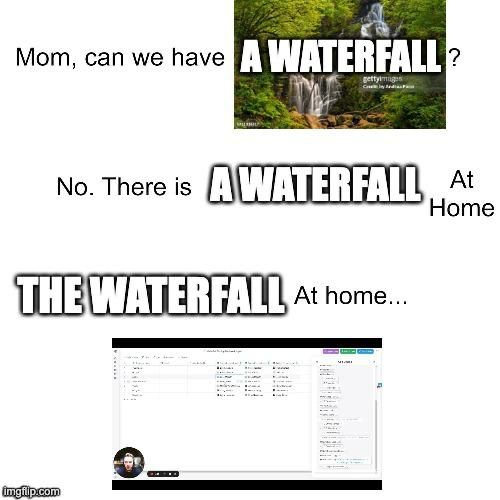
In this guide, I’ll break down how waterfall enrichment works, how modern GTM teams decide provider order, what fields are actually worth enriching, and why this approach often beats throwing budget at one “all-in-one” data platform that promised the moon and delivered a CSV.
What is a waterfall data enrichment workflow?
A waterfall data enrichment workflow is a system where records pass through multiple data vendors in a predefined sequence. If the first provider returns a match, great, the record moves on. If it fails or returns low-confidence data, the record cascades to the next provider in line. Then the next, and so on, until the record is enriched or the waterfall is exhausted.
The logic is straightforward. Think of it like calling a list of restaurants on a Friday night. You try your first choice, and if they're fully booked, you move to the second. You don't call all ten at once and pay ten cover charges. You work down the list until you get a table.
The reason this architecture exists is simple: no single vendor owns the truth. One provider might be excellent at US-based SaaS contacts and their work emails. Another might have superior coverage of EMEA mobile numbers. A third might specialise in firmographic data like revenue bands, employee counts, and tech stack signals. Each has strengths, and each has gaps. A waterfall lets you combine those strengths without paying for overlapping coverage.
Here's what makes a waterfall enrichment system distinctive from just "using multiple tools":
- Sequential logic. Providers fire in a deliberate order, not all at once.
- Higher coverage. You get composite match rates that exceed any single source.
- Cost control. Fallback vendors only process the records that earlier providers missed.
- Flexibility. You can enrich contacts, accounts, intent signals, and technographics through the same architectural pattern.
- Confidence scoring. Each step can include a threshold. If a provider returns data but at low confidence, the record still cascades.
Most teams think of enrichment as a data problem. Fill the empty fields, move on. But the real product of a waterfall isn't data. It's decision confidence. When your SDR picks up a lead, do they trust the email? When your routing logic assigns a territory, is the company size accurate? When your ABM campaign targets an account, is the firmographic data fresh?
A waterfall is a confidence engine. Every step in the sequence is designed to increase your team's trust in the record before it hits a human's workflow.
Why do GTM engineers choose waterfalls over a single provider?
The instinct to consolidate makes sense on paper. One vendor, one contract, one integration, one dashboard. It's clean. Marketing leaders often prefer this approach because it simplifies procurement and vendor management. But GTM engineers see the problem from a different angle, because they're the ones who deal with the downstream consequences when that single source falls short.
Here's what typically goes wrong with a single-source setup:
- Coverage gaps. Your vendor might cover 70% of your ICP, but the 30% it misses are often the exact accounts your sales team cares about most.
- Geography blind spots. A provider strong in North America might return almost nothing useful for UK, DACH, or ANZ contacts.
- Missing critical fields. You get emails but no phone numbers. Or you get titles but no department classifications.
- Stale job data. People change roles roughly every 2.5 years. A single provider's refresh cycle might not catch that quickly enough.
- Vendor lock-in. When renewal comes around, your negotiating power is essentially zero because switching costs feel enormous.
GTM engineers prefer waterfalls because they solve for outcomes. A waterfall delivers higher composite match rates, which directly translates to lower bounce risk in outbound sequences. It enables better routing logic because more fields are populated accurately. And the blended cost per enriched lead is often lower than a premium single-source contract, because fallback vendors only process the leftovers.
There's a mindset difference worth naming here. Marketing leaders tend to buy data tools. They evaluate vendors, compare feature lists, negotiate contracts. GTM engineers buy systems that survive scale. They think about what happens when lead volume doubles, when you expand into a new region, when a vendor's data quality degrades quietly over six months. A waterfall is designed for those realities. It's modular, so you can swap a vendor without rebuilding the whole pipeline. It's measurable, so you can track which provider is actually earning its cost. And it's resilient, because no single point of failure can tank your data quality overnight.
Industry conversations around B2B data enrichment have shifted noticeably in this direction. The consensus among RevOps and GTM engineering teams is that waterfall enrichment consistently outperforms single-source setups for coverage, especially when your ICP spans multiple segments or geographies.
How does a modern waterfall workflow actually work?
Understanding the concept is one thing. Seeing the architecture is another. Let me walk through what a real-world waterfall looks like, from input to CRM, with the decision points in between.
Where records enter the waterfall
Your waterfall needs a trigger, some event that creates or updates a record and kicks off the enrichment sequence. The most common input sources for B2B teams include:
- CRM leads and contacts created manually or via import.
- Demo request form fills from your website.
- Anonymous website visitors identified through reverse-IP or fingerprinting tools.
- Event and conference badge scans uploaded as CSV lists.
- Product signups from a free trial or freemium tier.
- Imported lists from partnerships, webinars, or co-marketing campaigns.
Each of these enters the waterfall at slightly different states of completeness. A demo form fill might already have a name, company, and email, but lack seniority and phone number. A website visitor record might have nothing but a company domain. The waterfall's job is to take whatever you've got and make it actionable.
The enrichment sequence, step by step
Here's a simplified version of how most GTM engineering workflows structure this:
- Normalise the company domain. Strip out subdomains, clean up formatting inconsistencies, and match to a canonical domain. This is the key that unlocks everything else.
- Check the CRM for existing records. Before you spend a single credit, see if the record already exists with usable data. Deduplication before enrichment saves real money.
- Query Provider A for primary fields. This is typically your strongest, broadest vendor. You're looking for work email, job title, seniority, and basic firmographics.
- If email is missing, cascade to Provider B. Provider B might specialise in contact discovery or have different sourcing methods that catch what A missed.
- If phone is missing, cascade to Provider C. Direct dials and mobile numbers are notoriously patchy. A dedicated phone-data provider often fills this gap.
- If confidence is low, run a verification pass. An email validation tool or phone verification API checks that what you've collected is actually deliverable.
- Push the enriched record to your CRM and sales engagement tool. Include source tags that identify which provider contributed each field.
- Trigger routing rules. With clean, enriched data, your lead routing logic can actually work. Assign by territory, segment, or account tier.
The tools GTM engineers commonly use to orchestrate this vary by team maturity. Some build directly in Clay, which handles multi-step enrichment natively. Others use n8n or similar workflow automation platforms. More mature teams build on Reverse ETL tools like Hightouch to sync enriched data from a warehouse back into the CRM. And some teams, especially at scale, build internal APIs that wrap vendor endpoints into a single enrichment service.
The key principle is that the waterfall is orchestrated, not manual. Nobody's logging into three vendor dashboards and copy-pasting results. The sequence fires automatically, the cascading logic runs on rules, and the output lands cleanly in the CRM with metadata attached.
A quick visual of the flow
What makes this architecture elegant isn't any single step. It's the fact that each step has a clear purpose and a clear condition. You don't waste vendor credits on records that are already complete. You don't skip verification just because a provider returned a result. And you never push untagged data into Salesforce where nobody can trace where it came from.
How should you choose the right provider order?
This is the section where most blog posts on waterfall enrichment get lazy. They'll tell you to "use the best provider first" and leave it there. That advice is useless because "best" depends entirely on who you're selling to.
The provider order in your waterfall should be driven by your ICP, not by some universal vendor ranking. A provider that's outstanding for US mid-market SaaS contacts might be mediocre for EMEA financial services. Your sequence needs to reflect your specific win conditions.
If you're selling to US SaaS mid-market
This is the most common ICP for B2B SaaS teams, and fortunately, it's also the best-covered by most data vendors. Your sequence might look like this:
- Lead with a provider that has strong US contact data. Names like Apollo, ZoomInfo, or Cognism often have dense coverage in this segment.
- Follow with an org-chart provider. If you need to map buying committees or identify multiple stakeholders at target accounts, a provider with organisational hierarchy data is valuable as a second step.
- Close with a mobile number specialist. Direct dials are the hardest field to source accurately. A dedicated provider as the final fallback maximises your chance of getting a usable number.
If you're selling to Europe
EMEA changes the calculus significantly. GDPR compliance isn't optional, and coverage from US-centric providers drops off sharply for markets like Germany, France, or the Nordics.
- Start with a GDPR-compliant source. Providers like Cognism or Lusha that have invested heavily in European compliance and sourcing should lead.
- Add a regional specialist. Some vendors focus specifically on DACH or UK contacts and have sourcing methods that global providers don't replicate.
- Finish with an email verifier. European email deliverability standards are strict, and bounce rates from unverified contacts will damage your sender reputation fast.
If you're running an ABM motion
ABM shifts the priority from individual contacts to account-level intelligence. Your waterfall's early steps need to focus on firmographics and signals before expanding to contacts.
- Firmographic data first. Revenue band, employee count, industry classification, HQ location. These determine whether the account even qualifies
- Buying signals second. Intent data, hiring patterns, technology adoption signals. These tell you whether the account is active in a buying cycle.
- Contact expansion third. Once you've confirmed the account is worth pursuing, you expand to individual contacts within the buying committee.
The critical takeaway here is to avoid ranking vendors globally. Rank them by win condition. Your ICP dictates the sequence, and if you serve multiple ICPs, you might need multiple waterfall configurations running in parallel.
I've seen teams spend weeks debating which vendor is "the best" as if it's a universal truth. The better question is: which vendor is best for the 60% of records that look like our closed-won deals from last quarter? Start there, and let the waterfall handle the rest.
Which fields are worth enriching (and which ones can you skip)?
Not all enrichment is created equal. Some fields directly impact revenue decisions, routing accuracy, and outbound performance. Others look useful in a dashboard but never actually influence a workflow. GTM engineers who've been through a few rounds of vendor evaluations learn this distinction quickly.
- High-value fields that earn their cost
These are the fields that, when populated accurately, change what your team can do:
- Verified work email. The foundation of outbound. Without it, nothing else matters.
- Seniority level. Knowing whether someone is a Director, VP, or IC determines messaging, routing, and whether they're a decision-maker.
- Department. Marketing, Sales, Engineering, Finance. This drives which sequence or campaign a contact enters.
- Revenue band. Determines segment (SMB, Mid-Market, Enterprise) and shapes everything from pricing to sales motion.
- Employee count. A proxy for company complexity and potential deal size.
- HQ geography. Drives territory assignment, compliance considerations, and timezone-aware outreach.
- Tech stack. Tells you what the prospect already uses, which influences competitive positioning and integration messaging.
- Hiring growth signals. A company actively hiring in your buyer's department is often a signal of budget and initiative.
- CRM owner history. Knowing who previously owned the account prevents embarrassing overlaps and wasted effort.
- Fields that teams over-invest in
Some fields sound valuable in a vendor pitch but rarely move the needle in practice:
- Random social media links. A prospect's Twitter handle almost never influences B2B outbound effectiveness.
- Vanity scores. Proprietary "fit scores" or "intent scores" from vendors that don't share their methodology are hard to trust or action.
- Excessive intent categories. Fifty granular intent topics sound impressive, but if your SDRs can't translate them into a personalised opening line, they're noise.
- Low-confidence phone numbers. A phone number that rings to a main switchboard or is six months out of date wastes more rep time than having no number at all.
The pattern I notice with most teams is this: they over-enrich noise and under-enrich routing fields. They'll pay for intent categories they never look at while leaving seniority and department blank because those fields "seemed basic." Basic fields are basic because they're essential. They power your lead scoring, your routing rules, your segment definitions. Without them, your fancy intent data has nowhere to go.
When you're building your waterfall, start by listing the fields that your routing logic, scoring model, and outbound sequences actually consume. Those are the fields worth enriching. Everything else is optional until those are covered.
Real-world use-cases for B2B teams
Waterfall enrichment is a pattern, not a product. The same architectural logic applies across very different GTM motions, but the specific implementation changes depending on the use case. Here are the ones I see most often in B2B teams that take their contact enrichment process seriously.
- SDR outbound
This is the most obvious use case and the one that usually justifies the first waterfall investment. The workflow is straightforward: identify target accounts, enrich them overnight or in real-time, auto-create contacts in the CRM, and surface them in the SDR's engagement tool by morning.
The waterfall's value here is direct. Higher match rates on email and phone mean more contacts per account that the rep can actually reach. Better title and seniority data means fewer messages wasted on contacts who aren't decision-makers. And because the waterfall tags each field with its source, your sales ops team can track which vendor is actually driving the conversations that lead to meetings.
One team I worked with went from a 55% email match rate with a single vendor to 78% with a three-provider waterfall. The cost per enriched lead dropped by about 20% because the fallback vendors were only processing the leftover records. The sales impact wasn't subtle.
- Inbound speed-to-lead
Every minute between a form submission and a sales response matters. Studies have shown the conversion rate drops dramatically after the first five minutes. A waterfall enrichment workflow that fires on form submission can enrich the record within seconds, before the routing logic even kicks in.
Imagine this: someone fills out your demo form with just their name and work email. In the background, the waterfall resolves their company, pulls firmographic data, identifies their seniority, checks for existing CRM records, and pushes the enriched lead into the right rep's queue. By the time the rep opens the notification, they already know they're talking to a VP of Marketing at a 200-person SaaS company. That context changes the entire conversation.
- ABM ad audiences
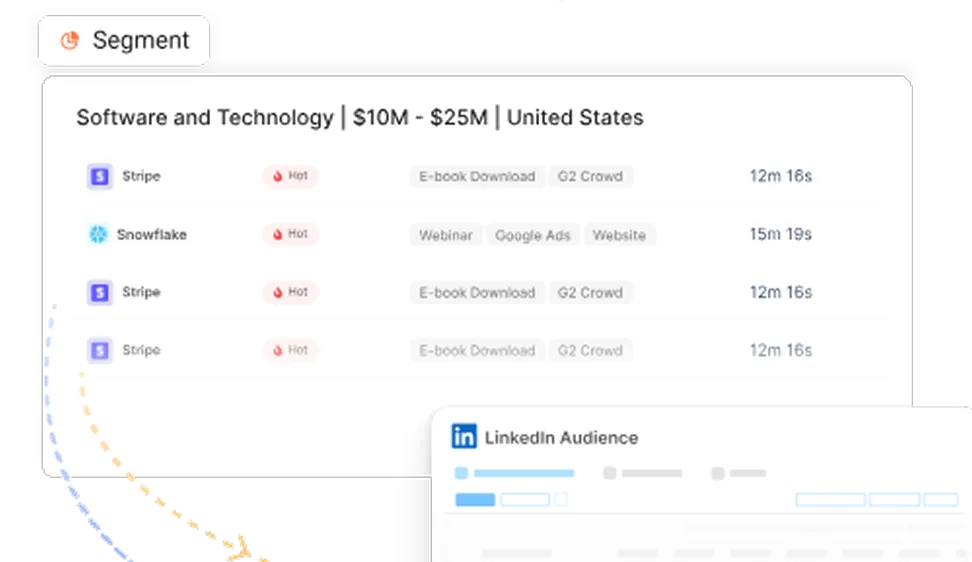
If you're running account-based advertising on LinkedIn or Google, the quality of your target account list determines everything. A waterfall can enrich your account list with firmographic and technographic data, then sync the enriched segments directly into your ad platforms.
The enrichment here isn't about individual contacts. It's about making sure your account list is accurately segmented by revenue, industry, tech stack, and geography so your ad spend goes where it matters. Without enrichment, you're targeting a generic list and hoping the platform's native targeting fills the gaps. With it, you're controlling the targeting yourself.
- Territory planning
Balancing sales territories fairly is a challenge that gets harder as your team grows. If your CRM data on company headcount, revenue, and geography is incomplete, your territory assignments will be skewed. Some reps get a book of high-potential accounts. Others get a book of unknowns.
Waterfall enrichment lets you fill those gaps systematically. Enrich every account in the CRM with employee count, revenue band, and HQ location, and suddenly your territory model has the inputs it needs to divide the book equitably. RevOps teams who've done this often discover that their old territory assignments were significantly imbalanced once the data gaps were filled.
- Pipeline attribution
This use case connects enrichment to revenue visibility, and it's where the value of the entire workflow becomes most tangible. When you can map anonymous website visitors to enriched account records, and then tie those accounts to pipeline and revenue, you've closed the loop between marketing activity and business outcomes.
Without enrichment, your anonymous traffic is just a number in Google Analytics. With it, you can say "we had 47 visits from target accounts this week, 12 of which are in active pipeline." That's the difference between marketing reporting and revenue intelligence. This is also where Factors.ai's relevance becomes particularly strong, but I'll get to that shortly.
Cost control, governance, and the match rate math
This section never gets the attention it deserves in enrichment conversations…. and that’s why we’ll spend some time here. Most teams focus on vendor features and match rates during the buying process, then don't revisit the economics until the renewal bill arrives. GTM engineers who treat enrichment as a system, not a purchase, think about cost structure from the start.
How does blended economics actually work?
The beauty of a waterfall is that you don't pay every vendor for every record. Your primary provider handles the bulk of the volume. The second provider only processes the records that the first one missed. The third provider only processes what both missed.
Here's a concrete example:
If you'd queried all three vendors for every record in parallel, your total cost would have been $100,000 (10,000 × $10). The waterfall achieves 92% coverage for roughly 28% of the parallel cost. That's not a marginal saving. It's a fundamentally different cost model.
The blended cost per enriched lead in this example is about$3. If you'd used only Provider A, you'd have 70% coverage at$2 per lead. The waterfall gets you to 92% at$3 per lead. That extra 22% coverage often represents the accounts your sales team cares about most, the ones that are harder to find.
Governance rules that prevent data rot
Cost control isn't just about vendor credits. The biggest hidden cost in enrichment is wrong data entering your CRM and silently corrupting everything downstream. A bad email means a bounced sequence. A wrong title means a misrouted lead. A stale company size means a deal that gets assigned to the wrong segment and the wrong rep.
Here are the governance rules that mature teams enforce:
- Never overwrite manually entered CRM fields. If a sales rep has updated a contact's phone number or title from a live conversation, that's the freshest data you have. Your enrichment workflow should respect it.
- Timestamp every enrichment source. Every field should carry metadata showing which provider populated it and when. This makes troubleshooting possible and vendor performance audits straightforward.
- Store confidence scores. If a provider returns a result with 60% confidence, treat it differently than one with 95% confidence. Your routing and scoring logic should consume confidence as an input, not just the field value.
- Re-enrich stale records on a 90 to 180-day cycle. People change jobs. Companies grow. Revenue bands shift. A record enriched six months ago might already be misleading your team.
- Audit duplicate vendors quarterly. Over time, teams accumulate overlapping data subscriptions. A quarterly review ensures you're not paying two vendors for the same coverage.
I've seen teams who obsess over vendor credit pricing while ignoring the cost of a bad Salesforce record that sends a deal down the wrong path. If you aren't measuring the accuracy of what enters your CRM, you're optimising the wrong thing.
Common mistakes GTM engineers make with waterfall enrichment
Even experienced GTM engineers stumble on some of these. Waterfall enrichment is conceptually simple, but the operational details have sharp edges that only show up at scale.
- Querying every provider for every record
This is the most expensive mistake and the most common one for teams transitioning from single-source enrichment. The whole point of a waterfall is conditional execution. If you're sending every record through every vendor "just to be safe," you're running parallel enrichment at waterfall's cost structure. Pick one approach and commit.
- No confidence thresholds
A match isn't a match isn't a match. Provider A might return an email with 95% confidence and Provider B might return one with 50% confidence. Without thresholds, your system treats both identically. Setting confidence floors, even simple ones like "only accept emails above 80% confidence," prevents low-quality data from entering your workflows.
- No deduplication before enrichment
If you don't check for existing CRM records before firing the waterfall, you'll burn credits enriching records you already have. Worse, you might create duplicates that confuse your routing and attribution. A CRM dedup check should always be the first step in the sequence.
- Overwriting rep-entered CRM data
Your SDR just had a call with a prospect who told them their direct number. Your enrichment workflow fires overnight and overwrites it with a switchboard number from Provider B. This happens more often than anyone admits, and it erodes sales team trust in the system.
- Ignoring stale data refresh cycles
Enrichment isn't a one-time event. B2B contact data decays at roughly 30% per year. If you enriched your database twelve months ago and haven't touched it since, nearly a third of it is suspect. Build re-enrichment into your workflow as a recurring process, not a one-off project.
- Buying more data before fixing routing logic
I've seen teams purchase a third enrichment vendor while their lead routing was still assigning leads randomly because the department field was empty. More data doesn't help if your system can't use the data it already has. Fix your routing and scoring logic first, then identify which missing fields are actually blocking those systems.
- No reporting on hit rate by vendor
If you don't measure which vendor is contributing what percentage of successful enrichments, your waterfall is just expensive plumbing. Monthly reporting on hit rate, cost per enriched record, and data quality by vendor is how you know whether your sequence is optimised or just running.
The common thread in all these mistakes is treating enrichment as a procurement problem rather than an engineering problem. Buying data is easy. Building a system that turns data into reliable decisions at scale is the actual work.
How does Factors.ai fits into the waterfall enrichment workflow?
Most enrichment tools solve the same problem: fill in missing fields on a known record. Factors.ai occupies a different position in the workflow because it starts a step earlier, at the point where you don't even know who's on your website yet.
Here's where Factors.ai connects to the waterfall pattern:
- Identifying anonymous website companies
Before you can enrich a record, the record has to exist. Factors.ai resolves anonymous website traffic into company-level identities. That gives your waterfall an entirely new input source: accounts that are actively visiting your site but haven't filled out a form.
- Enriching accounts before sales outreach
Once Factors.ai identifies a visiting company, that account can enter your enrichment waterfall. The result is a fully enriched account record, with firmographics, contacts, and engagement context, ready for outbound before the prospect has ever raised their hand.
- Triggering account scoring models
Enriched account data feeds your scoring logic. Factors.ai combines website engagement signals with enrichment data to help you prioritize which accounts are worth pursuing right now, not just which accounts look good on paper.
- Syncing audiences to LinkedIn and Google
Enriched account segments can be pushed directly into ad platforms for retargeting or ABM campaigns. This closes the gap between your enrichment system and your paid media execution.
- Connecting enrichment to pipeline outcomes
This is the piece most enrichment tools don't touch. Factors.ai lets you see which enriched accounts actually progressed through pipeline and which ones converted. That feedback loop is what turns enrichment from a cost centre into a measurable revenue input.
- Showing which enriched accounts actually convert
When you can tie enrichment back to closed revenue, you can calculate the actual ROI of your waterfall. Not just "we enriched 10,000 records" but "the records we enriched sourced$4.2 crore in pipeline this quarter."
- Many tools enrich records
Factors.ai helps enrich the decisions your team makes about which accounts to pursue, when to pursue them, and how to measure whether the pursuit was worth it. That's a different category of value than filling in a phone number.
How do you build your first waterfall workflow in seven steps?
If you've read this far and you're ready to build, here's a practical checklist that takes you from "we should do waterfall enrichment" to "it's running and measurable." The goal is to start focused, prove value quickly, and expand from there.
Step 1: Define your ICP segments
Before you choose a single vendor, write down who you're actually selling to. Industry, company size, geography, department of your buyer, seniority of your buyer. Be specific. "B2B SaaS companies in the US with 50 to 500 employees" is a segment. "Companies that might buy our product" is not.
Your ICP definition drives everything downstream: which vendors to evaluate, what order to put them in, and which fields to prioritise. Skip this step and you'll build a waterfall optimised for the wrong audience.
Step 2: List the fields that impact revenue decisions
Go through your lead scoring model, your routing rules, and your outbound sequences. Which fields do they actually consume? If your routing depends on company size and geography, those are high-priority enrichment fields. If your scoring model uses department and seniority, those go on the list too.
Be ruthless here. Only list fields that directly influence a workflow or decision. "Nice to have" fields can come later.
Step 3: Benchmark your current missing-field rates
Pull a report from your CRM showing what percentage of records are missing each of the fields you identified in Step 2. This gives you a baseline. If 60% of your leads are missing seniority data, you know exactly what your waterfall needs to fix first.
This step also reveals which fields are your biggest bottleneck. Some fields might already be at 90% coverage and don't need waterfall treatment. Others might be at 30% and are actively breaking your workflows.
Step 4: Choose two to three vendors with complementary strengths
Notice I said complementary, not "best." You want vendors whose coverage overlaps as little as possible. If Provider A is strong in US email but weak in EMEA phone, Provider B should be the reverse. Evaluate vendors against your ICP specifically, not their general marketing claims.
Request trial access and run a sample of 500 to 1,000 records from your CRM through each vendor independently. Compare match rates by field and by segment. This test takes a few days and saves you months of regret.
Step 5: Set routing and confidence logic
Define the rules that govern your waterfall. What confidence threshold triggers a cascade to the next provider? Which fields are mandatory versus optional? What happens when no provider returns a match? Do you flag the record for manual research or let it pass through unenriched?
Also decide your overwrite rules. Should enrichment data overwrite existing CRM values? For which fields? Under what conditions? These rules seem minor until the first time your enrichment workflow overwrites a rep's hand-entered data, and then they become very important very fast.
Step 6: Push into CRM with source tags
Every field that enters your CRM from the waterfall should carry metadata. Which provider supplied it, when it was enriched, and what the confidence score was. This isn't just good hygiene. It's the foundation for vendor performance reporting and data quality audits.
Set up your CRM fields to accommodate this metadata. Most teams use custom fields or a structured notes field. The exact implementation depends on your CRM, but the principle is non-negotiable: untagged enrichment data is untraceable enrichment data.
Step 7: Review monthly by pipeline impact, not vanity fill rate
This is where most teams get the measurement wrong. They track "percentage of fields filled" as their primary metric and call it a day. Fill rate is a fine operational metric, but it doesn't tell you whether your enrichment is actually working.
The metrics that matter are downstream: Has outbound reply rate improved? Has lead routing accuracy increased? Are reps spending less time researching contacts? Most importantly, has pipeline from enriched records grown? If you can connect enrichment to pipeline impact, you've built a system that justifies its own budget. If you can only show fill rates, you've built a cost line that finance will question every quarter.
One last piece of advice: start with one funnel stage, not your whole database. Pick inbound leads, or a specific outbound segment, or your ABM target account list. Build the waterfall for that slice, prove it works, measure the impact, and then expand. Teams that try to enrich everything on day one end up with a complex system and no clear evidence that it's working.
In a nutshell…
Waterfall data enrichment workflows exist because the B2B data landscape is fragmented by design. No single vendor covers every geography, every job function, every field your team needs. Instead of hoping one provider will solve everything, GTM engineers build sequential systems that combine multiple vendors' strengths while controlling costs.
The architecture is straightforward: records cascade through providers in a deliberate order, each vendor only fires on what the previous one missed, and every field enters the CRM with source tags and confidence scores. The economic model is compelling because you pay progressively, not universally.
What separates teams that get real value from this pattern is discipline. They define their ICP before choosing vendors. They prioritize fields that drive routing and scoring, not vanity metrics. They set confidence thresholds and overwrite rules. They measure by pipeline impact, not fill rate. And they treat enrichment as a recurring process, not a one-time project.
If you're just getting started, pick one funnel stage, two or three complementary vendors, and a clear set of fields that actually matter to revenue. Start small, instrument everything, and learn where your gaps really are before adding more complexity. You do not need a sprawling RevOps science experiment on day one. You need a system that works reliably.
Because that’s the real shift here. Good enrichment is not about having the most providers or the biggest database. It’s about getting the right data to the right team at the right moment, without wasting money or polluting your CRM in the process.
In a market where speed matters, territory precision matters, and sales teams have zero patience for bad records, waterfall enrichment stops being a backend nice-to-have. It becomes operating leverage.
FAQs for waterfall data enrichment workflow
Q1. What exactly is a waterfall data enrichment workflow?
A waterfall workflow is a sequential system where a record (lead or account) is sent to multiple data vendors in a specific order. If Vendor A fails to find a match or returns low-confidence data, the record "cascades" to Vendor B, then Vendor C. This process continues until the required fields are filled or all providers are exhausted.
Q2. Why should I use a waterfall instead of one premium provider?
No single data vendor has 100% coverage. A provider might be elite at US-based SaaS contacts but have massive blind spots in EMEA or APAC. Using a waterfall allows you to:
- Increase Match Rates: Blending multiple sources typically pushes match rates 20–40% higher than any single tool.
- Reduce Costs: You only pay for credits from secondary vendors when your primary (usually cheaper) vendor misses.
- Improve Accuracy: You can set "confidence thresholds" so that low-quality data from one vendor is automatically challenged by another.
Q3. How do I decide the order of my vendors?
The order should be determined by your Ideal Customer Profile (ICP) and geography, not vendor popularity.
- Primary Vendor: Your most cost-effective tool with the broadest coverage for your main market.
- Secondary Vendor: A specialist in the gaps of your primary tool (e.g., a specialist in mobile numbers or European GDPR-compliant data).
- Final Fallback: A high-cost, high-accuracy "premium" source that you only use for the hardest-to-find records.
Q4. Which fields are most important to enrich?
Focus on the fields that drive routing, scoring, and messaging. GTM engineers prioritize:
- Verified Work Email: The absolute baseline for outbound.
- Seniority & Department: Essential for routing leads to the right sales pod.
- Revenue & Employee Count: Used to segment accounts (SMB vs. Enterprise).
- Technographics: Knowing a prospect's tech stack (e.g., "Do they use Salesforce?") allows for highly personalized outreach.
Q5. How does Factors.ai fit into this workflow?
Most enrichment tools require you to already have a lead's name or email. Factors.ai starts a step earlier by identifying anonymous website visitors at the company level. Once a high-intent company is identified, it can be pushed into your waterfall workflow to find the right contacts (e.g., the VP of Marketing) before they even fill out a form.
Q6. What are the common "hidden costs" of enrichment?
The biggest cost isn't vendor credits; it's bad data integrity.
- Overwriting Rep Data: If a rep manually enters a phone number from a live call, your workflow should never overwrite it with automated data.
- Data Decay: B2B data decays at roughly 30% per year. Without a "refresh" cycle (re-enriching every 90–180 days), your CRM will eventually be filled with "ghost" contacts.

See how Factors can 2x your ROI
Boost your LinkedIn ROI in no time using data-driven insights
Try AdPilot Today


.avif)

See Factors in action.
Schedule a personalized demo or sign up to get started for free
LinkedIn Marketing Partner
GDPR & SOC2 Type II

.svg)










.png)