
Heading 2
Signal-based Outbound Workflows: how GTM engineers trigger outreach with buyer intent
Learn how GTM engineers use buyer intent signals to trigger outbound workflows, enrich accounts, route leads, and create pipeline faster.
Written by
.avif)
Vrushti Oza
Content Marketer
Summarize this article




.svg)


TL;DR
- Signal-based outbound workflows replace static lead lists with real-time buyer intent signals, triggering outreach only when accounts show genuine buying behaviour like pricing page visits, hiring spikes, or competitor research.
- The five-step signal workflow loop (detect, score, enrich, trigger, learn) gives GTM engineers a repeatable system for converting intent into pipeline, not just activity.
- First-party signals like repeat website visits and product usage expansion are often more reliable than third-party data, but the strongest programmes layer both together with ICP fit filters.
- Metrics like signal-to-meeting rate, pipeline per signal source, and win rate by signal type matter far more than open rates or reply rates when measuring signal programme health.
- The next wave of agentic outbound systems will monitor accounts autonomously, draft contextual outreach, and adjust playbooks in real time, making speed-to-signal the new competitive advantage.
You’re an SDR… you've spent forty-five minutes researching an account, crafting a personalized email, referencing a recent blog post they published, and maybe even a mutual LinkedIn connection. You hit send with the confidence of someone who's done their homework. Two weeks later… you learn the company signed with a competitor three months ago, and your perfectly crafted email landed in the inbox of someone who'd already made up their mind long before you showed up.
That feeling, the sinking realization that your timing was completely off, is the core problem with traditional outbound… you weren't wrong about the account… you weren't wrong about the message… you were wrong about the moment. And in B2B sales… the moment is almost everything.
Signal-based outbound workflows exist because of this exact gap. Instead of starting with a list and hoping your timing is decent, these systems start with a signal, a real buying behavior that suggests someone is actively in-market, and then they trigger the right outreach at the right time. It's a fundamental shift in how GTM engineers think about pipeline generation, and it's reshaping how the best B2B SaaS teams operate in 2026.
In this article, I’ll walk you through what signal-based prospecting actually looks like, why it works better than volume-driven outbound, and how to build a system that turns buyer intent signals into revenue instead of noise.
What are signal-based outbound workflows, exactly?
At the simplest level… a signal-based outbound workflow is an automated outreach system that fires when real buying behavior appears. Instead of relying on static lead lists or mass cold outreach, these workflows watch for specific actions, events, or patterns that suggest an account might be ready to buy. When those signals cross a confidence threshold, the system triggers a sequence of actions, whether that's alerting a rep, launching an email sequence, or syncing an account to an ad audience.
The distinction from traditional outbound is straightforward. Traditional outbound asks, "Who should we contact?" Signal-based outbound asks, "Who is showing intent right now?" That single reframe changes everything downstream, from how reps spend their time to how pipeline gets generated.
The signals themselves can take many forms. A cluster of pricing page visits from the same company. A target account hiring for a role that suggests they're building out a function your product supports. A funding announcement that changes their budget picture. Competitor searches that indicate active evaluation. Product usage spikes that hint at expansion readiness. Three different people from the same organisation visiting your site within a week.
Each of these moments represents a window where outreach moves from interruption to relevance. The best outbound in 2026 feels less like a cold call and more like a well-timed conversation that the prospect didn't know they needed but is glad showed up. That's the promise of intent-based outbound, and when it's engineered properly, it delivers.
What makes this approach genuinely different isn't the technology alone. It's the philosophy behind it. You're no longer optimising for volume or hoping that sheer activity creates enough at-bats to hit quota. You're optimising for timing, and timing compounds in ways that volume never can. A perfectly timed email to a genuinely interested buyer converts at rates that make spray-and-pray outbound look almost absurd by comparison.
Why is traditional outbound losing efficiency?
If you've managed an SDR team in the last two years, you've probably noticed the trendlines moving in the wrong direction. Reply rates declining. More emails needed per meeting booked. Reps spending increasing amounts of time on research that doesn't convert. The legacy SDR playbook, build a list, write sequences, blast them out, measure activity, is losing steam, and there are structural reasons why.
- The first is that buyers research anonymously before they ever want to talk to sales. By some estimates, B2B buyers complete the majority of their evaluation process before engaging with a vendor directly. They're reading your content, visiting your pricing page, comparing you against competitors, all without filling out a form or raising their hand. Your SDR team can't time outreach to a journey they can't see, which means most cold emails arrive either far too early or embarrassingly late.
- The second problem is inbox saturation. Every B2B buyer with a LinkedIn profile and a company email gets dozens of cold outreach messages weekly. The bar for earning attention keeps rising, but most outbound teams are still competing on volume rather than relevance. When everyone's sending "quick question" emails, nobody's email stands out. Domain reputation issues compound this, as high-volume sending patterns trigger spam filters more aggressively than they did even a year ago.
- Then there's the manual research bottleneck. Reps spend hours trying to figure out who to contact, what to say, and whether the timing makes sense. Most of that research yields dead ends or stale information because CRM data decays fast. Job titles change, companies get acquired, budgets shift quarterly. The data your rep is working from might have been accurate six months ago, but the buying landscape has moved on.
Unfortunately, the cost of bad timing is now higher than the cost of bad copy. Even a brilliantly written, deeply personalized email gets ignored if it lands in someone's inbox three months before they're ready to evaluate solutions. In B2B SaaS, where buying committees involve five to ten stakeholders and sales cycles stretch across quarters, timing isn't a nice-to-have. It's the single variable that determines whether your outreach gets a response or gets archived.
Traditional outbound isn't dead, but it's become remarkably inefficient when it operates blind. The teams that are still growing pipeline consistently aren't sending more emails. They're sending fewer emails to better-timed accounts, and that distinction matters enormously.
Which signals do GTM engineers actually use?
Not all signals are created equal, and one of the first mistakes teams make is treating every data point like a buying signal. A single blog visit from a random IP isn't a signal. Three decision-makers from a target account visiting your pricing page within 48 hours, that's a signal. The difference is pattern recognition and intent confidence.
GTM engineers typically organise signals into four categories, each with different reliability levels and use cases.
- First-party signals
These come from your own properties and tools, which makes them the most reliable because you control the data quality. They include website visits (especially to high-intent pages like pricing, demo requests, and comparison pages), repeat visits from the same account, trial signups, product usage expansion, and webinar engagement. First-party intent data is the foundation of most signal programmes because it reflects direct interaction with your brand.
- Third-party signals
These originate outside your owned ecosystem and require enrichment tools or data partners. Funding rounds change a company's budget picture. Hiring spikes for specific roles suggest they're building a function your product supports. Tech stack changes (like switching away from a competitor's tool) indicate active evaluation. Review site research on platforms like G2 or Capterra means they're comparing options. Search intent data reveals what topics and solutions accounts are actively researching.
- Relationship signals
These are often the most actionable and the most overlooked. A former champion changing jobs to a new company is one of the strongest buying signals in B2B, because they already know and trust your product. An existing customer acquiring another company creates expansion potential. A new executive hire at a target account often triggers a 90-day window where new tools get evaluated and purchased.
- Dark funnel signals
These are the hardest to measure but often the earliest indicators of intent. Direct traffic spikes to your site from a specific account suggest they've heard about you through word-of-mouth or offline channels. Branded search increases mean your company name is being actively researched. Multiple anonymous visits from the same account, even without form fills, indicate growing interest that hasn't surfaced yet.
Here's a comparison of these signal types at a glance:
The nuanced take that separates good signal programmes from noisy ones is this: not every signal deserves outreach. A funding announcement from a company outside your ICP is just news. A pricing page visit from a two-person startup when you sell enterprise software is noise. Signals need three things before they should trigger action: ICP fit, timing relevance, and intent confidence. Without all three, you're just automating irrelevance at speed, which is arguably worse than doing nothing.
How do signal-based workflows operate step by step?
The beauty of a well-designed signal workflow is that it looks simple from the outside but requires careful engineering underneath. GTM engineers build these systems as loops, not linear processes, because signals keep arriving and the system needs to keep learning. Here's the practical framework most high-performing teams follow.
Step 1: Detect
Everything starts with collection. Signals flow in from multiple sources: your CRM, website analytics, ad platforms, product telemetry, LinkedIn activity, and third-party enrichment tools. The engineering challenge here is unification. Most teams have signal data scattered across six or seven tools, and without a central layer that stitches it together at the account level, individual signals remain isolated data points rather than a coherent picture.
This is where real-time prospecting signals matter most. A pricing page visit that takes three days to surface in a report is no longer real-time. Detection needs to happen within minutes or hours, not days. The faster you detect, the more relevant your response can be, and relevance decays quickly in B2B buying cycles.
Step 2: Score
Not all detected signals carry the same weight, so scoring is where engineering judgment becomes critical. A pricing page visit typically scores high because it suggests active evaluation. A blog read scores medium, it shows interest but not necessarily buying intent. A careers page visit is contextual, it might mean they're growing (a positive signal) or that a job seeker stumbled onto your site (noise).
Funding rounds are timing indicators rather than direct intent signals. They suggest budget availability but don't confirm interest in your specific product. The scoring model needs to account for these differences, weighting signals based on their historical correlation with pipeline creation.
The best scoring models are composite. They don't just look at a single signal in isolation. They look at signal combinations. One pricing page visit is interesting. Three pricing page visits from different people at the same company, combined with a G2 comparison page view, is a strong composite signal that warrants immediate action.
Step 3: Enrich
Once an account crosses your scoring threshold, the next step is enrichment. Raw signals tell you that something is happening. Enrichment tells you who to contact and what to say. This step adds contact details for the buying committee, maps roles and seniority levels, identifies the technology stack already in use, assigns territory ownership, and adds firmographic data like revenue band and employee count.
Enrichment transforms an anonymous signal into an actionable account profile. Without it, your SDR gets a Slack notification that says "Company X visited pricing" and has to spend thirty minutes figuring out who to email. With enrichment, that same notification arrives with three contacts, their roles, and the context needed to write a relevant first touch.
Step 4: Trigger action
This is where the workflow becomes visible. Based on the signal type, score, and enriched data, the system triggers a specific action. Common triggers include an AE Slack alert for high-value accounts, SDR task creation in the CRM for accounts that need personal outreach, a personalised outbound sequence launch, LinkedIn audience sync for account-based advertising, or even a direct mail trigger for enterprise prospects.
The trigger should match the signal strength. A dark funnel signal might warrant adding an account to an awareness ad campaign. A strong first-party signal like repeated pricing page visits from multiple stakeholders warrants a direct call from the account executive. Matching signal strength to response intensity is one of the subtleties that separates effective programmes from ones that burn through prospect goodwill.
Step 5: Learn
The final step closes the loop, and it's the one most teams skip. Every triggered workflow should track downstream outcomes: meetings booked, pipeline created, and revenue closed, all tied back to the original signal source. Over time, this data reveals which signals actually predict revenue and which ones generate activity without results.
This learning step is where the system gets smarter. You discover that pricing page visits from accounts with more than 200 employees convert to meetings at three times the rate of visits from smaller companies. Or that champion job-change signals produce pipeline with 40% higher win rates. These insights feed back into your scoring model, making every subsequent cycle more precise.
This is where GTM engineers outperform traditional ops teams. They design systems that improve themselves, not spreadsheets that need manual updating every quarter. The engineering mindset treats outbound as a product to be iterated, not a process to be managed, and that distinction produces compounding returns over time.
What does buyer intent-triggered outreach actually look like?
Abstract frameworks are useful, but nothing clarifies a concept like concrete scenarios. Here are four patterns that GTM engineering teams run regularly, each triggered by a different signal type.
Example 1: The pricing page spike
Three visitors from a single target account hit your pricing page within 48 hours. None of them fill out a form, but your signal detection layer identifies the company through IP-to-account matching and cross-references it against your ICP criteria.
The workflow fires automatically. First, it identifies the company and confirms it meets your firmographic filters. Then it enriches the account with buying committee contacts, pulling in the VP of Marketing, the Director of Revenue Operations, and the CFO. The account owner receives a Slack notification with the signal context and contact details. Within two hours, a warm outreach sequence launches, referencing the specific pain points that pricing page visitors typically care about, like implementation timelines, ROI benchmarks, and contract flexibility.
The key here isn't the automation. It's the speed. That 48-hour window of concentrated interest might close by the end of the week. Teams that detect and respond within hours have a fundamentally different conversion rate than teams that discover the same signal in a weekly report.
Example 2: The VP of Marketing hire
A target account announces a new VP of Marketing. This is a classic relationship signal because new leaders almost always evaluate their existing tool stack within their first 90 days. They want to put their stamp on the function, and they're actively looking for better solutions.
The workflow triggers an intro playbook designed specifically for new executive hires. It sends benchmark content relevant to their industry, positioning your brand as a knowledgeable resource rather than a pushy vendor. Simultaneously, a 14-day outreach sequence begins, carefully paced to avoid overwhelming someone who's still settling into their new role. The messaging acknowledges the transition and offers value before asking for a meeting.
This playbook works because it respects the buyer's context. A new VP doesn't want another sales pitch in week one. They want to look smart and make informed decisions. Signal-triggered outreach that matches this mindset converts remarkably well.
Example 3: Product usage expansion
Your freemium product shows an interesting pattern. An account that started with two users six weeks ago now has fourteen active users across three departments. Nobody's asked about upgrading, but the usage trajectory is unmistakable.
The workflow notifies the account's sales owner with a usage summary and growth chart. It also triggers an in-app message offering a team plan consultation, framed as a way to unlock collaboration features rather than a hard upgrade push. The sales owner reaches out with a personalized note referencing the team's growing adoption, which feels relevant and helpful rather than invasive.
Product-led growth signals like these are some of the highest-converting triggers available, because the prospect has already experienced your product's value firsthand. Outreach at this moment isn't cold. It's a natural extension of an existing relationship.
Example 4: Competitor search intent
Third-party intent data reveals that a target account has been researching alternatives to a competitor's product. They've visited comparison pages, read reviews, and searched for terms like "alternative to [Competitor Name]."
The workflow triggers two parallel actions. On the advertising side, the account gets added to a LinkedIn campaign serving comparison content and customer case studies. On the outbound side, an SDR sends a personalized email that addresses common switching concerns, like data migration, onboarding timelines, and integration compatibility. The messaging doesn't trash the competitor. Instead, it positions your product as the logical next step for teams that have outgrown their current solution.
What makes this scenario powerful is that the prospect has already self-identified as being in evaluation mode. Your outreach doesn't need to create demand. It needs to capture demand that already exists, and that's a much easier conversation to start.
How should you build the modern GTM engineering stack?
Building signal-based outbound workflows requires a layered architecture where each layer has a clear job. Teams that try to solve everything with a single tool inevitably hit limitations, while teams that buy dozens of point solutions create integration nightmares. The sweet spot is a deliberate, five-layer stack where each layer feeds the next.
- Data layer
This is your foundation. It includes your CRM (typically Salesforce or HubSpot), your data warehouse (Snowflake, BigQuery, or similar), website event tracking, and ad platform data. The goal of this layer is to consolidate every interaction and attribute that matters into a single, queryable source of truth. Without a clean data layer, every subsequent layer operates on shaky ground.
- Signal layer
This is where intent detection, enrichment, and identity resolution happen. Tools at this layer watch for buying signals across your first-party and third-party data sources, resolve anonymous website visitors to known accounts, and enrich those accounts with firmographic and contact data. The signal layer transforms raw data into actionable intelligence.
- Workflow layer
This is the orchestration engine. It takes scored, enriched signals and routes them to the right actions. Common tools here include n8n, Clay, Hightouch, and various reverse ETL platforms. The workflow layer is where GTM engineers spend most of their time, building the logic that determines what happens when a signal fires, who gets notified, and what sequence launches.
- Activation layer
This is where the outreach actually happens. Email platforms, LinkedIn outreach tools, SDR task queues, ad audience syncs, and direct mail triggers all live here. The activation layer executes the decisions made by the workflow layer, and it needs to be fast. A workflow that triggers a Slack notification in real time but takes 24 hours to launch an email sequence loses much of its timing advantage.
- Measurement layer
The final layer closes the loop. Pipeline attribution and closed revenue tracking, tied back to the original signal source, tell you which workflows actually produce results. Without this layer, you're flying blind, unable to distinguish high-performing signals from noise.
Here's an opinion that's earned through watching dozens of teams build these stacks: too many teams buy tools before defining triggers. They get excited about a shiny new intent platform or enrichment tool and then try to figure out what to do with the data afterward. That's backwards. Triggers should decide tools, not the other way around. Start by defining the five or ten signal scenarios you want to operationalize, then evaluate which tools support those specific workflows. You'll end up with a leaner, more effective stack.
The other common mistake is over-engineering the stack before proving the concept. You don't need every layer fully built to start. Many teams begin with a simple two-step workflow: detect pricing page visits, alert the account owner via Slack. That alone, if executed quickly and consistently, can generate meaningful pipeline while you build out more sophisticated workflows over time.
How does Factors.ai power signal-based outbound?
Building the stack described above requires stitching together multiple tools and data sources, which is exactly where most GTM teams struggle. Factors.ai addresses this by providing a unified signal layer that connects the dots across your website, CRM, ad platforms, and account data without requiring a custom data engineering project.
Here's what that looks like in practice.
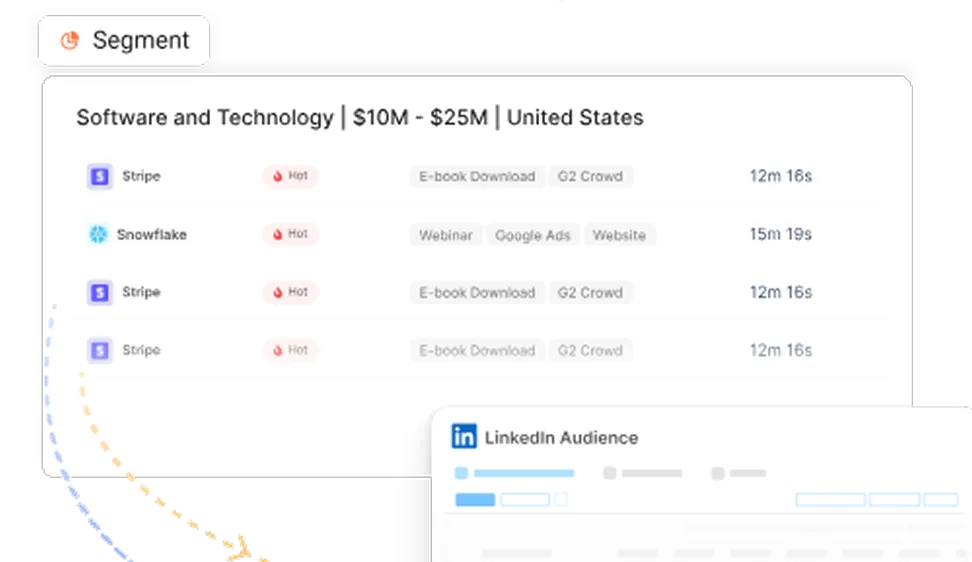
Factors.ai unifies signals from your website visits, CRM activity, and ad engagement into a single account-level view. Instead of checking three dashboards to understand what a target account has been doing, you see the complete picture in one place. It detects in-market companies by identifying accounts that match your ICP and are showing buying behavior, even when those visitors haven't filled out a form.
The platform reveals account engagement trends over time, so you can distinguish between a single casual visit and a sustained pattern of growing interest. This trend data is what separates genuine buying signals from random noise. It also syncs audiences directly to LinkedIn and Google ad platforms, letting you run account-based outbound workflows that combine personalized email sequences with targeted advertising.
When a high-scoring account crosses your intent threshold, Factors.ai routes it to the appropriate sales owner automatically. No manual list pulls, no weekly report reviews, no lag between signal detection and rep notification. The speed advantage this creates is substantial in competitive markets where multiple vendors are trying to reach the same in-market accounts.
On the measurement side, Factors.ai ties pipeline outcomes back to the signals that initiated them. You can see which signal types generate the most meetings, which workflows produce the highest pipeline value, and where your GTM investments are actually paying off.
An example workflow with Factors.ai
Consider this scenario. A target account visits your pricing page twice, engages with a LinkedIn ad comparing your product to a competitor, and matches your ICP criteria for industry, company size, and tech stack. Factors.ai detects this composite signal, scores it above your threshold, enriches the account with buying committee contacts, and pushes it into your outbound queue instantly.
The account owner gets a Slack notification with full context. The SDR launches a sequence within the hour. A LinkedIn retargeting campaign starts running comparison content to other stakeholders at the same company. All of this happens without anyone manually checking a report or building a list. That's the difference between signal-based outbound and traditional prospecting. The system does the detection and routing work, freeing your team to focus on the conversations that actually create pipeline.
Which metrics matter more than open rates?
Here's where most outbound teams get their measurement fundamentally wrong. They obsess over vanity metrics like open rates and reply rates because those numbers are easy to track and they move quickly. But an open rate tells you almost nothing about whether your signal programme is working. Someone opening your email might be curious, confused, or just clearing their inbox. It's a measure of subject line performance, not pipeline creation.
When you're running sales trigger workflows, the metrics that actually matter are the ones that connect signal detection to revenue outcomes. Here are the ones worth tracking.
Signal-to-meeting rate measures how often a detected signal converts into a booked meeting. This is your leading indicator for signal quality. If you're triggering on hundreds of signals but booking very few meetings, either your signals are too weak, your scoring is off, or your outreach isn't matching the intent context.
Time-to-first-touch after signal tracks how quickly your team responds after a signal fires. In our experience, the half-life of a buying signal is shorter than most teams assume. A response within two hours converts meaningfully better than one that takes two days. This metric keeps your team honest about execution speed.
Meetings per 100 triggered accounts normalize your performance across different signal volumes. It lets you compare the effectiveness of different signal types on an apples-to-apples basis, regardless of how many accounts each signal source produces.
Pipeline per signal source tells you which signals generate the most pipeline value, not just the most activity. You might find that competitor research signals produce fewer meetings than pricing page visits but generate larger deal sizes. Without this metric, you'd over-invest in the higher-volume, lower-value signal.
Win rate by signal type reveals which signals correlate with deals that actually close. Some signals are great at generating meetings but produce prospects who evaluate and ultimately choose someone else. Win rate by signal type helps you understand which signals indicate genuine buying readiness versus casual exploration.
CAC by triggered workflow connects your signal programme costs (tools, enrichment credits, rep time) to customer acquisition. This is your efficiency metric. If a specific workflow costs significantly more per acquired customer than others, it might need refinement or retirement.
Rep efficiency, hours saved quantifies how much time your sales team reclaims by not manually researching accounts. If your signal workflows save each SDR ten hours a week, that's ten hours redirected toward conversations and closing, and that reallocation often matters more than any individual metric improvement.
Open rate measures curiosity. Pipeline measures value. The teams that build their dashboards around the second set of metrics consistently outperform the ones still celebrating 45% open rates on emails that never generate a meeting.
What are the common mistakes that kill signal programmes?
I've watched teams invest significant resources in signal-based prospecting only to see the programme underperform or quietly get abandoned. The failure rarely happens because the concept is wrong. It happens because of execution mistakes that compound over time. Here are the most common ones.
- Treating all signals equally is probably the most frequent mistake
Teams get excited about having signal data and start triggering outreach on everything. A blog visit, a funding round, a job posting, they all get the same response. But a blog visit from a random visitor and a pricing page visit from a decision-maker at an ICP account are completely different events. Without signal weighting and scoring, you drown your sales team in low-quality alerts, and they start ignoring all of them.
- Triggering outreach too slowly undermines the entire value proposition of signal-based outbound
If your workflow detects a signal on Monday but the outreach doesn't launch until Thursday, you've lost the timing advantage that makes this approach work. Speed-to-action after signal detection is a critical design requirement, and teams that treat it as optional consistently underperform.
- Poor data hygiene corrupts your signal quality from the source
If your CRM has duplicate records, outdated contacts, or misassigned territories, even the best signal detection produces garbled outputs. Enrichment layers help, but they can't fix foundational data problems. Cleaning your data before building signal workflows isn't glamorous, but it's essential.
- No ownership routing means signals arrive without clear accountability
If a signal fires and nobody knows who's responsible for acting on it, the signal dies in a queue. Every workflow needs a clear owner, typically mapped to territory or account assignment, so that signals convert to action without ambiguity.
- Generic messaging after rich signals is a particularly frustrating waste
Your system detected that a VP of Marketing visited the pricing page three times after reading a case study. And then the outreach says, "Hi, I noticed you might be interested in improving your marketing operations." That's like having a detailed map and choosing to drive blindfolded. If your outreach ignores the reason the workflow triggered, the signal was wasted. Messaging needs to be contextual to the specific signal that initiated it.
- No feedback loop to revenue means you never learn which signals work
Without tracking meetings, pipeline, and closed deals back to signal sources, your programme can't improve. You end up with a collection of workflows running on assumptions rather than evidence.
- Over-automation with zero human judgment is the trap that technology-first teams fall into
Full automation works well for simple, high-confidence signals. But some signals require human interpretation before action. A competitor search signal combined with a recent executive departure might mean the account is in chaos and not ready to evaluate new tools. Automation should handle the detection and routing, but humans should retain judgment over nuanced situations.
- Ignoring existing customer expansion signals is the opportunity cost that almost never shows up in outbound strategy discussions
Most signal programmes focus entirely on new logo acquisition. But expansion signals from existing customers, like product usage growth, new department adoption, or champion promotions, often convert faster and at lower cost than any new logo signal. If your signal programme only looks outward, you're leaving revenue on the table.
What does the future of agentic outbound systems look like?
The current generation of signal-based outbound workflows still requires significant human design and maintenance. GTM engineers build the workflows, define the triggers, write the scoring logic, and update the playbooks. The next wave of outbound automation workflows will shift much of this work to AI agents that operate autonomously.
Imagine AI agents monitoring your entire target account universe around the clock, detecting signal patterns that humans would miss because the volume is too high to review manually. These agents won't just flag signals. They'll auto-generate outreach drafts tailored to the specific signal context, the account's industry, and the individual recipient's role and likely priorities. The GTM engineer's job shifts from building every workflow manually to setting strategic parameters and letting autonomous playbooks execute within those guardrails.
Budget allocation will become signal-responsive as well. Instead of setting quarterly ad budgets by channel, AI agents will dynamically shift spend toward account segments showing the strongest intent signals. If enterprise accounts in financial services suddenly show a spike in competitor research, the system reallocates budget to serve those accounts comparison content within hours, not weeks.
Multi-threading buying committees, one of the most time-intensive parts of enterprise sales, becomes automated. When a signal fires on one stakeholder, the system identifies the full buying committee and engages them in parallel across email, LinkedIn, and advertising. No rep needs to manually research org charts or guess who else should be in the loop.
CRM updates happen without rep input, because the agent tracks engagement, logs activity, and adjusts account scores based on real-time behavior. Reps spend their time on conversations, not data entry, which is frankly how it should have worked all along.
Speed-to-signal may become more important than speed-to-lead. The traditional GTM metric has been how fast you follow up on a lead that raises their hand. In the agentic future, the competitive metric becomes how fast your system detects a buying signal before the prospect even self-identifies. The teams that see intent earliest and respond fastest will capture disproportionate pipeline, and the gap between signal-aware and signal-blind organizations will widen dramatically.
We're not fully there yet, but the trajectory is clear. The GTM engineering teams that are building signal infrastructure today are laying the foundation for agentic systems tomorrow. The teams that wait will find themselves trying to retrofit autonomous capabilities onto legacy processes, and that's a much harder migration path.
In a nutshell…
Signal-based outbound workflows represent a genuine shift in how B2B SaaS teams generate pipeline. Instead of starting with a list and hoping for good timing, you start with a buying signal and engineer the right response. The five-step framework of detect, score, enrich, trigger, and learn gives GTM engineers a repeatable system that improves with every cycle.
The most important lesson from this entire piece is that signals alone aren't enough. You need ICP fit, intent confidence, and fast execution to convert a signal into a meeting. Teams that nail all three consistently outperform teams with better copy, larger SDR teams, or bigger tech budgets. Timing, when combined with relevance, is the most powerful lever in outbound.
If you're building a signal programme from scratch, start small. Pick one high-confidence signal type, like pricing page visits from ICP accounts, and build a single workflow that detects it, enriches the account, and alerts the right rep within hours. Measure the results against your existing cold outbound benchmarks. Once you prove the concept, expand to additional signal types and more sophisticated automation.
Track the metrics that connect to revenue, not activity. Signal-to-meeting rate, pipeline per signal source, and win rate by signal type tell you whether your programme is working. Open rates and send volumes don't.
For modern B2B SaaS teams, outbound should no longer start with a list. It should start with a signal, and the entire system you build around that signal is what separates engineered revenue from random activity.
Frequently asked questions about signal-based outbound workflows
Q1. What are signal-based outbound workflows?
Signal-based outbound workflows are automated sales systems that trigger outreach when buyers show real intent signals. These signals include website visits to high-intent pages, hiring announcements for relevant roles, funding events, product engagement spikes, and competitor research activity. Instead of relying on static lists or manual prospecting, the workflow detects buying behavior in real time and routes the right action to the right rep, making outreach timely and relevant rather than random.
Q2. Why are signal-based workflows better than cold outbound?
Signal-based workflows improve every key variable in the outbound equation: timing, relevance, reply rates, and rep efficiency. Cold outbound relies on volume, hoping that enough emails create enough conversations. Signal-based outbound targets accounts when their interest is highest, which means fewer emails generate more meetings. Reps spend less time researching and more time selling, and prospects receive outreach that actually matches where they are in their buying process.
Q3. What signals work best for B2B SaaS outbound?
The highest-converting signals for B2B SaaS include pricing page visits from multiple stakeholders, competitor research activity on review sites, hiring growth for roles your product supports, trial and product usage expansion, executive hires at target accounts, and multi-user engagement from the same company domain. First-party signals tend to be more reliable than third-party ones, but the strongest programmes layer both together and filter for ICP fit before triggering outreach.
Q4. Who typically owns signal workflows in a GTM team?
Signal workflows are usually owned by GTM engineers, RevOps teams, or growth operations professionals. These roles sit at the intersection of sales strategy, data infrastructure, and workflow automation. They work closely with sales and marketing to define which signals matter, build the detection and routing logic, and measure downstream impact on pipeline and revenue. In some organizations, this function lives within a centralized revenue team that spans both sales and marketing operations.
Q5. How does Factors.ai help with signal-based outbound?
Factors.ai provides the unified signal layer that many GTM teams struggle to build on their own. It brings together account signals from your website, CRM, and ad platforms into a single view, identifies in-market companies that match your ICP, reveals engagement trends over time, and helps teams understand which accounts are genuinely warming up versus just browsing casually.
Instead of relying on static lead lists or guesswork, sales teams can prioritize outreach based on real buying intent, recent activity, funnel stage, and fit. That means reps spend less time chasing cold accounts and more time speaking to companies already showing signs of interest.
It also helps marketing and sales work from the same playbook. Marketing can drive the right accounts into campaigns, while sales can act on those signals quickly with timely, personalized outreach. The result is outbound that feels sharper, faster, and far more relevant.

See how Factors can 2x your ROI
Boost your LinkedIn ROI in no time using data-driven insights
Try AdPilot Today


.avif)

See Factors in action.
Schedule a personalized demo or sign up to get started for free
LinkedIn Marketing Partner
GDPR & SOC2 Type II

.svg)











.avif)