Heading 2
SaaS Buyer Personas: The B2B Marketer's Guide to Knowing Who You're Actually Selling To
A SaaS buyer persona is a research-based profile of your ideal customer. Learn how to map buying committees and use intent data to drive B2B revenue.
Written by

Subiksha Gopalakrishnan
Growth Marketer
Edited by
.avif)
Vrushti Oza
Content Marketer
Summarize this article






.svg)

TL;DR
- A SaaS buyer persona is a research-based profile of your ideal B2B customer, defined by role, goals, pain points, behavior, and buying triggers.
- Strong personas go beyond demographics. They capture persona characteristics like decision authority, tool stack, and internal objections.
- A B2B buyer persona template should include firmographics, psychographics, buying committee role, and intent signals.
- Examples of customer personas in SaaS typically include the Champion, the Economic Buyer, and the Blocker; each needs a different message.
- Personas should be revisited quarterly, not treated as a one-time exercise.
Here's a scenario that plays out in B2B SaaS marketing teams more often than anyone wants to admit.
You've got a search campaign live. The creative and the copy look good. The targeting is... somewhere between “pretty good” and “vibes-based.” And then two weeks in, Sales pulls you aside and says the four words every marketer dreads: “These aren't our ICP.”
Ouch.
The problem here is that nobody paused long enough to clearly define who they were actually building this campaign for. That's where SaaS buyer personas come in. And no, not the dusty PowerPoint slide with a stock photo of “Marketing Sarah” that your team built in 2019 and never looked at again. We're talking about sharp, data-backed, genuinely useful persona profiles that your entire GTM team actually references.
Let's build them together.
What are SaaS buyer personas?
A SaaS buyer persona is a semi-fictional, research-based profile that represents a key segment of your target buyer. It captures who they are, what they care about, what slows them down, and how they make purchasing decisions.
The “semi-fictional” part is important. Personas are composites built from real customer data like customer interviews, CRM patterns, win/loss analysis, and behavioral signals from tools like Salesforce, HubSpot, and Factors.ai.
In B2B SaaS, buyer personas carry extra weight because you're rarely selling to a single person. You're selling to a buying committee who are a group of 6 to 10 stakeholders with different priorities, different objections, and wildly different levels of patience for your product demo.
If you don't know who's in that room, then it's highly unlikely they will be impressed with your demo call.
Why most B2B customer personas fail (and how to fix that)
Most persona work fails because it stops at the surface.
You end up with a profile that tells you someone is a “VP of Marketing, 35-45, based in the US, uses LinkedIn.” Cool. But that tells you almost nothing about why they'd buy your product, who they need to convince internally, or what language actually lands with them.
A weak persona profile isn't neutral. It actively misleads your campaigns. You target too broadly; the message doesn't resonate; Sales gets frustrated; and everyone blames the channel.
Strong SaaS buyer personas fix this by going three layers deeper than demographics.
What makes a solid B2B buyer persona template?
A B2B buyer persona template that actually works includes five core layers. It is like building a character with enough depth that your whole team could improvise a conversation with them.
Layer 1: Firmographic foundation
This is where you start. It includes the following.
- Company size (by revenue and employee count)
- Industry and vertical
- Go-to-market motion (sales-led, product-led, or hybrid)
- Tech stack (Are they a Salesforce shop or a HubSpot shop? This matters more than you think.)
- Geography and team structure
Layer 2: Role and persona characteristics
This includes:
- Job title and department (Director of RevOps vs. VP of Marketing are very different conversations)
- Decision-making authority (Do they sign? Do they recommend? Do they veto?)
- Metrics they're held to (pipeline, MQLs, revenue attainment, churn rate)
- How they prefer to buy (async research, demo-first, peer recommendation, analyst reports)
Layer 3: Goals and pain points
Your persona's goals are the things they're trying to achieve. Their pain points are the friction between where they are now and where they want to be.
For a Director of Demand Generation at a mid-market SaaS company, that might look like:
- Goal: Grow marketing-sourced pipeline by 30% without increasing headcount
- Pain: Can't prove which channels are actually influencing revenue; reporting is a mess
- Frustration: Sales keeps asking for better leads, but never defines what “better” means
See the pattern? That's a real human with a real problem. That's who you're writing for.
Layer 4: Objections and buying blockers
Every persona has a version of “yeah, but…” built into their brain. Map those out.
Common objections in B2B SaaS buying cycles include:
- “We already have a tool for that.” (displacement fear)
- “Our IT/Security team will never approve this in time.” (procurement blocker)
- “We tried something similar before, and it didn't work.” (past experience bias)
- “Can we start smaller and expand?” (budget constraint framed as scope)
Knowing these up front lets you pre-empt them in your content, sales decks, and nurture sequences.
Layer 5: Buying triggers and intent signals
A trigger is the event that moves a persona from passive browser to active buyer. For B2B SaaS personas, common triggers include:
- A new leadership hire (new VP wants new tools)
- A funding round (budget to spend, pressure to grow)
- A competitor switch or consolidation event
- A specific pain point hitting a breaking point (pipeline dried up, reporting broke, team scaled past the old tool)
Tools like Factors.ai, Bombora, and G2 can surface these signals in real time, so you're not guessing when an account is in-market.
Examples of customer personas in B2B SaaS
Most B2B SaaS companies are selling to a committee. Here are three persona types that show up in almost every mid-market deal, and what makes each of them tick.
Persona 1: The Champion (aka your internal advocate)
- Who they are: A Director or Senior Manager who discovered your product, loves what it does, and is now trying to sell it upward internally.
- What they need from you: Case studies from companies like theirs, ROI calculators, internal business case templates, and content they can forward to their CFO without it being embarrassing.
- What they fear: Looking foolish if the product doesn't deliver. Their credibility is on the line.
- Message that works: “Here's how teams like yours made the case internally and what happened after they did.”
Persona 2: The Economic Buyer (the one who signs)
- Who they are: A VP or C-level leader (CMO, CRO, VP of Revenue) who controls the budget and cares primarily about business outcomes, not product features.
- What they need from you: A clean answer to “what's the ROI?” They want numbers, payback periods, and references from companies they respect.
- What they fear: A tool that becomes a cost center instead of a growth lever.
- Message that works: “Our customers typically see [specific outcome] within [specific timeframe].” It should be real without vague claims.
Persona 3: The Blocker (the skeptic you can't ignore)
- Who they are: IT, Security, Legal, or Procurement. They didn't ask to evaluate your tool, and they're not particularly thrilled about it.
- What they need from you: Compliance documentation, SOC 2 reports, integration specs, and a very clear answer to “what data does this touch?”
- What they fear: Inheriting a tool that causes a security incident or a vendor management headache.
- Message that works: Don't ignore them or try to work around them. Equip your Champion with the right technical materials to bring them along.
Now that we've got the who sorted, let's talk about how to actually build these things.
How to build SaaS buyer personas in 6 steps
Step 1: Start with your closed-won data
Before you run a single interview or fill out a single template, pull your last 20-30 closed-won deals from Salesforce or HubSpot.
Look for patterns:
- Which titles showed up most in the buying committee?
- Which industries closed fastest?
- What was the most common trigger that started the conversation?
This is your empirical foundation. Everything else builds on it.
Step 2: Interview real customers (yes, actual humans)
Eight to ten customer conversations will teach you more than 500 survey responses.
Ask questions like:
- “Walk me through how you first realized you had this problem.”
- “Who else was involved in the buying decision, and what did they care about?”
- “What almost made you go a different direction?”
- “How did you sell this internally?”
Record everything. Tools like Gong, Chorus, or even a simple Otter.ai transcript will let you pull exact phrases your customers use to describe their own pain. Those phrases become your copy.
Step 3: Layer in behavioral and intent data
CRM interviews tell you what customers say. Behavioral data tells you what they do.
Use tools like Factors.ai to see which persona types visit your pricing page, which content they consume before a demo request, and which pages signal buying intent vs. casual curiosity.
This turns your persona from a static profile into a living signal you can act on in real time.
Step 4: Map your personas to your buying committee
For each deal, there's usually a Champion, an Economic Buyer, a Blocker, and a handful of end users. Map your personas to those roles and note how they interact with each other during the buying process.
This is especially important for mid-market and enterprise deals, where the buying committee can include RevOps, IT, Finance, and Legal, all in the same Slack thread, arguing about your contract.
Step 5: Build the actual persona profile
Now you actually fill in the B2B buyer persona template. For each persona, document:
- Name and title (give them a real name, it helps the team remember who they're writing for)
- Company context (size, industry, team structure)
- Goals and success metrics
- Pain points and frustrations
- Objections and buying blockers
- Trigger events and intent signals
- Preferred content formats and channels
- What they need at each stage of the buying journey
Keep it to one page per persona. If it's longer, it won't get used.
Step 6: Share, socialize, and update
A persona profile that lives in a Notion doc nobody opens is a nightmare. Share it with Sales, Customer Success, Product, and your content team. Run a short session where everyone reacts and adds what they're hearing in the field. Set a calendar reminder to revisit it quarterly, especially after closed-won and closed-lost interviews.
Personas aren't set in stone. As your ICP shifts, your market matures, or your product evolves, so should your personas.
What persona characteristics actually differentiate good B2B personas from generic ones?
The persona characteristics that separate a sharp B2B buyer persona from a generic one come down to three things:
- Specificity. A persona that captures one critical insight about how your buyer makes decisions is more useful than a persona that covers every demographic box. Focus on the insight that changes how you write, message, and target.
- Language. The most useful thing in a persona is the exact phrase they use to describe their problem. “We can't prove marketing ROI” is a persona quote. “Attribution challenges” is a label. One of those sounds like your customer. The other sounds like your internal wiki.
- Behavior. What your customers say they care about and what they actually click on are often two different things. Behavioral data from tools like Factors.ai, G2, and LinkedIn Campaign Manager gives you the ground truth.
How Factors.ai helps you activate your persona insights
Building a persona is the strategy. Activating it is the execution.
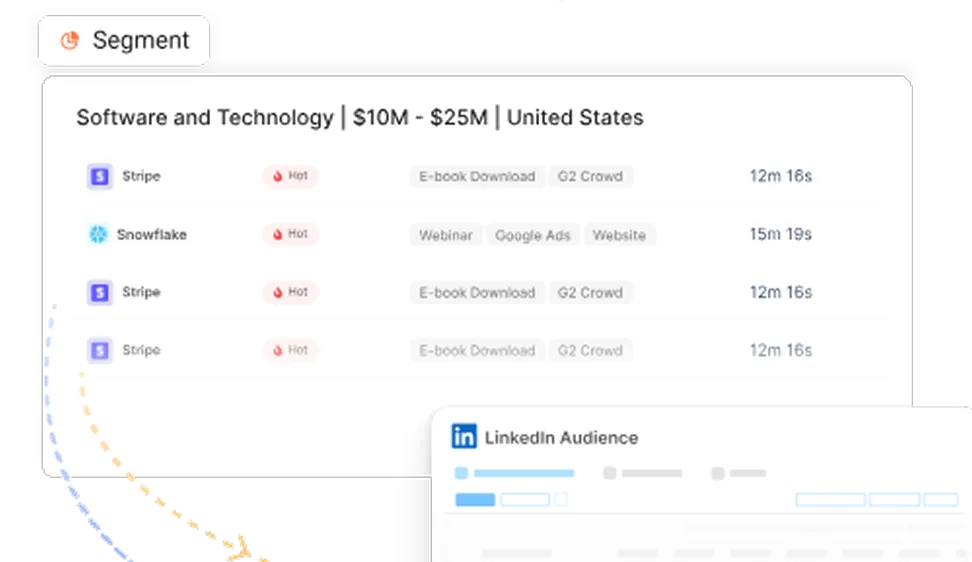
Factors.ai connects your persona profiles to real-time account behavior, so you're not just describing who your buyer is. You're seeing which accounts match that profile right now and what they're doing on your site.
Here's what that looks like in practice:
- Account identification reveals which companies are visiting your site, so you can match them against your ICP and persona definitions in real time
- Intent signals show which persona characteristics are active (pricing page visits, competitor comparison behavior, product page depth) without waiting for a form fill
- Account 360 gives your Sales team a full picture of who from the buying committee has engaged and how, so they walk into every call with context
In short, Factors turns your persona profiles from a static research artifact into a live targeting engine. That's when B2B customer personas stop being a marketing deliverable and start being a revenue tool.
To summarize
SaaS buyer personas are research-based profiles that describe who your B2B buyers are, what they care about, how they buy, and what stops them. A strong B2B buyer persona template includes firmographic context, role-specific goals, objections, and buying triggers, not just demographic data.
The three most common persona types in B2B SaaS deals are the Champion, the Economic Buyer, and the Blocker. Each needs a different message, different content, and different proof points.
Building a useful persona profile requires combining customer interviews, CRM data, and real behavioral signals. And once built, personas are only valuable if they're socialized across Sales, Marketing, and CS, and updated as your business evolves.
Pair sharp personas with intent data (from tools like Factors.ai, Bombora, and G2), and you shift from guessing who to target to knowing exactly which accounts match your persona right now and where they are in the buying journey.
FAQs on SaaS buyer personas
Q1. What is the actual difference between an ICP and a Buyer Persona?
An Ideal Customer Profile (ICP) defines the high-level account (company size, industry), while a Buyer Persona defines the individuals within that account. My honest take is that ICP tells you where to point your ship, but Personas tell you exactly what kind of bait to use once you start fishing; you can’t win the deal if you’re pitching a VP of Finance with features meant for an end-user.
Q2. Can I use AI to generate my buyer personas instead of doing interviews?
While AI is great for identifying broad industry trends, it cannot replicate the nuance of a raw customer interview. My honest take is that relying solely on AI is a recipe for “hallucinated marketing”; you'll end up with generic personas that sound like everyone else's, missing those specific, high-converting phrases that only a real customer will say during a 1-on-1 call.
Q3. How many personas are too many for a mid-market SaaS company?
Most successful B2B teams focus on 3 to 5 key personas to keep their messaging sharp and their team aligned. My honest take is that “Persona Creep” is a real productivity killer; if you have twelve personas, your content team will lose their minds trying to personalize for everyone, and your Sales team will just ignore them all and go back to “vibes-based” pitching.
Q4. What exactly qualifies as a “Buying Trigger” in a persona profile?
A trigger is a specific external or internal event, such as a fresh round of Series C funding or a new CMO hire, that forces a company to seek a solution. My honest take is that triggers are the “secret sauce” of timing; targeting someone based on their job title is fine, but targeting them because their current reporting just broke after a merger is how you close deals in half the time.
Q5. How do I get my Sales team to actually look at these persona docs?
The best way to ensure adoption is to involve Sales in the interview process and make the final “One-Pagers” accessible directly within their CRM. My honest take is that Sales only cares about things that help them hit quota faster; if you show them how these personas provide “pre-built” rebuttals for their most common objections, they’ll treat these docs like a holy grail.
See how Factors can 2x your ROI
Boost your LinkedIn ROI in no time using data-driven insights
Try AdPilot Today


.avif)
See Factors in action.
Schedule a personalized demo or sign up to get started for free
LinkedIn Marketing Partner
GDPR & SOC2 Type II

.svg)