
Heading 2
LLM marketing: A comprehensive guide for B2B marketers
Learn how marketers use LLMs for smarter campaigns, content, targeting, and reporting. Real B2B examples plus strategy tips from Factors.ai.
Written by
.avif)
Vrushti Oza
Content Marketer
Summarize this article




.svg)


TL;DR
- LLM marketing means applying large language models like GPT, Claude, or Gemini to real marketing workflows, from content production and campaign optimisation to ABM targeting and pipeline reporting.
- LLMs are most powerful when connected to clean first-party data (CRM, ad platforms, website analytics), not when used for generic prompt-and-paste tasks.
- Practical use cases span every funnel stage: ToFu ideation, MoFu nurture personalization, and BoFu sales enablement, with measurable time savings and performance gains.
- Human oversight remains non-negotiable. The best LLM marketing workflows pair AI speed with human judgment for brand safety, accuracy, and strategic thinking.
- Building an LLM marketing workflow starts small: pick one painful process, connect real data, layer in review, measure outcomes, and expand carefully.
You know those crime shows where detectives have a wall full of clues, red strings, blurry photos, and somehow still no idea who did it?
That’s how a lot of modern marketing teams operate.
Data is all over the place… ad platforms have one story… CRM has another… Website analytics is doing its thing in the corner… someone has a spreadsheet called “Final_Final_Updated2.xlsx” that may or may not contain the truth. Everyone has information, but nobody has clarity.
That mess is exactly why LLM marketing is getting real attention: because businesses are drowning in tools, dashboards, tabs, and partial answers.
The real value of large language models in marketing is simple: they help make sense of chaos by processing vast amounts of customer data to extract actionable, data-driven insights.
Imagine asking one connected system which campaigns actually influenced pipeline last week, why demo requests dropped, or which accounts are suddenly showing buying intent. Instead of playing detective across six platforms, you get a useful answer in seconds.
That changes how teams work. Less time gathering numbers. More time making decisions. Less reporting theatre. More actual progress.
Yes, LLMs can help with content too. But the smarter use case is bigger than copywriting. It’s reporting, segmentation, forecasting, campaign planning, lead intelligence, and helping humans move faster with better context.
This guide is for people who are curious about LLM marketing but allergic to AI hype. We’ll cover what it actually means, where it creates value, and how to use it without turning your workflow into a sci-fi side quest.
What is LLM marketing?
As usual, I’ll share the textbook-y definition first… LLM marketing is the practice of using large language models (think GPT, Claude, Gemini, Llama, and their growing family of cousins) to improve how marketing teams plan, create, analyze, and execute their work. It's a straightforward concept dressed up in a lot of unnecessary mystique.
At its core, a large language model is a type of AI model trained on massive datasets using neural networks. LLMs rely on these massive datasets to process and generate human-like text, enabling advanced natural language processing and context understanding. LLMs learn from vast datasets, which can sometimes contain biases or stereotypes, so monitoring and refining how LLMs learn is crucial to ensure fair and unbiased outputs. It can understand context, generate language, summarize information, and respond to instructions in natural conversation. When you apply that capability to marketing tasks, you get LLM marketing. The “marketing” part is the important bit, because the model is only as useful as the workflow you embed it in.
It's worth separating this from the automation wave that came before it. Traditional marketing automation, the kind that's powered drip sequences and lead scoring rules for a decade, operates on rigid if-then logic. If a lead downloads a whitepaper, send email three. If they visit the pricing page, increase their score by ten points. It's rule-based, predictable, and entirely dependent on someone building those rules in advance.
LLM-powered systems work differently… they can interpret unstructured data, generate nuanced responses, and adapt to context without someone manually coding every scenario. An LLM doesn't just follow a script; in fact, it can draft the script, evaluate the script, and suggest a better one based on patterns it's learned from millions of examples.
That distinction matters because marketing problems aren't always neat enough to fit into if-then logic. When a prospect visits your website four times, engages with two LinkedIn ads, opens a nurture email, and then goes quiet for three weeks, a traditional automation tool sees a lead score. An LLM can summarize the entire behavioral pattern, suggest what the silence might mean, and draft a re-engagement message tailored to that specific journey.
The catch, and this is where most "AI marketing" conversations go sideways, is that LLMs are strongest when paired with real first-party data. A model generating generic ad copy from a vague prompt is a parlour trick. A model that summarizes your actual pipeline data and identifies which campaigns influenced closed-won revenue last quarter is a competitive advantage. The difference between the two is the quality of the data you feed it and the specificity of the task you give it.
Marketers should care about this now because the tooling has crossed a practical threshold. Two years ago, using LLMs in marketing meant copying text into ChatGPT and hoping for the best. Today, models are being integrated directly into CRM platforms, analytics tools, ad managers, and revenue intelligence systems. The interface is becoming invisible. You don't need to be a prompt engineer. You need to be a marketer who knows what questions to ask.
Why do LLMs matter for modern B2B teams?
B2B marketing has always been complicated, but the complexity has compounded in ways that make the old playbook feel like it was designed for a simpler era. It kind of was.
Consider the typical B2B buying journey… multiple stakeholders, each with different priorities, researching independently across a handful of channels. Your champion might discover you through a LinkedIn ad. Their CFO might read a G2 review. The technical evaluator might visit your docs page three times before anyone fills out a form. The sales cycle stretches across weeks or months, and the data trail is scattered across platforms that weren't built to talk to each other.
Most B2B teams are juggling ad platforms, CRM systems, website analytics, email tools, and event platforms as separate stacks with limited integration. That fragmentation is the root of nearly every operational headache in modern marketing. You can't personalize what you can't see. You can't report on what you can't connect. And you definitely can't move fast when every insight requires manual data stitching across three dashboards.
This is the environment where LLMs start to make a material difference. Not because they're magic, but because they're exceptionally good at the kinds of tasks that eat up marketing hours without producing strategic value.
- Take insights, for example. An LLM connected to your campaign data can summarize performance trends in seconds, surfacing patterns that would take an analyst an hour to compile into a slide. It can spot that your mid-funnel email sequence is underperforming for enterprise accounts while outperforming for mid-market and flag that without anyone asking.
- Personalization is another area where the impact compounds. B2B buyers expect relevant messaging, but personalizing content across accounts, personas, and funnel stages is labor-intensive. LLMs can generate messaging variations tailored to specific ICPs, adjust tone for different buying stages, and draft personalized outreach at a speed that human writers simply can't match on their own. The human still needs to review and refine, but the first draft arrives in minutes instead of days.
- Content velocity is what gets content teams excited, and rightfully so. The gap between "we need more content" and "we have the bandwidth to produce it" is a permanent feature of B2B marketing life. LLMs compress the production cycle for blogs, emails, social posts, ad copy, and sales collateral without requiring you to double headcount.
- Reporting and decision support might be the most underrated benefit. When an LLM can ingest your attribution data, CRM pipeline, and campaign spend, then answer a question like "which channels are contributing to pipeline but not getting enough budget?" you've moved from dashboards you stare at to intelligence you act on.
Here, I want to add that LLMs don't (and cannot) replace humans and strategy. They remove the admin work that blocks strategy from happening. That's a meaningful distinction, because the value isn't in the AI itself. It's in the hours it gives back to people who know how to use those hours well.
How are marketers using LLMs across the funnel?
The most useful way to think about LLM marketing isn't by tool or by team. It's by funnel stage because the problems LLMs solve change depending on where the buyer sits in their journey. A ToFu content challenge looks nothing like a BoFu sales enablement problem, and the LLM applications reflect that.
- Top of funnel: getting seen by the right people
ToFu marketing is fundamentally about reach and relevance. You need the right topics, the right channels, and enough volume to stay visible in a noisy market. LLMs accelerate almost every part of that equation.
- Topic ideation is a natural starting point. Instead of brainstorming in a Google Doc for 45 minutes, you can feed an LLM your ICP descriptions, recent content performance data, and competitor themes, then get back a prioritised list of topic clusters worth exploring. It won’t replace editorial judgement, but it compresses the ideation phase from a half-day exercise to a 20-minute conversation. By analyzing audience behavior and user behavior, LLMs can help inform your content strategy, ensuring topics resonate with your target audience.
- SEO clustering benefits from the same capability. LLMs can group semantically related keywords into clusters, suggest content hierarchies, and identify gaps in your existing coverage. They’re particularly good at spotting the long-tail variations that humans tend to overlook because they don’t show up in the first page of a keyword tool.
- Social posts and ad copy variants are where the speed advantage really shows up. Generating 15 LinkedIn post variations from a single blog post, or 20 headline options for an ad campaign, is the kind of task that used to take a copywriter half a day. An LLM can produce those drafts in minutes, giving you more material to test and iterate on.
- Thought leadership drafting is trickier, because genuine thought leadership requires original thinking, not just fluent writing. But LLMs can serve as a useful first-draft partner. You provide the perspective and the argument. The model structures it, fills in supporting context, and handles the connective tissue that takes time to write from scratch.
- Middle of funnel: nurturing without annoying
MoFu is where most B2B teams struggle with personalization at scale. The leads are in your system, but the content they receive often feels generic. LLMs help close that gap.
- Email nurture personalization is a strong use case. Instead of writing one nurture sequence and sending it to every segment, you can use LLMs to generate variations tailored to different personas, industries, or engagement patterns. LLMs enable personalized messaging and tailor content for specific audience segments by analyzing user behavior and preferences, ensuring each message is relevant and engaging. A VP of Marketing and a Director of Demand Gen might both be in your nurture flow, but they care about different things. The LLM can adjust messaging for each without requiring a separate campaign build.
- Webinar follow-up sequences benefit from the same logic. Rather than sending the same “thanks for attending” email to every registrant, an LLM can draft follow-ups that reference specific webinar topics, tie in related resources, and vary the call to action based on attendee behavior (did they stay for the full session or drop off at minute twelve?).
- Landing page messaging by persona is another area where LLMs compress the work. If you’re running campaigns targeting three distinct ICPs, you ideally want three versions of your landing page copy. That’s a lot of writing. LLMs can generate those variations quickly, letting your team focus on testing and optimization rather than drafting. This streamlines the content creation process and allows for refining messaging for different personas, making your campaigns more effective.
- Lead scoring summaries are a quieter but genuinely useful application. Instead of looking at a numerical score and guessing what it means, an LLM can generate a plain-language summary: “This account has visited the pricing page twice, engaged with three LinkedIn ads, and downloaded the ROI calculator. They appear to be in active evaluation.” That context helps sales prioritize without needing to dig through activity logs.
3. Bottom of funnel: helping deals close
BoFu is where marketing and sales overlap most, and where LLM marketing connects directly to revenue. The applications here are less about content production and more about intelligence and enablement.
- Sales enablement copy is a natural fit. LLMs can draft one-pagers, competitive comparisons, and case study summaries tailored to specific deal contexts. If a prospect is evaluating you against two competitors, an LLM with access to your battlecard library can generate a custom comparison document in minutes. LLM-powered virtual assistants can also handle customer queries and facilitate real-time customer interactions, ensuring prospects receive instant, personalized responses that improve satisfaction and conversion rates.
- Account summaries are one of the highest-value BoFu use cases. Before a sales call, an LLM connected to your CRM and engagement data can compile a brief covering the account’s recent website visits, ad interactions, email engagement, and pipeline stage. That brief turns a generic sales call into an informed conversation and enhances the overall customer experience by enabling more relevant and timely engagement.
- Competitor battlecards benefit from LLM-powered maintenance. Markets shift quickly, and keeping battlecards current is a perpetual headache. LLMs can scan competitor websites, press releases, and review sites, then flag updates that need human revpersonalizationiew.
- Proposal personalisation is where deals get won or lost on detail. An LLM can adjust proposal language based on the prospect’s industry, stated priorities, and previous conversations logged in the CRM. It’s the difference between a template that feels like a template and a proposal that feels like it was written just for them.
- Pipeline risk alerts round out the BoFu picture. An LLM monitoring deal activity can flag when engagement drops, when a key stakeholder goes quiet, or when a deal has been sitting in the same stage too long. These aren’t insights that require genius. They require attention, and LLMs are very good at paying attention to everything simultaneously.
LLM marketing use cases for content creation teams
Content teams live in a permanent tension between quality and volume. You know the feeling. The editorial calendar is full, the request queue is overflowing, and the team is already stretched across blogs, emails, social posts, webinars, and that one sales deck someone needed yesterday. AI content creation for B2B doesn't eliminate that tension, but it changes the economics of it dramatically.
- Blog production at a different speed
Blog production is where most content teams first experiment with LLMs, and for good reason. The workflow has obvious bottlenecks that AI can compress.
- Keyword research
LLMs can take a seed topic, suggest semantically related terms, estimate search intent, and group keywords into content clusters. They won't replace a dedicated SEO tool for volume and difficulty data, but they're excellent for the qualitative layer: understanding what searchers actually want to know and how to structure content around those questions.
- Outline generation
A strong outline is the difference between a blog that flows and one that wanders. LLMs can generate detailed outlines with suggested H2s, H3s, key points per section, and internal linking opportunities. The content strategist still needs to review and refine, but the starting point is dramatically better than a blank page.
- First drafts
An LLM-generated first draft isn't a finished blog. It's raw material that needs human shaping, fact-checking, voice adjustment, and strategic editing. But it cuts the drafting phase from hours to minutes, which means your writers spend their time on the high-value work: making the piece original, credible, and genuinely useful.
- Refreshing stale content
Most B2B blogs have dozens of posts that are 18 months old and slowly losing rankings. An LLM can identify outdated stats, suggest updated angles, and draft revised sections, turning a content refresh from a multi-hour project into a focused editing session.
- Repurposing blogs into newsletters, social posts, video scripts, and email snippets
You've already done the hard thinking for the original blog. The model just restructures that thinking for different formats and channels. One blog can become five LinkedIn posts, a newsletter section, and an email teaser, all in minutes.
- SEO support beyond keywords
- Featured snippet optimization
LLMs can analyze the format and structure of existing featured snippets for a target query, then draft content specifically shaped to win that position. It's a small tactical advantage, but those add up.
- FAQ generation
For any given topic, an LLM can produce a comprehensive list of related questions that real searchers ask. These become FAQ sections, People Also Ask targets, or standalone blog topics.
- Semantic keyword coverage
They're trained on enormous text corpora, which means they naturally understand the semantic relationships between terms. When you use an LLM to expand or refine your content, it tends to include related terms organically, improving topical depth without anyone manually checking a keyword density tool.
- Internal linking
These suggestions can be generated by feeding an LLM a list of your existing blog URLs and their target keywords
It can then suggest relevant internal links for any new piece, improving site structure and SEO without requiring someone to manually search through your blog archive every time.
- Editorial operations get smoother
- Style guide enforcement
This is a persistent challenge for content teams, especially those working with freelancers or multiple writers. An LLM trained on your style guide can review drafts for tone, terminology, formatting, and brand voice inconsistencies. It won't catch everything, but it catches the obvious stuff before a human editor needs to.
- Tone consistency across a content library
LLMs can flag sections that drift from your established voice, suggest adjustments, and help maintain a consistent reading experience across dozens or hundreds of pieces.
- Brief generation for writers
Instead of a content strategist spending 30 minutes writing a detailed brief for each blog post, an LLM can generate a first-draft brief based on the target keyword, competitive analysis, and your content strategy. The strategist reviews and adjusts, but the grunt work is handled.
Through all of this, human editing remains critical for originality, credibility, and differentiation. An LLM can produce fluent, well-structured content. What it can't do is develop a genuinely original point of view, validate claims against primary sources, or make the strategic editorial choices that separate useful content from forgettable content. The teams getting the best results use LLMs to handle the production mechanics while reserving human attention for the parts that actually create competitive advantage.
LLM marketing use cases for paid media teams
Paid media in B2B, particularly on LinkedIn, operates in an environment where CPCs are high, budgets are finite, and the margin between a good campaign and a wasted one is thinner than most teams admit. AI campaign optimisation doesn't make bad strategy good, but it makes good strategy significantly faster to execute and easier to refine.
- Campaign planning that moves faster
Audience ideas are a natural starting point. LLMs can take your ICP definitions and generate specific targeting suggestions: job titles to include, seniority levels to test, industry verticals worth expanding into, and company size ranges that might be underexplored. It's the kind of brainstorming that usually happens in a whiteboard session, compressed into a five-minute prompt.
Message testing also benefits from volume. The challenge with B2B ad copy isn't usually writing one decent version. It's writing enough variations to actually test what resonates. LLMs can produce 20 or 30 headline and body copy combinations from a single creative brief, giving your team a much larger testing pool without requiring proportional writing time.
Creative angles by ICP are where this gets genuinely useful. If you're targeting both VP-level buyers and practitioner-level users, the messaging needs to be different. The VP cares about business outcomes and strategic fit. The practitioner cares about workflow, integrations, and whether the tool will actually make their Tuesday easier. An LLM can generate distinct ad sets for each persona, ensuring your creative speaks to the right concerns.
- Optimisation with an analytical edgeOptimisation with an analytical edge
Summarizing underperforming campaigns is a task that usually involves someone pulling data into a spreadsheet, staring at it, and writing a summary for the team's Slack channel. An LLM connected to your ad platform data can automatically generate that summary, highlighting which campaigns are below benchmark, what's dragging them down, and where the budget might be better allocated.
I’d say detecting wastes spend is also related but more specific. LLMs can identify patterns that humans miss because they involve cross-referencing multiple dimensions at once. Maybe a campaign targeting the EMEA region is spending heavily on a specific industry vertical, which is generating clicks but not pipeline. An analyst might catch that eventually, but an LLM flags it on a fresh Monday morning.
Based on performance patterns, an LLM can suggest specific experiments and tests: "Try increasing bid on the mid-market segment, which is showing higher CTR but limited spend," or "Test a pain-point-focused headline variant for the enterprise audience, where the current benefit-focused copy is underperforming." These suggestions aren't guaranteed to work, but they give the team a running start on experiment design.
Weekly reporting summaries are perhaps the most time-saving application. Instead of a demand gen manager spending two hours compiling a weekly performance report, an LLM can generate a draft summary from the raw data. The manager reviews, adds context, and sends it out. That's 90 minutes reclaimed every week, which adds up to nearly 80 hours over a year.
- The LinkedIn and B2B angle
Most marketers would agree that while LinkedIn works magically well for B2B, advertising on the platform can feel more… premium. Now, to operate efficiently in that environment, smarter targeting and messaging aren't really nice-to-haves; they're the difference between a campaign that generates pipeline and one that burns budget on vanity metrics.
LLMs help here by enabling faster testing cycles. When you can generate 30 ad variants in minutes instead of days, you can test more aggressively, learn faster, and allocate spend toward what's actually performing. The feedback loop tightens from weekly to almost daily.
Here's a concrete example: an LLM can review 50 ad variants and identify recurring hooks tied to higher CTR. Maybe you discover that ads mentioning "pipeline visibility" consistently outperform ads mentioning "marketing analytics." That insight would take a human analyst hours of tagging and cross-referencing. The model surfaces it in seconds, giving your creative team a data-backed direction for the next round of copy.
LLM marketing use cases for sales and ABM teams
Account-based marketing is based on a simple idea: if you know exactly who you’re selling to, you can reach them more precisely. The problem is that “knowing” an account requires synthesizing data from multiple sources, and most teams don’t have the bandwidth to do that well for more than a handful of priority accounts. LLMs help businesses connect with their audiences more effectively by enabling deeper personalization and more meaningful engagement.
This is where LLM use cases for marketers start to overlap with sales enablement in a genuinely useful way. By analyzing customer feedback from reviews and social media, LLMs can uncover audience preferences and inform product suggestions—personalized recommendations generated by recommendation engines and collaborative filtering algorithms. These insights enhance ABM strategies, allowing teams to tailor outreach and content to each account’s specific needs and interests.
When ABM meets LLM marketing
Summarizing target accounts from CRM data, website visits, and ad engagement is one of the highest-leverage applications of LLMs in B2B. Instead of an SDR spending 15 minutes researching an account before an outreach attempt, an LLM connected to your data stack can generate a comprehensive account brief in seconds. That brief might include recent website pages visited, which ads the account engaged with, what content they downloaded, their current CRM stage, and any relevant firmographic details. Importantly, LLMs can also segment and tailor these summaries to specific audience segments, ensuring that outreach aligns with distinct group characteristics and audience preferences identified through behavioral data.
Drafting personalized outreach based on account behavior follows naturally. Once you have that account summary, the LLM can generate outreach messages that reference specific actions the account has taken. Not in a creepy “we saw you on our pricing page” way, but in a way that demonstrates genuine relevance: “I noticed your team has been exploring our integration capabilities. Here’s a quick overview of how we connect with [their CRM].”
Detecting buying committee activity is a subtler but powerful application. B2B purchases involve multiple stakeholders, and LLMs can spot when several people from the same account are engaging with your content simultaneously. If the VP of Marketing visited your blog, the Director of Ops downloaded a case study, and someone from IT checked your security page, that pattern suggests a buying committee is forming. An LLM can flag that pattern and alert the right people on your team.
Prioritizing warm accounts is a direct extension of this capability. Instead of relying solely on lead scores or gut feel, an LLM can rank accounts based on a holistic view of their engagement signals, recency, and buying stage indicators. It provides a plain-language explanation for why each account is ranked where it is, which makes the prioritization transparent rather than opaque.
Turning intent signals into actions is the critical last step. Intent data is only valuable if someone acts on it, and that action needs to be fast. An LLM can take an intent signal (multiple pricing page visits, ad clicks, content downloads) and immediately generate a recommended next step: a personalized email draft, a suggested call script, or an alert to the account owner with a summary of what’s happening.
Here’s a scenario that makes the value concrete. An account visits your pricing page twice in a week, clicks on two LinkedIn ads, and opens a nurture email. Traditionally, that pattern might increase a lead score, and someone would eventually notice. With an LLM connected to that data, the system can instantly summarize the likely buying stage, draft a tailored outreach message, and push it to the account owner’s queue. The time between signal and action shrinks from days to minutes.
The impact of B2B AI marketing tools in the ABM context isn’t about replacing the human relationships that close deals. It’s about making sure the humans in the loop have the right information at the right time, without needing to dig through four different platforms to find it.
Real artificial intelligence in marketing examples
Theory is useful, but let’s talk about what this looks like in real life. These are real artificial intelligence in marketing examples already happening inside modern B2B teams, not speculative futures.
Example 1: the content team that turns one webinar into five assets
A B2B SaaS company runs a 45-minute webinar on account-based marketing trends. Traditionally, the content team watches the recording, takes notes, and spends the next two weeks turning those notes into a blog post, some social clips, and maybe a follow-up email. With an LLM workflow, the team feeds the webinar transcript into their model and gets back a structured blog draft, three variations of LinkedIn posts, a five-email nurture sequence, and a set of ad copy snippets, all within an hour.
The human editors still spend a day refining, fact-checking, and aligning everything to the brand voice. But the total production cycle drops from two weeks to three days, and the content is more cohesive because it all originates from the same source material. The team isn’t working harder. They’re just starting further ahead.
Example 2: the demand gen team that finds the real pipeline drivers
Imagine this: a demand generation team at a mid-market SaaS company reports on campaign performance the traditional way: impressions, clicks, CTR, and cost-per-lead. The dashboards look fine, but pipeline doesn’t grow in proportion to ad spend. Something feels off, and the standard metrics aren’t explaining it.
Then the team connects an LLM to attribution data and asks a simple question: Which campaigns are driving demo requests, not just clicks? The model’s analysis reveals that two campaigns with relatively modest click volumes are generating a disproportionate share of demo requests and qualified pipeline. Meanwhile, the highest-spend campaign is driving lots of traffic that isn’t converting past the initial form fill.
That insight leads to a budget reallocation that improves pipeline contribution by shifting spend toward the campaigns influencing real buying behavior. The LLM doesn’t do anything an analyst couldn’t do. It just does it faster and asks the right question in a way a dashboard can’t.
Example 3: the sales team with better pre-call prep
An enterprise sales team spends 15 to 20 minutes per account researching before calls. Multiply that by ten calls a day, and you’ve got a serious productivity drain. They implement an LLM-powered account brief generator that integrates with their CRM, website analytics, and ad engagement data.
Before each call, the AE receives a one-page brief: recent website activity, content downloads, ad interactions, relevant firmographic details, and a suggested talking point based on the account’s apparent interests. Prep time drops from 15 minutes to two minutes of reviewing the brief. More importantly, the conversations improve because reps walk in with relevant context instead of generic discovery questions.
Example 4: the website team that stops losing hot leads
A B2B website generates decent traffic but hemorrhages qualified visitors who never fill out a form. The team deploys an AI chatbot powered by an LLM that can engage visitors in natural conversation, answer product questions using the company’s knowledge base, and qualify visitors based on their responses.
The chatbot identifies visitors who are in active evaluation, asking about pricing, integrations, or specific use cases, and routes them directly to sales with a summary of the conversation. Within two months, the team sees a measurable increase in qualified conversations from website visitors who would have otherwise bounced without a trace.
The LLM isn’t replacing the sales team. It’s making sure the sales team sees the right visitors at the right moment.
These AI in marketing examples share a common thread: the LLM isn’t doing the strategic thinking. It’s handling the operational overhead that prevents humans from doing the strategic thinking fast enough.
How Factors.ai uses LLM thinking for revenue teams
One of the persistent challenges with applying LLMs to marketing is that most models operate in isolation from your actual business data. You can ask ChatGPT to draft an ad copy, but you can't ask it which of your LinkedIn campaigns influenced pipeline last quarter, because it doesn't have access to that data.
This is the gap that platforms like Factors.ai are designed to address. Not by being an LLM themselves, but by creating the data infrastructure that makes LLM-powered workflows genuinely useful for revenue teams.
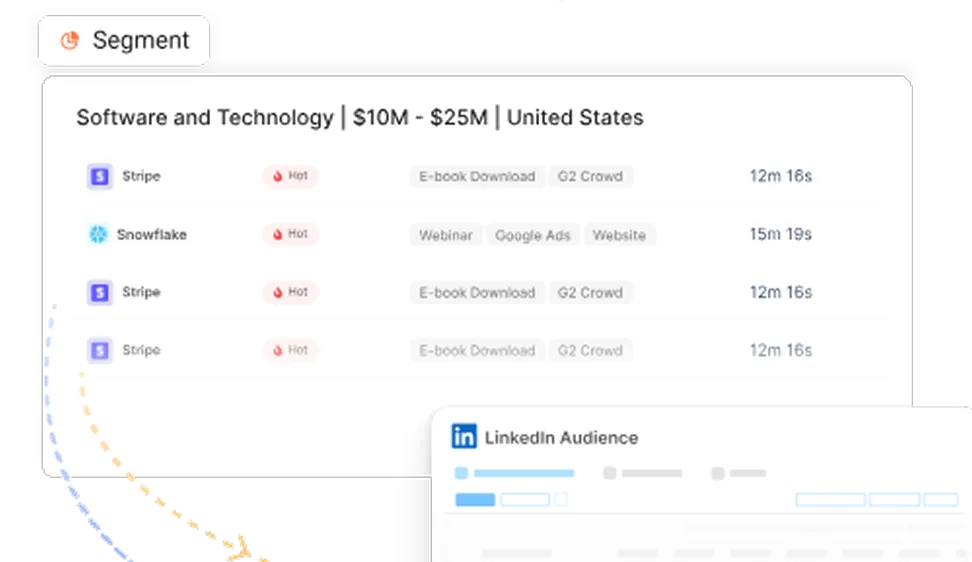
Factors.ai centralizes the data streams that B2B marketing and sales teams need to make intelligent decisions. That includes ad signals from platforms like LinkedIn, Google, and Facebook. It includes website behavior, capturing which accounts are visiting which pages and how often. It connects to CRM stages, so you can see where accounts sit in the pipeline. It tracks account journeys across touchpoints. And it provides attribution models that connect marketing activity to revenue outcomes.
When you layer LLM capabilities on top of that kind of unified data, the questions you can ask become dramatically more useful. Optimizing for AI-driven search is increasingly important as search engines evolve from traditional keyword-based approaches to AI-powered semantic analysis, prioritizing credibility and high-quality sources. Instead of “Write me a blog post about ABM,” you’re asking “which accounts showed buying intent this week based on their cross-channel behavior?” Instead of generating generic copy, you’re generating insights rooted in your actual pipeline data. Ensuring your brand appears in authoritative sources and AI-generated search results is now critical for both human and AI-driven visibility. To maintain a competitive edge, it’s essential to monitor emerging trends in LLM technology and search, adapting your strategy as the landscape shifts.
Here are a few examples of what that looks like in practice:
- Ask which campaigns influenced pipeline last quarter. Instead of building a custom report across three platforms, you ask a natural-language question and get a summary with specific campaigns, pipeline values, and conversion paths.
- Find accounts showing buying intent. The platform identifies accounts exhibiting high-intent behavior (multiple site visits, ad engagement, content downloads) and surfaces them with context about what they've been doing.
- Summarize journey gaps. An LLM connected to Factors.ai's data can identify where accounts are dropping out of the funnel and suggest where additional touchpoints might re-engage them.
- Recommend audience expansion. Based on the firmographic and behavioural profiles of accounts that have converted, the system can suggest lookalike characteristics for campaign targeting.
The core insight here is about a principle that applies to any LLM marketing workflow: models become exponentially more valuable when they're connected to clean, unified revenue data. A model with access to your attribution data, CRM stages, and cross-channel engagement can do things that a standalone chatbot never will.
For revenue teams operating in complex B2B environments with long sales cycles and multiple stakeholders, that connection between LLM capability and real data is where the meaningful competitive advantage lives.
Risks, limits, and governance while using LLMs to create campaigns and content
If the previous sections made LLM marketing sound like an unqualified good, this one is the necessary counterweight. Every marketing leader evaluating these tools should understand the failure modes, because they’re real and they’re not always obvious.
The risks you need to plan for
- Hallucinations are the most well-known issue, and they remain a serious concern. LLMs can generate confident, well-structured text that is factually wrong. They don't "know" things in the way humans do. They predict likely word sequences based on their training data, and sometimes those predictions produce plausible-sounding nonsense. In a marketing context, that could mean publishing a blog with an incorrect statistic, sending a prospect email that references a feature your product doesn't have, or generating a competitive comparison with inaccurate claims about a competitor.
- Generic copy is a subtler risk. Because LLMs are trained on vast amounts of existing content, they naturally gravitate toward the average. The phrasing is smooth, the structure is competent, and the result is indistinguishable from every other piece of AI-generated content on the internet. If your content strategy depends on differentiation (and it should), unedited LLM output will actively work against that goal.
- Brand inconsistency shows up when different team members use LLMs independently without shared guidelines. Your demand gen team's AI-drafted ad copy might use a different tone than your content team's AI-drafted blog, which might conflict with the messaging your sales team's AI-drafted outreach is using. Without coordination, LLMs can fragment your brand voice faster than they unify it.
- Compliance issues are particularly relevant for companies in regulated industries or those operating across multiple jurisdictions. LLMs don't inherently understand data privacy regulations, advertising standards, or industry-specific disclosure requirements. They'll generate content that sounds great and could expose your company to legal risk if no one catches it.
- Privacy concerns arise when teams feed proprietary data, customer information, or competitive intelligence into third-party LLM tools without understanding where that data goes. Some models use input data for further training, which means your confidential information could theoretically surface in other users' outputs.
- Over-automation is the risk that doesn't look like a risk until it's already caused damage. When teams automate too many workflows without adequate human oversight, output quality gradually degrades. Nobody notices because each individual piece looks "fine." But over time, the content becomes homogeneous, the insights become shallow, and the brand starts to feel like it's run by a committee of algorithms.
The best-practice stack that mitigates these risks
Addressing these risks doesn't require avoiding LLMs. It requires building a governance layer around them. The most effective teams treat this like an editorial and operational framework, not a technology problem.
- Human review of every external output. Nothing goes to a customer, prospect, or public channel without a human reviewing it. This is the most basic and most important safeguard. The review should check facts, tone, brand alignment, and compliance.
- Brand prompts and style guidelines. Create standardized prompts that include your brand voice, terminology rules, and messaging frameworks. When everyone uses the same foundation, the outputs are more consistent. Update these prompts quarterly as your positioning evolves.
- Approved data sources. Define which data sources are approved for LLM inputs. CRM data, anonymized analytics, and public marketing materials are typically fine. Customer emails, internal strategy documents, and competitive intelligence gathered under confidential terms are usually not shared. Make these boundaries explicit so teams aren’t improvising with sensitive data.
- Role-based access controls. Not everyone needs access to every workflow. A content marketer may need blog drafting tools, while RevOps may need pipeline summarisation. Limit access based on function and data sensitivity.
- Prompt libraries and version control. If certain prompts consistently generate strong results, document them. If a prompt causes poor or risky output, retire it. Treat prompts like operating assets, not random experiments buried in someone’s notes app.
- Measurement beyond productivity. Saving time matters, but it cannot be the only KPI. Track quality signals too: conversion rates, reply rates, pipeline influence, content engagement, error rates, and brand consistency. Fast bad work is still bad work.
- Regular audits. Every quarter, review how LLMs are being used across the organization. Which workflows are genuinely helping? Which are producing average output? Which need tighter controls? AI sprawl is real, and governance keeps it useful.
ALL of that said, the human layer still matters most.
I know… there’s a temptation to think governance slows innovation. But if you think of it… it actually enables it. Teams move faster when they know what’s safe, what’s useful, and what standards they’re held to.
The companies that win with LLM marketing won’t be the ones that automate the most. They’ll be the ones that combine speed with taste, judgment, and discipline.
How to start using LLM marketing (without creating chaos)
You don’t need an “AI transformation roadmap” and a 74-slide deck to begin. You need one painful process that wastes time and one clear outcome you’d like to improve. Before leveraging LLMs in your marketing workflows, it’s crucial to define your marketing goals and identify pain points, those specific challenges or inefficiencies that hinder your progress. This ensures your efforts are aligned with measurable objectives and that LLM integration addresses real needs.
Pick a workflow like:
- Weekly campaign reporting that takes too long
- Blog production bottlenecks
- SDR research before outbound outreach
- Lead follow-up that feels generic
- Account prioritization based on scattered signals
Then apply a simple framework:
- Define the current pain
How many hours does it take? Where are delays happening? What quality issues exist today? - Add the LLM to one narrow step
Maybe it drafts the weekly report summary. Maybe it creates first-pass outlines. Maybe it summarizes account activity before calls. - Keep a human owner
Someone remains accountable for quality, approvals, and outcomes. Always. - Measure the result
Did time reduce? Did output improve? Did response rates increase? Did better decisions happen faster? - Expand carefully
Once one workflow works, move to the next adjacent one.
This is slightly important because many teams do the exact opposite. They buy tools first, announce an AI initiative second, and search for use cases third. That route usually leads to unused software, with everyone pretending it was a strategic decision.
The better route is boring, practical, and effective.
Here’s what smart B2B teams will look like next
The future marketing team probably won’t be smaller… but sharper for sure.
Using AI tools and LLMs is essential for marketing teams to stay relevant and stay competitive in a rapidly evolving marketing landscape. These technologies help teams adapt quickly, automate routine tasks, and maintain an edge over competitors.
LLMs will increasingly become the operating layer between raw data and human action.
But humans still decide:
- What the brand stands for
- Which bets are worth making
- What great creative feels like
- Which customers deserve focus
- What trade-offs make sense
That part isn’t going anywhere.
In a nutshell…
LLM marketing is not about replacing marketers with chatbots who use words like “synergy” unironically.
It’s about removing repetitive work, speeding up analysis, improving execution, and helping good teams operate like stronger versions of themselves.
Used badly, it creates generic content, risky decisions, and a brand voice that sounds like beige wallpaper.
Used well, it gives your team leverage.
And in B2B, where buying journeys are messy, data is fragmented, and time is always short, leverage is a very valuable thing.
FAQs for LLM marketing
Q1. What is LLM marketing?
LLM marketing is the use of large language models like GPT, Claude, or Gemini to improve marketing workflows such as content creation, reporting, targeting, campaign optimisation, and sales enablement.
Q2. How are LLMs different from traditional marketing automation?
Traditional automation follows fixed rules. LLMs can interpret context, summarise unstructured information, generate language, and respond more flexibly to complex scenarios.
Q3. Can LLMs replace marketers?
No. They can automate repetitive tasks and speed up workflows, but strategy, judgment, creativity, positioning, and relationship-building still require humans.
Q4. What are the best LLM use cases for B2B teams?
Strong use cases include campaign summaries, attribution insights, content drafting, nurture personalisation, account research, proposal customisation, and identifying buying intent.
Q5. Are there risks in using LLMs for marketing?
Yes. Common risks include hallucinated facts, generic copy, privacy issues, compliance mistakes, and over-automation without human review.
Q6. How should a team start with LLM marketing?
Start with one narrow workflow that wastes time today, assign a human owner, measure outcomes, and expand only after proving value.

See how Factors can 2x your ROI
Boost your LinkedIn ROI in no time using data-driven insights
Try AdPilot Today


.avif)


See Factors in action.
Schedule a personalized demo or sign up to get started for free
LinkedIn Marketing Partner
GDPR & SOC2 Type II

.svg)










.png)