
Heading 2
GTM Engineering Agency and Consulting Services: Pricing, Implementation, and Case Studies
Compare GTM engineering agencies, pricing models, services, audits, implementation partners, and how B2B SaaS teams choose the right fit.
Written by
.avif)
Vrushti Oza
Content Marketer
Summarize this article




.svg)


TL;DR
- A GTM engineering agency builds the systems layer behind revenue: data pipelines, automation, routing, enrichment, attribution, and AI-assisted workflows. They build the machine that campaigns run on.
- Pricing typically ranges from $3k–$15k+/month for retainers, with project-based work running $5k–$40k+ depending on scope and complexity.
- The best agencies start with a revenue friction audit, diagnosing CRM hygiene issues, routing delays, attribution gaps, and wasted sales touches before they build anything.
- A realistic 90-day roadmap covers diagnosis and design (days 1–30), building workflows and enrichment logic (days 31–60), and optimising for adoption and conversion (days 61–90).
- Choose a GTM engineering consulting firm based on your specific revenue bottleneck, stack maturity, speed requirements, and whether you need ongoing support or a one-time build.
Most B2B teams don’t set out to build a messy go-to-market system. It just… happens…
You add a tool to fix lead quality… another one for enrichment… something for intent data… a few workflows stitched together to make it all “talk.” For a while, it feels like “Ooohh, I’m making progress…”
Until one day, answering a basic question like “which accounts should sales prioritize this week?” turns into a multi-tab exercise that no one (including you) fully trusts.
Most teams don’t realize that the problem is that the system underneath them is not primarily designed to support how your team actually sells… and that’s where GTM engineering agencies come in.
They build the infrastructure that everything else depends on… including the data layer, workflows, signal capture, the way your tools connect, and most importantly, how all of that translates into something your sales and marketing teams can actually use without second-guessing it… in short, it’s about fixing the system.
This blog is set to break down what a GTM engineering agency actually does, how their pricing works, what working with one really looks like, and how to decide if your team needs one or if your current setup just needs a rethink.
What is a GTM engineering agency?
A GTM engineering agency helps B2B companies build the systems layer behind revenue growth. That includes data pipelines, automation, outbound workflows, attribution, CRM hygiene, intent routing, enrichment logic, lead scoring, and increasingly, AI-assisted execution. If that sounds like a lot of ground to cover, it is. The scope reflects how fragmented most go-to-market stacks have become.
The simplest way to think about it: traditional agencies run campaigns… but GTM engineering agencies build the machine those campaigns run on. A demand gen agency might create a killer LinkedIn ad sequence, but if the leads from that sequence land in a CRM where routing takes 18 hours and nobody knows which accounts are actually engaged, the campaign's impact dies quietly in a spreadsheet somewhere.
Here's what it can look like in a typical workflow… a GTM engineering consulting firm might connect your CRM to your ad platforms and website signals so you can see which target accounts are actually engaging. They'd build signal-based outbound workflows so your SDRs aren't cold-calling into the void. They'd set up auto-routing so hot accounts reach a sales rep in minutes, not days. They'd clean up duplicate data and close enrichment gaps that have been silently degrading your reporting. They'd turn anonymous website traffic into identifiable sales opportunities. And increasingly, they'd create AI workflows for SDRs and RevOps teams that make personalization scalable without making it robotic.
The common thread across all of this is systems thinking. These agencies don't optimize one channel. They connect the dots between channels, tools, teams, and data sources so the whole revenue engine runs with less friction.
If your GTM motion feels manual, fragmented, slow, or impossible to measure, you likely need GTM engineering.
Note: You might not need another tool… you probably need someone to make the tools you already own actually work together.
Why B2B teams are hiring GTM engineering partners right now
The rise of GTM engineering is happening because headcount is expensive, tech stacks are bloated, and revenue teams are SO exhausted from disconnected tools that each solve 20% of the problem…. and together, don’t solve anything because they never talk to each other.
The pressure to ‘do more with less’ is the truth B2B SaaS teams are dealing with. Minimalism, but tool-y minimalism.
Just think about what's changed in the last two years. Sales teams need better account prioritization, but the data they need lives across four different platforms. Marketing needs pipeline attribution, but stitching together the buyer journey across paid, organic, and outbound requires engineering work that most marketing ops people don't have time for. Founders need efficiency, not more software subscriptions. SDR teams need personalization at scale, but the "personalization" most AI tools offer without proper data orchestration is… embarrassingly thin. Growth teams need speed without hiring five more people who each own one slice of the stake (read: stack).
And then there's the AI layer… every team is experimenting with AI tools for outbound, content, lead scoring, or some combination. But AI tools need orchestration, not random prompts. Without clean data flowing into them and clear logic governing their outputs, they produce noise. A GTM engineering implementation partner brings the connective tissue that makes AI actually useful, rather than just impressive in a demo.
I’m just going to say this bluntly now… many companies have a systems problem. They're generating demand, but that demand is leaking through broken handoffs, slow routing, missing enrichment, and attribution blind spots. Hiring another demand gen agency to pour more leads into a leaky system is like turning up the water pressure when the pipes have holes. It feels productive, but it makes the mess wayyy worse.
That's why the best GTM engineering agencies are booked out. The companies hiring them have realized that fixing the infrastructure is the highest-leverage investment they can make before spending another pound on ads or another hour on outbound.
What services does a GTM engineering agency actually provide?
The scope of GTM engineering services can feel overwhelming when you first look at it. So let's make it concrete… here's a breakdown of what a full-stack GTM engineering agency typically covers, organised by category.
The best GTM engineering agencies don't sell "automation." They sell fewer bottlenecks. Every workflow they build, every integration they configure, every enrichment waterfall they design, it all points back to a specific friction point in the revenue process that's costing the company pipeline or velocity.
When you're evaluating GTM engineering services, ask yourself which of these categories represents your biggest leak. That's where the engagement should start. Agencies that try to boil the ocean on day one are usually more interested in expanding scope than solving problems.
GTM engineering agency vs RevOps consultant vs demand gen agency
This is one of the most common questions I see from B2B leaders, and honestly, the confusion is understandable. The boundaries between these three types of partners have gotten blurry. Some RevOps consultants now offer automation work. Some demand gen agencies claim they "do GTM engineering." And some GTM engineering agencies have expanded into strategy consulting.
So let's clarify what's going on with each of them:
The important point of difference is what each partner actually changes in your organization.
- A RevOps consultant will tell you that your lead handoff process is broken and design a better one.
- A GTM engineering agency will build the automated routing, enrichment, and notification system that makes the new process actually work.
- A demand gen agency will drive the leads that flow through that process.
If your paid ads are underperforming because your CRM data is messy, hiring a demand gen agency first is treating smoke, not fire. The agency will optimize creative and targeting while leads continue to fall into a broken system. Three months later, everyone's frustrated and pointing fingers. The demand gen agency blames lead quality. Sales blames marketing. And the actual problem, a systems infrastructure gap, remains untouched.
The healthiest B2B teams treat these as complementary investments, not alternatives. But if you can only pick one starting point, start where the biggest friction lives. If your campaigns are strong but your systems are fragmented, a GTM engineering agency is the right first move.
GTM engineering agency pricing models explained
Let’s talk about money. Your CFO’s favorite topic, your budget’s worst enemy, and the one thing you really don’t want to spend on a GTM agency that ends up being an expensive group chat. GTM engineering agency pricing is one of the most searched topics in this space, and for good reason. Unlike demand gen agencies with relatively standardized rate cards, GTM engineering pricing varies significantly based on scope, complexity, and engagement model. Here's how the most common models work.
- Retainer model
Monthly retainers typically range from roughly $3k to $15k+/month, depending on complexity and the number of systems involved. This model works best for ongoing optimization, fractional GTM engineering support, and teams that need a consistent technical partner rather than a one-off project. You're essentially getting a dedicated (or semi-dedicated) GTM engineer or team on call, building, iterating, and maintaining your systems over time.
The advantage is continuity. Your agency partner develops deep context about your stack, your data, and your team's workflows. The risk is that without clear deliverables and milestones, retainers can drift into maintenance mode where you're paying for availability rather than impact.
- Project model
One-time projects range from $5k–$40k+, depending on what you're building. Common project scopes include a full CRM rebuild, a Clay-powered outbound engine, an attribution setup, or AI SDR workflow development. This model makes sense when you have a defined problem, a clear scope, and internal capacity to maintain the system after it's built.
The advantage is clarity. You know what you're paying for and when it ends. The risk is that complex GTM systems often need iteration after the initial build, and a project model doesn't always account for the "what happens next" phase.
- Audit and strategy sprint
Shorter engagements, typically $2k–$10k, designed to diagnose problems before committing to a larger build. A GTM engineering audit identifies the highest-impact friction points in your stack and provides a prioritized roadmap. This is the right starting point if you're not sure what's broken or if you want to validate that an agency understands your business before signing a longer contract.
I'd argue every engagement should start with some version of this, even if it's folded into a larger retainer. Agencies that skip diagnosis and jump straight to building are optimizing for billable hours, not for your outcomes.
- Performance and hybrid model
Some agencies offer a lower base fee plus upside tied to outcomes, pipeline generated, meetings booked, or efficiency metrics improved. This model aligns incentives nicely on paper, but it requires clear measurement infrastructure. If your attribution is already broken (which is often why you're hiring a GTM engineering agency in the first place), performance-based pricing becomes hard to operationalise honestly.
operationalize
Note I need you to remember: Cheap GTM engineering often becomes expensive technical debt later. An agency that charges half the market rate and builds your workflows in a fragile, undocumented way might save you money in Q1. But when those workflows break in Q3 and nobody can figure out why, you'll spend more fixing the mess than you saved on the original build. Quality GTM engineering is an investment in systems that compound over time. Cut-rate work is an expense that compounds in the wrong direction.
How do you evaluate the best GTM engineering agencies?
Finding the best GTM engineering agencies isn't just about reading case studies on websites. Most agency case studies are carefully curated highlights that tell you very little about what the day-to-day engagement actually looks like. Here's a practical framework for evaluating whether an agency is the right fit.
Seven questions to ask before signing
1. What systems have you built that are similar to ours?
You want specificity here. "We've worked with B2B SaaS companies" isn't enough. Ask which CRM they rebuilt, which enrichment waterfall they designed, which routing logic they implemented. The answer should sound like architecture, not marketing.
2. Can you show me the architecture AND the results?
Any agency can show you a "3x pipeline" stat. Ask to see the system map, the workflow logic, and the integration diagram. If they can't show how they built it, they probably didn't build it themselves.
3. How do you handle data governance?
This is the question that separates serious GTM engineering consulting firms from glorified Zapier freelancers. Ask about data validation, error handling, fallback logic, and how they deal with API rate limits or data source outages.
4. What happens after implementation?
The best agencies plan for the handoff from day one. Ask whether they provide documentation, training, SOPs, and whether your internal team can maintain the system independently.
5. Can you integrate with our specific stack?
Name your tools: HubSpot, Salesforce, Clay, LinkedIn, Factors.ai, whatever you're running. Generic "we integrate with everything" answers should raise an eyebrow. Ask for examples.
6. How do you measure ROI?
A strong agency will talk about pipeline velocity, routing speed, data coverage, attribution accuracy, and rep productivity. A weak agency will talk about "deliverables completed."
7. What breaks most often in engagements like ours?
This is my favorite question. An honest agency will tell you where things typically go wrong, maybe it's internal adoption, maybe it's data quality, maybe it's scope creep. If they say "nothing, we're great," walk away.
Red flags to watch for
- Avoid agencies that only demo dashboards. A pretty Looker dashboard doesn't mean the data flowing into it is clean or that the underlying workflows are sound.
- Watch out for agencies that promise results without first understanding your current state, that skip the audit phase, or that can't articulate their methodology beyond "we'll set up automations."
- The word "automations" without context is a red flag the size of a billboard.
What does a GTM engineering audit actually diagnose?
A good GTM engineering audit, what I'd call a "Revenue Friction Audit," is the single most valuable deliverable an agency can provide in the first two weeks of an engagement. It's the diagnostic phase that tells you where revenue is leaking and why. And it should happen before anyone touches a workflow builder.
Here's what the best agencies inspect during an audit:
- CRM duplicates and stale data
How many of your contacts are duplicated? How many accounts haven't been updated in 12+ months? Dirty CRM data doesn't just annoy sales reps… but it breaks routing, corrupts reporting, and makes every downstream automation unreliable.
- Lead routing delays
How long does it take for a qualified lead to reach a sales rep? If the answer is "hours" or "it depends on who's on duty," you're losing deals to competitors who respond in minutes.
- Anonymous traffic leakage
What percentage of your website visitors are you identifying at the company level? If you're running paid campaigns that drive traffic to your site but can't tell which accounts visited, you're paying for visibility you never actually receive.
- No buying committee visibility
Are you tracking individual contacts or entire buying committees? In B2B, decisions involve multiple stakeholders. If your CRM only tracks the person who filled out the form, you're missing the full picture.
- Broken lifecycle definitions
Do your MQL, SQL, and opportunity stages mean the same thing to marketing and sales? Misaligned lifecycle definitions create phantom pipeline and erode trust between teams.
- SDR wasted touches on low-intent accounts
How much of your SDR team's time is spent reaching out to accounts with no engagement signals? Without intent data, outbound becomes a volume game that burns out reps and annoys prospects.
- No closed-loop attribution
Can you trace a closed-won deal back to the marketing activities that influenced it? If not, your marketing team is flying blind on budget decisions.
- Poor signal prioritization
Are your sales reps getting notified about every website visit, or only the ones that actually matter? Alert fatigue is a real problem, and it usually means nobody's built proper scoring and threshold logic.
Most audits focus on tools: "You're using HubSpot, here's how to configure it better." Great audits focus on lost revenue moments, the specific points in the buyer journey where friction causes pipeline to stall, leak, or disappear. That distinction is what separates a GTM engineering audit from a generic tech stack review.
What does a typical 90-day GTM engineering implementation look like?
Most GTM engineering implementation partner engagements follow a roughly 90-day arc. The timeline can stretch or compress depending on stack complexity and team size, but the three-phase structure remains consistent. Here's what a realistic roadmap looks like.
Days 1–30: diagnose and design
The first month is about understanding what exists, what's broken, and what matters most. During this phase, the agency audits your entire stack, from CRM configuration to enrichment sources to workflow logic. They map the buyer journey across marketing, sales, and customer success touchpoints. They identify the highest-priority leaks, the places where you're losing the most pipeline or velocity. And they define success metrics that everyone agrees on before any building begins.
This phase often feels slow to stakeholders who want immediate action. But skipping it is how you end up with beautifully engineered workflows that solve the wrong problems. I've seen teams burn an entire quarter building a lead scoring model when the actual issue was that routed leads sat in a queue for two days because nobody owned the response process.
Days 31–60: build
Month two is where the actual construction happens. The agency builds the workflows, enrichment waterfalls, CRM syncs, routing logic, and reporting infrastructure identified during the design phase. This is the most technically intensive period, and it usually requires close collaboration between the agency and your internal ops or RevOps team.
Common deliverables during this phase include automated enrichment sequences that fill in missing firmographic and technographic data, routing rules that assign leads and accounts based on territory, intent signals, or deal size, integration connections between your CRM and ad platforms or analytics tools, and initial reporting dashboards that show pipeline velocity, attribution, and engagement metrics.
Days 61–90: optimise and hand off
The final month is about quality assurance, adoption, and iteration. The agency QAs every workflow to ensure data flows correctly and edge cases are handled. They work with your sales team to ensure adoption, because the most elegant system in the world fails if reps don't use it. They optimise conversion rates based on early data from the new workflows. And they create SOPs and documentation so your internal team can maintain and iterate on the system after the engagement ends.
Here's a truth that most agency websites won't tell you: implementation fails less from technology and more from poor internal adoption. You can build the perfect signal-based routing system, but if your sales reps don't trust it or don't understand how to use it, they'll revert to their old habits within two weeks. The best agencies build adoption into the implementation plan, not as an afterthought but as a core deliverable.
GTM engineering examples from realistic B2B scenarios
I want to share four scenarios that reflect the kinds of engagements I've seen GTM engineering agencies handle. These aren't branded case studies from a specific vendor's website. They're composite examples drawn from common B2B patterns that illustrate what good GTM engineering actually solves.
Case study 1: SaaS company losing demo requests
A mid-market SaaS company was spending heavily on paid search and LinkedIn ads. Traffic was strong. Demo request form fills were decent. But the sales team kept complaining that leads were "going cold" before they could reach them. When the GTM engineering agency dug in, they found two problems. First, there was no enrichment happening at the point of form submission, so reps received a name and email with no context on company size, industry, or tech stack. Second, routing logic was based on a round-robin that didn't account for timezone or territory, which meant leads sometimes sat in a queue for 18 hours before a rep even saw them.
The agency rebuilt the enrichment flow so every form submission was instantly appended with firmographic data. They redesigned routing to prioritize speed-to-lead and match accounts to the right rep based on segment. Response time dropped from 18 hours to 7 minutes. Demo-to-opportunity conversion improved measurably within the first month, not because more leads came in, but because the ones already coming in were handled properly.
Case study 2: ABM team running blind
An enterprise B2B team was running an account-based marketing programme across LinkedIn, display, and content syndication. They had a target account list. They were spending budget against it. But they couldn't answer a basic question: which target accounts are actually engaging with us across channels? Ad engagement data lived in LinkedIn. Website visit data lived in Google Analytics. CRM opportunity data lived in Salesforce. Nobody had connected these three layers.
The agency integrated ad engagement data, website visitor identification, and CRM pipeline data into a unified account-level view. For the first time, the marketing team could see which accounts were engaging across multiple channels and which were showing buying signals that warranted sales outreach. Pipeline reporting shifted from lead-level to account-level, which is what ABM was supposed to deliver all along.
Case study 3: SDR team burned out on volume-based outbound
A Series B startup had a six-person SDR team doing 80+ activities per rep per day. Booking rates were low, morale was lower, and two reps had already quit that quarter. The fundamental issue was that outbound was entirely volume-based. Reps were working from static lists with no signal data to indicate which accounts were worth prioritising.
The GTM engineering agency built a signal-based outbound workflow. Website visitor identification flagged accounts showing intent. Enrichment data was layered in automatically. Scoring logic prioritised accounts based on engagement recency, firmographic fit, and content consumption patterns. Reps went from contacting 80+ accounts per day to 25–30, but those accounts were significantly more likely to convert. Meeting bookings per rep actually increased, and the team's burnout problem improved alongside the metrics.
Case study 4: Factors.ai as GTM infrastructure
In this scenario, a GTM engineering partner was building a full-stack revenue system for a B2B SaaS client. They needed a way to identify which companies were visiting the website, understand engagement patterns across paid and organic channels, and prioritize accounts for sales outreach based on real buying signals. They brought Factors.ai into the stack as the visibility layer.
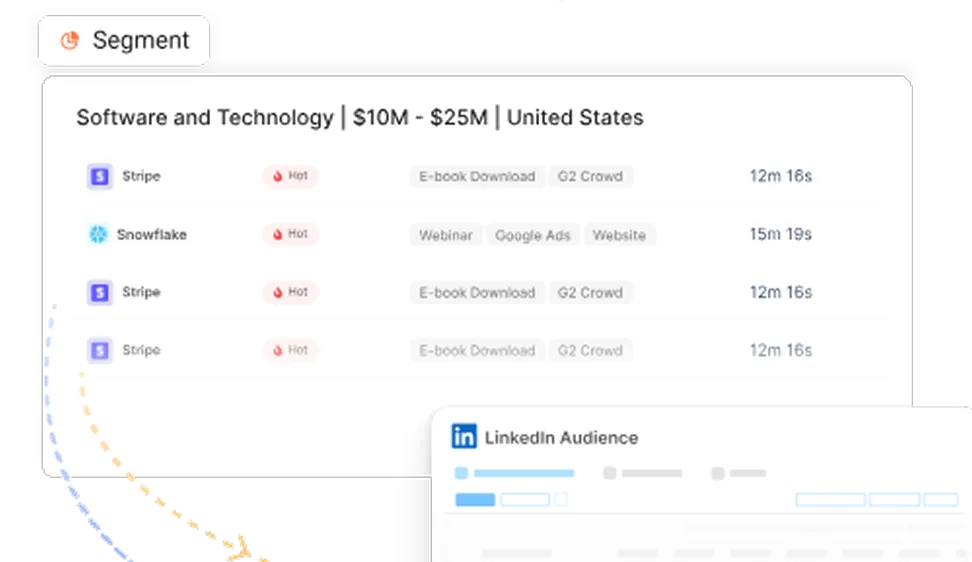
Factors.ai identified engaged companies visiting the website, even when those visitors hadn't filled out a form. High-intent audiences were synced into ad platforms for targeted retargeting and suppression. Multi-touch pipeline attribution showed which marketing activities were actually influencing revenue. And account prioritization based on real engagement signals replaced the guesswork that had previously driven outbound targeting.
What's notable about this example is how Factors.ai functioned as infrastructure within the larger system, not as a standalone tool but as the data layer that made routing, attribution, and prioritization possible. A GTM engineering agency without visibility data is building workflows in the dark. Factors.ai provided the light.
When should you hire an agency vs build in-house?
This is the question that every B2B leader eventually lands on, and the honest answer is that it depends on your specific situation. Both paths have legitimate advantages. The mistake is treating them as mutually exclusive when they work best as sequential phases.
- Hire a GTM engineering agency if:
You need results in fewer than 90 days and don't have time to recruit, onboard, and ramp an internal hire. Or if you don't currently have internal ops talent with the technical depth to build complex workflows, enrichment waterfalls, and multi-tool integrations. An agency also makes sense when your stack is genuinely messy and you need someone who's cleaned up similar messes before. If growth has stalled and you suspect systems friction is the bottleneck, an agency can diagnose and fix faster than an internal hire who's still learning your stack. And sometimes you just need temporary specialists for a defined project, a CRM migration, an attribution build, an outbound engine, without committing to a permanent headcount.
- Build in-house if:
Your GTM engineering needs are continuous and highly customised to your business. If you're running large-scale data operations that require deep institutional knowledge, an internal hire will eventually outperform an external partner. Continuous experimentation, where you're constantly testing new workflows, signals, and routing logic, also favours in-house ownership. And if your GTM systems represent a genuine strategic moat (they're a competitive advantage, not just operational infrastructure), you'll want that expertise owned internally.
- The hybrid model (usually the best modern option)
The pattern I see working best in practice is using an agency to build version one of your GTM infrastructure, then hiring an internal GTM engineer or ops leader to own version two onward. The agency brings speed, expertise, and cross-client pattern recognition. The internal hire brings context, continuity, and the ability to iterate daily without an SOW negotiation.
This hybrid approach also reduces risk. If you hire an in-house GTM engineer before you know what your systems should look like, you're asking one person to both architect and build while learning your business from scratch. That's a lot of pressure and a common reason internal hires underperform in their first six months. An agency can lay the foundation, document everything, and hand it off cleanly so your internal hire walks into a system that works rather than a stack that needs saving.
Why Factors.ai fits the GTM engineering stack
I want to be specific about why Factors.ai keeps coming up in conversations about GTM engineering, because the connection isn't immediately obvious if you think of it as "just another analytics tool." It's not. In the context of a GTM engineering stack, Factors.ai provides the visibility layer that most other tools assume already exists.
Factors.ai identifies which companies are visiting your website, even when those visitors don't fill out a form. It captures company-level intent signals that show you which accounts are actively researching your category. It provides multi-touch attribution so you can trace pipeline back to specific marketing activities. It surfaces paid and organic engagement visibility in one place, so you're not toggling between five dashboards. It prioritises accounts based on real buying signals rather than gut instinct. It syncs high-intent audiences directly into your ad platforms for smarter campaign targeting. And it provides pipeline influence reporting that connects marketing spend to revenue outcomes.
For GTM engineering agencies, these capabilities are foundational… you can't really build signal-based routing without signals (good morning). You can't design enrichment waterfalls without knowing which accounts to enrich first. You can't create meaningful attribution without cross-channel visibility. Factors.ai solves the "what's happening" problem so the agency can focus on the "what should we do about it" problem.
The teams getting the most value from Factors.ai are the ones using it alongside a GTM engineering partner or an internal GTM engineer. The platform provides the data layer. The human (or agency) provides the orchestration logic. Together, they create a system where marketing spend, sales effort, and pipeline outcomes are actually connected rather than existing in separate spreadsheets that get reconciled once a quarter during a painful meeting that nobody enjoys.
How to choose the right GTM engineering agency partner?
Let's close this with a practical decision framework. After everything we've covered, the choice of a GTM engineering partner should come down to five factors, and you should be honest with yourself about where you actually stand on each one.
- Start with your revenue bottleneck
What's the single biggest thing preventing more pipeline from converting to revenue? Is it lead routing speed? Attribution visibility? CRM data quality? Outbound efficiency? The right agency is the one that has demonstrably solved your specific bottleneck for a similar company. A generalist agency that's "good at everything" is usually great at nothing in particular.
- Assess your current stack maturity
If your CRM is relatively clean and your integrations are mostly functional, you might need a focused project rather than a full-stack overhaul. If your stack resembles a collection of tools that were purchased by different people in different years with no shared logic connecting them (which is more common than anyone admits), you need a more comprehensive engagement.
- Be realistic about speed
If you need a functioning outbound engine in 60 days, you can't afford to spend three months in discovery. But if you rush past diagnosis, you'll build the wrong thing faster. The best agencies can move quickly without skipping the thinking phase. Ask how they balance speed with thoroughness.
- Consider internal ownership capacity
Who on your team will own the systems after the agency leaves? If the answer is "nobody yet," factor that into your timeline and budget. An agency that builds something brilliant but hands it off to a team that can't maintain it has created a ticking time bomb, not a sustainable system.
- Decide whether you need ongoing support
Some companies need a one-time build. Others need a fractional GTM engineering partner who stays involved month over month to optimise, iterate, and adapt as the business evolves. Be clear about which model fits your situation before you start evaluating proposals.
The final thought I'd leave you with is this: don't hire a GTM engineering agency because you saw a LinkedIn post about Clay workflows. Hire one because you've identified specific revenue friction that's costing you real money, and you've decided that fixing the systems layer is a better investment than adding more headcount or more tools on top of a broken foundation. Revenue friction is expensive. The right partner pays for themselves by eliminating it.
In a nutshell…
GTM engineering agencies are here to stay because B2B revenue teams have outgrown their own infrastructure. The tools are there, often too many of them, but the connective tissue between those tools is usually missing. That’s what creates the slow routing, broken attribution, wasted SDR effort, and messy CRM data that quietly erode pipeline every quarter.
GTM engineering agencies specialize in building automated revenue engines and orchestrating growth engines that transform disconnected tools into unified systems. These systems are designed to deliver measurable business outcomes by automating and optimizing core revenue-generating activities, ensuring that every process is aligned with clear, quantifiable goals.
The most important decision is understanding your specific bottleneck first. Start with an audit, whether it’s a formal paid engagement or an internal honest assessment of where your revenue process breaks down. From there, evaluate agencies based on their ability to solve that specific problem, not on their website design or their client logo wall.
Pricing ranges from $3k–$15k+/month for retainers and $5k–$40k+ for projects, but the cost of doing nothing is almost always higher. And the hybrid approach, using an agency to build version one while hiring an internal owner for version two, remains the most practical path for most B2B SaaS teams.
Factors.ai fits into this picture as the visibility layer that makes GTM engineering possible. Without knowing which accounts are engaging, which channels are driving pipeline, and which touchpoints matter, even the best-engineered workflows are operating on incomplete data. Pair the right agency with the right infrastructure, and you’ve got a revenue system that actually compounds over time rather than degrading.
Frequently asked questions about GTM engineering agencies
Q1. What does a GTM engineering agency do?
A GTM engineering agency builds and optimizes the systems that help sales and marketing generate pipeline more efficiently by automating sales, marketing operations, and customer success workflows. This includes designing, building, and maintaining AI-powered systems that serve as automated revenue engines, streamlining and scaling core revenue-generating activities without proportional headcount growth. Their expertise applies software engineering principles to data pipelines, CRM architecture, lead routing, enrichment workflows, attribution, outbound automation, and AI-assisted execution. They don’t run your campaigns; they build the infrastructure your campaigns depend on.
Q2. How much does a GTM engineering agency cost?
GTM engineering agency pricing typically ranges from $3k–$15k+/month for retainer engagements, depending on scope, tools involved, and implementation depth. One-time projects can range from $5k–$40k+, while audit and strategy sprints usually cost $2k–$10k. The right model depends on whether you need ongoing support or a defined project.
Q3. Is GTM engineering different from RevOps?
Yes, though they’re closely related. RevOps typically governs processes, definitions, and alignment across revenue teams, often leveraging specialized RevOps tools for organization, automation, and strategic functions. Sales ops, on the other hand, is a distinct function focused on supporting sales teams with process optimization, reporting, and execution, complementing but not replaced by revops tools or GTM engineering. GTM engineering builds the systems and automation that make RevOps processes operational. For example, a RevOps leader might define your lead qualification criteria, while a GTM engineer builds the scoring model, routing logic, and enrichment flow that bring those criteria to life.
Q4. What tools does a GTM engineering agency typically use?
Common tools include Factors.ai, HubSpot, Salesforce, Clay, Apollo, Zapier, Make, various enrichment APIs, and BI tools like Looker or Metabase. Agencies typically build and optimize the entire GTM stack, a collection of marketing and sales technology tools, to streamline go-to-market processes. Workflow automation is used to connect these tools and processes, creating seamless operational workflows and improving efficiency. The specific stack depends on the client’s existing tools and the problems being solved. Good agencies are tool-agnostic and choose based on fit, not partnership incentives.
Q5. When should a SaaS company hire a GTM engineering agency?
When manual research, manual work, poor attribution, slow lead routing, or outbound inefficiency starts visibly slowing growth, it's time to consider a GTM engineering agency. If your team is spending more time on workarounds than on actual selling or marketing, a GTM engineering agency can help you transition to automated workflows, replacing labor-intensive processes with scalable, AI-powered automation. The earlier you address systems friction, the less technical debt you accumulate.
Q6. Can Factors.ai replace a GTM engineering agency?
No. Factors.ai is a platform that provides website visitor identification, intent signals, attribution, and account prioritization. It's a critical data layer, but it doesn't build your workflows, configure your CRM, or design your routing logic. Many teams use Factors.ai alongside an agency or an internal GTM engineer to get the most value from both the data and the systems built on top of it.

See how Factors can 2x your ROI
Boost your LinkedIn ROI in no time using data-driven insights
Try AdPilot Today


.avif)

See Factors in action.
Schedule a personalized demo or sign up to get started for free
LinkedIn Marketing Partner
GDPR & SOC2 Type II

.svg)










.png)