
Clay vs Floqer: Emerging growth engineering tools compared
Compare Clay vs Floqer for GTM teams. Pricing, workflows, enrichment, outbound automation, scale, and which tool fits modern B2B growth teams.
.avif)
Content Marketer



.svg)


TL;DR
- Clay is the power tool for GTM teams with RevOps capacity. It offers deep enrichment waterfalls, custom logic layers, and near-infinite workflow flexibility, but demands real operational investment to maintain.
- Floqer positions itself as a simpler, faster Clay alternative. It targets lean teams that want outbound workflow automation without the complexity overhead.
- The real cost of any growth engineering tool isn't the subscription. It's the credits, ops maintenance, broken workflows, and retraining that pile up when nobody owns the system after month two.
- Most B2B teams don't fail because their tools lack features. They fail because workflows become too painful to maintain, and execution stalls while the enrichment stack gathers dust.
- Factors.ai occupies a different layer entirely. If your team needs buying signals, account-level visibility, ad activation, and multi-touch attribution in one place, that's a different category from enrichment-and-outbound tooling.
Most Clay vs Floqer articles read like a spec sheet showdown. Feature A vs Feature B, pricing tier vs pricing tier, as if GTM tools are Pokémon cards you collect until something evolves into pipeline.
That’s not how this decision actually plays out.
The real moment looks more like this: your team has just enough data to be dangerous and just enough tools to be confused. You’ve got leads coming in, accounts being flagged, maybe even a few “signals” floating around in Slack. But nothing connects cleanly. Lists don’t stay updated. Outreach feels slightly off. And every time someone says “we should automate this,” it turns into a mini project that never quite finishes.
That’s the backdrop for Clay vs Floqer.
This isn’t a “which tool is more powerful” question. It’s a “what kind of system are you trying to build?” question.
Because both tools sit in the same broad category, helping you enrich data, build workflows, and automate outbound. But they come from very different philosophies:
- One assumes you want to design your own machine from scratch, piece by piece, with full control.
- The other assumes you want something that works out of the box, even if it’s a bit opinionated.
And that difference matters way more than any individual feature.
So instead of running through a checklist, this comparison is going to do something more useful: break down how each tool behaves in the real world, what kind of team it actually works for, and where each one starts to feel either powerful or painful.
Clay vs Floqer: the quick answer
If you want maximum flexibility, custom workflows, deep enrichment waterfalls, and a builder-style GTM operating system, Clay is the stronger pick. It's built for teams that have RevOps capacity and want to experiment with complex outbound motions. The trade-off is operational overhead. Someone needs to design, maintain, and troubleshoot those workflows consistently.
If you want faster setup, simpler management, and lower-friction outbound execution, Floqer is worth a serious look. It positions itself as a Floqer alternative to Clay that strips away the complexity layer and gets lean teams running sooner. The trade-off here is depth. You're exchanging granular control for speed and usability.
And if your team's real need isn't just enrichment or outbound sequencing but rather knowing which accounts are actually in-market, understanding their journey, activating ads against them, and connecting all of that to attribution, then you're looking at a different category entirely. That's where Factors.ai becomes relevant, not as a replacement for Clay or Floqer, but as the signal-and-activation layer that sits alongside or above them.
The rest of this piece breaks down exactly why those distinctions matter.
What are Clay and Floqer?
Clay: the GTM workflow platform
Clay has become one of the most talked-about tools in the B2B growth stack over the past couple of years, and for good reason. At its core, it's a modern GTM workflow platform that combines data enrichment, logic layers, CRM syncing, and automated outbound motions into a single flexible interface.
Think of it as a spreadsheet that can call APIs, enrich records on the fly, score leads based on custom criteria, and trigger downstream actions. You can connect dozens of enrichment providers, build waterfall logic that tries multiple data sources in sequence, and pipe the results into your CRM or outbound tools automatically. For GTM engineers and revenue ops automation teams, it's genuinely powerful. The community around Clay has grown quickly, with templates, playbooks, and shared workflows making it easier for new users to get started.
The catch is that "flexible" and "easy" aren't the same thing. Clay rewards teams that invest in learning its logic, building their own systems, and maintaining them over time. It's a platform with a real learning curve, and that curve gets steeper the more ambitious your workflows become.
Floqer: the simpler alternative
Floqer is a newer entrant in the GTM engineering software space, positioning itself as an easier and more affordable Clay alternative. Its pitch is straightforward: do similar GTM motions, enrichment, prospecting, and outbound automation, but with simpler UX and lower friction.
For teams that looked at Clay and thought, "this is brilliant but we don't have the bandwidth to operate it," Floqer aims to be the answer. It targets the segment of the market that wants results without needing a dedicated ops person to build and maintain every workflow.
One honest caveat worth noting here. Floqer has significantly less public documentation, community content, and third-party review coverage compared with Clay. That means some of the comparisons in this piece rely on available positioning, market mentions, and what the product signals about its intended audience rather than deep feature-by-feature benchmarking. I'll be transparent about that throughout. Where evidence is lighter, I'll say so.
Clay vs Floqer: The core difference in philosophy
This is where the Clay vs Floqer conversation gets genuinely interesting, because the feature lists alone don't tell you very much. The philosophical difference between these two tools shapes everything, from who should buy them to how they'll perform inside your team six months from now.
Clay is an infinite Lego set
Clay gives advanced teams individual building blocks and says, "Go build whatever you want." You can create custom enrichment waterfalls that try five different providers in a specific order. You can set up intent triggers that fire when a prospect's company hits certain criteria. You can build list scoring systems, CRM automations, and hyper-personalized outbound sequences that would make most SDR managers weep with joy.
The operative word in all of those sentences is "you." Someone on your team has to design each workflow, test it, debug it when data gets weird, and update it when your ICP shifts or a provider's API changes. Clay is an extraordinarily capable platform, but it assumes you have an extraordinarily capable operator. For teams with strong RevOps talent, that's a feature. For teams without it, it's a liability.
Floqer is a prebuilt growth machine
Floqer appears to target teams that want faster time to value, less complexity in day-to-day management, and a lower barrier to experimentation. Instead of handing you Lego bricks and a blank table, it seems to offer more opinionated workflows that get you from "signed up" to "sending outbound" with fewer decisions along the way.
This approach resonates with founder-led sales teams, small SDR groups, and budget-conscious startups that need sales prospecting automation to work right away. They don't want to spend three weeks designing a waterfall. They want to upload a list, enrich it, and start sequences by Friday.
The insight most comparison articles miss
Here's the thing that most "Tool A vs Tool B" articles skip entirely. Most teams don't fail because their tools lack features. They fail because workflows become too annoying to maintain. The enrichment waterfall that worked beautifully in week one breaks when a data provider changes its response format. The CRM sync that was supposed to be automatic starts creating duplicates. The custom scoring logic that the RevOps lead built is now incomprehensible because that person left the company.
Workflow decay is the silent killer of GTM tooling investments, and it disproportionately affects complex tools. That doesn't mean complexity is bad. It means you should be honest about whether your team has the discipline and capacity to sustain it. Buying enterprise-grade flexibility too early is like renting a stadium for a house party. Impressive on paper, absurd in practice.
Clay vs Floqer: Feature comparison
Before diving deeper into individual capabilities, here's a high-level comparison table. I've been careful with wording in areas where public evidence about Floqer is lighter, and marked those with qualifiers.
This table gives you the shape of the comparison, but the real differences show up in how each tool handles specific workflows. The next few sections unpack the areas that matter most for day-to-day GTM execution.
Clay vs Floqer: Data enrichment and waterfall logic
Why is enrichment quality a make-or-break factor?
Bad data doesn't just sit there quietly being wrong. It actively damages your entire outbound motion. When email addresses are stale, your deliverability tanks. When job titles are outdated, your SDRs waste time on people who've moved on. When company data is incomplete, your routing logic misfires, and hot accounts end up in the wrong rep's queue.
In B2B, where deal sizes justify real research and personalization, enrichment accuracy directly affects pipeline quality. A 15% improvement in email validity doesn't sound dramatic until you calculate how many more conversations that means per month and how many fewer bounced messages are quietly wrecking your domain reputation.
How does Clay handle enrichment?
Clay's enrichment strength comes from its ability to connect many providers and build waterfall logic across them. The concept is simple but powerful. If Provider A doesn't return a work email, try Provider B. If that fails, try pulling from a LinkedIn source. If you still don't have an email, enrich the company data and flag the record for manual research.
You can stack these checks in any order, weight them by reliability, and add conditional logic at each step. For teams that care deeply about data accuracy and have the ops bandwidth to tune their waterfalls, Clay is genuinely best-in-class here. The depth of control is hard to match. You're not just picking a single enrichment vendor and hoping for the best. You're building a system that maximizes coverage across multiple sources.
The flip side is that building and maintaining these waterfalls takes time. When a provider changes its API, or when you add a new data source, someone needs to update the logic. And if your enrichment needs are relatively straightforward, like "give me verified work emails for this list of 500 people," the full waterfall machinery might be more than you need.
How does Floqer approach enrichment?
Floqer's angle appears to be simplifying the enrichment process so that non-technical teams can get accurate data without needing to design their own waterfall from scratch. If it delivers on that promise, it wins on usability for teams that don't have a dedicated ops person managing data pipelines.
The trade-off is presumably less granular control over which providers get called in which order, and fewer options for conditional logic at each step. For many teams, especially those with straightforward ICPs and standard outbound workflows, that's a perfectly reasonable trade-off. You're exchanging fine-tuned control for speed and simplicity.
What actually matters
Here's a perspective that's becoming clearer as the enrichment market matures. The winner in this space isn't going to be the tool with the most provider integrations. It's going to be the tool that helps teams trust their data enough to act fast. The gap between "enriched" and "actionable" is where most B2B teams lose momentum. You can have beautiful waterfall logic pulling from eight providers, but if your reps still don't trust the emails enough to send cold outbound without manual verification, you haven't actually solved the problem.
Both Clay and Floqer are competing to close that gap, just from different directions. Clay gives power users the tools to build high-confidence enrichment systems. Floqer tries to make good-enough enrichment accessible to everyone. Which approach works better depends entirely on your team's context, but I'd argue that speed-to-trust matters more than depth-of-sources for most B2B growth teams today.
Clay vs Floqer: Outbound execution and sequencing
The enrichment-to-action gap
Data enrichment without execution is just an expensive spreadsheet. This is a trap that more B2B teams fall into than you'd expect. They invest heavily in building a beautiful, enriched database, complete with verified emails, job titles, technographic data, and intent signals. Then the data sits there because nobody built the bridge to actual outbound action.
The real-world GTM need isn't just "enrich this list." It's a chain of actions that needs to happen quickly once the data is ready. You need to trigger SDR alerts when high-intent accounts surface. You need to launch email sequences personalized with the enriched data. You need to route hot accounts to the right rep based on territory or segment. You need to sync everything back to the CRM so nothing falls through the cracks. And increasingly, you need to activate LinkedIn or Google ad audiences based on the same account lists.
That chain, from enriched data to coordinated outbound motion, is where the real value lives. Any tool that breaks the chain at any point is costing you pipeline.
Clay's approach to outbound orchestration
Clay functions as a strong orchestration layer. It can trigger actions based on workflow conditions, push data to external tools, update CRM records, and coordinate multi-step sequences. The keyword here is "orchestration" rather than "execution." Clay is brilliant at deciding what should happen and when, but many teams still pair it with dedicated outbound tools like Instantly, Smartlead, or Apollo for the actual email sending and sequence management.
This isn't necessarily a weakness. In fact, separating orchestration from execution gives you the flexibility to swap out individual components without rebuilding your entire workflow. But it does mean your B2B growth stack has more moving parts, more integrations to maintain, and more potential points of failure. For teams comfortable managing a multi-tool setup, Clay's orchestration capabilities are excellent. For teams that want fewer tools and simpler management, it adds complexity.
Floqer's approach to outbound execution
Floqer appears to position itself as a more consolidated solution, with outbound execution capabilities closer to the core product rather than relying as heavily on external integrations. If that's accurate, it's an appealing proposition for teams that want one tool handling the workflow from enrichment through to email send, without needing to configure and maintain three or four separate platforms.
The likely trade-off is flexibility. A more consolidated tool can cover the most common outbound motions well, but may not support the edge cases and custom workflows that advanced GTM engineers need. If your outbound motion is "enrich list, personalize emails, send sequence, sync to CRM," a simpler consolidated tool probably serves you fine. If your motion involves conditional branching, multi-channel orchestration, and dynamic scoring, you'll probably need Clay's depth.
The execution speed blind spot
Here's something I see repeatedly in growth teams. They over-invest in enrichment and under-invest in execution speed. The logic seems sound: better data should produce better outcomes. And it does, up to a point. But there's a diminishing return curve that kicks in faster than most teams expect.
Going from 60% email accuracy to 85% is transformative. Going from 85% to 92% is nice but marginal. Meanwhile, the team that acts on 85%-accurate data within 24 hours of an intent signal will almost always outperform the team that waits three days to get to 92% accuracy. Speed of execution, the time between "this account looks interesting" and "an SDR is having a conversation with them," is the metric that actually predicts pipeline. Both Clay and Floqer can help you move faster, but only if you've designed your workflow to prioritize action over perfection.
Clay vs Floqer: Ease of use for lean teams
This is the section where the Clay vs Floqer comparison gets personal, because "ease of use" isn't an abstract product quality. It's a reflection of your team's reality.
When does Clay start to feel heavy?
Clay is a remarkable tool, but it wasn't designed for every team. I've watched early-stage startups sign up for it with genuine excitement and then struggle because the operational prerequisites weren't in place. If your team doesn't have a RevOps owner or someone who genuinely enjoys building data workflows, Clay's flexibility becomes a burden rather than an asset.
If you don't have a GTM engineer who understands API logic, conditional branching, and data hygiene, the waterfall that looked so elegant in the demo quickly becomes a mess of broken steps and stale enrichments. If you're a fast-moving startup with four sellers and no dedicated ops person, the tool doesn't maintain itself. And when nobody maintains it, the data degrades, the workflows break, and the team quietly stops using it. I've seen this happen at three different companies in the past year alone. The fit was the only problem.
When does Floqer make more sense?
Floqer seems to resonate with a different profile of team. Founder-led sales organizations where the CEO is also the top seller. Small SDR teams that need outbound workflow automation to work without a dedicated ops hire. Budget-conscious startups that want to experiment with growth engineering tools without committing to a heavy platform.
These teams don't need infinite customization. They need something that works on Tuesday so they can have conversations by Thursday. They want to import a prospect list, get it enriched, write some personalized outreach, and start sending. The fewer decisions required between "I have a list" and "emails are going out," the more likely the tool actually gets used.
For this audience, Floqer's positioning as a simpler Clay alternative makes strategic sense. It's not trying to out-feature Clay. It's trying to out-simplify it.
Matching tool complexity to team maturity
There's a pattern I keep noticing in B2B software purchasing. Teams buy for where they want to be, not where they actually are. A five-person startup buys the tool designed for a 50-person sales org because the features look amazing, and they're planning to scale. Six months later, they're using maybe 20% of what they bought, and the other 80% is creating friction rather than value.
The smartest growth teams I know match their tool complexity to their current operational maturity. They pick the tool they can fully utilize today, extract value from it, and upgrade when they've genuinely outgrown it. There's no shame in starting with a simpler stack. The shame is in paying for complexity you can't operate.
Clay vs Floqer: Pricing and total cost of ownership
Clay Pricing
Clay follows a usage-based pricing model built around actions and data credits. Instead of charging per seat or feature, you pay based on how many workflow steps you run and how much external data you enrich.
- Plans start with a free tier (6K actions, 1.2K credits annually), scale to $167/month (180K actions, 30K credits), and go up to $446/month for Growth (480K actions, 72K credits), with enterprise pricing available on request.
The structure is transparent, but costs scale with workflow complexity. A simple enrichment flow may use a handful of actions per record, while a full GTM workflow with waterfalls, signals, and CRM sync can multiply usage significantly. In practice, this means Clay rewards teams that design efficient systems, but costs can rise quickly if workflows are layered without control.
Floqer Pricing
Floqer does not publicly list its pricing on its website, which suggests a sales-led, custom pricing approach rather than a fixed, usage-based model. Because of this, exact plan details, credit systems, or cost breakdowns are not transparently available, and pricing likely depends on team size, use case, and scope of implementation. Unlike Clay, where you can directly map cost to usage, Floqer appears to package its offering at a higher level, making it easier to budget upfront but harder to dissect at a granular level. This creates a key tradeoff: Clay offers visibility and control over how costs scale with usage, while Floqer prioritizes simplicity and predictability, with pricing clarity only emerging during the sales process.
That said, Clay pricing has been a topic of conversation in the GTM community, with some teams noting that credit-based usage can scale quickly as enrichment volume grows. Floqer positions itself as a more affordable option, which suggests lower sticker pricing, though the specifics depend on your usage pattern.
The hidden costs that really add up
The costs that sneak up on teams have nothing to do with the subscription line item. They live in the operational gaps between "we bought this tool" and "this tool is generating pipeline."
- Credit consumption
Any tool with a credit-based model means your costs scale with usage, and usage has a way of growing faster than you expected. A waterfall that checks three enrichment providers per record uses three times the credits of a single-provider check. Multiply that by thousands of records per month, and the credit bill can surprise you.
- Ops maintenance
Every workflow needs someone to monitor it, update it when data formats change, and troubleshoot it when something breaks. That's not a software cost; it's a people cost. But it's directly proportional to the complexity of the tool. More flexible tools require more maintenance hours.
- Retraining
When your ops person leaves, or when you hire a new SDR who needs to understand the system, there's a ramp-up cost. Complex tools have longer ramp times. Simpler tools get new users productive faster.
- Broken workflow recovery
When an integration breaks or a workflow logic error goes unnoticed for two weeks, the cost isn't just the fix. It's the pipeline you didn't generate during those two weeks, plus the data cleanup afterward.
- Duplicate tooling
When a primary tool doesn't cover a need well enough, teams bolt on secondary tools. Before long, you're paying for three platforms that each do 30% of what you need, with manual processes filling the gaps.
Clay vs Floqer: Best fit by team type
Rather than pretending there's one correct answer, here's a framework for matching the tool to your actual situation. The honest version of this conversation acknowledges that different teams need different things and that choosing a tool isn't a permanent commitment.
Choose Clay if your team matches this profile
You have a dedicated RevOps person or GTM engineer who enjoys building workflows. You need custom enrichment waterfalls, conditional logic, and complex segmentation. Your outbound motion involves multiple channels, triggers, and scoring criteria. You want experimentation depth and are willing to invest the ops hours to maintain what you build. Your team is large enough that one person can own the tool without it becoming their entire job.
Clay rewards investment. The more you put into designing and maintaining your workflows, the more pipeline value you'll extract. But the "more you put in" part is non-negotiable. It's not a tool that runs on autopilot.
Choose Floqer if your team matches this profile
You need outbound execution speed now, not after a three-week implementation period. Your team is small, probably with fewer than ten people involved in outbound. You want easier operations that don't require a specialist to manage. You're looking for clay pricing alternatives that won't scale unpredictably with usage. Your outbound motion is relatively standard: enrich, personalize, send, follow up. You'd rather have something that works consistently at 80% of Clay's capability than something that theoretically works at 100% but practically works at 40% because nobody maintains it.
Floqer's value proposition as a Floqer alternative to Clay makes sense for this audience. Speed and usability trump raw capability when your team doesn't have the bandwidth for complexity.
When neither tool alone is the right answer
Here's where the conversation gets more nuanced. Both Clay and Floqer live primarily in the workflow, enrichment, and outbound operations layer of the GTM stack. They're excellent at what they do within that layer. But a growing number of B2B teams are realizing that enrichment and outbound are just two pieces of a much larger puzzle.
If you need full-funnel signals, meaning you want to know which accounts are visiting your site, what content they're engaging with, and how they're progressing through their buying journey, that's not what Clay or Floqer are designed to tell you. If you need multi-touch attribution to understand which campaigns actually drove pipeline, that's a different problem entirely. And if you need to activate audiences across LinkedIn and Google ads based on intent signals, you're looking at a capability that lives outside the enrichment-and-outbound category.
When your growth team's needs span signal detection, enrichment, activation, and attribution, no single outbound tool covers all of it. That's not a criticism of Clay or Floqer. It's an acknowledgment that the B2B growth stack has more layers than any one tool can own.
Where Factors.ai fits in this category
When teams search for "clay vs floqer" or "clay competitors," they're usually trying to solve a specific problem: "How do I enrich my prospect data and run outbound more effectively?" That's a valid and important question. Both Clay and Floqer address it, and the sections above should help you decide which approach fits better.
But there's another question that's becoming more common in B2B growth conversations: "How do we know who is actually in-market, what they've done across our website and campaigns, and how to act on that information right now?" That question spans a different set of capabilities. It requires website intent signals that tell you which accounts are showing buying behavior. It requires account journey visibility that stitches together touchpoints across channels. It requires ad activation so you can target in-market accounts on LinkedIn and Google without manual list uploads. It requires CRM syncing that keeps your sales team informed without requiring them to check another dashboard. And it requires multi-touch attribution so you can actually measure what's working.
What does Factors.ai do differently?
Factors.ai sits in this signal-to-action layer. It's designed for revenue ops automation teams and growth leaders who want to connect the dots between anonymous website visits, known account engagement, ad spend, and pipeline outcomes, all in one platform.
It identifies accounts visiting your site, even before they fill out a form. It maps their journey across touchpoints. It activates ad audiences based on account intent. It syncs signals to your CRM for sales prioritization. And it provides attribution data so you can see which channels and campaigns actually contributed to revenue.
That's a fundamentally different value proposition from enrichment-and-outbound tools. It's not competing with Clay or Floqer on waterfall logic or email sequencing. It's answering the question that comes before those tools even get involved: "Which accounts should we be targeting in the first place, and what do we know about their buying intent?"
How does this connect to the enrichment-and-outbound layer?
The most effective B2B growth stacks in 2026 aren't choosing between signals and outbound. They're connecting them. You use a signal layer like Factors.ai to identify which accounts are in-market and understand their journey. Then you use an enrichment and outbound layer, whether that's Clay, Floqer, or something else, to act on those signals with personalized outreach.
Instead of enriching a cold list and hoping some of them are interested, you're enriching a warm list of accounts that have already shown buying behavior. That changes the economics of your entire outbound motion. Your enrichment credits go further because you're spending them on higher-probability accounts. Your SDRs convert at higher rates because they're reaching out to people who are already engaged. And your attribution data closes the loop so you know which signals led to which outcomes.
That integrated approach, signals plus enrichment plus execution plus measurement, is where the B2B growth stack is heading. No single tool owns all of it today, but the teams that think in systems rather than individual tools are the ones generating disproportionate pipeline.
In a nutshell…
This comparison started with a simple question, Clay vs Floqer, and ended up in a much broader conversation about how modern B2B growth teams should think about their tool stack. Here's what I'd want you to take away from it.
Clay wins on power and flexibility. If your team has the RevOps talent to build and maintain complex workflows, it offers depth that's genuinely hard to match. Waterfall enrichment, custom logic, multi-step orchestration, and a thriving community of builders make it the strongest option for teams that want maximum control over their GTM engine. The cost of that power is operational overhead, and it's a real cost that you should budget for in people-hours, not just subscription dollars.
Floqer wins on simplicity and speed. For lean teams, founder-led sales organizations, and budget-conscious startups, it offers a faster path to outbound execution. You trade granular control for usability, and for many teams, that's a trade worth making. A tool you actually use consistently will always outperform a more powerful tool that sits half-configured.
Factors.ai wins when the question changes from "how do we enrich and send outbound?" to "how do we identify in-market accounts, understand their journey, activate ads against them, and measure what works?" It occupies a different layer of the growth stack, one that's becoming increasingly essential as B2B teams move from spray-and-pray outbound to signal-driven revenue generation.
The actionable takeaway is this: match your tool to your team's actual operational maturity today, not your aspirational maturity six months from now. If you have an ops team ready to build, Clay is your playground. If you need outbound running by next week with minimal setup, Floqer deserves a serious evaluation. And if your biggest gap isn't enrichment or sequencing but rather knowing who to target and measuring what's actually driving pipeline, explore Factors.ai as the signal-to-action layer that connects everything upstream.
The next generation of GTM tools won't be judged by how much data they collect. They'll be judged by how quickly they turn buying signals into revenue conversations. Whichever tool helps your specific team do that fastest, with the least operational friction, is the right choice.
Frequently asked questions about Clay vs Floqer
Q1. Is Floqer better than Clay?
It depends on your team's needs and operational capacity. Clay is the stronger choice for advanced customization, complex waterfall enrichment, and multi-step workflow orchestration. But that power comes with a steeper learning curve and more maintenance overhead. Floqer may be a better fit for teams that want simpler workflows, faster setup, and easier day-to-day management without a dedicated ops person. Neither tool is universally "better." The right answer depends on whether your team can actually operate the complexity you're buying.
Q2. Is Clay worth it for startups?
Only if you have someone who can operate it well. Clay's flexibility is genuinely powerful, but it requires a RevOps-minded person to design workflows, maintain enrichment waterfalls, and troubleshoot integrations when they break. For startups with a technical co-founder or an ops-oriented team member who enjoys building systems, Clay can deliver significant value. For startups without that profile, the complexity often outweighs the benefit, and a simpler tool that gets used consistently will produce better outcomes.
Q3. What is the best Clay alternative?
That depends on what you're trying to solve. If you're looking for a simpler, faster outbound workflow tool with less operational overhead, Floqer positions itself as a direct alternative. If your core need is actually identifying in-market accounts, understanding their buying journey, activating ad audiences, and measuring attribution across channels, Factors.ai fits a different part of the stack that Clay doesn't address. The best alternative is the tool that matches the specific gap in your growth motion, not just the one with the most similar feature list.
Q4. Does Clay include outbound sequencing?
Clay supports workflow actions and integrations that can trigger outbound motions, including personalized message drafting and CRM updates. However, many teams pair Clay with dedicated outbound sending tools like Instantly, Smartlead, or Apollo for the actual email sequencing and delivery. Clay is stronger as an orchestration and enrichment layer than as a standalone outbound execution platform. If you want enrichment and sequencing in a single tool with less integration management, you may want to evaluate more consolidated options.
Q5. What tool is best for GTM engineering?
The best growth engineering tool matches your team's maturity level and operational bandwidth. Power teams with dedicated GTM engineers and RevOps capacity tend to get the most from Clay's flexibility and depth. Lean teams without dedicated ops support may prefer simpler tools like Floqer that prioritize speed and usability over customization. Revenue-focused teams that need signal detection, enrichment, activation, and attribution in a unified system should evaluate platforms like Factors.ai that span multiple layers of the growth stack. There's no single "best" tool for GTM engineering; there's only the best tool for your team's current reality.

See how Factors can 2x your ROI
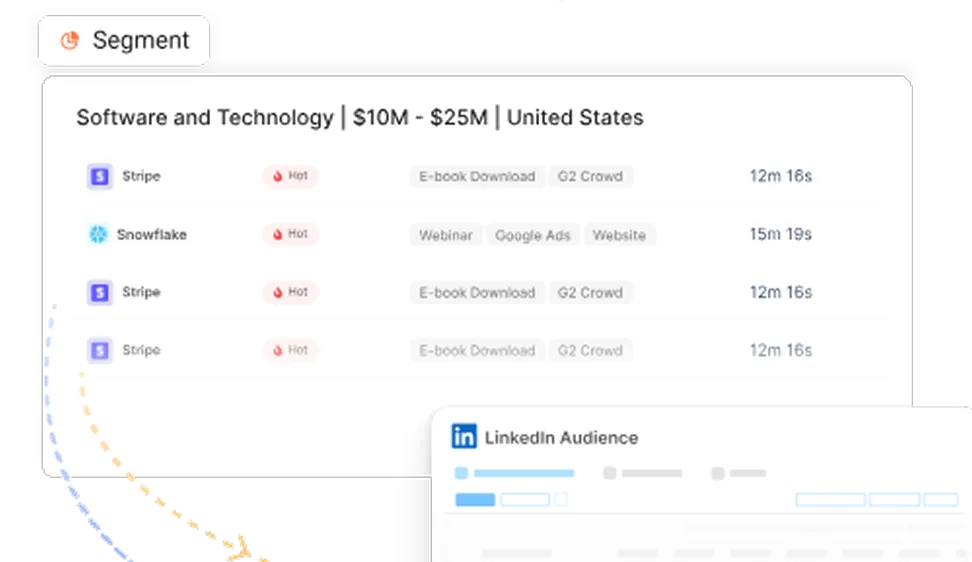
Boost your LinkedIn ROI in no time using data-driven insights


.avif)

See Factors in action.
Schedule a personalized demo or sign up to get started for free
LinkedIn Marketing Partner
GDPR & SOC2 Type II

.svg)



.avif)

