
Heading 2
B2B SaaS go-to-market strategy: Aligning sales, marketing, and revenue goals
Build a B2B SaaS go-to-market strategy that aligns sales, marketing, and revenue teams for stronger pipeline, faster growth, and lower CAC.
Written by
.avif)
Vrushti Oza
Content Marketer
Summarize this article




.svg)


TL;DR
- A B2B SaaS go-to-market strategy is the continuous operating system for how your company acquires, converts, and expands revenue every quarter.
- Most GTM strategies break because teams optimize for local metrics (leads, meetings, efficiency) instead of shared revenue outcomes, creating expensive misalignment.
- The modern GTM model is account-centric, built on buying signals, multi-touch influence, and full-funnel visibility rather than linear funnels and form fills.
- Aligning sales and marketing around shared metrics like qualified pipeline, opportunity rate, and CAC payback eliminates the finger-pointing that slows growth.
- Intent data, feedback loops, and revenue operations tie the engine together, but only when they trigger action rather than sit in dashboards.
Some B2B SaaS companies treat go-to-market strategy like a New Year’s resolution.
Big energy in January. Fancy plans. A few expensive tools. Bold declarations about pipeline. By March, sales is freelancing, marketing is boosting random campaigns, RevOps is stressed, and everyone is pretending the attribution model just needs “more time.”
I say this with love.
Most GTM problems don’t come from weak teams or weak products. They come from building growth around disconnected incentives. Marketing is rewarded for leads. Sales is rewarded for closed revenue. Finance wants lower CAC. Leadership wants faster growth. Nobody is technically wrong, which is exactly why it gets messy.
Meanwhile, your buyer is on a journey designed by committee. They click an ad, download a guide, get three emails, receive a cold call from someone who has no idea what they downloaded, then vanish forever into the CRM graveyard.
Iconic.
A proper B2B SaaS go-to-market strategy should make the business feel coordinated. The right accounts should be clear. Teams should know what matters. Metrics should connect to revenue. Buyers should feel understood, not processed.
This blog is for companies tired of operating like three separate startups sharing one logo. We’ll cover how to define your ICP properly, choose the right GTM motion, align teams around numbers that matter, and use intent data before competitors smell the opportunity first.
Because growth gets a lot easier when everyone stops playing different sports..
What is a B2B SaaS go-to-market strategy, really?
Most blog posts will tell you a go-to-market strategy is a plan for launching a product. That definition made sense in 2010 when software shipped once and sales teams did the rest. It doesn’t hold up in a world where SaaS companies reprice quarterly, release features biweekly, and enter new segments every year.
A better definition would be this… a B2B SaaS go-to-market strategy is the operating system for how your company acquires, converts, expands, and retains revenue. It’s the connective tissue between your ideal customer profile, your positioning, your pricing and packaging, your acquisition channels, your sales motion, your revenue ownership model, and your expansion playbook, as well as essential components such as messaging strategy, unique value proposition, pricing strategy, distribution channels, and thorough market research. Remove any one of those layers and the system develops cracks.
What makes SaaS GTM fundamentally different from traditional go-to-market planning is that it never stops. You don’t launch once and move on. Every quarter presents a new GTM moment that demands recalibration. Moving upmarket from SMB to mid-market is a GTM shift. Introducing a product-led growth motion alongside your sales-led one is a GTM shift. Expanding internationally, reducing CAC pressure, improving win rates against a specific competitor, all of these are GTM problems wearing different clothes.
The SaaS go to market strategy, then, isn’t a document you write before launch and file away. It’s a living system you revisit constantly. The companies that treat it that way tend to compound their growth. The ones that treat it as a one-time exercise tend to wonder why their metrics plateau after the initial traction wears off.
Think of it like an operating system for a computer. The hardware (your product) matters, but without an OS that coordinates everything, the machine doesn’t function well. Your GTM strategy is that coordination layer for revenue.
Why do most SaaS GTM strategies break?
Here's something that doesn't get said often enough: most SaaS growth strategies fail not because they lack ideas, but because they're assembled from disconnected departmental plans.
- Marketing builds a plan to hit lead targets. Sales builds a plan to hit quota. Finance builds a plan to improve unit economics. Product builds a plan for adoption. Customer success builds a plan for retention. Each plan looks reasonable in isolation. But nobody owns the full buyer journey from first anonymous visit to expansion revenue, and the gaps between these plans become expensive fast.
- The hidden tax of this misalignment shows up in specific, measurable ways. Paid spend generates a flood of leads that SDRs quietly ignore because they don't match what sales actually wants to work. SDRs who do engage those leads end up booking demos with accounts that were never a great fit. Sales closes some of those poor-fit deals to hit quarterly numbers. Then churn rises three quarters later, CAC payback stretches beyond anything the financial model assumed, and someone calls a meeting to "fix the funnel."
- A broken GTM strategy often looks busy from the outside and expensive from the inside. The dashboards show activity everywhere. Campaigns are running, sequences are firing, content is publishing, and reps are calling. But when you trace the path from spend to revenue, the leakage is staggering.
- The root cause is structural, not motivational. People aren't being lazy or difficult. They're responding rationally to their own incentive structures. When marketing is rewarded for MQL volume, they'll optimize for it. When sales is rewarded for closed-won revenue, they'll focus on deals they think they can close this quarter, regardless of long-term fit. The b2b gtm strategy breaks when each team's success metric can be hit while the company's overall revenue health deteriorates.
This fix: Fixing this isn't about adding more meetings or building bigger Slack channels. It requires rethinking what teams are measured on and how they share information. That's where the modern GTM model comes in.
The new GTM model: revenue alignment first
For years, the default SaaS funnel looked like a simple conveyor belt. Traffic flows in, leads get captured, demos get booked, deals get closed. It was clean, linear, and reassuring. It was also increasingly disconnected from how B2B buyers actually behave.
The old model assumed buyers followed a predictable sequence: see ad, click, fill out form, talk to sales, buy. The reality in most B2B buying cycles is far messier. Buyers self-educate extensively before they ever talk to your team. They read your blog, check your G2 reviews, ask peers on Slack communities, watch your webinar on 2x speed, and compare your pricing page against two competitors. By the time they fill out a demo form, they've already formed an opinion. And they did most of that research in channels you can't easily track, the dark funnel that marketing teams increasingly acknowledge but struggle to measure.
The modern go to market framework for SaaS reflects this reality. Instead of tracking a linear path from traffic to leads to demos, it starts with accounts and tracks buying signals across multiple touchpoints. The sequence looks more like this: identify target accounts, detect buying signals (site visits, ad engagement, content consumption, competitor research), influence those accounts through coordinated multi-touch campaigns, convert engaged accounts into qualified opportunities, and then expand revenue within those accounts over time.
This move from lead-centric to account-centric thinking changes everything about how teams operate. Marketing isn't just generating form fills. They're warming and influencing buying committees across channels. Sales isn't waiting for inbound leads. They're prioritising accounts that are already showing intent. Revenue operations isn't just reporting on what happened. They're routing signals in real time so teams can act.
Your GTM model should be account-centric, not form-fill centric. When you organize around accounts instead of individual leads, you naturally break down the walls between departments because everyone is looking at the same unit of analysis.
Step 1: How do you define your ICP by revenue potential?
Most companies define their ideal customer profile with two variables: industry and employee count. "We sell to mid-market SaaS companies with 200-1000 employees." That's a starting point, not a strategy. It describes a huge population of companies, most of whom will never buy from you.
A sharper ICP uses a four-layer model that goes well beyond firmographics.
- Layer 1: Firmographic. This is the baseline. Industry, company size, region, funding stage, business model. It tells you who could theoretically be a customer. Most teams stop here, and that's why their targeting stays broad.
- Layer 2: Technographic. What tools are they already using? What does their tech stack look like? A company running a mature marketing automation platform alongside a CRM signals very different readiness than one still managing contacts in spreadsheets. Stack maturity tells you how sophisticated their buying process is and how your product fits into their existing workflow.
- Layer 3: Behavioral. This is where it gets interesting. Which companies are visiting your high-intent pages like pricing, comparisons, and case studies? Which ones are clicking your ads repeatedly? Who's consuming competitor content or researching your category on review sites? Behavioral signals tell you who's actively in a buying cycle, not just who fits your demographic profile.
- Layer 4: Economic. What's the realistic deal size? Does this account have expansion potential, meaning multiple teams, growing headcount, or use cases that deepen over time? What's their likely retention profile based on similar customers you've served? This layer filters for accounts that don't just convert but stay long enough to be profitable.
The best ICP isn't defined by who can buy. It's defined by who buys fast, stays long, and expands. That distinction changes your entire targeting strategy because it shifts the conversation from volume to quality. You'd rather have 200 perfectly matched accounts in your pipeline than 2,000 that vaguely fit your firmographic criteria.
Tools like Factors.ai make this layered approach practical by identifying companies visiting your site anonymously. You don't need to wait for a form fill to know that a high-fit account is researching your category. When you can see that a Series B fintech with a mature tech stack has visited your pricing page three times this week, your ICP model moves from theory to action.
Step 2: How do you choose the right GTM motion?
Not every SaaS company should run the same playbook, and the GTM motion you choose should match your product's complexity, your average contract value, and the way your buyers actually make decisions. There are three primary motions, and most serious companies eventually evolve into a hybrid.
- Product-led growth (PLG) works best for low-friction products where individual users can sign up, experience value quickly, and eventually pull their team in. Think collaboration tools, developer utilities, and design platforms where the product itself does the selling. The beauty of PLG is its efficiency. The challenge is that it struggles when implementation requires multiple stakeholders, security reviews, or significant onboarding.
- Sales-led growth (SLG) fits high-ACV products with complex buying committees. When six people need to agree on a purchase and the contract involves legal review, procurement negotiation, and custom implementation, you need a sales team guiding that process. SLG is more expensive per acquisition but essential when deal complexity demands human navigation.
- Marketing-led growth (MLG) relies on strong content engines, inbound demand generation, and SaaS demand generation programmes that create category awareness and capture existing demand. It's powerful for building pipeline at scale but works best when combined with sales capacity to convert that demand into revenue.
Here's a comparison of when each motion fits:
Many founders copy PLG because it sounds modern and capital-efficient. But if your product implementation genuinely requires six stakeholders to agree, a security review, and a three-month onboarding, you need sales involved. There's no shame in that. The motion should match the buyer's reality, not the founder's aesthetic preference.
Most SaaS companies that reach meaningful scale end up running a hybrid motion. PLG handles the bottoms-up adoption and self-serve segment. Sales-led covers the upmarket deals. Marketing-led fuels the demand that feeds both. The trick is making these motions share data and operate against the same revenue targets rather than running as parallel tracks.
Step 3: How do you align sales and marketing around shared metrics?
If you only implement one idea from this entire piece, make it this one. Sales and marketing alignment isn't a culture problem. It's a measurement problem. When marketing is measured on MQL volume and sales is measured on closed-won revenue, conflict is guaranteed by design. The incentive structures literally pull in different directions.
Marketing optimizes for lead volume because that's what their dashboard rewards. They'll run campaigns that generate high form-fill rates regardless of lead quality. Sales ignores most of those leads because they've learned from experience that "marketing leads" rarely convert. Both teams then blame each other in the quarterly review, and leadership calls for "better alignment" without changing the underlying metrics.
The fix is to replace vanity KPIs with shared revenue metrics that both teams own. Here's what that shift looks like in practice:
When marketing knows they'll be evaluated on qualified pipeline rather than raw lead count, they start caring about lead quality. When sales knows that marketing's contribution to pipeline is visible and measured, they start engaging with marketing-sourced accounts more seriously. The SaaS revenue strategy becomes a shared language instead of a source of internal friction.
Account engagement scoring is particularly powerful here. Instead of arguing about whether a lead is "qualified" based on a form fill, both teams can look at the same account engagement score that aggregates website visits, ad interactions, content consumption, and sales touchpoints. A high engagement score means the account is active and warming. A low score means it needs more nurturing before sales invests time.
This shared measurement model doesn't eliminate healthy tension between teams. Sales will still push marketing for better targeting, and marketing will still push sales for faster follow-up. But that tension becomes productive because it's oriented around the same outcome rather than competing ones.
Step 4: How do you build a full-funnel channel strategy?
One of the most common mistakes in SaaS pipeline strategy is asking a single channel to do everything. I've seen teams expect SEO to generate bottom-funnel demos, paid ads to build long-term brand awareness, and webinars to somehow serve as the entire pipeline engine. Each channel has a natural strength, and the best GTM teams deploy channels deliberately at different funnel stages.
- Awareness channels
At the top of the funnel, you're trying to get on the radar of accounts that don't know you yet. SEO-driven content, thought leadership on LinkedIn, video ads, partnerships with complementary tools, and podcast appearances all work well here. The goal isn't conversions. It's recognition. You want decision-makers at your target accounts to have heard your name and associated it with a relevant point of view before they ever enter a buying cycle.
- Consideration channels
Once accounts are aware and exploring options, different channels take over. Retargeting campaigns keep you visible as they research. Webinars let you demonstrate expertise in a more interactive format. Comparison pages help buyers who are actively evaluating alternatives. ROI calculators give them a reason to engage with your value proposition concretely. Case studies provide the social proof that moves accounts from "interesting" to "credible."
- Decision channels
When accounts are close to a buying decision, the playbook shifts again. ABM campaigns targeted at specific buying committees deliver personalized messaging. Direct outreach from sales carries more weight when the account is already warmed. Peer proof, whether through customer references or community discussions, addresses the last-mile hesitation. Buying committee nurture ensures you're not just influencing one champion but reaching the CFO, the VP of Engineering, and whoever else has veto power.
The critical insight here is that each channel has a job description. SEO is not your SDR team. Paid ads aren't an onboarding experience. Webinars won't magically create pipeline if the accounts attending them don't match your ICP. When you assign channels to specific funnel stages and measure them against stage-appropriate metrics, your entire SaaS demand generation effort becomes dramatically more efficient.
A practical way to operationalize this is to map every active channel to a funnel stage and a specific metric. If LinkedIn video ads are an awareness channel, measure them on reach and engagement within your target account list. If comparison pages are a consideration asset, measure them on time-on-page and demo request rate. This clarity prevents the "is this channel working?" debates that consume hours in marketing meetings.
Step 5: How do you use intent data to prioritize accounts?
Here's where a modern B2B GTM engine gains its sharpest competitive edge. Every company in your market is running campaigns, publishing content, and reaching out to prospects. The teams that win aren't necessarily doing more of these activities. They're doing them at the right time, aimed at the right accounts.
Intent data makes this possible by telling you which accounts are actively in a buying cycle before they raise their hand. The sources of intent vary, and the best strategies layer multiple signals together.
- Website visits to high-value pages
An anonymous company visiting your pricing page, your integration docs, or your competitor comparison page three times this week is signaling something meaningful. That's very different from someone who read a top-funnel blog post once and bounced.
- Content consumption patterns
When an account downloads your ROI guide, watches your product demo video, and then reads two case studies in the same week, that's not casual browsing. That's research behavior that typically precedes a buying conversation.
- Ad engagement
Repeated clicks on your paid campaigns from the same account suggest growing interest. Single clicks might be noise. Patterns are signal.
- CRM reactivation signals
Accounts that went cold six months ago and suddenly start re-engaging with your content or visiting your site again deserve immediate attention. They've already been through your sales process once, which means the re-entry barrier is much lower.
- Competitor research activity
Third-party intent data can reveal when accounts are actively researching your competitors or your product category on review sites and comparison platforms.
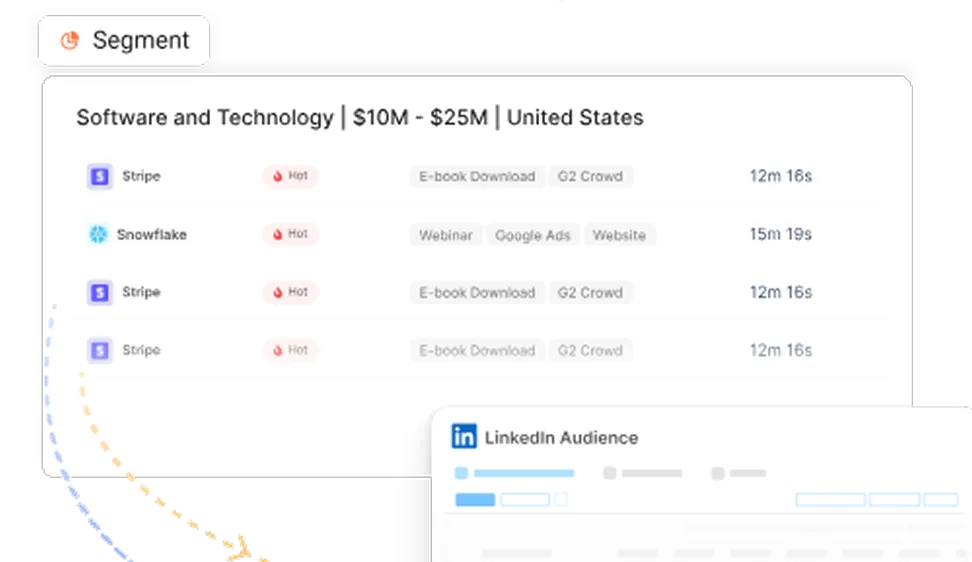
The critical point that many teams miss is that intent data without routing is useless. Knowing that a high-fit account is showing buying signals is only valuable if that knowledge triggers a specific action. That action might be syncing the account into a targeted LinkedIn audience, triggering a Slack alert to the account's assigned SDR, adding them to a personalized email sequence, or moving them up in the sales prioritization queue.
Factors.ai connects these dots by turning anonymous website activity into identified accounts and then routing those signals to the systems where your team can act on them. The data doesn't just live in a dashboard. It flows into your audience syncs, your alerts, your sequences, and your account prioritization workflows. That's the difference between having intent data and actually using it.
Step 6: How do you create feedback loops between teams?
Even with shared metrics, the right GTM motion, and solid intent data, alignment erodes without deliberate information exchange. Most companies lose momentum here because feedback loops feel like overhead until you realize how much pipeline they save.
The most effective GTM teams I've observed run a weekly operating cadence that's short, structured, and focused on decisions rather than status updates. Each team brings something specific to the table.
Marketing brings: the top engaged accounts from the past week, channel performance data showing what's working and what's underperforming, and content gaps they've identified based on search demand or sales conversations they've overheard.
Sales brings: the objections they're hearing most frequently, the reasons deals are being lost, any shifts in the personas or job titles showing up in buying committees, and insights about how prospects are describing their problems in their own language.
Revenue operations brings: funnel leakage analysis showing where accounts are dropping off, attribution data revealing which touchpoints are genuinely influencing pipeline, and forecast trends that signal whether the current trajectory will hit quarterly targets.
This cadence works because it creates a recurring data habit, not a recurring meeting habit. The difference is important. A meeting where people share updates is a status call. A meeting where people share data that changes what they do next week is a feedback loop. If marketing hears that sales is losing deals because prospects don't understand a specific integration, marketing can create content addressing that objection within days. If sales sees that a particular webinar is driving unusually high account engagement, they can prioritize those attendees in their outreach.
The revops strategy here is connective tissue. Revenue operations ensures the data is clean, the attribution is trustworthy, and the funnel reporting is honest. Without that layer, marketing and sales end up arguing about whose numbers are right instead of discussing what to do next.
One practical tip: keep these meetings to 30 minutes. The moment they stretch to an hour, attendance drops and the cadence collapses within a month. Brevity forces focus, and focus is what makes feedback loops survive past the first quarter of enthusiasm.
GTM metrics that actually matter
If your leadership team's dashboard is dominated by traffic and lead volume, you're measuring effort rather than outcomes. A SaaS pipeline strategy lives and dies on metrics that connect activity to revenue. Here are the ones worth tracking seriously.
- Pipeline created by segment
Not total pipeline. Pipeline broken down by ICP segment, GTM motion, and source. This tells you where your best opportunities are actually coming from and whether your targeting is working.
- Opportunity rate
What percentage of qualified accounts convert into real sales opportunities? This is the single best indicator of alignment between marketing targeting and sales acceptance criteria.
- Win rate
Not just overall win rate, but win rate sliced by source channel, segment, and deal size. If your win rate on marketing-sourced opportunities is dramatically different from outbound-sourced ones, that tells you something important about messaging and targeting.
- Sales cycle length
How long does it take from first qualified touchpoint to closed deal? If this is getting longer despite more activity, something in your GTM is creating friction rather than removing it.
- CAC payback period
How many months of revenue does it take to recover the cost of acquiring a customer? This metric forces discipline because it connects acquisition spending to actual retention and monetisation.
- Expansion revenue
Revenue from existing customers through upsells, cross-sells, and seat expansion. If your GTM strategy only focuses on new logos, you're leaving the most efficient revenue source underinvested.
- Retention by source
Do customers acquired through certain channels retain better than others? This is a backtest of your ICP and GTM motion. If paid search customers churn at twice the rate of inbound organic customers, that's a signal about targeting quality.
- Multi-touch ROI
Which combinations of touchpoints are most efficiently producing revenue? This goes beyond single-channel attribution to understand how channels work together.
- Account penetration
Within your target account list, how many accounts have you reached? How many are engaged? How many are in pipeline? This gives you a clear picture of how effectively your GTM engine is working through your addressable market.
Traffic growth without pipeline growth is just prettier reporting. I've watched teams celebrate doubling their blog traffic while their pipeline stayed flat for three consecutive quarters. Vanity metrics feel good in the moment, but they don't survive scrutiny when the board asks why growth is stalling.
Common mistakes SaaS teams make with GTM
After watching dozens of SaaS teams build and rebuild their GTM strategies, the same mistakes surface repeatedly. Recognising them early saves quarters of wasted effort and budget.
- Targeting everyone
When your ICP is "any company with more than 50 employees," you're not targeting. You're hoping. Broad targeting leads to diffused messaging, wasted ad spend, and a pipeline full of accounts that don't convert. Narrowing your ICP feels scary because it means saying no to potential revenue, but the math consistently favours focus over breadth.
- Too many channels too early
Startups with small teams often try to be everywhere simultaneously: SEO, paid search, LinkedIn ads, webinars, events, podcasts, email, partnerships. Each channel gets 10% of the attention it needs to work, and none of them perform. Picking two or three channels and executing them well beats half-hearted presence across eight.
- Measuring clicks over pipeline
Click-through rates and impression volumes are activity metrics, not outcome metrics. When channel reviews focus on clicks rather than on how many qualified opportunities each channel influenced, teams optimize for the wrong thing. The channel with the best CTR might be generating the worst pipeline.
- Misaligned SDR handoffs
Marketing generates engaged accounts. SDRs don't follow up quickly enough, or they follow up with generic messaging that ignores the context of what the account was engaging with. The handoff between marketing engagement and sales outreach is one of the leakiest points in most funnels. Speed and context both matter here.
- Ignoring expansion revenue
New logo acquisition dominates most GTM conversations, but expansion within existing accounts is typically the highest-margin, shortest-cycle revenue available. SaaS teams that don't build expansion into their GTM strategy are overworking acquisition to compensate.
- No owner for GTM systems
Someone owns the CRM. Someone owns the marketing automation platform. Someone owns the ad accounts. But who owns the system of systems, the way data flows between platforms, the rules for routing intent signals, the definition of a qualified account? Without a RevOps function (or at least a designated owner), the GTM tech stack becomes a collection of tools rather than an integrated engine.
- Copying enterprise tactics as an SMB startup
Field marketing events, multi-threaded ABM campaigns, and dedicated SDR pods make sense at certain scales. Running them when you have twelve customers and a team of five is a recipe for burning cash on infrastructure you can't yet leverage. Match your GTM complexity to your stage.
- Running ABM with no data foundation
Account-based marketing sounds compelling in theory. In practice, it requires knowing which accounts to target, what they're doing, and when they're active. Without reliable account identification and engagement data, ABM becomes expensive guesswork with nice-looking account lists.
How does Factors.ai helps modern SaaS GTM teams
Most of the problems discussed in this article share a common root: teams can't see the full picture. Marketing doesn't know which accounts sales is working. Sales doesn't know which accounts marketing has warmed. Neither team can see anonymous website activity, and RevOps can't build attribution because the data lives in separate silos.
Factors.ai addresses this by providing the visibility layer that modern GTM teams need to operate as one unit. Here's how the capabilities connect to the challenges we've covered.
- Anonymous account identification
Most B2B website traffic is anonymous. Factors.ai identifies the companies behind that traffic, so your team knows when target accounts are researching your product without waiting for a form submission. This directly enables the intent-based prioritisation discussed in Step 5.
- LinkedIn and paid audience syncing
When Factors.ai identifies high-intent accounts, it can sync those accounts into your LinkedIn ad audiences and other paid platforms automatically. Your ad spend concentrates on accounts that are already showing buying signals rather than spraying broadly.
- Multi-touch attribution
Instead of arguing about which channel "gets credit," Factors.ai shows how multiple touchpoints work together to influence pipeline. This supports the shared metrics model from Step 3 by giving both teams a single source of truth.
- Shared dashboards for sales and marketing
Both teams see the same account engagement data, the same pipeline metrics, and the same channel performance. This eliminates the "your numbers vs. my numbers" dynamic that destroys alignment.
- Pipeline source clarity
Every opportunity traces back to the touchpoints that influenced it. When leadership asks "what's driving pipeline?", the answer comes from data rather than opinion.
- Account-level engagement tracking
Instead of tracking individual leads, Factors.ai tracks engagement at the account level. This fits the account-centric GTM model and gives teams a complete picture of how buying committees interact with your brand across channels.
Instead of debating which team gets credit, give everyone the same view of what actually moved pipeline. When the data is shared and trusted, alignment becomes a natural consequence rather than a forced initiative.
Final framework: build a GTM engine
After everything we’ve covered, the pattern should be clear. Companies that build strong SaaS growth engines do three things consistently, regardless of their size, segment, or stage.
- They choose focus over channel chaos. Rather than trying every channel and tactic simultaneously, they identify the two or three motions that match their ICP and buying process, then execute those deeply. They resist the temptation to add more until the core motions are working predictably. This focus feels limiting at first but compounds quickly because resources concentrate where they matter most, helping to build a competitive advantage in the crowded SaaS market.
- They align teams around revenue outcomes. Shared metrics aren’t a nice-to-have. They’re the structural foundation that prevents the departmental optimization trap. When marketing, sales, and customer success all orient around qualified pipeline, opportunity rate, and CAC payback, the internal friction that plagues most SaaS companies dissolves. People still have different roles, but they’re pulling in the same direction, driving recurring revenue, revenue growth, and customer retention by fostering strong customer relationships and long-term customer relationships.
- They use data to prioritize accounts continuously. Static target account lists built once a quarter don’t keep pace with how quickly buying intent shifts. The strongest GTM teams refresh their prioritization weekly based on intent signals, engagement scores, and pipeline stage data. Revenue operations SaaS teams sit at the center of this, ensuring the data flows correctly and the prioritization rules stay current, enabling the business to expand its customer base and deliver tangible value that meets evolving customer demands.
The go-to-market framework for SaaS that works in practice isn’t a one-time strategy document or a set of team-level OKRs. It’s an operating rhythm where targeting, messaging, channel allocation, and team coordination all adjust based on what the data says is happening in the market right now. This approach is essential for any SaaS business looking to position its SaaS product effectively, achieve sustainable growth, and maintain a strong foothold in the dynamic SaaS market.
Your buyers experience one company. If sales, marketing, and revenue ops feel separate internally, the market feels it externally. The companies that close that gap are the ones that grow predictably, and predictability is what separates a SaaS startup from a SaaS engine.
In a nutshell…
Building a B2B SaaS go-to-market strategy that actually works requires structural changes, not just better slide decks or more meetings. Start by defining your ICP with the four-layer model (firmographic, technographic, behavioral, and economic) so your targeting is precise enough to matter. Choose a GTM motion that matches how your buyers actually purchase, whether that's product-led, sales-led, or hybrid.
Replace the metrics that create conflict between teams (MQL volume for marketing, closed-won for sales) with shared ones like qualified pipeline, opportunity rate, and CAC payback. Build your channel strategy with clear funnel-stage assignments so every channel has a defined job. Layer in intent data to prioritize accounts that are actively showing buying signals, and route those signals into workflows where your team can act immediately.
Create weekly feedback loops where marketing, sales, and RevOps share data that changes next week's actions, not just last week's status. Track the nine metrics covered in this piece to keep your leadership team focused on outcomes rather than activity.
If you take one thing away, it's this: your GTM strategy should feel like a single engine, not three departments running parallel plans. The companies that operationalize this consistently are the ones that hit revenue targets predictably rather than heroically.
Frequently asked questions about B2B SaaS go-to-market strategy
Q1. What is a B2B SaaS go-to-market strategy?
It's a structured, continuous plan for how a SaaS company acquires, converts, and grows customers through aligned product, sales, marketing, and revenue operations. Unlike traditional launch planning, a SaaS GTM strategy operates as an ongoing system that adapts to pricing changes, new segments, product updates, and competitive shifts every quarter.
Q2. How is a GTM strategy different from a marketing strategy?
Marketing is one component within the broader GTM system. A full go-to-market strategy includes positioning, pricing and packaging, channel selection, sales motion design, onboarding, expansion playbooks, and revenue accountability across teams. Marketing strategy focuses specifically on demand generation and brand, while GTM strategy coordinates the entire revenue engine.
Q3. What is the best GTM motion for SaaS?
It depends entirely on your average contract value, product complexity, and buying process. Low-friction tools with quick time-to-value often suit a product-led growth motion. Enterprise products with large buying committees typically need a sales-led or hybrid approach. Most scaling SaaS companies eventually run a hybrid motion that combines elements of PLG, SLG, and marketing-led growth across different segments.
Q4. Why do SaaS GTM teams struggle with alignment?
The most common reason is that teams optimize for their own metrics instead of shared revenue outcomes. When marketing is measured on lead volume and sales is measured on closed deals, both teams can technically hit their targets while the overall business underperforms. Replacing departmental KPIs with shared metrics like qualified pipeline and CAC payback resolves this structural conflict.
Q5. How can intent data improve a SaaS GTM strategy?
Intent data helps you prioritize accounts that are already showing buying signals, such as visiting your pricing page, engaging with competitor content, or consuming multiple pieces of your content in a short period. This improves efficiency because your sales and marketing resources focus on accounts with the highest likelihood of converting, rather than spreading effort evenly across your entire target list. The key is routing intent signals into actionable workflows rather than letting them sit in a dashboard.

See how Factors can 2x your ROI
Boost your LinkedIn ROI in no time using data-driven insights
Try AdPilot Today


.avif)

See Factors in action.
Schedule a personalized demo or sign up to get started for free
LinkedIn Marketing Partner
GDPR & SOC2 Type II

.svg)










.png)