
Heading 2
Automated sales prospecting tools: Streamlining outreach & lead generation
Learn how automated sales prospecting tools improve outreach, lead quality, and pipeline growth for B2B teams using smarter signals and workflows.
Written by
.avif)
Vrushti Oza
Content Marketer
Summarize this article




.svg)


TL;DR
- Automated sales prospecting replaces guesswork with data-driven targeting, helping B2B teams identify the right accounts at the right time instead of blasting cold lists.
- Most prospecting is a prioritization problem, where reps spend hours on accounts that were never going to convert.
- The strongest prospecting stacks work in four layers: data collection, intelligence and scoring, automated action, and revenue measurement.
- Predictive sales intelligence shifts the focus from "who fits your ICP" to "who is actively changing in ways that signal buying intent right now."
- First-party signals from your own website, ads, and CRM consistently outperform third-party databases for building warm, high-conversion prospect lists.
It's 9:14 on a Monday morning… your SDR team is already deep into a spreadsheet someone exported from LinkedIn Sales Navigator last Thursday. Half the contacts have moved companies… a quarter of them work at organizations that don't remotely match your ICP. By the time anyone picks up the phone or sends a personalized email, the list is stale and the day is half gone. You've seen this cycle before… everyone has.
The irony is that the people responsible for filling your pipeline spend most of their time on work unrelated to selling.
This is the problem automated sales prospecting was built to solve… not by making reps faster at doing the wrong things, but by fundamentally changing what they spend their time on. When the right signals surface the right accounts at the right moment, your team stops guessing and starts acting on real buyer behavior. The shift sounds incremental on paper, but it transforms how pipeline gets built.
Over the next few sections, I'm going to unpack how modern B2B prospecting tools actually work, what separates the genuinely useful ones from the noise, and where most teams go wrong even after they invest in automation. Whether you're an SDR leader tired of watching reps burn hours on research or a RevOps leader trying to connect marketing signals to sales action, this piece is designed to give you a practical, opinionated framework.
What is automated sales prospecting?
I’ll get to the definition first… automated sales prospecting is the use of software, data enrichment, AI, and workflow logic to identify ideal accounts, prioritize leads, personalize outreach, and trigger sales actions. All without relying on manual spreadsheets, gut instinct, or the kind of guesswork that makes pipeline forecasting feel like astrology.
That definition needs an immediate clarification, though. Automated prospecting isn't the same thing as spam automation. The distinction matters more than most people realize. Spam automation takes a bad list and blasts it faster. Automated prospecting takes a smart list and acts on it more effectively. One creates noise. The other creates pipeline. The tools are similar; the intent and architecture behind them are completely different.
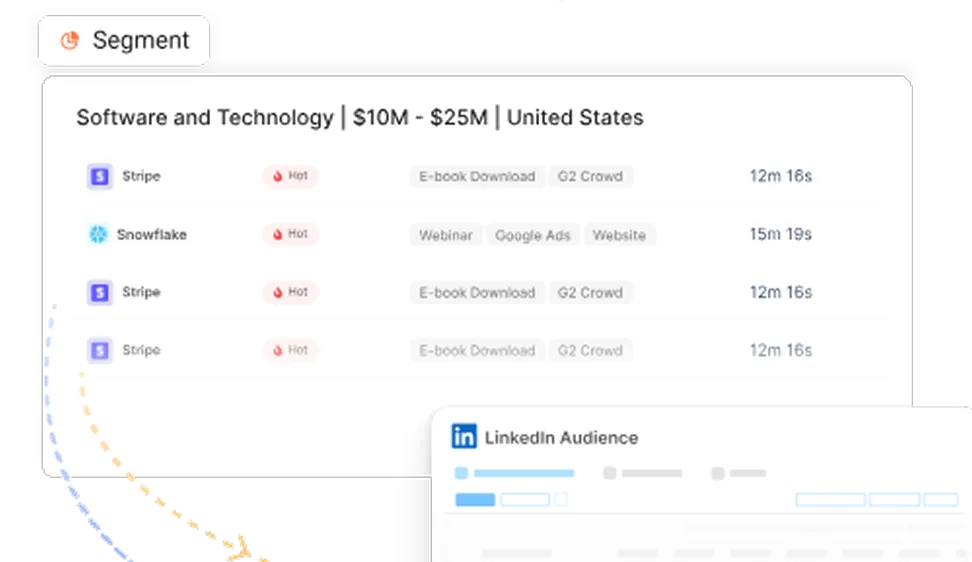
To make it more tangible, here's what automated prospecting looks like in practice. It's identifying companies visiting your pricing page before your rep even knows they exist. It's alerting an SDR when a target account's intent score spikes after they attended a webinar and clicked a retargeting ad in the same week. It's auto-building ICP-matched lists from first-party engagement data rather than purchased contact databases. It's triggering a personalized email sequence the moment a dormant account re-engages with your content.
You'll notice something about all those examples. None of them start with "send more emails." They all start with a signal, an observable behavior that suggests someone might be ready for a conversation. That's the biggest mental shift teams need to make. The primary value of automation isn't speed. It's the removal of randomness from pipeline creation. When you stop relying on volume and start relying on signals, your conversion rates change dramatically and your reps stop dreading Monday mornings.
Think of it this way. A sales team without automation is playing darts in the dark. A sales team with good automation still has to throw the darts, but someone turned the lights on first.
Why does manual prospecting break at scale?
Manual prospecting works fine when you've got three reps and fifty target accounts. Everyone knows the list, everyone remembers who they called last week, and nobody steps on each other's toes. That's a nice stage of company life, and it doesn't last very long.
The moment you scale to twenty reps, five hundred accounts, and multiple go-to-market motions running simultaneously, the cracks become impossible to ignore. SDRs start spending the first two hours of every day researching accounts instead of reaching out to them. Reps contact companies too early, before any buying intent exists, or too late, after the prospect already signed with a competitor. Duplicate outreach happens across teams because nobody has a shared view of who owns what. Your CRM decays steadily as contacts change jobs, companies get acquired, and firmographic data goes stale without anyone updating it.
The numbers paint a pretty grim picture of how reps actually spend their time. Research consistently shows that salespeople dedicate less than a third of their working hours to actual selling. The rest goes to administrative tasks, data entry, internal meetings, and the kind of lead research that automation was specifically designed to eliminate. That ratio gets worse as your team grows, because complexity multiplies faster than headcount.
Here's the part that most sales leaders don't say out loud, though. The core problem with manual prospecting at scale isn't that reps are lazy or undisciplined. It's that prioritization is genuinely hard when you don't have signal data. When every account on the list looks roughly the same on paper, reps default to recency bias, alphabetical order, or whoever they happen to remember from last quarter's pipeline review. Most prospecting problems are actually prioritization problems disguised as activity problems. Teams don't need to make more calls. They need to make the right calls, and the only way to do that consistently at scale is to let data and automation handle the sorting.
The thing is that high-volume, low-conversion outbound isn't just inefficient. It actively damages your brand. When prospects receive generic outreach that demonstrates zero awareness of their situation, they form impressions that are hard to reverse later. Manual prospecting at scale doesn't just fail to work. It creates a negative compound effect that makes future outreach harder.
How do modern prospecting tools actually work?
Most people think of prospecting tools as fancy contact databases with an email button attached. That's like describing a car as a metal box with wheels. Technically correct, but it misses everything that matters about how it actually functions.
Modern automated lead generation platforms work in four distinct layers, and understanding those layers changes how you evaluate and buy these tools. Too many teams skip straight to the action layer and wonder why their results are mediocre. So let's walk through all four.
Layer 1: the data layer
This is the foundation. It's where the tool collects and organizes raw information about potential accounts and contacts. Firmographics tell you the company size, industry, revenue range, and location. Technographics reveal what software they already use. Hiring signals show you which departments are growing. Website visit data captures anonymous traffic from target accounts. Engagement data from your ads, emails, and content rounds out the picture.
Without a clean, reliable data layer, everything built on top of it falls apart. Garbage in, garbage out applies to sales prospecting with the same severity it applies to everything else in data science.
Layer 2: the intelligence layer
This is where raw data becomes actionable insight. The intelligence layer applies scoring models, intent prediction, and account prioritization logic to determine which accounts actually deserve attention right now. Not every company that fits your ICP is worth pursuing today. The intelligence layer separates "good fit" from "good fit that's actively showing buying signals."
Account prioritization software sits squarely in this layer. It takes signals from the data layer and translates them into ranked lists, heat scores, or tiered segments that help reps focus their energy where it's most likely to produce results. This is the layer most teams underinvest in, and it's the layer that makes the biggest difference.
Layer 3: the action layer
Now we're in familiar territory. The action layer is where outbound sales automation lives. Email sequences get triggered. CRM records get updated. Tasks get routed to SDRs. Alerts fire when high-priority accounts engage. Contacts get added to nurture campaigns or meeting booking flows.
Most teams buy tools primarily for this layer, because the outcomes are visible and tangible. But here's the contrarian insight that most prospecting blog posts won't tell you: the action layer is only as good as the intelligence layer feeding it. Automating outreach without intelligent prioritization is just automating noise. You're sending faster, not smarter.
Layer 4: the measurement layer
The final layer connects prospecting activity to revenue outcomes. Meetings booked. Opportunities created. Pipeline sourced. Deals closed. Without this layer, you're measuring vanity metrics like emails sent and open rates, which tell you almost nothing about whether your prospecting is actually working.
The measurement layer is what allows you to iterate. It shows you which workflows produce pipeline, which signals actually predict conversion, and where your process leaks value. Teams that operate without it are flying blind, optimizing for activity rather than outcomes.
The mistake I see repeatedly is teams shopping for Layer 3 tools when their real bottleneck is Layer 2. They've got plenty of outreach infrastructure but no intelligent prioritization feeding it. If your reps are busy but your pipeline isn't growing, the problem probably isn't your sequencing tool. It's the absence of a signal-driven intelligence layer telling reps who to prioritize and when.
Core features to look for in B2B prospecting software
Knowing the four layers is useful for understanding how prospecting tools work conceptually. But when you're actually evaluating platforms, you need a concrete checklist of capabilities. Not every tool covers every feature, and that's fine. What matters is knowing which ones are non-negotiable for your team and which ones are nice-to-have.
Here's what the best sales tools for B2B teams tend to include:
- CRM integration
If the tool doesn't sync cleanly with your CRM, you'll create data silos that make the rest of your stack less useful. Bi-directional sync is the standard now. Anything less creates friction your team will resent.
- Verified company and contact data
Enrichment quality varies wildly between providers. Look for tools that verify contact information regularly, not just at the point of initial collection. Bounce rates above five percent are a red flag that your data source isn't being maintained.
- Buying signal detection
This includes website intent, ad engagement, content downloads, and event attendance. The tool should surface accounts that are actively researching your category, not just accounts that passively match your ICP filters.
- Multi-touch attribution visibility
You need to see the full journey an account takes before it enters pipeline. Which channels influenced the account? Which touchpoints happened before the SDR's outreach? Without this visibility, you can't optimize your prospecting motions.
- Lead scoring
A scoring model that combines fit data with engagement data gives reps a reliable way to prioritize their daily work. Static scores based on firmographics alone aren't enough anymore. Dynamic scoring that updates in real time based on behavior is the benchmark.
- Sales workflow automation
Automated task creation, lead routing, and sequence triggers reduce the manual steps between signal detection and outreach. Every manual step is a place where deals slip through the cracks.
- Sequence triggers
The ability to automatically enroll accounts into specific outreach sequences based on behavior. For example, a pricing page visit triggers a different sequence than a blog content download.
- Territory routing
As your team grows, clean territory management becomes essential. The tool should route accounts to the right rep based on geography, segment, or account ownership rules without manual intervention.
- Reporting tied to revenue
Activity metrics are table stakes, and the reporting you actually need connects prospecting inputs to pipeline outputs. Meetings booked per workflow, opportunity conversion by signal type, and sourced pipeline by channel are the metrics that drive decisions.
One pattern I'd encourage you to resist is the temptation to buy six "best-in-class" point solutions and stitch them together with integrations and Zapier workflows. It sounds rational on paper, and it almost always creates a fragmented mess in practice. Fewer tools with cleaner data flows will consistently outperform a sprawling stack where data quality degrades at every handoff between systems. Your ops team will thank you later.
Predictive sales intelligence
If the previous sections described the machinery of automated prospecting, this section is about the brain. Predictive sales intelligence is what separates tools that help you prospect faster from tools that help you prospect smarter.
At its core, predictive sales intelligence refers to systems that analyze behavioral, firmographic, and intent signals to estimate which accounts are most likely to buy in the near future. Instead of treating your entire TAM as equally worth pursuing, these systems build probabilistic models that surface the accounts with the highest conversion likelihood right now. The difference between "who fits" and "who is ready" is the difference between a static list and a dynamic, prioritized pipeline.
The signals that feed predictive models are more diverse than most people expect. Funding rounds indicate a company has fresh capital and may be evaluating new vendors. Repeated visits to your category or pricing pages suggest active research behavior. Engagement with your paid ads across multiple sessions reveals sustained interest rather than casual browsing. Rapid employee growth in specific departments, like hiring five new SDRs in a quarter, signals that the company is investing in the exact function your product supports. Even competitor research activity, when detectable through intent data providers, can indicate a buying window.
The academic evidence behind this approach is increasingly solid. Machine learning models applied to account prioritization have shown measurable improvements in meeting booking rates across B2B contexts. That shouldn't surprise anyone. When you give reps a ranked list based on hundreds of behavioral signals instead of a flat spreadsheet sorted by company size, the quality of their conversations improves because the timing of their outreach improves.
Here's where I want to push the thinking a bit further than most articles go. The conventional wisdom says prospecting starts with ICP definition: "find companies that look like our best customers." That's necessary but insufficient. The future of prospecting isn't just "who fits." It's "who is changing right now." A company that matched your ICP six months ago and has been stable ever since is a worse prospect than a company that marginally fits your ICP but just raised a Series B, hired a new VP of Sales, and visited your website three times this week.
Change is the strongest buying signal. Predictive sales intelligence is, at its best, a system for detecting change at scale. Companies don't buy software because they're static. They buy because something shifted, a new leader, a new goal, a new pain point, a new budget, and the timing aligned with a vendor who showed up at the right moment. If your prospecting engine can identify those moments of change faster than your competitors can, you win the conversation before it even starts.
That's why I'd argue predictive intelligence is the single most important investment a B2B sales team can make in its prospecting stack. Better data is nice. Faster sequences are nice. But knowing which accounts to call this week, and why, is what actually creates pipeline.
Best automated sales prospecting workflows for B2B teams
Theory is important, but workflows are where prospecting actually happens. The difference between a team that "has automation" and a team that gets results from it usually comes down to whether they've designed specific, signal-driven workflows for their most common prospecting scenarios. Let me walk through five workflows that consistently produce pipeline for B2B teams using sales workflow automation.
Workflow 1: website intent to SDR alert
This is the foundational workflow, and it's surprising how many teams still haven't implemented it properly. When a target account visits your pricing page twice within a week, the system automatically creates a task for the assigned SDR with context about the visit. The rep doesn't have to check a dashboard or wait for a weekly report. They get a notification with the account name, pages visited, visit frequency, and any existing CRM data about the account.
The key to making this workflow effective is setting the right threshold. A single blog visit isn't enough signal. Two pricing page visits within seven days, or a combination of pricing and case study page visits, gives the rep enough confidence that the outreach won't feel random to the prospect.
Workflow 2: paid ad engagement to sales follow-up
Your marketing team spends significant budget running LinkedIn ads to target accounts. When one of those accounts actually clicks through and engages, that signal should route directly to the owning rep. The workflow is straightforward: target account clicks a LinkedIn ad, the system matches the account, and the rep receives a notification to follow up with context about which ad and campaign triggered the engagement.
This workflow bridges the gap between marketing spend and sales action in a way that manual handoffs never reliably achieve. It also gives your marketing team a direct line of sight into how their campaigns influence outbound conversations, which is the kind of cross-functional visibility that RevOps teams dream about.
Workflow 3: dormant pipeline revival
Every B2B company has a graveyard of closed-lost opportunities that went cold for reasons that had nothing to do with product fit. Budget got cut. Timing wasn't right. The champion left. When one of those accounts re-engages, visiting your website, downloading content, or clicking an ad, the system should automatically flag it for re-engagement.
The workflow triggers a re-open playbook: update the CRM status, assign the account back to the original rep or a new owner, and queue a personalised sequence that acknowledges the previous relationship. Dormant pipeline is one of the most underutilised assets in B2B sales, and this workflow turns it into a reliable source of warm opportunities.
Workflow 4: territory expansion signals
Your existing customer shows website traffic from a new geographic region you don't currently serve them in. Or their subsidiary in a different market starts researching your product category. The system detects the new engagement pattern and notifies the account executive responsible for expansion.
This workflow is particularly valuable for companies with land-and-expand motions. It surfaces growth opportunities that reps would otherwise miss because they're focused on their existing contacts within the account, not monitoring for new signals from adjacent parts of the organisation.
Workflow 5: champion movement tracking
Your best buyer champion just changed jobs. They moved to a new company that fits your ICP. This is one of the strongest buying signals in B2B, because that person already knows your product, already trusts your team, and is likely evaluating tools for their new role.
The workflow detects the job change through LinkedIn data or contact enrichment updates, identifies whether the new company fits your ICP, and triggers a referral outreach sequence. The messaging is warm and personal because the relationship already exists. Champion tracking is one of those workflows that feels almost unfair when it works, because the conversion rates are dramatically higher than cold outreach.
Each of these five workflows starts with a signal, not a calendar reminder or a manager's request. That's the design principle worth remembering. The best prospecting workflows are event-driven, not schedule-driven. They fire when something happens, not when someone remembers to check.
How Factors.ai improves prospecting with first-party signals
Most sales prospecting tools rely heavily on third-party databases for their data layer. Those databases are useful, but they come with inherent limitations. The data is shared with every competitor who subscribes to the same provider. It decays faster than vendors acknowledge. And it often lacks the granularity needed to determine whether an account is actively engaged with your brand, or just passively sitting in a segment that matches your filters.
Factors.ai takes a different approach by building prospecting intelligence from your own first-party data. That distinction matters more than it might seem at first glance.
Here's what that looks like in practice. Factors.ai captures website visitor intelligence, identifying which companies are visiting your site even when individual visitors don't fill out a form. It connects CRM opportunity data to upstream marketing activity, so you can see the full journey an account took before it became pipeline. It pulls in ad engagement signals from your paid campaigns, showing you which target accounts are responding to your LinkedIn or Google ads. And it maps attribution paths across channels, giving you a clear picture of how accounts move from awareness to engagement to sales conversation.
All of this combines into account-level journey visibility. Your reps don't just get a list of companies that fit your ICP. They get a ranked view of companies that are actively engaging with your brand across multiple channels. The difference between "this company matches your filters" and "this company visited your pricing page twice, clicked your LinkedIn ad, and downloaded your integration guide this week" is the difference between cold outreach and warm, informed prospecting.
The practical implication is significant. Your best prospecting list is often already on your website. You just haven't identified it yet. Factors.ai makes that identification possible without requiring prospects to self-identify through form fills or demo requests. For teams running ABM motions or coordinating sales and marketing signals through a RevOps function, that first-party intelligence layer becomes the connective tissue between marketing spend and sales action.
The platform's approach also solves a problem that plagues teams using multiple disconnected tools. When your website data, ad data, CRM data, and attribution data all live in one system, you don't have to stitch together account journeys manually. The signals are already unified, which means your reps can act on them immediately instead of waiting for someone in ops to build a report.
How do you choose the right sales intelligence solution?
Not every team needs the same prospecting stack, and buying the wrong tool for your stage is one of the fastest ways to waste budget while creating shelfware that nobody uses. The right sales intelligence solution depends heavily on your company's size, sales motion, and existing infrastructure. Here's how I'd think about the decision across three common scenarios.
- Early-stage SaaS (under 50 employees, small sales team)
At this stage, you need speed and affordability above all else. Your ICP is still evolving. Your sales process isn't fully codified. You don't have a RevOps team to manage complex integrations. The right move is a simple enrichment tool paired with a sequencing platform that gets reps into conversations quickly. Look for tools with low setup time, clean contact data, and basic CRM sync. Don't overthink scoring models or attribution at this stage, because you don't have enough data volume to make those features meaningful yet.
- Mid-market B2B (50 to 500 employees, growing sales org)
This is where the prioritization layer becomes critical. You've got enough pipeline volume that reps can't manually evaluate every account. You need signal-based scoring, clean lead routing, and tight CRM integration. Look for platforms that offer buying intent signals, territory management, and the ability to trigger workflows based on account behavior. Your ops team should be able to configure routing rules without engineering support.
- Enterprise (500+ employees, complex go-to-market)
Enterprise teams need governance, territory controls, custom scoring models, and attribution reporting that connects prospecting activity to revenue outcomes. The tool needs to support multiple sales motions running simultaneously without data conflicts. Role-based access, audit trails, and custom reporting become non-negotiable at this scale. Look for platforms that offer API flexibility and play nicely with your existing data warehouse.
If you already run paid ads to target accounts
There's a fourth scenario worth calling out specifically. If your marketing team invests meaningful budget in paid campaigns targeting named accounts, you should strongly consider platforms that unify marketing and sales signals in a single view. The biggest leak in most ABM motions is the gap between ad engagement and sales follow-up. When those signals live in separate systems, the handoff between marketing and sales is slow, lossy, and often invisible. A platform that captures ad engagement alongside website intent and CRM data eliminates that gap.
The meta-principle across all four scenarios is the same: buy for the bottleneck you actually have, not the bottleneck you imagine having eighteen months from now. Overbuying tooling is nearly as harmful as underbuying it, because unused features create complexity without creating value.
Common mistakes teams make with prospecting automation
Buying the right tools is half the battle. Using them correctly is the other half, and this is where a surprising number of teams stumble. After watching dozens of B2B teams implement prospecting automation, I've noticed the same mistakes recurring with almost predictable regularity. Let me walk through the most common ones so you can sidestep them.
- Automating bad ICP lists
Automation amplifies whatever you feed it. If your ICP definition is vague or outdated, automation just helps you reach the wrong accounts faster and in greater volume. Before automating anything, pressure-test your ICP against your actual closed-won data from the last twelve months. If your ICP says "mid-market SaaS" but your best customers are all financial services companies with 200 to 500 employees, your automation will be optimized for the wrong audience.
- Measuring emails sent instead of meetings created
This one is depressingly common. Teams implement outbound sales automation and then celebrate activity metrics: emails sent, sequences completed, open rates. None of those metrics tell you whether your prospecting is actually creating pipeline. The only metrics that matter are meetings booked, opportunities created, and pipeline sourced. Everything else is an intermediate indicator at best and a vanity metric at worst.
- Ignoring inbound signals while chasing cold outbound
Some teams invest heavily in outbound automation while completely ignoring the fact that their website is generating intent signals from accounts that are already interested. Warm signals from inbound behavior almost always convert at higher rates than cold outbound to accounts that haven't engaged with your brand. A balanced prospecting strategy works both channels and prioritizes accounts showing active engagement.
- No ownership between sales and marketing
Prospecting automation works best when there's clear ownership of the handoff between marketing signals and sales action. If marketing generates intent signals but nobody on the sales side is responsible for acting on them within a defined SLA, those signals expire, and the investment is wasted. The workflow needs a named owner on both sides.
- Too many tools, no system
I mentioned this earlier, but it's worth repeating because it's so prevalent. Six disconnected tools with manual integrations create more work than they save. Data degrades at every handoff between platforms. Reps lose trust in the system because the data they see in one tool contradicts what they see in another. A smaller, well-integrated stack almost always outperforms a sprawling one.
- Using AI personalization with zero relevance
The latest trend is using generative AI to "personalize" outreach at scale. The problem is that AI-generated personalization often reads as exactly what it is: a machine-generated sentence inserted at the top of a template. If the underlying signal driving the outreach isn't relevant to the prospect's actual situation, a personalised first line doesn't save it. Bad prospecting at scale is just faster irrelevance, regardless of how clever the opening sentence sounds.
The common thread across all six mistakes is the same: teams focus on the automation part and neglect the intelligence part. The tools aren't the problem. The inputs, logic, and measurement frameworks surrounding them are where most implementations fall short.
What does the future of automated sales prospecting look like in the AI era?
Prospecting is shifting faster right now than it has in the last decade, and most of that acceleration is driven by AI capabilities that are moving from experimental to practical. Here's what I think the next two to three years look like for B2B teams investing in this space.
- AI research agents building account briefs. Instead of SDRs spending thirty minutes researching an account before writing an email, AI agents will compile account briefs automatically. They'll pull in recent funding news, leadership changes, technographic updates, social activity from key contacts, and relevant buying signals into a single brief that's ready when the rep starts their day. The research phase of prospecting is about to compress from hours to seconds.
- Intent scoring from first-party journeys. Third-party intent data has been the default for years, but it's noisy and shared with every competitor. The shift is toward first-party journey scoring, where the intent model is built from your own website, ad, and CRM engagement data. This produces sharper, more proprietary signals that your competitors don't have access to. Tools like Factors.ai are already moving in this direction, and the trend will only accelerate.
- Cross-channel signal orchestration. Right now, most teams process signals from different channels in isolation. Website intent sits in one tool, ad engagement sits in another, and CRM activity lives in a third. The future state is cross-channel orchestration, where a single platform combines all those signals into a unified account score that updates in real time. That score triggers different workflows depending on the signal combination, not just individual channel activity.
- Autonomous SDR workflows. We're not far from a world where certain prospecting workflows run entirely without human intervention. Account shows intent, system verifies ICP fit, AI generates contextual outreach, email sends, and a meeting booking link routes to the right rep's calendar. The human enters the picture at the conversation stage, not the research or outreach stage. That's a fundamental restructuring of the SDR role, and teams that embrace it early will have a significant productivity advantage.
Use real-time next-best-action prompts… instead of reps deciding what to do next based on their own judgment, the system will recommend the next best action for each account. "This account just visited your pricing page for the third time. Call now." Or "This dormant opportunity just re-engaged. Send the case study sequence." These prompts turn prospecting from a planning exercise into a response exercise, which is a much better use of human selling time.
The teams that win in this environment won't be the ones with the loudest outbound engines. They'll be the fastest signal responders, the teams that detect buying intent earliest and act on it with the most relevance. Speed-to-signal is replacing speed-to-send as the defining competitive advantage in B2B prospecting.
In a nutshell…
This article covered a lot of ground, so here's what I'd want you to walk away with.
Automated sales prospecting works when it combines five things: accurate data that doesn't decay between quarterly list refreshes, intelligent prioritization that ranks accounts by likelihood to buy rather than just ICP fit, timely outreach triggered by real engagement signals rather than calendar cadences, human messaging that demonstrates genuine understanding of the prospect's situation, and revenue measurement that connects prospecting activity to pipeline outcomes instead of email open rates.
The four-layer framework, data, intelligence, action, and measurement, gives you a practical way to evaluate your current stack and identify where the gaps are. Most teams are over-invested in the action layer and under-invested in intelligence. If your reps are busy but your pipeline isn't growing, that imbalance is probably the reason.
Predictive sales intelligence shifts prospecting from static list-matching to dynamic change detection. Accounts don't buy because they fit your ICP. They buy because something changed, and your team showed up at the right moment. Building your prospecting engine around first-party signals, the engagement data you already own from your website, ads, and CRM, gives you a signal advantage that third-party databases can't match.
The five workflows I outlined, from website intent alerts to champion movement tracking, give your team a concrete starting point for turning signal data into sales conversations. Pick the one that aligns most closely with your biggest pipeline gap and implement it first. Don't try to build all five simultaneously.
For B2B teams looking to build real pipeline rather than just send more emails, the next frontier is better timing on the right accounts. The tools exist. The signals are there. The question is whether your team is set up to detect and act on them faster than the competition.
Frequently asked questions about automated sales prospecting
Q1. What is automated sales prospecting?
Automated sales prospecting uses software, data enrichment, AI, and workflow automation to identify, prioritize, and engage potential buyers. It replaces manual research and guesswork with signal-driven targeting. The goal is to surface the right accounts at the right time, so reps spend their energy on conversations rather than list building.
Q2. Are automated prospecting tools worth the investment?
Yes, but only if they reduce manual work and improve opportunity creation, not just email volume. A tool that helps your team send ten thousand more emails per month but doesn't increase meetings booked is a cost center, not a growth lever. Evaluate ROI based on pipeline sourced and meetings created, not activity metrics.
Q3. What is predictive sales intelligence?
Predictive sales intelligence uses behavioral and firmographic signals to predict which accounts are most likely to buy in the near future. It analyses patterns like website visits, ad engagement, funding events, and hiring signals to rank accounts by conversion probability. The result is a prioritized list that helps reps focus on accounts with active buying intent rather than treating every ICP-matched company as equally worth pursuing.
Q4. What are the best sales tools for B2B teams?
The best stack for most B2B teams includes a CRM as the system of record, an enrichment tool for verified company and contact data, an intent signal platform for detecting buying behavior, a sequencing tool for automated outreach, and an attribution layer to connect prospecting to revenue. The specific vendors matter less than how cleanly the tools integrate with each other.
Q5. How does Factors.ai help with sales prospecting?
Factors.ai helps B2B teams identify engaged accounts using first-party signals from their website, paid ads, and CRM. It surfaces which companies are visiting your site, maps their engagement across channels, and provides account-level journey visibility. This allows sales teams to prioritize warm opportunities based on real engagement rather than relying solely on third-party data.
Q6. Can small B2B companies use prospecting automation?
Absolutely. Even startups with small sales teams can automate core prospecting workflows like ICP list building, lead routing, and outreach triggers based on website activity. The key for smaller teams is starting with one or two high-impact workflows rather than trying to automate everything at once. A simple workflow that routes pricing page visitors to your rep can meaningfully improve pipeline quality without requiring enterprise-grade tooling.

See how Factors can 2x your ROI
Boost your LinkedIn ROI in no time using data-driven insights
Try AdPilot Today


.avif)

See Factors in action.
Schedule a personalized demo or sign up to get started for free
LinkedIn Marketing Partner
GDPR & SOC2 Type II

.svg)










.png)