Heading 2
Building Agentic GTM Workflows: Automating personalized outbound at scale
Learn how agentic GTM workflows help B2B teams automate personalized outbound, route signals, enrich accounts, and scale pipeline efficiently.
Written by
.avif)
Vrushti Oza
Content Marketer
Summarize this article






.svg)

TL;DR
- Agentic GTM workflows go beyond simple "if X, then Y" automation. They observe buyer signals, enrich context, make routing decisions, and execute personalized outbound across channels without waiting for a human to intervene at every step.
- The bottleneck for most B2B teams in 2026 isn't data volume. It's orchestration, the ability to connect fragmented signals into a coherent, timely action.
- AI SDR agents are best used to replace repetitive research and sequencing labor, not the relationship-building that actually converts pipeline into revenue.
- Signal-based outbound workflows consistently outperform batch-and-blast because timing beats copywriting. A decent message sent at the right moment often outperforms a perfect email sent randomly.
- The smartest first workflow to build is website intent detection plus enrichment plus personalized outbound plus retargeting. Start there before layering complexity.
Your GTM stack isn’t broken. It’s just… emotionally unavailable.
It sees everything. A dream account binge-visits your website at 11:42 pm... then someone clicks your LinkedIn ad, stalks your case studies, and maybe even hovers over pricing like they’re about to commit... And then? Nothing at all… there’s no follow-up or momentum.
Not because your team is slow. Because your system is. Every signal has to be spotted, interpreted, discussed, assigned, and eventually actioned. By the time that happens, your buyer has moved on, signed up for a competitor demo, or lost interest entirely. Modern buying windows don’t wait for your internal alignment meetings.
The gap is… speed of decision-making.
Agentic GTM workflows exist to fix that. They don’t just collect signals or trigger pre-set sequences. They decide what matters, figure out what to do next, and actually do it while the intent is still warm.
This guide gets into what that actually looks like in practice, why your current automation probably feels like a very polite bottleneck, and how to build outbound systems that don’t just react to pipeline… they keep up with it.
What are agentic GTM workflows, really?
Agentic GTM workflows are AI-driven systems that don't just trigger tasks… they observe signals across your go-to-market stack, decide what action to take next, enrich the context around that decision, personalize the output, and execute across multiple tools without a human pressing buttons at each stage. Think of them as the layer between raw data and coordinated action that most B2B teams are currently filling with manual effort, Slack pings, and good intentions.
The distinction from traditional automation matters more than it might seem at first glance. Static automation operates on fixed rules. If a lead fills out a form, send email A. If they open it, wait two days, and send email B. It's predictable, rigid, and completely blind to context. Agentic workflows operate differently. They take an event, like a VP of Marketing from a target account visiting your pricing page twice in a week, and set off a chain of decisions. The system enriches the account, checks CRM ownership, evaluates intent signals from other channels, drafts a personalized outbound note referencing what it found, syncs the account into a LinkedIn retargeting audience, and alerts the assigned AE. All of that happens without a human intervening between steps.
The ‘agentic’ bit is not some random buzzword borrowed from AI research. It describes a system that has a degree of autonomy in its decision-making. It doesn't just follow a script. It evaluates conditions, weighs priorities, and chooses among possible actions based on the context it gathers. That's a fundamentally different architecture than a Zapier chain that fires the same webhook regardless of whether the account is a perfect-fit enterprise prospect or a student researching for a class project.
Here's the honest observation that most GTM teams arrive at eventually: you don't need more dashboards, more data sources, or more alerts. You need systems that notice what's happening, think about what it means, and act on it before the window closes. That's the promise of agentic workflows, and it's why they've moved from experimental curiosity to operational necessity for teams serious about scaling outbound without scaling chaos.
Why is traditional GTM automation breaking?
If you've been in B2B marketing or sales ops for more than a couple of years, you've probably lived through the golden era of "connect everything." Buy an intent tool here and an enrichment platform there, wire them into the CRM with a dozen Zapier steps, and hope the sequencing tool picks up the right leads at the right time. For a while, it felt like progress… and then reality settled in.
- The first crack is tool fragmentation. Most GTM teams run between six and fifteen tools that touch the buyer journey in some way. CRM, ad platforms, website analytics, product analytics, enrichment APIs, outbound sequencers, conversational intelligence, and whatever the last vendor sold your VP on during a conference demo. Each tool captures a slice of the picture. But unfortunately, none of them see the full frame. Your CRM knows who the account owner is, but doesn't know the prospect just visited your pricing page… your intent tool knows the account is surging, but doesn't know they're already in a live deal…. your ad platform knows the click happened, but has no idea whether the person behind it is remotely qualified.
- The second crack is generic sequencing. Most outbound motion today still runs on static lists. Someone pulls a segment from Apollo or ZoomInfo, loads it into a sequence, and sends the same five-email cadence to everyone on that list. It doesn't matter whether the prospect just raised a Series B or just went through layoffs. The emails go out on the same schedule, with the same angle, regardless of what's actually happening in that buyer's world. It's batch-and-blast wearing a ‘personalization’ costume, with maybe a {{FirstName}} token and a mention of the company name to make it feel bespoke.
- The third crack (and honestly, the most painful one), is the time drain on SDRs. In most organizations, SDRs spend a shocking portion of their day doing research that a system should have done for them. They're checking LinkedIn profiles, reading funding announcements, looking up tech stacks, trying to figure out if this account is actually worth the effort. By the time they've done the homework, the intent signal that triggered the task in the first place may have gone cold. The follow-up window in B2B is shorter than most teams realise, especially when your competitors are working from the same intent data.
The underlying problem ties all of these cracks together. Most companies automate tasks… not decisions. They build workflows that could move data between systems and trigger actions on a schedule, but they never really build a layer that could evaluate whether the action was the right one, at the right time, for the right account. That's why you end up with Zapier chains that technically work but produce nothing useful. Apollo lists with no prioritization logic. CRM alerts that nobody checks because they fire too often and with too little context. Intent tools that surface interesting data but have no execution layer attached.
The bottleneck in 2026 appeared to be data volume… but there's more buyer signal data available than any team could manually (and possibly) process. SO, what is it? The bottleneck is orchestration, the ability to connect those signals into a coherent, timely, and intelligent action. And that's the gap traditional automation was never designed to fill.
How is AI changing GTM engineering?
The shift happening right now isn't just about adding AI to existing workflows. It's about rethinking what GTM engineering means when the system itself can make judgment calls. There are four distinct shifts worth understanding, because each one changes how teams should think about their stack, their processes, and their headcount.
- From data pulling to context building
The old model treated data as something you collected and then stared at. Pull a report. Build a dashboard. Hope someone notices the interesting pattern before the quarterly review. AI changes this by combining signals from across your stack, CRM history, website behavior, ad engagement, content consumption, product usage, and third-party intent, into a contextual picture of what an account is actually doing right now. Instead of asking "which accounts visited our site this week?" you can ask "which accounts are showing a cluster of buying signals across multiple channels simultaneously?" That's a fundamentally different question, and it leads to fundamentally different outbound.
- From bulk outreach to precision outreach
This is where the efficiency gains actually materialize. Traditional outbound operates on volume logic. Send more emails, make more calls, add more accounts to the sequence, and pipeline will eventually follow. AI-driven outbound flips this. It only triggers outreach when the timing indicators suggest a real window exists. An account isn't just on your target list. They're actively researching your category, engaging with content that maps to a known pain point, and the right persona within the account is showing individual-level activity. The result is fewer touches that convert at dramatically higher rates, which is better for pipeline and better for your domain reputation.
- From reps doing research to reps reviewing recommendations
This shift is the one that saves the most human hours. Instead of an SDR spending forty minutes researching an account before deciding whether to reach out, the system does the research, drafts a recommended angle, and presents it for the rep to review, tweak, and send. The human still makes the final call on tone and timing. But the heavy lifting of gathering context, identifying the right persona, and crafting a relevant opening line is handled before the rep even opens the task. It's the difference between building from scratch and editing a strong first draft.
- From manual ops to self-improving systems
This is the shift that's still early but carries the most long-term leverage. Agentic systems can track their own outcomes. Which messages got replies? Which signals correlated with booked meetings? Which accounts that scored high actually converted to opportunities? Over time, the system adjusts its own scoring, routing, and messaging logic based on what's working. It's not quite autonomous optimization yet, but it's meaningfully closer to a self-correcting loop than anything batch automation could offer.
Here's the nuance that separates thoughtful GTM teams from the ones just buying AI tools and hoping for magic: most "AI SDR" products focus almost entirely on writing emails. They generate copy at scale, which is genuinely useful. But the harder, more valuable problem is deciding who deserves an email right now. Writing is cheap. Judgment is expensive. The teams getting outsized results from ai outbound workflows are the ones investing in the decision layer, not just the drafting layer.
Core components of an agentic GTM stack
Building an agentic GTM system is all about assembling layers that each handle a specific function, then connecting those layers so information flows without friction. Here's the framework that makes this concrete.
- Data layer
This is your foundation. CRM records, product usage data, ad engagement metrics, website visitor activity, and third-party enrichment sources. Everything the system needs to know about an account and the people within it lives here. The quality of your agentic workflows is directly tied to the quality and freshness of this layer. Stale data in, useless actions out.
- Signal layer
Signals are events that indicate something meaningful is happening. An intent spike on a category keyword. A pricing page visit from a target account. A key persona changing jobs to a company on your ICP list. A competitor raising funding (which usually means their customers start evaluating alternatives). These signals are the triggers that initiate the workflow. Without a signal layer, you're back to batch-and-blast on a static list.
- Decision layer
This is where agentic workflows earn their name. The decision layer evaluates the signal, scores the account against ICP criteria, checks CRM ownership and deal stage, applies suppression rules (don't email accounts already in active deals, for example), and determines the right routing. Should this go to an SDR for outbound? Should it trigger an ad retarget? Should it alert an AE who already owns the relationship? The decision layer is where context turns into judgment, and it's the layer most teams are still building manually through rules and Slack messages.
- Action layer
Once a decision is made, the action layer executes it. That could mean enrolling a contact into an outbound sequence, pushing an account into a LinkedIn advertising audience, creating a task in the CRM, sending a Slack notification to the account team, or all of the above simultaneously. The action layer needs to be multi-channel by default, because modern buyers don't live in one channel, and your GTM motion shouldn't either.
- Feedback layer
This is the layer most teams forget, and it's the one that makes the whole system smarter over time. Reply rates, meeting booked rates, opportunity creation rates, pipeline quality scores, and revenue attribution data all feed back into the system. Over time, this feedback sharpens the decision layer. Accounts that looked high-intent but never converted help refine the scoring model. Message angles that drove replies inform the drafting templates. Without this loop, you've built a sophisticated machine that never learns.
Factors.ai sits at the intersection of several of these layers. It helps unify fragmented account signals, combining website behavior, ad engagement, and CRM data so the workflow starts with real buyer behavior rather than cold assumptions. When your signal layer is built on what accounts actually do across channels, every downstream decision becomes sharper.
How do you build signal-based outbound workflows?
Theory is useful, but the teams winning with agentic outbound have specific workflows they can point to and explain step by step. Here's a framework you can actually implement, broken into the sequence of events that make signal-based outbound workflows work in practice.
Step 1: Detect an account intent surge
This could be a spike in category keyword research, repeated visits to high-intent pages on your site, or a cluster of engagement signals across content and ads within a short window. The key is that you're detecting a pattern (not decoding a single event). Just one page visit is noise or worse, a mistake. But three visits plus an ad click plus a G2 comparison page in the same week is a signal.
Step 2: Check ICP fit
Not every surging account deserves outbound. The system should evaluate the account against your ideal customer profile criteria, including company size, industry, tech stack, geography, and any other firmographic or technographic filters you use. Surging intent from an account that's a terrible fit is a distraction, not an opportunity.
Step 3: Identify the right personas
Within the account, who should you actually reach out to? The system should map the account's org chart (using enrichment tools) and identify contacts that match your buyer personas. A VP of Marketing, a Head of Revenue Operations, a Director of Demand Gen, whatever roles your product typically sells into.
Step 4: Pull recent company context
This is where the personalization becomes real. The system checks for recent funding rounds, leadership changes, job postings that suggest strategic priorities, earnings mentions, or product launches. This context becomes the foundation for a relevant opening line.
Step 5: Generate a tailored message angle
Based on the persona, the intent signals, and the company context, the system drafts a message that connects the dots. Not "Hi {{FirstName}}, I noticed your company is growing." Instead, something that demonstrates you understand what's happening in their world and why it might create a problem your product addresses.
Step 6: Trigger outbound via email and LinkedIn
The message goes out through the channels where the persona is most likely to engage. For many B2B buyers, that means a combination of email and LinkedIn touch points, timed to land within the intent window.
Step 7: Retarget with ads if there's no reply
If the initial outbound doesn't get a response within a set window, the system syncs the account into an advertising audience for warm retargeting. This keeps your brand visible without requiring another cold touch from a rep.
Step 8: Notify the rep after engagement
When the prospect engages, whether they reply to the email, click a retargeting ad, or visit a key page on your site, the system alerts the assigned rep with full context so they can take the conversation from there.
Why does this workflow outperform traditional outbound?
Because timing beats copywriting. A mediocre message sent at the right moment, when the buyer is actively researching and the problem is front of mind, often beats a beautifully crafted email sent on a random Tuesday to someone who isn't thinking about your category at all. Signal-based outbound workflows work because they respect the buyer's timeline instead of imposing your cadence schedule on them.
The caveat worth mentioning: building this workflow isn't trivial. It requires clean data, reliable enrichment, a functional signal layer, and tooling that can orchestrate across channels. But the payoff is disproportionate. Teams that get even a basic version of this running consistently report higher reply rates, shorter sales cycles, and dramatically better pipeline quality than their batch outbound counterparts.
How do you personalize outbound at scale without becoming spam?
This is the question that makes most marketing leaders nervous, and for good reason. The history of "personalization at scale" in B2B is largely a history of increasingly sophisticated-looking spam. We went from batch emails with no personalization to batch emails with merge fields, and somehow declared victory. Then we added "I noticed your company" openers that referenced publicly available information in a way that felt more surveillance than relevance. Most buyers can smell a templated email within the first sentence, no matter how many dynamic fields you've stuffed into it.
- Real personalization operates on a spectrum, and understanding where most teams sit on that spectrum explains why their outbound underperforms.
- Weak personalization is the {{FirstName}} and {{CompanyName}} level. It's table stakes and nobody is impressed by it anymore. Every automated tool does this by default. It signals that you have a merge field, not that you've done any thinking about the recipient.
- Medium personalization references something specific and recent, like a funding round, a new product launch, or a leadership hire. It shows you've done at least surface-level research. This is better, but it's also increasingly common because enrichment tools make this data available to everyone. When every SDR opens with "Congrats on the Series B," the signal gets noisy.
- Strong personalization ties together observed behavior, role context, timing, and relevant proof into a message that feels like it was written specifically for that person in that moment. Something like: "Noticed your paid team is posting growth ops roles while your LinkedIn ad traffic climbed sharply last quarter. In our experience, that usually means attribution complexity is about to become a board-level conversation." That message demonstrates understanding, not just information retrieval. It connects dots in a way that makes the recipient think, "This person actually gets what I'm dealing with."
AI's role in scaling this kind of personalization is significant, but it needs to be understood correctly. AI should generate hypotheses about what a prospect might care about, based on the signals and context available. It shouldn't generate fake intimacy. There's a meaningful difference between "based on your hiring patterns and traffic trends, here's what we think might be a growing challenge for you" and "I was just thinking about your company and felt compelled to reach out." The first one is useful. The second one is dishonest, and buyers know it.
The best AI-personalized outbound at scale systems work because they separate the research and hypothesis layer from the writing layer. The AI gathers context, identifies the most relevant angle, and drafts a message that connects the angle to the product. A human reviews it, adjusts the tone, and decides whether the hypothesis is actually strong enough to send. That review step matters. It's the difference between personalization that builds credibility and personalization that erodes it.
One more thing worth saying plainly: scale doesn't have to mean "send to everyone." Scale in an agentic context means running this kind of thoughtful, signal-informed outreach across your entire target account list simultaneously, without requiring each message to be manually researched and written. You're scaling the process, not lowering the bar. That distinction is what separates AI personalized outbound at scale from just sending more emails faster.
AI SDR agents vs. human SDR teams
This is the section where nuance matters most, because the conversation around AI SDR agentic outbound tends to collapse into binary positions. Either AI is about to replace every SDR on the planet, or it's a gimmick that can't match human intuition. The reality is more interesting than either of those takes.
Here's a comparison that maps out where each approach genuinely excels:
The pattern in this table points toward a clear operating model. AI should handle the work that's repetitive, data-intensive, and time-sensitive: researching accounts, monitoring signals, drafting initial messages, prioritizing outreach lists, and managing sequencing logistics. Humans should handle the work that requires trust, judgment in ambiguous situations, and genuine interpersonal skill: live conversations, objection handling, relationship nurturing, and complex deal navigation.
The best model isn't AI replacing SDRs. It's AI qualifying and preparing so that humans can convert. Think of it like this: the AI does the homework and writes the study guide. The human walks into the exam room and actually takes the test. Trying to have the AI take the test as well is where most implementations break down, because buyers can sense when they're talking to a system rather than a person, and trust evaporates quickly when that happens.
One honest admission: the line between "AI-assisted SDR" and "AI SDR agent" is blurring rapidly. Some teams are already running fully autonomous outbound for certain segments, particularly high-volume, lower-deal-size motions where the cost of a human touch on every interaction doesn't pencil out. For enterprise and mid-market motion, though, the hybrid model still wins. The deals are too large, the buying committees too complex, and the relationships too important to hand off entirely to automation.
Use cases for B2B SaaS teams
Abstract frameworks are helpful, but seeing how agentic workflows apply to specific GTM motions makes the value tangible. Here are five scenarios that map to common B2B SaaS situations.
- Mid-market SaaS: competitor signal outbound
A mid-market SaaS company selling marketing analytics notices that a cluster of accounts on their target list are showing increased traffic to a competitor's comparison pages and G2 reviews. The agentic system detects the intent surge, enriches the accounts, identifies the right personas (typically Heads of Marketing or Directors of Analytics), pulls recent context like new hires or campaign launches, and triggers an outbound sequence. The messaging angle isn't "we're better than Competitor X." Instead, it focuses on the specific capability gap that prospects in evaluation mode typically care about. The timing makes these messages land when the prospect is actively comparing options, which is when they're most receptive to a new perspective.
- Enterprise ABM: coordinated multi-stakeholder plays
An enterprise software company running an account-based programme notices that three different personas within the same target account have engaged with content in the past two weeks. A CFO downloaded a whitepaper on cost optimisation, a VP of Engineering attended a webinar on infrastructure scaling, and a Director of Procurement visited the pricing page. The agentic system recognises this as a multi-threaded buying signal and triggers a coordinated play. Each persona gets outreach tailored to their role and the content they engaged with. The account team receives a consolidated briefing showing all three engagement threads, and the account is prioritized for executive outreach. This kind of coordinated response across a buying committee is nearly impossible to execute manually at speed.
- Product-led growth: usage threshold routing
A PLG company offers a free tier that thousands of users sign up for each month. The agentic system monitors product usage patterns and identifies free users who've hit a meaningful usage threshold; maybe they've created more than a certain number of projects, invited team members, or used a premium feature in trial mode repeatedly. When a user crosses that threshold and also matches ICP criteria (right company size, right industry), the system routes them to sales with full context on their usage patterns. The handoff message to the rep includes what the user has done in the product, how their usage compares to converted accounts, and a suggested talk track. Instead of SDRs cold-calling free users who signed up three weeks ago, reps are reaching out to people who've already experienced value and shown buying signals through their behavior.
- Expansion revenue: dormant account reactivation
A SaaS company's existing customer base includes accounts that were highly engaged twelve months ago but have gone quiet. Suddenly, one of those dormant accounts shows renewed activity: a new user from the account logs in, they visit the integrations page, and someone from the company starts reading content about a feature that was released after they went dormant. The system flags the account for an upsell motion, routes it to the customer success team with the renewal date and usage context, and triggers a re-engagement sequence that highlights the new capabilities relevant to their observed interests. Expansion revenue is some of the most efficient pipeline a SaaS company can generate, and catching reactivation signals early is the difference between a natural upsell conversation and a desperate renewal save.
- Paid media efficiency: real-time audience sync
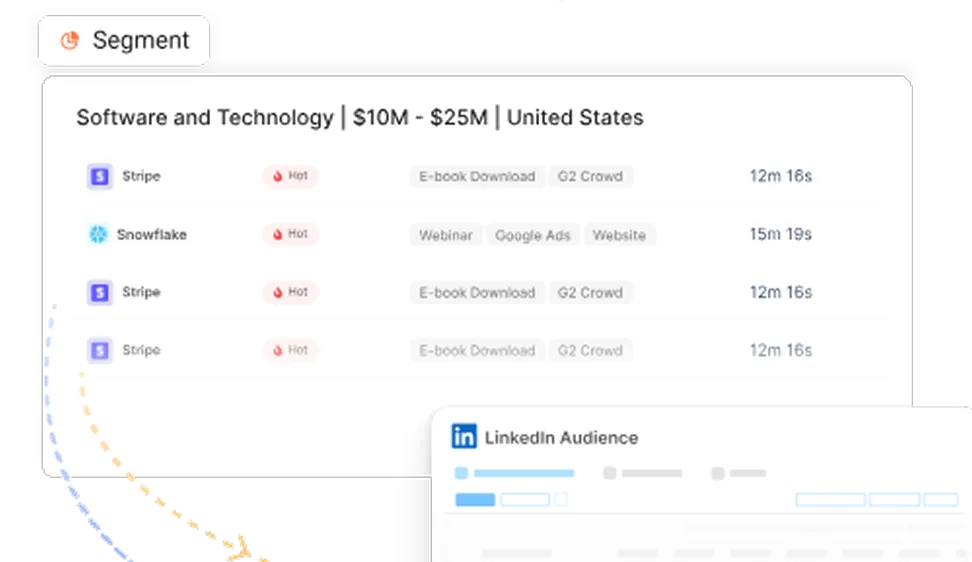
A B2B company running LinkedIn and Google ads spends significant budget reaching broad audiences. With an agentic workflow connected to their website intelligence layer, the system identifies high-fit accounts that visit the site (even if they don't convert) and immediately syncs them into a targeted ad audience on LinkedIn. Instead of waiting for a weekly list pull and manual audience upload, the retargeting happens in near real-time. The ads these accounts see aren't generic brand awareness messages. They're tailored to the pages the account visited, whether that's a specific product line, a use case page, or pricing. This is where Factors.ai's strengths around account intelligence and ad platform integration become particularly relevant. The platform connects web behavior to ad audiences so that paid spend is directed toward accounts already showing buying signals, not sprayed across an entire industry vertical.
How Factors.ai powers agentic GTM execution
Throughout this piece, I've referenced the systems and layers that make agentic workflows possible. Factors.ai fits into this picture as the connective tissue between fragmented signals and coordinated action. It's worth exploring specifically what that looks like in practice.
Factors.ai detects account-level buying signals by identifying which companies are visiting your website, even when individual visitors haven't filled out a form. It goes beyond basic reverse-IP lookup by combining web behavior data with ad engagement and CRM context to build a richer picture of what each account is actually doing across your GTM surface area.
The platform syncs audiences into LinkedIn and Google Ads in near real-time. That means high-fit accounts showing intent on your site can be retargeted within hours, not days. For teams running paid media as part of their outbound motion, this collapses the lag between signal detection and ad exposure.
Prioritization is another core capability. Factors.ai helps teams rank target accounts based on the density and recency of buying signals, so outbound effort is directed toward accounts with the highest conversion probability. This is the decision layer in practice, replacing gut feel and static lists with a dynamic ranking based on observed behavior.
The connection between ad performance, web engagement, and CRM outcomes is where pipeline measurement gets honest. Instead of reporting on impressions and clicks as proxies for value, Factors.ai ties upstream activity to downstream pipeline creation. You can see which campaigns and channels influenced accounts that actually became opportunities, not just which ones generated traffic.
For teams building AI sales workflow orchestration, the platform serves as the signal and prioritization engine that feeds the rest of the stack. It doesn't try to be the sequencing tool or the CRM. It focuses on answering the question that matters most before any outbound action fires: which accounts should we be talking to right now, and why?
Most tools in the GTM stack help you send more activity. Factors helps you direct activity toward accounts where revenue probability is highest. That distinction is the difference between a busy pipeline and a productive one.
KPIs that actually matter for agentic outbound
One of the fastest ways to sabotage an agentic GTM investment is to measure it with the wrong dashboard. If you're tracking the same vanity metrics you used for batch outbound, you'll either undervalue the system or optimize for the wrong outcomes. Here are the metrics that genuinely reflect whether your agentic workflows are producing results.
- Time from signal to first touch
This measures how quickly your system converts a detected buying signal into an actual outbound action. In traditional setups, this gap can be days or even weeks. Agentic workflows should compress it to hours. The shorter this window, the more likely your outreach lands while the buyer is still actively engaged.
- Meetings per high-intent account
Not meetings per thousand emails sent. Meetings from the specific accounts your system flagged as high-intent. This tells you whether your signal detection and prioritization are accurate, not just whether your sequencing tool is sending volume.
- Opportunity rate from triggered outbound
What percentage of outbound actions triggered by the agentic system result in a qualified opportunity? This is the single most important conversion metric because it ties the workflow directly to pipeline creation.
- Pipeline created per workflow
Each workflow you build (competitor signal outbound, PLG conversion routing, dormant account reactivation) should have its own pipeline attribution. This lets you compare workflows against each other and invest more in the ones generating disproportionate returns.
- Cost per qualified meeting
This includes the technology costs, the human time involved in review and follow-up, and any paid media spend integrated into the workflow. Agentic outbound should produce a lower cost per qualified meeting than pure manual outbound at a comparable scale, and this metric keeps you honest about whether it's actually doing so.
- Reply quality rate
A "not interested" reply and a "tell me more about how this works for companies our size" reply are not the same thing. Tracking reply quality separately from reply volume gives you a much cleaner signal on whether your messaging and targeting are working together.
- Multi-touch influenced revenue
For accounts that eventually close, which touchpoints from the agentic workflow were in the journey? This is where B2B intent-driven outbound automation proves its compound value, because the initial signal detection, the outbound touch, the ad retarget, and the rep conversation all contribute to the closed deal.
If your AI outbound dashboard only shows opens and clicks, you're measuring theatre. Opens and clicks are noise metrics that tell you almost nothing about pipeline impact. They're easy to game, easy to inflate, and easy to celebrate without any corresponding revenue outcome. The KPIs above are harder to track but infinitely more useful.
Common mistakes to avoid when building agentic workflows
Every new GTM architecture comes with its own set of failure modes, and agentic workflows are no exception. Here are the ones I see most often, along with why they matter.
1. Automating bad data
If your CRM is full of stale contacts, incorrect ownership records, and accounts that haven't been cleaned in eighteen months, automating workflows on top of that data just accelerates the mess. You'll route outreach to the wrong people, trigger actions based on outdated signals, and erode your domain reputation faster than you can repair it. Clean data first. Automate second. There's no shortcut here, even if the vendor demos make it look like there is.
2. Triggering too many low-quality alerts
This is the "boy who cried wolf" problem applied to GTM ops. If your system fires alerts for every minor signal, reps quickly learn to ignore all of them. The signal-to-noise ratio of your alerts determines whether the sales team trusts the system or treats it as background noise. Be ruthless about setting thresholds high enough that an alert actually means something.
3. Using AI-generated copy with no strategic context
AI can draft competent email copy in seconds. But competent copy built on no strategic foundation is just polished irrelevance. If the system doesn't understand your positioning, your competitive differentiators, or the specific pain points your product addresses, the messages it generates will be grammatically correct and strategically empty. The copy layer needs a strategic brief to work from, not just a prompt that says "write a cold email."
4. No suppression rules
Without suppression logic, your agentic system will cheerfully send outbound to accounts that are already in active deals, companies you've already lost recently, competitors, existing customers who shouldn't be getting prospecting emails, and people who've explicitly asked not to be contacted. Suppression rules are as important as trigger rules. Build them before you launch anything.
5. No human review layer
Fully autonomous outbound sounds efficient until it sends something embarrassing to your most important target account. Every agentic workflow should include a human review checkpoint, even if that checkpoint only applies to a subset of actions (like outreach to enterprise accounts above a certain size). The efficiency loss from a review step is trivial compared to the reputational cost of a bad automated touchpoint at the wrong account.
6. Ignoring attribution
If you can't tell which workflows are actually creating pipeline and which are just creating activity, you'll invest in the wrong ones. Attribution for agentic workflows should be built in from day one, not bolted on after the system has been running for six months.
7. Measuring volume over revenue
It's tempting to celebrate metrics like "we sent 10,000 outbound messages this month" or "we triggered 500 workflows." But if those messages and workflows aren't generating meetings, opportunities, and revenue, the volume is meaningless. Worse, high-volume, low-quality outbound damages your brand and your deliverability over time.
The memorable version of all this: bad workflows scale embarrassment faster than pipeline. Getting the logic right before you scale the volume is the only sequence that works.
Should you build agentic GTM workflows now?
The direct answer is yes, if you have the right foundation in place. Agentic workflows amplify what's already working. They can't create something from nothing, and teams that skip straight to automation without the underlying infrastructure tend to automate their way into a bigger mess.
You're ready to build if you already have meaningful website traffic (enough to generate detectable account-level signals), a CRM with reasonably clean data and ownership records, an existing outbound motion (even if it's manual and inconsistent), or active paid acquisition that you want to make more efficient. These foundations give the agentic system something to work with. The workflows layer intelligence on top of existing motion, which is where the leverage comes from.
You should wait if you don't yet have ICP clarity, meaning you can't precisely define which accounts are worth pursuing and why. You should also wait if your CRM ownership is a mess, because routing logic depends on knowing who owns what. And you should wait if your team doesn't have follow-up capacity, because an agentic system that generates high-quality outbound opportunities is useless if nobody is available to take the conversations that result from it.
For teams that are ready, the best starter workflow is straightforward: website intent detection plus enrichment plus personalized outbound plus retargeting. This workflow captures accounts showing buying signals on your site, enriches them to confirm ICP fit and identify personas, triggers personalized outbound, and retargets with ads if there's no initial response. It touches every layer of the agentic stack without requiring exotic tooling or months of setup. Once this foundational workflow is producing results, you can layer on competitor signal triggers, PLG conversion routing, expansion plays, and multi-stakeholder ABM orchestration.
The future for B2B teams isn't bigger SDR armies or more software subscriptions. It's smaller, sharper teams running systems that are genuinely intelligent about where to spend their finite attention and effort. Agentic GTM workflows are how you get there, and the teams building them now are creating a compounding advantage that will be very difficult for latecomers to replicate.
In a nutshell…
Here's what this entire piece comes down to in practical terms. Agentic GTM workflows represent a genuine architectural shift in how B2B teams run outbound, not just another layer of automation stacked on top of existing tools. They work because they compress the gap between detecting a buying signal and acting on it, which is where most pipeline leaks out of traditional GTM motions.
The core insight is that orchestration, not data, is the bottleneck. You probably already have enough signals flowing through your stack. What's missing is a system that can evaluate those signals, make routing decisions, personalize the outreach, and execute across channels before the buying window closes. That's what the decision layer in an agentic stack provides.
Practically, if you're building this for the first time, start with the workflow that has the clearest signal-to-action path: website intent detection, account enrichment, personalized outbound, and retargeting. Get that workflow producing qualified meetings before you expand into more complex plays. Measure it on pipeline metrics (opportunity rate, cost per qualified meeting, and time from signal to first touch), not vanity metrics like open rates.
The comparison between AI SDR agents and human teams isn't a replacement story. It's a division-of-labor story. Let the system handle research, prioritization, and drafting. Let humans handle conversion, trust-building, and complex deal navigation. That hybrid model produces better pipeline than either approach alone.
If you're investing in GTM engineering automation, Factors.ai gives you the signal detection and account prioritization layer that feeds the rest of the stack. It connects web behavior, ad engagement, and CRM data so that every downstream workflow starts from an accurate picture of what target accounts are actually doing. That foundation is what makes the difference between workflows that generate activity and workflows that generate revenue.
Build now… start simple… measure efficiently.. And scale what works.
Frequently asked questions about agentic GTM workflows
Q1. What are agentic GTM workflows?
Agentic GTM workflows are AI-driven go-to-market systems that go beyond simple "if X, then Y" automation. They detect buying signals across your stack, evaluate context, decide on the best next action, personalize the output, and execute across tools automatically. The "agentic" part means the system has a degree of decision-making autonomy rather than following a fixed script. In practice, this looks like a system that can detect intent, enrich an account, check CRM ownership, draft a tailored message, trigger outbound, and retarget with ads, all without a human intervening between each step.
Q2. How is agentic AI different from normal GTM automation?
Normal automation follows fixed rules that don't change regardless of context. If a lead fills out a form, send Email A. If they open it, wait two days and send Email B. Agentic AI adapts its behavior based on the signals and context it gathers. It evaluates whether the account fits your ICP, checks what other buying signals are present, considers the timing, and chooses the best action from a set of possibilities. Traditional automation executes a predetermined path. Agentic AI navigates a decision tree in real time based on what it observes.
Q3. Can AI really personalize outbound at scale without it feeling like spam?
Yes, but only if the personalization is built on real signals and account context rather than merge fields and templates. Strong AI-driven personalization connects observed behavior (like a hiring pattern or a traffic spike) with role-specific context and a relevant proof point. It generates hypotheses about what the prospect might care about, not fake intimacy. The key is that AI handles the research and hypothesis layer, while a human reviews the output before it sends. That combination produces outreach that feels genuinely relevant at a volume no manual process could match.
Q4. Will AI replace SDR teams entirely?
AI will replace repetitive SDR tasks much faster than it replaces relationship-building. Account research, signal monitoring, list prioritization, and initial message drafting are all areas where AI is already faster and more consistent than manual effort. But live conversations, objection handling, trust-building, and navigating complex buying committees remain deeply human skills. The most effective model is a hybrid where AI qualifies and prepares, and humans convert. For high-volume, lower-deal-size segments, fully autonomous outbound is becoming viable. For mid-market and enterprise, the human layer remains essential.
Q5. What tools are typically used for GTM engineering automation?
A full GTM engineering stack usually includes a CRM (like Salesforce or HubSpot), enrichment tools (like Clearbit or Apollo), workflow and orchestration platforms, outbound sequencing tools (like Outreach or Salesloft), ad platforms (LinkedIn Ads, Google Ads), intent data providers, and an intelligence platform like Factors.ai that unifies account signals across web, ads, and CRM. The specific tools matter less than how well they're connected and whether there's a decision layer that can evaluate signals and route actions intelligently across the stack.
Q6. What is the best first agentic workflow to build?
The best starter workflow is intent-based website visitor routing combined with personalized outbound follow-up. It works like this: detect accounts showing buying intent on your site, enrich them to confirm ICP fit and identify personas, trigger personalized outbound, and retarget with ads if there's no initial reply. This workflow touches every layer of the agentic stack (data, signal, decision, action, feedback) without requiring complex tooling or months of configuration. Once it's producing qualified meetings consistently, you can expand into competitor signal triggers, PLG conversion routing, and multi-stakeholder ABM plays.
See how Factors can 2x your ROI
Boost your LinkedIn ROI in no time using data-driven insights
Try AdPilot Today


.avif)

See Factors in action.
Schedule a personalized demo or sign up to get started for free
LinkedIn Marketing Partner
GDPR & SOC2 Type II

.svg)